

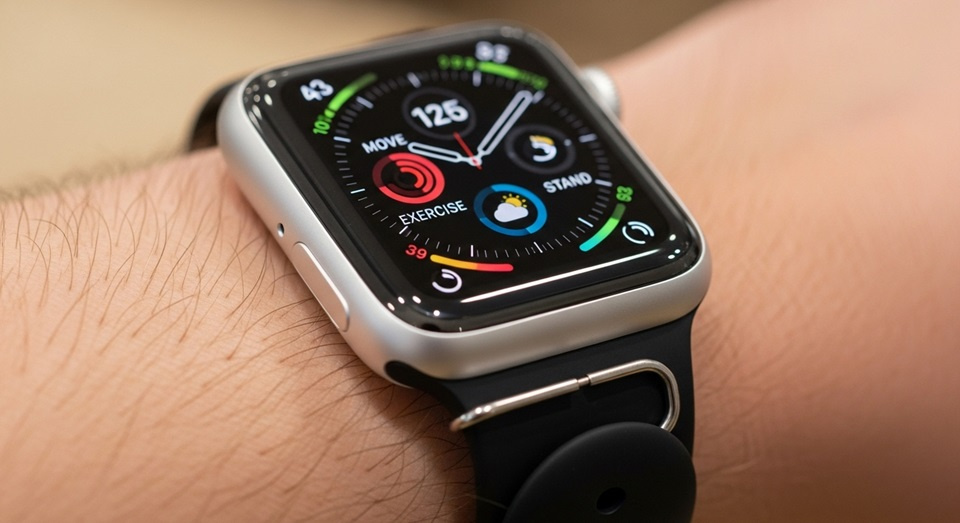
The Apple Watch Series 3 is the watch that made Apple’s wearable affordable and, in its cellular version, independent of the iPhone for the first time. Its features, original price, and compatibility with iPhone still drive a steady stream of questions from people inheriting one from a family member, spotting one cheap on a resale site, or wondering whether the one on their wrist is safe to keep using. The short answer is that the hardware still works, but the software clock stopped some time ago, and that single fact shapes every buying decision around this model.
This guide covers what the Series 3 actually offers, what it cost at launch and what it costs now, exactly which iPhones it pairs with, where its software support ends, and which current smartwatches make sense as an upgrade for an iPhone owner. Every specification below comes from Apple’s own documentation, and every current price comes from the official store of the brand that sells it.
What the Apple Watch Series 3 Is and Why It Mattered
Apple announced the Series 3 in September 2017 with orders opening on September 15 and general availability on September 22. The headline was built-in LTE and UMTS cellular radio, achieved with an antenna design that used the display itself to send and receive signals. That let the cellular model place calls, send messages, and stream music without an iPhone nearby, which no previous Apple Watch could do.
The watch shipped in two flavours. The GPS model launched at $329 and the GPS + Cellular model at $399, according to Apple’s launch announcement, while the older Series 1 dropped to $249 alongside it. The cellular version rolled out first in 10 countries including the United States, United Kingdom, Canada, Australia, Japan, and China, while the GPS model reached 28 countries in a phased launch.
Apple kept the Series 3 on sale as its entry-level watch for years after newer models arrived, which is why so many units are still in circulation. That long retail life is also the root of its biggest problem today: a lot of people bought a Series 3 near the end of its run without realising its software support was about to stop.
Apple Watch Series 3 Features That Still Hold Up
Strip away the age of the software and the Series 3 still covers the fundamentals a first smartwatch needs. Here is how each part of the hardware holds up against current expectations.
Display and Case Design
The Series 3 uses a Retina OLED display rated at 1000 nits of brightness. The 38mm case has a 272 by 340 pixel screen with 563 square millimetres of viewing area, while the 42mm case steps up to 312 by 390 pixels and 740 square millimetres. Cases came in aluminium, stainless steel, and ceramic, with the aluminium GPS models being the lightest at 26.7 grams for the 38mm size and 32.3 grams for the 42mm size, case only.
The screen does not support an always-on mode, so the display stays dark until the wrist is raised. Compared with current models, the bezels are thick and the usable screen is small, which matters for reading longer notifications or tapping small on-screen keyboards.
S3 Chip and Wireless Performance
Inside sits the S3 system in package with a dual-core processor, which Apple said was 70 percent faster than its predecessor at launch. The W2 wireless chip made Wi-Fi 85 percent faster and made Bluetooth and Wi-Fi 50 percent more power efficient, according to the same announcement. Connectivity includes Bluetooth 4.2 and 2.4GHz Wi-Fi 802.11b/g/n, with LTE and UMTS on cellular units.
That chip was fast for its time, but app launches and watch face complications feel sluggish next to anything Apple sells now. Simple tasks like checking the time, reading a message, or starting a workout remain responsive enough.
Health and Fitness Sensors
The sensor list is what keeps the Series 3 useful for basic fitness tracking. It includes built-in GPS with GLONASS, Galileo, and QZSS support, an optical heart sensor, a barometric altimeter, an accelerometer rated to 16 g-forces, a gyroscope, and an ambient light sensor. The altimeter was new to this generation and lets the watch count flights of stairs climbed and track elevation during hikes, runs, and ski sessions.
Built-in GPS means runners and cyclists can leave the phone at home and still get an accurate route map and pace data. Heart rate is tracked throughout the day and during workouts, and the Workout app covers running, walking, cycling, swimming, high-intensity interval training, and more.
What the Series 3 lacks is just as important. There is no ECG app, no blood oxygen sensor, no wrist temperature sensing, and no fall detection. Those features arrived on later models and are now considered core health tools rather than extras.
Water Resistance, Siri, and Music
Every Series 3 is water resistant to 50 metres under the ISO 22810:2010 standard, which makes it suitable for pool and open-water swimming. It was also the first Apple Watch with a built-in speaker capable of letting Siri talk back rather than only displaying text responses.
Cellular models carry 16GB of storage and were marketed with access to the Apple Music catalogue for streaming directly from the wrist. GPS-only models carry half that at 8GB, a limitation that later caused serious update headaches covered below.
Battery Life
Apple rates the Series 3 at up to 18 hours of battery life, the same all-day figure it still quotes for the current entry-level model. In practice, a watch that is several years old will almost certainly fall short of that because lithium-ion batteries lose capacity with every charge cycle. Anyone buying a used unit should treat the original rating as the best case, not the expected result.
Apple Watch Series 3 Price Then and Now
Pricing for the Series 3 falls into three distinct phases. At launch, the $329 GPS and $399 cellular pricing positioned it as Apple’s mainstream watch. Over the following years, Apple kept it in the lineup as its cheapest option, which pulled its price down and made it the default gift watch for children and first-time owners.
The third phase is the current one. Apple no longer sells the Series 3 new or refurbished; according to security firm Intego, Apple removed even its refurbished Series 3 units from its online stores in March 2023. Today the only way to buy one is through resale marketplaces, third-party refurbishers, or private sellers.
Resale pricing depends on case size, case material, GPS versus cellular, battery health, cosmetic condition, and whether the seller includes a charger and band. Stainless steel and ceramic editions command more than aluminium. Because there is no official price anchor anymore, the more useful comparison is against Apple’s own current entry point. Apple sells a certified refurbished Apple Watch SE 3 GPS 40mm for $209 and a new SE 3 from $249, both with full current software support. Any used Series 3 price has to be weighed against that gap.
Apple Watch Series 3 Compatibility with iPhone
Compatibility is the question that sends most people to this page, and it has a clear answer from Apple’s own compatibility chart.
Which iPhones Work with the Series 3
Apple’s Apple Watch and iPhone compatibility page lists the Series 3 as compatible with iPhone 6s or later running iOS 11 or later, and supporting watchOS 4 through watchOS 8.8.1. The Series 3 technical specifications page states the requirement as iPhone 6s or later with the latest iOS version.
That means the watch is designed to pair with a broad span of iPhones, from the 6s onward. Setup, watch face customisation, settings, and app installation all run through the Apple Watch app on the paired iPhone. Older phones such as the iPhone 5s, which some older articles list, are not on Apple’s current chart for this model, so the iPhone 6s is the floor to rely on.
The watchOS 8 Ceiling
The Series 3 stops at watchOS 8. It never received watchOS 9 or any later version, so every new watch feature Apple has shipped since then is unavailable on it. That includes newer workout views, sleep stage tracking improvements, medication tracking, and every redesign of the interface since. Third-party developers also gradually drop support for older watchOS versions, so apps that work today may stop updating or stop appearing in the on-watch App Store.
Pairing a Series 3 with a brand-new iPhone running the latest iOS is the area where expectations should be managed most carefully. Apple’s chart describes compatibility in terms of minimum requirements, but a watch frozen on an old operating system paired with a phone several major versions ahead is the scenario most likely to produce sync bugs, missing complications, and apps that behave inconsistently. Owners who rely on the watch for anything important should test pairing and core features before committing.
The 8GB Storage Problem
The GPS-only Series 3 has a well-documented storage problem. According to MacRumors, starting with the iOS 14.6 and watchOS 7.5 updates, owners of the 8GB model were told they had to unpair the watch and pair it again before the update could install, because there was not enough free space to download the new software in place. Unpairing wipes the watch and restores it from a backup, which takes time and occasionally loses data such as watch face arrangements.
The cellular model’s 16GB of storage largely avoided the problem. For anyone choosing between used units, that difference alone makes the cellular version the more practical buy even if cellular service will never be activated.
Security and Software Support: The Angle Most Reviews Skip
Most Series 3 articles discuss features and price without mentioning security, which is the most important reason to think twice before relying on one. According to Intego’s timeline, watchOS 8.7 in July 2022 turned out to be the final security update for the Series 3, and watchOS 8.7.1 in August 2022 was its last software release covered in that analysis.
Intego also reported that the Series 3 stayed exposed to two actively exploited zero-day vulnerabilities, CVE-2022-32893 and CVE-2022-32894, after Apple patched them on iOS and macOS. Apple continued selling refurbished Series 3 units for months after that without issuing matching watchOS 8 fixes. Apple’s own compatibility chart now lists support up to watchOS 8.8.1, but there is no indication that the Series 3 receives ongoing security maintenance like current models do.
In practical terms, a watch that receives notifications, stores health data, and on cellular models carries a phone line is a device worth keeping patched. For a child’s first watch or a backup workout tracker that never touches payment cards, the risk is lower. For an adult using Apple Pay, reading work email, and storing health records on the wrist, the lack of current security updates is a strong argument for upgrading.
Who Should Still Use a Series 3 and Who Should Not
A Series 3 that is already owned and still holds a charge remains a reasonable tool for step counting, heart rate monitoring, workout logging, timers, alarms, and glancing at notifications. Swimmers benefit from the 50-metre water resistance, and runners still get standalone GPS. Spending nothing to keep using a working watch is a defensible choice for low-stakes use.
Buying one now is harder to justify. The used price has to cover an ageing battery, a frozen operating system, no ECG or blood oxygen, a small screen without always-on mode, and, on the GPS model, update frustrations from limited storage. Apple’s certified refurbished SE 3 at $209 changes that maths considerably because it comes with a one-year warranty and current software support. Parents shopping for a child, seniors who want fall detection, and anyone who wants health alerts are all better served by a current model.
Top 10 Smartwatches and Upgrades for Apple Watch Series 3 Owners
The entries below are ranked for a typical Series 3 owner who uses an iPhone and wants a dependable replacement: iPhone integration and long-term software support carry the most weight, followed by value for money, then battery life and health sensing. Apple models lead because they keep every iPhone-only convenience a Series 3 owner is used to, while the non-Apple options earn their place by beating Apple on battery life, price, or a specific health niche. All work with an iPhone.
1. Apple Watch SE 3 — Best Overall Series 3 Replacement
The SE 3 is the most direct successor to the Series 3’s role as Apple’s affordable watch. It runs on the S10 chip, adds an Always-On Retina display rated up to 1000 nits, and brings health features the Series 3 never had, including sleep score, wrist temperature sensing, and sleep apnea notifications. It suits anyone who wants the familiar Apple Watch experience with years of software ahead of it. Apple’s store lists it from $249.
- S10 chip with full current watchOS support
- Always-On Retina display up to 1000 nits
- Sleep score and wrist temperature sensing
- High and low heart rate and irregular rhythm notifications
- Up to 18 hours of battery, up to 32 hours in Low Power Mode
Its strength is that it fixes nearly every Series 3 shortcoming at a modest price. The weakness is that it still lacks the ECG and Blood Oxygen apps found on the Series 12, and its 18-hour rating means nightly charging for most owners.
2. Apple Watch Series 12 — Best for Full Health Tracking
The Series 12 is Apple’s flagship mainstream watch and the right pick for anyone upgrading primarily for health features. It runs on the S11 chip with a wide-angle Always-On Retina display rated up to 2000 nits, and adds the ECG app, the Blood Oxygen app, hypertension notifications, and sleep score. Cellular versions support 5G for calls, texts, and streaming. Apple’s store lists it from $399.
- ECG app and Blood Oxygen app
- Hypertension notifications and sleep score
- Up to 2000-nit wide-angle Always-On display
- Up to 24 hours of battery, up to 38 hours in Low Power Mode
- 5G on cellular models
No watch on this list offers a more complete health package inside the Apple ecosystem. The trade-off is price, at $150 more than the SE 3, and battery life that still requires charging most days.
3. Apple Certified Refurbished Apple Watch — Best Budget Path
Apple’s refurbished store is the closest modern equivalent to buying a cheap Series 3, except the watches are current models with full support. At the time of research, a refurbished SE 3 GPS 40mm was listed at $209, a refurbished SE 3 GPS 44mm at $239, and a refurbished Series 11 GPS 42mm at $299. Apple states that all refurbished Apple Watch models are Apple-certified and include a one-year warranty.
- Current-generation models at reduced prices
- One-year Apple warranty included
- Full watchOS support, unlike any Series 3
- Series 11 option brings ECG-class features under $300
- Bought directly from Apple, not a third-party seller
This is the smartest answer to anyone tempted by a used Series 3. Its weakness is availability: stock rotates constantly, so a specific size, colour, or model may not be listed on a given day.
4. Garmin Forerunner 165 — Best for Runners
The Forerunner 165 is a dedicated GPS running watch that works with iPhone through the Garmin Connect app. It has a 1.2-inch AMOLED display, personalised race training plans, wrist-based running power, sleep scores, and Garmin Pay contactless payments. Garmin rates it at up to 11 days in smartwatch mode and up to 19 hours in GPS mode, and announced it at $249.99, with the Music version at $299.99.
- Up to 11 days of smartwatch battery life
- Up to 19 hours of GPS tracking
- Adaptive race training plans
- Wrist-based running power
- Garmin Pay contactless payments
Battery life and training depth far exceed what any Apple Watch offers runners at this price. Its weakness is that iPhone notification handling and third-party app support are more limited than on an Apple Watch, so it works best as a training tool rather than a wrist-based iPhone extension.
5. Withings ScanWatch 2 — Best Lesser-Known Pick for Long Battery Life
The ScanWatch 2 rarely appears on Apple Watch upgrade lists, which is exactly why it belongs here. It is a hybrid watch with real analogue hands and a small PMOLED screen, yet it includes a medical-grade one-lead ECG, on-demand SpO2, 24/7 temperature tracking, and sleep stage tracking. Withings rates the battery at up to 35 days per charge, and the official store lists it at $369.95.
- Up to 35 days of battery life
- Medical-grade one-lead ECG for atrial fibrillation detection
- Continuous SpO2 and 24/7 temperature tracking
- Overnight heart rate variability and respiratory rhythm
- 38mm and 42mm sizes, iOS and Android compatible
For someone who disliked charging a Series 3 every night but still wants serious health data, nothing else here comes close. The weakness is the tiny secondary screen, which makes it poor for reading messages, and some advanced insights sit behind the Withings+ subscription after a one-month free trial.
6. Fitbit Charge 6 — Best Low-Cost Fitness Band
The Charge 6 is a slim fitness band rather than a full smartwatch, but it covers the tracking jobs many Series 3 owners actually used their watch for. It includes built-in GPS, an ECG app, blood oxygen and skin temperature monitoring, 40-plus exercise modes, Google Maps, and Google Wallet. Google lists it at $159.95, with a 7-day battery and iPhone support on iOS 16.4 or newer.
- 7-day battery life
- Built-in GPS and 40-plus exercise modes
- ECG app plus blood oxygen and skin temperature
- Google Wallet and Google Maps on the wrist
- Three months of Google Health Premium included
It delivers ECG and week-long battery for well under the cost of any new Apple Watch. The weakness is the narrow band-style screen, which cannot match a smartwatch for notifications, apps, or calls.
7. Amazfit Active 2 — Best Under $150
The Active 2 is the cheapest full smartwatch on this list and pairs with iPhone through the Zepp app. It has a round 1.32-inch AMOLED display in a stainless steel case, GPS with turn-by-turn directions and offline maps, more than 160 workout modes, and Zepp Flow voice control. Amazfit lists the standard version at $99.99 and the premium version, with sapphire glass and a leather band, at $129.99.
- Up to 10 days of typical battery life
- GPS with offline maps and turn-by-turn directions
- 160-plus workout modes including HYROX race mode
- Zepp Flow voice assistant
- Premium version adds sapphire glass
It undercuts even a used Series 3 on value while offering far better battery life and current software. Its weakness is availability and ecosystem depth: the round version was showing as sold out in both colours during research, and its third-party app selection is thin compared with Apple’s.
8. Garmin Venu 4 — Best Premium Non-Apple Smartwatch
The Venu 4 is Garmin’s lifestyle and wellness smartwatch, available in 41mm and 45mm sizes. It tracks heart rate, HRV, respiration, skin temperature, and Pulse Ox, adds lifestyle logging and detailed sleep metrics, and includes the Garmin Fitness Coach, a built-in speaker and microphone for calls, an LED flashlight, and Garmin Pay. Garmin rates it at up to 12 days in smartwatch mode and announced it starting at $549.99.
- Up to 12 days of smartwatch battery life
- Health status from HRV, respiration, skin temperature, and Pulse Ox
- Garmin Fitness Coach with personalised workouts
- Speaker and microphone for iPhone calls
- Built-in LED flashlight
It pairs a premium metal design with battery life Apple cannot match. The weakness is cost: at its starting price, it is more expensive than a Series 12 while offering a smaller app ecosystem and less seamless iPhone integration.
9. Apple Watch Ultra 4 — Best for Outdoor Adventure
The Ultra 4 is Apple’s rugged sports and adventure watch, built around a 49mm titanium case and a wide-angle Always-On display rated up to 3000 nits. It adds Emergency SOS via satellite, a WR100 rating suitable for recreational scuba diving to 40 metres, and Apple’s longest battery life at up to 50 hours of normal use. Apple’s store lists it from $799.
- 49mm titanium case
- Up to 3000-nit Always-On display
- Emergency SOS via satellite
- Recreational scuba diving to 40 metres
- Up to 50 hours of normal battery life
For hikers, divers, and endurance athletes who want to stay in the Apple ecosystem, it has no equal. The weakness is obvious: the price and the large case make it overkill for anyone who used a Series 3 for steps and notifications.
10. Oura Ring 4 — Best Screen-Free Alternative
The Oura Ring 4 suits Series 3 owners who mainly valued sleep and health tracking and found a watch uncomfortable to wear overnight. It tracks sleep quality, activity, stress, cardiovascular health, and cycle patterns using heart rate, blood oxygen, temperature, and movement sensors, with an iOS app. The silver finish is listed at $349, and Oura membership costs $5.99 per month or $69.99 per year, with the first month free.
- Sleep, activity, and stress tracking
- Heart rate, blood oxygen, and temperature sensors
- 5 to 8 days of battery life
- No screen and minimal distraction
- FSA and HSA eligible
It is the most comfortable way to collect overnight health data on this list. Its weakness is twofold: there is no screen for notifications or timers, and the ongoing membership fee adds to the real cost of ownership every year.
Pricing Comparison
The cheapest viable option on this list is the Amazfit Active 2 at $99.99, followed by the Fitbit Charge 6 at $159.95. Both deliver current software and multi-day battery life for less than many sellers ask for a used Series 3 in good condition, though neither replicates the Apple Watch’s iPhone integration.
The best value sits in the middle. Apple’s refurbished SE 3 at $209 and the new SE 3 at $249 keep the full Apple experience at the lowest Apple price, while the refurbished Series 11 at $299 brings flagship-class health features for $100 less than a new Series 12. The Garmin Forerunner 165 at its $249.99 launch price competes directly with the SE 3 for runners who prioritise battery life over apps.
Moving up the ladder, the Series 12 at $399 is the sensible ceiling for most iPhone owners. The Oura Ring 4 at $349 and the Withings ScanWatch 2 at $369.95 sit near that tier but serve different needs, with Oura adding a recurring membership cost. At the premium end, the Garmin Venu 4 from $549.99 and the Apple Watch Ultra 4 from $799 buy longer battery life, tougher builds, and specialised outdoor features that most former Series 3 owners will not use.
How to Choose a Series 3 Replacement
iPhone integration should be the first filter. Only an Apple Watch can reply to iMessages with the full Apple experience, use Apple Pay, unlock a Mac, and share data natively with the Health app across every Apple service. Anyone who leaned on those features with a Series 3 should stay with the SE 3, Series 12, Ultra 4, or a refurbished Apple model.
Battery tolerance comes next. If nightly charging was the biggest frustration with the Series 3, the Withings ScanWatch 2 at up to 35 days, the Garmin Venu 4 at up to 12 days, and the Forerunner 165 at up to 11 days solve that outright. Within Apple’s range, the Ultra 4 at up to 50 hours is the only model that comfortably passes two days.
Health priorities shape the shortlist further. For heart rhythm checks, the Series 12, ScanWatch 2, and Fitbit Charge 6 all include an ECG app. For sleep-first tracking, the Oura Ring 4 and the SE 3 with its sleep score cover the need without paying for the full flagship.
Activity type matters as well. Runners get the most from the Forerunner 165, divers and hikers from the Ultra 4, and general gym-goers from the SE 3 or Amazfit Active 2 with its 160-plus workout modes.
Total cost of ownership is the last check. Subscriptions change the real price: Oura membership runs $69.99 per year, and the Withings+ plan unlocks extra ScanWatch insights after the free trial. Apple, Garmin, and Amazfit do not require a subscription for their core tracking features.
Current Market Prices and Deals
Apple’s certified refurbished store offers the clearest savings on this list, with the SE 3 GPS 40mm reduced from $249 to $209, the SE 3 GPS 44mm from $279 to $239, and the Series 11 GPS 42mm from $349 to $299, each with a one-year warranty. Apple also offers monthly payment options; its store illustrates a Series 12 42mm at $399 through its Apple Upgrade program at $11.99 per month on a 24-month term.
Google lists the Fitbit Charge 6 with 12-month financing at $13.33 per month and bundles three months of Google Health Premium. Oura gives new members the first month of its membership free and offers a lower effective rate on the $69.99 annual plan compared with paying monthly. Withings includes a one-month free trial of Withings+ with the ScanWatch 2. Garmin and Amazfit pricing quoted here reflects official list and launch prices; both brands run periodic promotions, so checking their official stores before buying is worthwhile.
Apple Watch Series 3 FAQ
Is the Apple Watch Series 3 still worth buying?
For most people, no. The Series 3 stopped at watchOS 8 and no longer receives Apple’s ongoing security maintenance. A used unit also carries an ageing battery. Apple’s refurbished SE 3 at $209 includes a one-year warranty and current software, which makes it a far safer buy for nearly the same money.
Will the Apple Watch Series 3 work with my iPhone?
It works with an iPhone 6s or later, according to Apple’s compatibility chart, which lists iOS 11 or later and watchOS 4 through watchOS 8.8.1. Pairing and setup run through the Apple Watch app. Because the watch is frozen on old software, test core features after pairing with a newer iPhone.
Can the Apple Watch Series 3 update to watchOS 9?
No. Apple’s compatibility chart caps the Series 3 at watchOS 8.8.1, so watchOS 9 and every later version are unavailable. That means no new interface features, no new health tools, and gradually shrinking third-party app support as developers move to newer watchOS releases. Upgrading the watch is the only way to get current software.
Is the Apple Watch Series 3 waterproof?
It is water resistant rather than waterproof, rated to 50 metres under the ISO 22810:2010 standard. That rating covers shallow-water activities such as pool and open-water swimming. Older units with worn seals or prior damage may no longer meet that rating, so treat water exposure on a used watch with caution.
How long does the Apple Watch Series 3 battery last?
Apple rates the Series 3 at up to 18 hours on a charge. That figure applied to a new battery, and lithium-ion cells lose capacity over time, so an older unit will typically last noticeably less. Heavy GPS workouts and cellular use drain the battery faster than ordinary daily wear.
Why does my Series 3 say there is not enough space to update?
The GPS-only Series 3 has just 8GB of storage, too little to download updates in place. Starting with watchOS 7.5, owners were told to unpair and re-pair the watch to install updates. Unpairing wipes and restores the watch from a backup. The 16GB cellular model largely avoided this problem.
Pro Tips for Series 3 Owners and Buyers
Buy the cellular model if buying used at all. Even with no carrier plan attached, its 16GB of storage avoids the unpair-and-restore cycle that plagued the 8GB GPS model, and the price difference on the resale market is usually small relative to the frustration it saves.
Check battery condition before handing over money. Ask the seller to show the battery health screen if available, or wear the watch for a full day during a trial. A watch that cannot reach the evening is a battery replacement waiting to happen, and that cost erodes any saving over a refurbished SE 3.
Confirm the watch is unlocked from the previous owner’s Apple Account. Activation Lock ties an Apple Watch to its owner, and a locked unit cannot be set up on a new iPhone. Have the seller unpair and remove it from their account in front of you before paying.
Remove payment cards from a Series 3 that will stay in service. Given the lack of current security updates, keeping Apple Pay off the watch reduces the impact of any unpatched vulnerability while still allowing fitness tracking and notifications.
Repurpose an old Series 3 rather than discarding it. It works well as a dedicated swim tracker, a bedside alarm, or a backup watch for travel where losing an expensive device would hurt. Apple also accepts older devices through its trade-in and recycling programmes, which beats sending one to a drawer.
Before upgrading, back up through the iPhone. Unpairing a Series 3 from the Apple Watch app creates a backup on the iPhone, which preserves watch settings and lets a new Apple Watch restore familiar watch faces and preferences rather than starting from scratch.
Final Verdict on the Apple Watch Series 3
The Apple Watch Series 3 earned its place in Apple’s history by bringing cellular connectivity to the wrist and keeping the Apple Watch affordable for years. Its hardware still handles step counting, heart rate tracking, GPS workouts, and swimming, and a unit already owned can stay in service for low-stakes use. As a purchase today, though, it carries too many compromises: software frozen at watchOS 8, no ongoing security maintenance, an ageing battery, missing health sensors, and storage trouble on the GPS model.
For iPhone owners ready to move on, the Apple Watch SE 3 from $249, or $209 refurbished, is the natural successor and the strongest all-round recommendation. Those who want ECG and blood oxygen should step up to the Series 12 from $399 or a refurbished Series 11. Runners get more from the Garmin Forerunner 165, long-battery health trackers from the Withings ScanWatch 2, and tight budgets from the Amazfit Active 2. Whichever direction fits, buying a watch with current software support is the single decision that matters most.
