

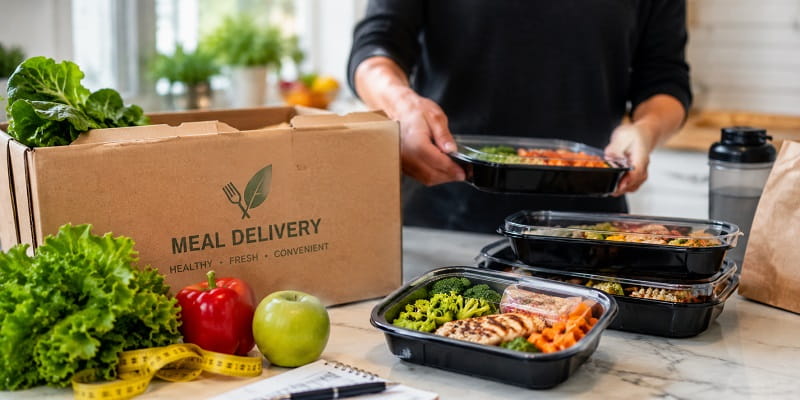
The best meal delivery service depends on whether you want to cook or not. Meal kits send raw ingredients with recipes and average around $8.74 per serving; prepared meals arrive fully cooked and average about $13.62. Across the major US services the median price sits near $11.49 per serving, before shipping, which averages roughly $12.84 per box.
That gap between kits and prepared meals matters more than any brand ranking, because it decides how much of your week the service actually gives back. A kit still costs you thirty to forty-five minutes of cooking. A prepared meal costs you three minutes in a microwave. Everything else — menu size, organic certification, macro tracking — is secondary to that one choice.
The other thing worth knowing before you compare anything: almost every service advertises a heavily discounted first box, typically thirty to fifty percent off. That intro rate is not the price you will pay. Ongoing pricing usually kicks in from week three, and the difference can be five dollars per serving. Every figure below is the ongoing rate, not the promotional one.
Meal Kits vs Prepared Meals — Which Is Right for You?
Meal kits ship pre-portioned raw ingredients with a recipe card. You do the cooking. They cost less per serving, produce fresher results, and suit people who genuinely enjoy cooking but hate planning and shopping. The failure mode is predictable: boxes pile up unopened during busy weeks, and you end up paying for food you throw away.
Prepared meals arrive fully cooked and need reheating only. They cost more per serving, but they eliminate cooking entirely, which is the actual point. They suit shift workers, people managing a demanding schedule, anyone recovering from illness or surgery, and households where nobody wants to cook on a weeknight. Portion sizes tend to be smaller than a kit serving.
A reasonable rule: if you cook willingly at least three nights a week already, choose a kit. If you order takeaway more than twice a week, choose prepared meals — the comparison that matters is not kit versus prepared, it is prepared versus delivery apps, where meal services run roughly sixty percent cheaper per meal.
The Best Meal Delivery Services Compared
Pricing below reflects ongoing per-serving rates at time of writing, taken from each service’s own plan pages. All of these figures move — this category reprices several times a year — so confirm on the provider’s site before subscribing.
1. HelloFresh — Best Overall Meal Kit
The largest meal kit service in the US, and the safest default if you are new to the category. HelloFresh runs a rotating menu of roughly forty recipes weekly, with clear instructions written for people who are not confident cooks. Recipes are rarely inventive, but they work, which is worth more than novelty when you are cooking on a Tuesday night.
Price: roughly $9.99 to $12.49 per serving ongoing. Shipping around $10.99 per box.
- Pros: huge weekly menu, genuinely beginner-friendly instructions, plenty of family-friendly recipes, some prepared options for nights you would rather not cook
- Cons: limited vegan choice, no certified gluten-free, recipes less creative than smaller competitors, intro pricing rolls off steeply
2. EveryPlate — Best Budget Meal Kit
EveryPlate is the cheapest national kit worth ordering. It achieves that by keeping ingredient lists short and packaging simple, which also means faster prep — most meals land in twenty to thirty minutes rather than forty-five.
Price: roughly $4.99 to $8.99 per serving.
- Pros: lowest per-serving cost of any major service, quick prep, simple recipes that are hard to get wrong
- Cons: minimal dietary accommodation, smaller weekly menu, basic ingredients, little appeal for adventurous cooks
3. Home Chef — Best for Flexible Prep Time
Home Chef is the most adaptable option, offering traditional kits alongside fifteen-minute meal kits and oven-ready trays in the same box. That flexibility is genuinely useful when your week is uneven — a full recipe on Sunday, a fifteen-minute option on Wednesday.
Price: from around $7.99 per serving.
- Pros: multiple prep formats in one subscription, strong protein customisation, reliable weeknight recipes, good value
- Cons: less exciting than premium kits, produce quality inconsistent by region, fewer specialty diet plans
4. Factor — Best Prepared Meals
If you want to stop cooking entirely, Factor is the most consistent choice. Meals arrive fresh rather than frozen, reheat in about three minutes, and carry clear macro labelling — which is why it dominates among people tracking protein intake or managing a specific eating plan.
Price: roughly $11 to $15 per meal, with shipping typically included.
- Pros: no cooking at all, fresh not frozen, excellent macro transparency, very consistent quality, free shipping
- Cons: portions smaller than a kit serving, menu narrower than CookUnity, shared kitchen makes it unsuitable for severe celiac
5. CookUnity — Best Variety in Prepared Meals
CookUnity works differently from its competitors: meals are created by a rotating roster of professional chefs rather than a single central kitchen, producing hundreds of weekly options. The ceiling is the highest in prepared meals — and so is the variance, since quality shifts between chefs.
Price: roughly $10.39 to $15.99 per meal, plus $9.99 to $11.99 shipping per order.
- Pros: enormous rotating menu, restaurant-quality ceiling, genuine culinary variety, easy app-based management
- Cons: quality varies by chef, shipping charged on every order, no coverage in some states, premium pricing
6. Green Chef — Best Certified Organic and Gluten-Free
Green Chef is the strongest option for people who need certification rather than marketing language. It is certified organic and certified gluten-free, which makes it the safest kit for celiac households — a meaningful distinction, since most services only label gluten-free items without controlling for cross-contamination.
Price: roughly $10 to $13 per serving.
- Pros: genuine organic and gluten-free certification, strong keto and plant-based plans, high ingredient quality
- Cons: materially more expensive than standard kits, smaller weekly menu, longer prep times
7. Dinnerly — Cheapest Option Overall
Dinnerly undercuts even EveryPlate by dropping printed recipe cards and streamlining packaging. Its vegetarian selection is noticeably better than most budget services, which makes it a reasonable choice for households cutting back on meat without going fully vegetarian.
Price: from roughly $4.69 to $5.89 per serving.
- Pros: lowest headline price in the category, over forty weekly recipes, decent vegetarian range, fast prep
- Cons: digital-only recipes, simple flavour profiles, no specialty diet plans, basic ingredient quality
8. Purple Carrot — Best Vegan Service
Purple Carrot is entirely plant-based, which matters for anyone concerned about cross-contamination in shared facilities. It was the first fully vegan kit in the US and remains the most competent, with recipes that treat vegetables as the point rather than the substitute.
Price: roughly $9 to $13.25 per serving, with a shipping fee on smaller orders.
- Pros: fully plant-based operation, genuinely good vegan recipes, prepared options alongside kits, strong sustainability record
- Cons: no option for mixed households, prep times run twenty-five to forty-five minutes, pricier than budget kits
9. Sunbasket — Best Premium Organic Kit
Sunbasket sits at the top of the kit market on ingredient sourcing — organic produce, responsibly raised proteins, wild-caught fish. Its paleo and Mediterranean plans are the most credible in the category, with no filler ingredients padding the macros.
Price: up to roughly $13.99 per serving.
- Pros: outstanding sourcing quality, strong paleo and Mediterranean plans, dedicated gluten-free prep areas, fresh kits outperform its ready meals
- Cons: among the most expensive kits, smaller menu, ready meals weaker than the kits
10. Trifecta — Best for Athletes
Trifecta is built for macro tracking rather than dinner. Meals are USDA organic, vacuum-sealed, and the app auto-logs macros and syncs with fitness trackers — a feature no competitor matches. Performance plans average around 700 calories with over fifty grams of protein.
Price: roughly $12 to $18 per meal, shipping included.
- Pros: USDA organic, automatic macro logging, five distinct dietary protocols, free shipping, built for serious training
- Cons: most expensive on this list, small menu, cancellation requires contacting support, flavour secondary to nutrition
What These Services Actually Cost
The advertised per-serving price is rarely what lands on your card. Three things inflate it.
Shipping is the first. It averages close to $12.84 per box across major services and is usually charged per delivery regardless of how many meals are in it. Services that include shipping — Factor and Trifecta among them — are often cheaper in practice than a competitor with a lower headline rate.
Intro pricing rolloff is the second, and the most common source of complaints. A box advertised at fifty percent off returns to full price by week three or four. If you are budgeting, calculate from the ongoing rate. A kit at $7.49 introductory may sit near $12 ongoing.
Plan size is the third. Per-serving pricing drops as you order more meals per week and more servings per meal. A two-person, three-meal plan almost always costs more per serving than a four-person, four-meal plan, which is why small households pay a premium for the same food.
Realistically, a single-person household ordering three to four meals a week should expect roughly $70 to $120 weekly all-in. That competes well against grocery shopping at a premium supermarket once time is valued, loses to budget grocery on pure cost, and comfortably beats delivery apps — which is where the genuine saving lives. If cutting spending is the goal, the same logic that applies to any effort to save money applies here: the win comes from replacing your most expensive habit, not your cheapest one.
How to Choose the Right Service
Start with cooking willingness, not price. Choosing a kit you will not cook is the single most expensive mistake in this category, because unopened boxes cost the full amount and deliver nothing.
Then check delivery coverage. Several strong services do not ship nationwide — some skip Alaska, Hawaii, and parts of the Mountain West entirely, and a few regional prepared-meal services cover only the Northeast. Confirm your zip code before comparing anything else.
Then match the dietary requirement to actual certification. There is a real difference between a service that labels items gluten-free and one that is certified gluten-free with dedicated prep areas. For celiac disease, allergies, or medically necessary restrictions, only certification counts. The same care applies whether you are managing type 2 diabetes or simply avoiding an ingredient.
Finally, consider protein and fibre content rather than calorie count alone. Prepared meals vary enormously — some carry over fifty grams of protein, others under twenty at the same price. If satiety is the goal, prioritise meals built around lean protein and check whether the service publishes full macros or only calories.
Are Meal Delivery Services Worth It?
For some households, clearly yes. For others, clearly not, and the category’s marketing tends to obscure which is which.
They are worth it when they replace expensive habits. If you currently spend forty dollars twice a week on delivery apps, a prepared meal service at twelve dollars a meal is an obvious saving with better nutrition attached. If you routinely waste fresh produce because plans change, pre-portioned kits eliminate that loss entirely.
They are not worth it when they replace cheap habits. If you already shop at a budget supermarket and cook from scratch, no meal service will beat your cost per meal. You would be paying for convenience you have already solved, and the money is better spent elsewhere.
The middle case is the common one: people who cook adequately but inconsistently, and whose bad weeks are expensive. There, the value is in eliminating the worst nights rather than every night — which argues for a small plan of three or four meals rather than a full-week subscription. Pairing that with staples you keep on hand, such as high fiber pantry items, covers the remaining nights at minimal cost.
Common Mistakes When Subscribing
The most frequent is ordering too many meals in the first week. Enthusiasm at signup routinely produces a five-meal plan that becomes three uncooked boxes. Start at three meals and increase only after you have cooked all of them for two consecutive weeks.
The second is forgetting the skip deadline. Nearly every service charges automatically unless you skip several days ahead, and the cutoff is often five or six days before delivery. Set a recurring calendar reminder in the first week, not after the first unwanted charge.
The third is comparing prices across different plan sizes. A service quoting $8.99 for a four-person plan is not cheaper than one quoting $10.99 for a two-person plan — they are different products. Always compare at the plan size you will actually order.
The fourth is assuming prepared portions match kit portions. They generally do not. A prepared meal is a single serving sized for one adult, while a kit serving is often more generous. People switching from kits to prepared meals frequently report feeling underfed until they adjust the number of meals ordered.
Frequently Asked Questions
What is the best meal delivery service overall?
For meal kits, HelloFresh remains the strongest all-round choice because of menu size and instruction quality. For prepared meals, Factor is the most consistent, and CookUnity offers the widest variety. There is no single best service — the honest answer depends entirely on whether you intend to cook, which is the only question that changes the recommendation substantially.
Which is cheaper, HelloFresh or EveryPlate?
EveryPlate is meaningfully cheaper, running roughly $4.99 to $8.99 per serving against HelloFresh at about $9.99 to $12.49 ongoing. Both are owned by the same parent company, and the difference shows in ingredient variety and recipe complexity rather than quality of the core ingredients. EveryPlate is the better value; HelloFresh is the better experience.
Do meal delivery services work for one person?
Yes, though you pay a premium. Per-serving pricing falls as plan size increases, so single-person households sit at the expensive end of every price range. Prepared meal services suit solo households better than kits, since kit recipes are usually written for two servings minimum and generate leftovers you may not want.
What is the cheapest meal delivery service?
Dinnerly is generally the cheapest, starting around $4.69 per serving, with EveryPlate close behind. Both achieve low prices through simpler recipes, shorter ingredient lists, and reduced packaging. For prepared meals, the budget end sits nearer $9 per meal — prepared food does not reach kit-level pricing at any provider.
Can you use meal delivery services for weight loss?
They can help, mainly through portion control rather than any special property of the food. Fixed portions remove the estimation errors that undermine most home cooking, and full macro labelling makes tracking straightforward. Services with calorie-controlled plans are the most useful here, though the same results are achievable by cooking weight loss friendly meals yourself at lower cost. Anyone with a medical condition or a history of disordered eating should discuss any structured eating plan with a doctor or registered dietitian first.
How long do meal kits stay fresh?
Kit ingredients typically last three to five days refrigerated, with proteins best cooked within two or three. Fresh prepared meals hold four to seven days. Frozen prepared meals last far longer — some up to twelve months — which makes frozen services a better fit for irregular schedules where fresh deliveries would spoil.
Can I cancel a meal delivery subscription easily?
Most services allow cancellation through the app or account settings without contacting support, though a few still require a phone call or email. Check the cancellation process before subscribing rather than after. Also note the skip deadline, which is usually five to six days before delivery — cancelling after that point will not stop the next box.
The Bottom Line
The meal delivery market has matured into two distinct products that happen to share a name. Kits sell you organised cooking; prepared meals sell you the removal of cooking. Deciding which you actually want eliminates most of the confusion in the category and narrows ten options down to two or three.
From there, the deciding factors are practical rather than culinary: does it deliver to your zip code, does it hold the certification your diet requires, what does it cost once shipping and rolloff pricing are included, and can you cancel it without a phone call. Those four questions separate a subscription you keep from one you resent.
Start small — three meals a week — and increase only once you have proven you will use them. The most expensive meal delivery service is not the one with the highest per-serving price. It is the one sitting unopened in your refrigerator.
Prices and plans in this category change frequently. Every figure here reflects published ongoing rates at time of writing, not promotional first-box pricing, and should be confirmed on each provider’s own site before you subscribe.

Loading comments…