

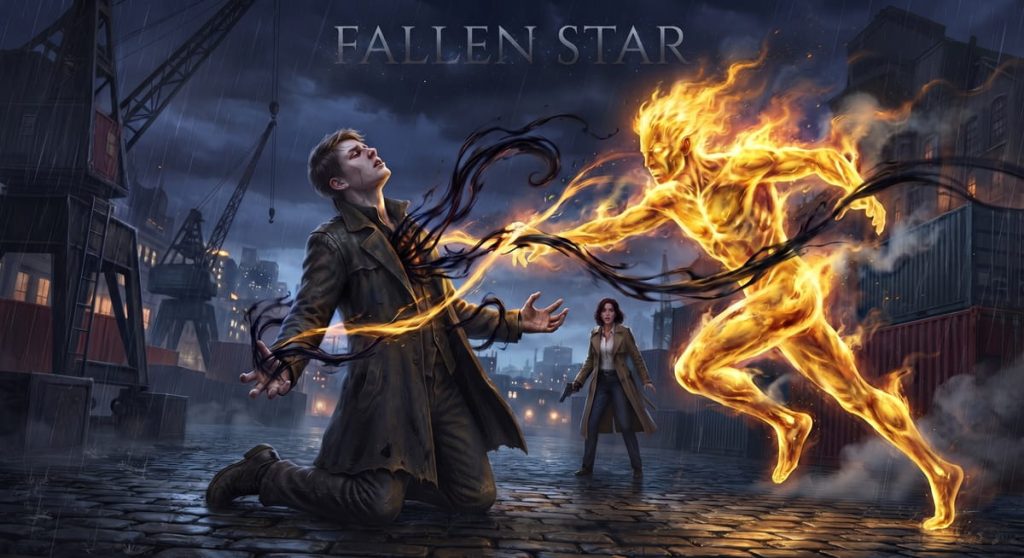
Episode 1: The Dying Sky and the Weight of the Dark
The night sky above Earth has always been a museum of ghosts.
Every point of silver and gold burning in the winter dark carries light that left its source millions or billions of years ago. By the time a photon reaches a human eye, the star that shed it may already have swelled, collapsed, or burned itself out into cold remnant matter. Billions of years ago, long before continents settled into their modern coastlines or rivers carved their valleys through Europe, countless massive stars were already burning through lighter elements until their cores choked on heavy iron. Fusing iron consumes energy rather than releasing it, so internal balance failed. Stars shuddered, expanded, and neared the end of their lives.
Some of those dying stars refused to vanish quietly as cinders or drifting dust. Instead of falling as burning rocks from the sky, they cast their final, fusion-charged souls toward Earth, seeking living vessels capable of holding a sliver of ancient fire long after their own skies had gone dark. A human body is narrow, fragile, and brief—yet to a dying star facing extinction, human flesh was a vessel that could keep its last energy burning.
Not far from a snow-dusted village in rural Europe, an old man with a crooked walking stick and a coat patched from three different winters stood beside a stone bridge, staring up at a clear stretch of stars between two mountain peaks. Around the tavern hearth, villagers called him half-mad whenever his raspy voice made the glasses rattle on the oak tables.
“Listen to me, you fools who think the sky belongs to you,” the old man muttered to the frost-rimed road, his voice rough as dry bark. “The elders used to tell a tale before the roads were paved—how the lights up there aren’t lamps hung for our comfort, they’re old kings burning down to the bone. And the legend says when the sky starts shedding its fire, the stars won’t stop coming. They’ll keep pouring their fury into shapes that walk like us, until the heat rises up from the ground and brings the end of the world. You laugh now because the night is cold. Wait until the chosen start waking up.”
He tapped his stick once against the frozen earth and turned away just as an unnatural stillness settled over the nearby pine woods.
Deep inside those woods, far from the village lanterns, the beginning of the story looked nothing like a catastrophe.
He was small then—just a little boy with grass-stained knees, scraped shins, and dark soil under his fingernails—chasing beetles and skipping flat stones along a shallow forest stream with his older brother. Late-afternoon sunlight filtered through dense green boughs in shifting patches, and the air smelled of wet moss, crushed pine needles, and warm earth. His older brother laughed as the little boy stumbled over a twisted root, offering a steady hand to pull him up while warning him not to stray too far toward the deeper, shadowed pines.
There was no meteor screaming across the sky. No fireball tore the timber apart.
Instead, as the little boy knelt beside the clear water to wash mud from his hands, the woods around them went dead quiet. Birds stopped calling mid-note. The breeze died on the leaves. High above the canopy, a cold, heavy shadow seemed to stretch across the afternoon light, and a dark soul—ancient, silent, and vast beyond anything a child’s heart could comprehend—slipped through the branches and settled straight into his soul.
For a heartbeat, the little boy froze. Inside his chest, something deep and dark opened its awareness, drawing on the warmth of his small, beating heart like a traveler coming out of an endless void. It did not scorch the grass or topple a single tree. It simply took root inside him, quiet as a shadow, while his older brother called out from the bank, unaware that the boy standing up from the water was no longer carrying only his own spirit.
The sickness did not strike like a sudden blow; it crept into his bones like winter seeping through a drafty wall.
That very evening, walking back toward the cottage beside his brother along the darkening trail, the boy’s steps grew heavy and uneven. His forehead burned with a dry, relentless fever that made the cool forest air sting in his lungs, yet his fingertips turned icy cold. At the cottage door, he swayed against the timber frame, his vision blurring as if a heavy curtain had been drawn over the oil lamp. For weeks afterward, he lay buried under thick wool blankets while his older brother sat beside the bed with a basin of cool water and a damp cloth, watching in helpless alarm as the boy shivered, gasped in his sleep, and murmured sounds like wind moving through empty canyons.
A child’s small body and fragile soul were never built to hold the weight of a cosmic abyss—especially a dark soul bound to the immense gravitational pull of TON 618, an ultra-massive quasar black hole billions of light-years away with tens of billions of times the mass of the Sun. Every time that ancient presence shifted inside him, it pressed against his ribs like an invisible tide pulling inward. His pulse hammered too fast; his breath caught on nothing; the water in a cup on his nightstand rippled faintly without a draft.
Yet as the weeks stretched into years, the boy survived the fever—and began the quiet, lifelong struggle of living inside a modified soul.
Growing up with that dark weight inside him meant walking a narrow line every single day. Anger made his chest tighten until the air around his hands felt heavy and strange; fear made the shadows along the walls stretch a fraction too long. He learned early that if he lost control—or if he ever let the wild, burning energy of the star-chosen walk unchecked—the inward pull and pressure inside him could tear apart whatever stood near him. Even toward his older brother, who had stayed by his bedside through the worst of the fever, he had to learn careful distance so the weight inside him would never put the people he loved in harm’s way. So he practiced stillness. He counted his breaths in the dark. He kept his hands clenched in his pockets when his temper rose, forcing a child’s discipline and a young man’s restraint onto a soul that had known nothing but endless dark and immense gravity.
Across the weeks and months that followed his recovery, other dying stars chose other hosts far from those woods.
In a quiet mountain valley, near a bustling port, and across crowded streets across Europe, ordinary people began showing signs that defied everyday explanation: strength that snapped thick iron without effort, sudden surges of temper that made the air shimmer with scorching heat, or bodies that shrugged off trauma that should have proved fatal. Nobody yet knew why they were so strong, or what dying furnace had pushed its final energy into their soul. Only eerie clues lingered in their wake: air turning suddenly hot around an angry man, witnesses speaking of eyes holding a heavy, unnatural weight, and ruthless figures rising through the underworld with untouchable power.
Far overhead, star by star, the night sky was quietly going out. Inside the woods, a little boy had taken a dark soul into his own—and spent every day since fighting to keep his own modified soul from breaking the world around him.
Episode 2: The Shadow in the Rain and the Detective
Eighteen years after that afternoon in the woods, rain fell cold and steady over the narrow streets of a European port city, turning cobblestones into dark mirrors that caught the amber glow of streetlamps.
Detective Clara Novak stood beside a damp brick alley with her coat collar pulled up against the drizzle, staring at a case file that made no sense on paper. Six months earlier, a brutal night in a mountain valley had taken her own parents in a sudden, unexplained tragedy that still haunted her every time the wind rose at night. Now, working homicide and major crimes, she was tracking a string of impossible deaths across the city.
Three ruthless crime bosses—men who had bought off judges, buried witnesses, and ruled the city’s docks and black markets without ever touching a weapon themselves—had been found dead in locked rooms or quiet alleys. None of them had been shot or stabbed. Yet in each case, the air inside the room had felt strangely dry, steel door latches had softened like warm wax, and the victims’ bodies had been left cold and drained, as if every drop of heat and strength had been pulled straight out of them.
The city called the killer the Ghost in the Rain. Some witnesses swore he moved without footsteps, his coat dry even in a downpour. Others claimed they had seen a pale, quiet young man standing near the edge of the scene right before the lights flickered—a man who looked almost ordinary, save for the faint, heavy shadow that seemed to gather around his shoulders whenever he grew angry or tense.
Clara knelt beside the latest victim, a syndicate enforcer named Marek who had walked away from two murder trials and a dozen armed ambushes. Around Marek’s wrists, the dark wool of his sleeves was scorched in a ring, though there was no open flame anywhere in the alley.
“No powder burns. No blade,” Clara murmured, her gloved fingers hovering just above the damp stone. “Whoever did this didn’t fight him like a normal man. It’s like something took everything out of him at once.”
Before she could stand, the heavy iron gate at the back of the alley groaned as two men in wet leather coats pushed through into the dim light. They were Marek’s bodyguards—bruisers known along the piers for breaking men’s ribs with a single swing of a crowbar. Instead of reaching for pistols, the larger one stopped ten feet away, staring at Marek’s cold body while his breath plumed thick and white in the damp air.
“He said somebody was hunting him,” the bigger guard rasped, his voice dropping too low, too gravelly for a normal man. When he clenched his fist around a rusted iron pipe, the metal didn’t just bend—it glowed a dull, angry cherry red in his grip before sagging like taffy. “Said the people in the dark were coming for every boss who thought he couldn’t be touched.”
Clara narrowed her eyes, stepping slowly to her feet. “Put the pipe down. You’re surrounded by uniform two blocks out.”
The guard laughed, a harsh, booming sound that rattled the loose bricks along the alley wall. Heat rolled off him in a sudden, suffocating wave that dried the rain on the cobblestones between them in a hissing arc. For a second, the air around his shoulders rippled with a faint, golden-orange shimmer, and his eyes flashed like coals stirred beneath ash. He took one heavy step toward Clara, his boots cracking the baked earth, his temper flaring hot enough to blister paint off the nearby drainpipe.
A shadow moved at the mouth of the alley.
The young man from the witnesses’ accounts stood there in a dark coat, his face pale, his posture careful and measured—like someone walking across thin ice. He had watched the police cordon from across the wet street for ten minutes before stepping closer, his dark eyes fixed not on the glowing guard, but on Clara.
“You’re asking the wrong question, Detective,” he said quietly. His voice was calm, low, and steady, carrying the quiet weight of someone who spent every waking hour holding a storm inside his ribs.
Clara swung her gaze toward him, one hand dropping to her holstered service pistol while keeping her eyes on the heat-waving guard. “Step back. This is an active investigation. And if you know anything about what happened to Marek—or any of the others—you’re coming to the station.”
The guard snapped his head toward the newcomer, snarling as a burst of scorching heat blasted down the alley. The air shrieked as moisture turned to steam, hurling loose gravel against the brick walls. “Another freak! You think you can walk in here and play hero?”
The young man did not flinch, nor did he step away. He moved with a sudden, fluid speed that left the guard’s heavy swing striking empty air. Before the guard could pull back his arm, the young man’s bare hand closed around the man’s wrist.
The effect was immediate and terrifying.
The orange glow inside the guard’s skin didn’t erupt outward; it bent inward, pulled like bright thread straight toward the young man’s palm. The guard’s eyes widened in shock as the heat in his chest seemed to get yanked out through his arm, leaving the air cold and still again. Within seconds, the guard’s strength gave out, his knees buckling as he slumped against the wet wall, pale, shivering, and utterly spent, while his smaller partner bolted around the corner in blind panic.
Clara stood frozen, her pistol half-drawn, staring at the scene in disbelief. No gunshot. No knife. Just a grip that seemed to drain the fire right out of a man who had been glowing like a furnace a heartbeat before.
“What did you do to him?” Clara demanded, her voice sharp with anger and old grief. “You walk around acting like some judge in the dark, leaving behind heat and ruin just like the night everything I loved was taken from me.”
For a fraction of a second, the air around the young man grew heavy. The rain falling past his coat seemed to bend inward by an inch before hitting the stones, and the faint dark shadow beneath his gaze deepened like water pooling in a deep well. Then he closed his eyes, took a slow, deliberate breath, and forced the pressure back down behind his ribs—his jaw tightening with the quiet strain of a man holding back a landslide with bare hands.
“I didn’t come here to be your enemy, Detective,” he said, his voice dropping back into quiet control. “I came because what’s inside me—and what’s inside men like Marek and that guard—is tearing this world apart.”
Before Clara could call for backup or step closer, he turned and walked calmly down the wet street, disappearing into the mist and lamplight like a shadow that had only borrowed human shape for a few minutes.
Episode 3: One Boss After Another
For three weeks after the night in the rain-soaked alley, the port city lived under a quiet, uneasy dread.
Officially, the homicide board listed the deaths of the city’s syndicate bosses as unresolved medical anomalies or freak accidents. To the detectives working the night shift, however, the pattern was impossible to ignore. Every week another untouchable boss—men who owned dockyard cranes, bribed port magistrates, and kept armed guards at every entrance—turned up dead without a single bullet hole, knife wound, or struggle mark on their skin.
Clara Novak spent her evenings poring over forensic reports that read like riddles. The first body after Marek was a smuggling kingpin named Boric, found inside a reinforced steel vault on Pier Nine. The thick outer door had been locked from the inside with a heavy deadbolt, yet when the locksmiths finally cut through the hinges, they found the inner bolt twisted slightly out of alignment as if something had pressed against it with immense, silent force. Inside the cramped room, the air had been stripped of moisture so thoroughly that ledger books on the iron desk had curled into brittle, yellowed scrolls. Boric himself lay slumped across a leather chair, his face as pale as chalk, his wool coat stiff with frost despite the heavy, muggy summer air outside along the harbor.
Two nights later, a black-market arms dealer known along the rail yards vanished from his guarded penthouse during a sudden power flicker. Residents in neighboring apartment blocks reported a brief, suffocating wave of heat that made windowpanes rattle in their frames and sent stray dogs howling wildly down the avenues. By dawn, the dealer was dead on his Persian rug, his chest cold as winter river stone, his fingertips blackened around the nails as if something had drawn heat inward straight through his bones.
Each time, the same eerie rumors followed. Witnesses who happened to be near the perimeter spoke of a quiet, pale young man in a dark coat who moved through the shadows without drawing attention—and of a strange, heavy stillness that settled over the air right before the boss fell. Yet no witness could ever say they saw him swing a fist or pull a trigger. They only remembered the sudden drop in pressure, the way light seemed to bend slightly around his shoulders, and the look of deep, exhausted strain on his face as he walked away into the night.
Clara refused to treat him as just another street vigilante. To her, he looked like a threat wearing a human face—someone who could walk past locked doors, bend the air around his hands, and leave behind the same eerie signature of heat and ruin that had haunted her since childhood. Determined to catch him before another body hit the floor, she began mapping every crime scene on a wall board in her office, drawing red lines between dockyard warehouses, freight depots, and private clubs while tracking every witness account and setting traps whenever a boss’s security tightened.
She did not know that the young man was not hunting out of malice or pride. He was fighting a war inside his own skin every single hour.
In a cramped, dimly lit room above an old clockmaker’s shop near the harbor, the young man sat alone at a wooden table with a glass of cold water in front of him. Outside his rain-streaked window, the distant horns of cargo ships groaned through the fog. Inside, his chest ached with a dull, persistent pressure—the heavy, ancient weight of the dark soul that had entered him beside a forest stream when he was a child. Whenever he grew tired, or when anger flared in his thoughts at the cruelty of the men running the city’s underworld, the darkness inside him stirred like a deep tide pulling against his ribs.
He had to keep his emotions on a tight leash. If his temper snapped, the pull inside him could grow wild enough to crush whatever stood within reach. And when he confronted men like Boric or the arms dealer—men who already carried unnatural heat and terrifying strength from dying stars—he could not afford a long brawl. A prolonged fight with one of them risked letting their power flare out of control, turning a city block into a furnace.
So he struck fast, closing the distance before they could unleash their full heat, gripping them with bare hands to draw out the volatile energy burning inside their bodies before it could erupt against innocent people. Every time he pulled that raw, scorching force through his own palms, it left him exhausted, trembling, and bruised from the inside out, forcing him to spend hours afterward breathing slowly in the dark just to steady his pulse and quiet the abyss inside his own soul.
On a night when he had barely slept, another name pulled him toward the eastern docks: a brutal racketeer named Davor, whose men ran protection rackets over half the fishing piers and had beaten a dockworker into a coma the week before. The young man moved along the darkened rooftops above the warehouses, his coat wet and heavy, his breath coming in quiet, measured counts to keep the darkness beneath his ribs from rising. Below him, Davor’s armed guards patrolled the loading bay with rifles slung across their chests, while Davor himself stood near a stack of shipping crates, laughing as his voice boomed with a sudden, unnatural rumble that made the corrugated metal roof vibrate.
Heat began to roll off Davor in waves, shimmering visibly in the damp night air as his temper flared at a subordinate. The young man dropped down from the rafters onto a catwalk above the crates, watching the heat build inside the racketeer’s chest. Every ounce of fire Davor held was a spark waiting to catch. Moving before the guards could even turn their flashlights upward, the young man dropped to the concrete, swept a rifleman’s legs out from under him, and lunged straight through a blast of scorching air that singed the cuffs of his coat.
He caught Davor by the collar and wrist before the man could throw a full thermal shockwave. Bare hand against burning skin, the young man pulled. Bright, searing threads of heat seemed to tear out of Davor’s veins and rush into the young man’s palms, making the air crackle with static as the temperature around them plunged back to normal. Davor gasped, his strength collapsing in seconds as he slumped backward against a crate, pale and shivering, while the remaining guards fired wild bursts into the mist and shadows where the young man had already slipped away.
By the time the young man reached his room above the clockmaker’s shop, his hands were shaking so badly he could barely set the latch on the door. He sank onto the edge of the bed, pressing a palm against his aching chest as cold sweat ran down his temples. The stolen star-heat he had pulled out of Davor had been scorched away into the dark beyond his reach, yet the effort had left his muscles burning and his vision swimming. He sat in the quiet dark for nearly an hour, counting his breaths until his pulse slowed and the heavy, silent dark inside him settled back into sleep.
One rainy Thursday night, Clara’s stakeout finally paid off.
She had staked out the private riverfront club of a brutal extortion boss named Kaelen, a man so arrogant he kept six armed bodyguards outside his office and boasted that no cop in the city could touch him. At eleven o’clock, the streetlights along the river embankment flickered twice. A dry, unnatural warmth drifted out through the club’s ventilation grates, carrying the faint smell of scorched dust.
Clara slipped through the side door with her badge in her pocket and her pistol drawn, moving quietly up the back stairs while sirens wailed two blocks away on a false call she had arranged with a trusted patrol sergeant.
When she pushed open the heavy oak door to Kaelen’s office, the room was already half-ruined.
Two bodyguards lay unconscious against the bookshelves, their weapons dropped on the carpet. Kaelen stood backed against the tall windows overlooking the dark river, his face flushed a deep, angry crimson, his shirt collar open as waves of visible heat shimmered off his shoulders. The glass behind him cracked with sharp, tiny pings from the sudden thermal stress.
“Stay back!” Kaelen roared, his voice booming with a terrifying, unnatural resonance as he raised a hand toward the desk. A burst of searing air slammed across the room, shattering a heavy oak table and hurling splinters across the rug. “I don’t care who sent you! Nobody takes what’s mine!”
Before Kaelen could throw another wave of heat toward the doorway, a dark figure stepped out from behind the velvet curtain.
It was the pale young man from the alley. His coat was damp from the river mist, his face set in hard, focused lines as he watched Kaelen’s glowing, overheated hands.
“You’re burning too hot, Kaelen,” the young man said, his voice low and urgent. “If you let that out again, the whole building goes up.”
“Shut up!” Kaelen snarled, lunging forward with a speed that blurred across the room. His fist struck the young man’s shoulder with the force of a battering ram, driving him sideways into the wall and cracking the plaster.
Clara aimed her pistol, her breath catching as she watched the young man hit the wall hard—human enough to grunt in pain, human enough to bleed a thin line from his split lip as he pushed himself upright. Yet as Kaelen swung again, a wave of blistering heat washing over the room, the young man ducked under the blow and caught Kaelen’s wrist with both bare hands.
Clara watched closely from the doorway, her eyes wide as she tried to understand what she was seeing.
There was no flash of lightning, no blade, no gunshot. Instead, the angry crimson glow inside Kaelen’s skin seemed to pull inward like bright threads being reeled into a spool. The shimmering heat around Kaelen’s shoulders thinned, sucked straight toward the young man’s palms. Kaelen’s eyes went wide with sudden shock and weakness, his breath hitching as the strength drained out of his limbs. Within seconds, Kaelen’s knees gave way, and he collapsed onto the ruined carpet, gasping weakly, cold and spent.
The young man let go of Kaelen’s wrist and leaned heavily against the edge of the desk, his chest heaving, his pale hands trembling as sweat beaded across his forehead. The effort had clearly taken a steep toll on him; he looked drained, strained, and barely steady on his feet.
Clara stepped into the room, keeping her gun trained on him while her mind raced through everything she had just witnessed. He wasn’t just killing crime bosses in cold blood—he was taking something out of them, something that left them hollow and left him trembling like a man carrying a weight far too heavy for his frame.
“Stop,” Clara said, her voice tight with confusion and suspicion. “Don’t move. Tell me what you just pulled out of him—and why you’re doing this.”
The young man looked at her with tired, dark eyes, breathing hard as he fought to keep his balance and steady the dark pressure stirring beneath his own ribs.
“If you want answers, Detective,” he said quietly, “you’re going to have to stop looking at me like a monster—and start paying attention to who else is walking through this city.”
Before Clara could step closer, footsteps echoed on the stairwell below—more of Kaelen’s men coming up from the dockside. With a quick, measured glance at the window, the young man slipped out onto the narrow iron balcony and dropped silently into the river fog below, leaving Clara standing alone over Kaelen with more questions than when she had walked in.
Episode 4: Stronger Bosses and the Name in the Ledger
After Kaelen’s riverfront club went cold, the city did not grow quieter—it grew hotter.
Over the next two weeks, the underworld bosses who survived the first wave stopped hiding in ordinary rooms and began gathering in fortified compounds, heavy steel warehouses, and underground bunkers far from prying eyes. Word had spread through encrypted channels and hushed dockside whispers that something in the shadows was hunting men who held unnatural heat inside their veins. Those who had felt the strange warmth rising in their own blood since their stars chose them realized they were not alone—and instead of holding back, they began feeding their power, letting anger and greed fan the fire inside them until their bodies could withstand gunfire, blast doors, and crushing impacts.
Detective Clara Novak spent her nights chasing every rumor, every scorched wall, and every witness statement that linked the pale young man to the fall of the syndicate bosses. On her office wall, photographs of Marek, Boric, the rail-yard dealer, and Kaelen hung beside a map of the harbor and a printed copy of an old rural legend she had dug out of a regional archive—a story from a mountain valley about old lights burning out in the sky, pouring their wrath into human vessels until the heat from the earth brought ruin.
At first, Clara still believed the pale young man was the source of the devastation. Every time she remembered the night her parents died, her chest tightened with grief and suspicion, making it hard to separate her duty as a detective from the ache of an old wound. Yet as she studied the scenes, a nagging contradiction kept pulling at her logic.
When the pale young man fought, the air around him did not stay blazing for long. Where he stood, heat seemed to get pulled inward rather than thrown outward like a wildfire, leaving behind a heavy, breathless stillness and a man who looked pale, exhausted, and humanly bruised afterward. He never seemed eager to fight; he moved with the grim, reluctant focus of someone trying to disarm a bomb before it went off in a crowded room.
The real danger, Clara began to realize, came from the men he was confronting.
One stormy night, intelligence led Clara to an old iron foundry on the edge of the city, where a towering syndicate lord named Malakor had holed up with twenty armed guards. Malakor was older and far more dangerous than Kaelen or Boric—a man whose temper turned the air inside a room so hot that iron tools sagged and sweat evaporated off his skin in white mist. Rumors among his lieutenants said Malakor called himself the Sovereign of Ash, boasting that his power came from a dying star so bright it had outshone whole constellations before its light burned out.
Clara arrived with a tactical unit holding perimeter positions outside the foundry gates, determined to watch closely and understand what the pale young man was actually doing to these bosses.
Inside the cavernous foundry, furnace slag glowed in pits beneath catwalks while Malakor paced back and forth before a row of armored crates. When a lieutenant brought bad news about a seized shipment, Malakor’s face flushed a blinding, molten red. A wave of sheer thermal force erupted from his chest, blowing out every glass pane along the upper rafters and sending a shockwave that rattled the steel girders overhead.
“You think a bullet can stop a dying sun?!” Malakor bellowed, his voice ringing like hammer on anvil as heat shimmered off his broad shoulders in visible waves. “I am fire that refused to die! I am Phoenix!”
From the high catwalk above the slag pits, a dark coat moved silently through the steam.
The pale young man dropped down into the foundry, landing lightly on the ash-covered floor with his face set in tight, weary lines. He looked thinner in the harsh orange light of the foundry, his dark eyes ringed with fatigue from days of tracking star-chosen bosses across the city while keeping his own inner darkness locked down.
“You’re already losing control, Malakor,” the young man said, his voice carrying clearly over the hiss of cooling metal. “If you push that heat any further, the whole foundry—and every person within half a mile—will cook alive.”
Malakor spun around with terrifying speed, slamming a heavy iron bar aside as if it weighed nothing. “You! The shadow-crawler who’s been picking off my associates! You don’t have fire, boy—you’re cold, weak, and hollow! Let’s see how long that thin skin holds when I turn this floor into a furnace!”
Malakor charged across the foundry floor like a runaway locomotive, trailing a wake of scorching air that blistered the concrete beneath his boots. His fist came down with enough force to split a thick iron pillar in two.
The pale young man threw himself sideways just in time, the wind of the blow tearing his coat sleeve and hurling him across a stack of timber. He hit the ground hard, grunting through gritted teeth as a sharp pain lanced through his ribs. He was no invulnerable juggernaut; every heavy strike from a star-chosen boss rattled his mortal bones and tested the fragile balance of his own modified soul.
Outside the shattered foundry windows, Clara watched through binoculars from a ridge overlooking the yard, her jaw set as she saw the young man struggle back to his feet, breathing hard, blood trickling from a cut above his temple.
Inside, Malakor raised both hands, gathering a roaring sphere of blinding golden-white heat that made the air shriek and turned the rivets on nearby beams cherry red. “Die in the light!” Malakor roared.
Before Malakor could release the blast, the pale young man lunged forward through the searing heat, closing the gap in a blur and locking both bare hands around Malakor’s wrists.
Clara lowered the binoculars, leaning forward with every nerve sharp as she watched what happened next.
Instead of exploding outward, the blinding golden-white fire inside Malakor bent violently inward. Thick, luminous streams of heat tore out of Malakor’s arms and chest, twisting like glowing currents pulled straight into the young man’s palms. The roaring heat in the foundry dropped within seconds, replaced by a heavy, unnatural pull in the air that made loose ash and sparks swirl toward the young man’s hands.
Malakor’s roar turned into a choked gasp. The fiery glow beneath his skin faded into dull, ashen gray, his massive frame trembling violently as his strength and heat were stripped away. Within moments, the towering boss collapsed onto his knees on the cold ash, weak, shivering, and defeated.
The young man let go and staggered back a step, leaning heavily against a steel support column. His chest rose and fell in ragged, painful breaths; his hands trembled so hard his fingers could barely curl, and a thin dark shadow seemed to pool beneath his eyes as he fought to steady himself without letting his own inner darkness surge out of control.
As police sirens wailed in the distance and tactical lights swept across the foundry yard, the pale young man slipped out through a rear drainage tunnel into the night, leaving behind a quiet, freezing room where a terrifying star-chosen boss lay drained—and leaving Clara more convinced than ever that the true mystery lay not in simple murder, but in a secret force that could pull a dying star’s fire straight out of human flesh.
Episode 5: Eternal Darkness
By the end of the month, the port city felt like a tinderbox waiting for a single spark.
Three more syndicate bosses had fallen across the harbor district, each one leaving behind the same eerie signature: cold, drained bodies where fierce, unnatural heat had once burned bright enough to warp steel and crack stone. The police department was stretched thin, tactical units were on high alert, and whispers of a secret war between men holding ancient stellar fire were spreading through every dockside tavern and back-room office.
Detective Clara Novak had spent forty-eight hours piecing together the clues from the foundry, the riverfront club, and the old regional archive. Looking at the recovered syndicate ledgers alongside the witness accounts from Malakor’s men, a sharp, unsettling realization snapped into place for her.
The men who had been calling themselves Phoenix—or claiming to carry the blaze of dying stars—were not the shadow killer she had been hunting. One of the dead crime bosses had used the name Phoenix A in private coded ledgers, boasting that his soul held the last fire of a blazing star cluster, while witnesses had also used that same name in confusion when speaking of the pale young man who drained them. Two different forces had been tangled together under the same name, making a dangerous truth look like a simple murder spree.
And now the strongest of them all—a ruthless syndicate overlord who had survived every raid and gathered the remaining star-chosen under his command—was preparing to unleash his full heat inside a massive power station along the northern docks, a blast powerful enough to turn half the harbor district into glass.
Clara arrived at the power station with two patrol cars held back at the outer gate, pushing through the heavy steel doors alone with her badge in her coat and her hand on her pistol. Inside the turbine hall, massive generators hummed like giants under strain as the crime overlord stood at the center of the catwalk, his chest blazing with a blinding, searing white-gold light that melted the railings around him and sent waves of scorching air roaring toward the ceiling.
“You see what happens when you corner a star!” the overlord shouted, his voice shaking the bolts on the turbine housing as heat warped the air into rippling ribbons. “I don’t have to hide anymore! This whole city will burn in my light!”
Before Clara could shout a warning, a quiet step sounded behind her on the grated steel walkway.
It was the pale young man. His coat was torn along one sleeve, his face pale and drawn, his dark eyes steady despite the exhaustion etched across his features. He walked past Clara without looking at his hands, stepping directly into the path of the roaring heat wave.
“You’re already losing your grip on it,” the young man said calmly, his voice cutting through the hum of the generators. “If that fire spills out any wider, thousands of people won’t even have time to run.”
“Then come and try to put it out, shadow!” the overlord roared, hurling a torrent of blinding stellar heat straight down the catwalk.
The shockwave slammed into the young man with enough force to buckle the steel grating beneath his boots. For a brief second, the young man’s human frame buckled under the sheer thermal pressure—his knees bending, his breath catching sharp and ragged, his face showing the raw strain of a mortal body holding back something far larger than itself. A thin line of blood appeared at the corner of his mouth as the heat pressed against his ribs.
Clara froze, her gun raised, watching him struggle to stand against a blast that should have vaporized any normal man on the spot.
Then the pale young man stepped forward into the fire and reached out both bare hands.
There was no flash of a blade and no sound of a gunshot. Instead, the blinding white-gold light inside the overlord’s chest bent violently inward. Thick, luminous streams of starfire tore out of the crime boss’s skin, twisting like bright currents pulled straight into the young man’s palms. The roaring heat in the hall dropped in seconds, replaced by a deep, heavy stillness as every spark of stellar energy was drawn away from the overlord’s body and cast outward into the vast dark beyond Earth’s sky.
The overlord’s roar broke into a weak, ragged gasp. The fire inside him vanished completely, leaving him cold, pale, and collapsed on the steel floor—just another ordinary man, stripped of the borrowed starlight that had made him feel like a god.
Silence settled over the turbine hall, broken only by the hum of the cooling machinery and the heavy, uneven breathing of the pale young man standing beside the fallen boss.
Clara slowly lowered her pistol and walked closer, her heart pounding as she looked at his trembling, blood-streaked hands and the deep exhaustion in his eyes. The mystery that had begun on a quiet night in the woods—and taken her parents in the valley—finally stood bare before her.
“You’re not a fallen star,” Clara said quietly, her voice steady as she looked at him. “You never were. Stars burn and shine. You… you just pull everything in.”
The pale young man looked up at her. For a fleeting second, the human restraint in his eyes gave way, and Clara saw an endless, bottomless dark stretching behind his gaze—cold, ancient, and absolute, older than any star in the sky.
“Phoenix A was only a name men gave to dying fire,” he said softly, his voice carrying the quiet weight of an abyss that had walked in human skin for years. “I am not a star trying to survive. My true form is Ton 618—the eternal darkness at the edge of the void. I came in human shape, carrying a dark soul inside a fragile body, because if I ever let go of control, or let them lose control of their fire, nothing on this earth would survive the dark.”
He closed his eyes for a brief moment, letting the quiet stillness settle back over his chest as the distant sirens faded into the night. The star-chosen threat in the city was broken, the truth of his nature finally spoken aloud, and as Clara stood watching him in the dim light of the turbine hall, both of them knew the sky above would never look the same again.

Loading comments…