

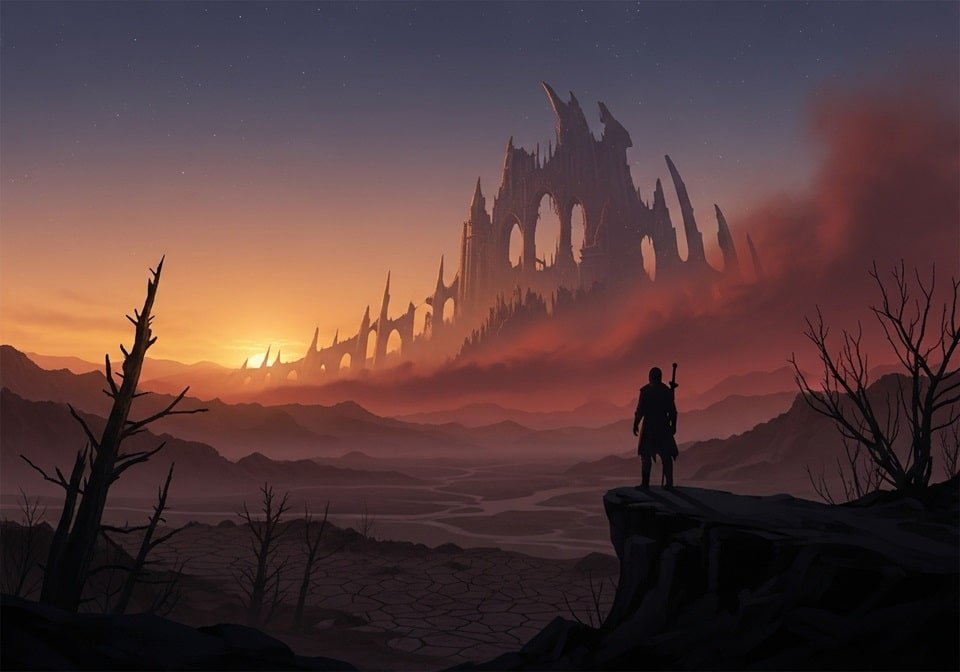
Chapter I: The Edge of the Veil
The data feed from the Event Horizon Explorer IX did not arrive in real time. It couldn’t. Even with quantum-entanglement arrays tethering the drone to the deep-space relays of the United Terran Alliance, the sheer distance between the Sol System and the absolute perimeter of existence introduced a agonizing three-minute latency.
In the subterranean command bunker of the Geneva Astrophysics Institute, Dr. Aris Thorne stared at the primary terminal. His hair, once dark, had turned entirely silver during the three decades he had spent directing Project Terminus.
“Approaching coordinates,” announced Althea, the artificial intelligence monitoring the drone’s telemetry. “Distance to target: one hundred kilometers. Visual sensors are operating at maximum capacity.”
On the central holographic projector, a massive, three-dimensional rendering of the deep universe flickered. For centuries, humanity had pushed further into the void, driven by a singular, obsessive question: Where does it end? They had bypassed the dead husks of ancient galaxies, skirted past supermassive black holes that swallowed light itself, and navigated through vast expanses of dark energy.
And then, they hit it.
It was not a boundary of expanding gas or a fading ripple of the Big Bang. It was a wall. A perfect, seamless, absolute black barrier that absorbed one hundred percent of all electromagnetic radiation. It did not reflect light; it did not emit heat. To the telescopes of Earth, it looked like a sudden, terrifying absence of existence. Up close, it was a solid, impenetrable surface that spanned the entirety of the cosmic horizon, curving gently away into infinity, enclosing everything humanity had ever known—every star, every nebula, every galaxy—inside a cosmic cage.
“Initiating kinetic impact test forty-seven,” Althea stated, her voice devoid of emotion.
On the screen, the drone fired a slug of dense tungsten-carbide traveling at five percent the speed of light. The projectile struck the black surface. There was no flash, no debris, no vibration. The slug simply flattened completely, its kinetic energy instantly neutralized, before drifting away like a dead leaf.
“Zero structural deformation,” Aris muttered, rubbing his tired eyes. “Nothing. We’ve hit it with thermonuclear payloads, relativistic kinetic impactors, localized gravitational shear. We haven’t even left a scratch.”
“Perhaps it is not meant to be broken, Aris,” murmured Dr. Elena Vance, the lead theorist sitting beside him. She looked at the data readouts with a mixture of awe and exhaustion. “Look at the composition analyses. It acts like an absolute heat sink, a perfect dampener. It’s holding the universe together. What if it’s a container?”
“A container implies something outside,” Aris replied, his voice tight. “And humanity has never stood before a closed door without trying to find the key.”
Chapter II: The Mirror in the Dark
While the outer edge of the universe remained locked, the laboratories back on Earth had achieved a different kind of breakthrough. The mastery of dark matter had allowed humanity to manipulate the very fabric of subatomic space, leading to the creation of Project Micro-Cosmos.
Elena led Aris down into the high-containment vault beneath the institute. In the center of the room, suspended within a massive matrix of magnetic levitation rings, floated a perfect sphere. It was roughly the size of a glass marble, but it possessed a terrifying density.
“The miniature universe,” Elena whispered, stepping up to the observation glass. “We successfully initiated a localized Big Bang within a controlled spatial pocket.”
Aris peered through the digital microscope interface. Inside the marble-sized anomaly, spiraling galaxies the size of dust motes spun in silent majesty. Tiny, burning points of light—miniature suns—clustered together, flanked by microscopic black holes that warped the subatomic space around them.
“But you didn’t use ordinary matter,” Aris said, knowing the theory but wanting to see the reality.
“We couldn’t,” Elena explained, her fingers dancing across the console to bring up the structural schematics. “The mathematics were clear. If we created a miniature universe using the baryonic matter of our own world, the gravitational fields would be unstable. The microscopic black holes would interact with our atmosphere, feeding on local atoms, growing exponentially. Within days, the miniature suns and singularities would have expanded, engulfing the laboratory, then Switzerland, then the Earth itself.”
She looked at Aris, her expression grim. “To prevent that catastrophe, we reversed the engineering. We built the micro-universe entirely out of antimatter. Every subatomic particle inside that sphere carries the opposite charge of our world. Because of this, it is entirely self-contained. If any piece of that universe ever breaches the containment sphere and comes into contact with our matter, it instantly annihilates. It evaporates into harmless flashes of pure radiation. The fear of our own destruction forced us to use the mirror image of existence.”
“And the containment sphere itself?” Aris asked, looking closely at the dark, dense shell wrapping around the tiny cosmos.
“Extremely condensed dark matter,” Elena said. “We designed it to be an absolute barrier. Because we knew exactly what forces existed inside that micro-world, we engineered the shell to be entirely impervious to them. None of the forces generated by the antimatter stars or black holes inside can ever breach that dark matter wall. They don’t have the structural properties required to disrupt it.”
She paused, leaning against the console. “The only way to destroy that sphere, or to free what is inside, is from the outside. A localized force from our world—a kinetic impact or an energy pulse of ordinary matter—is the only thing that can destabilize the dark matter shell. The inhabitants inside, if they ever evolve to intelligence, will find themselves trapped forever. Nothing they build can ever scratch the wall from within.”
Aris froze. His breath caught in his throat as the pieces of a terrifying puzzle began to click together in his mind.
He stared at the tiny, black-walled sphere containing the antimatter universe. Then, he looked up at the digital display showing the massive, unbreakable black wall at the edge of their universe.
“Impervious to everything inside,” Aris whispered, his voice trembling. “We’ve spent centuries hitting our wall with nuclear bombs, lasers, and kinetic slugs. We used the matter of our universe, and it didn’t even leave a scratch.”
Elena stared at him, the color rapidly draining from her face as she realized what he was suggesting.
“Because the wall wasn’t designed to withstand outside forces,” Aris said, his eyes wide with a sudden, reckless realization. “It was designed to withstand us. It’s a containment sphere. We aren’t living in the true universe, Elena. We are living inside a subatomic pocket of matter. And the world outside… the world that built our wall… must be made of antimatter.”
Chapter III: The Key and the Lock
The hypothesis swept through the scientific community like wildfire, igniting a dangerous mix of scientific hubris and existential curiosity. If the universe was a locked room, humanity had finally deduced the composition of the key.
“It is too dangerous,” Elena argued during the emergency summit of the United Terran Alliance. “If the wall is a protective barrier, breaking it could mean total destabilization. We don’t know what lies beyond!”
“And we will never know if we remain huddled in the dark,” Aris countered from the podium. “For millennia, we believed we were the center of existence. Now we know we are a microscopic anomaly, a pocket of matter preserved inside a shell. If the outside world is antimatter, then our matter cannot harm it, nor can its forces harm us through the barrier. But if we use an antimatter payload—the opposite of everything inside our universe—we can neutralize the binding energy of the wall. We can open the door.”
The desire for forbidden knowledge triumphed over caution. The Alliance authorized the construction of the Janus Payload: a specialized, high-yield antimatter warhead, carefully cultivated in the deep-space synthesis fields of Saturn. It was loaded onto the Event Horizon Explorer X, a heavily armored, automated drone designed to deliver the payload directly to the black wall and record the results.
Months passed as the drone made its lonely voyage to the edge of existence. On Earth, the world held its breath. The philosophical and religious implications had plunged society into a state of suspended animation. People gathered in the streets, staring up at giant screens displaying the live telemetry of the drone.
In the Geneva command bunker, the atmosphere was suffocatingly tense. Aris stood over the primary console, his hands resting on the edge of the terminal. Elena sat next to him, her eyes fixed on the countdown timer.
“The Janus Drone has reached the perimeter,” Althea announced. “Distance to the black wall: ten kilometers. Antimatter payload is primed and stable.”
“Transmit the detonation command,” Aris ordered. His voice was steady, but his heart hammered against his ribs.
“Command transmitted,” Althea replied. “Accounting for latency, detonation will occur in three minutes. Visual arrays are locked onto the impact coordinates.”
The three minutes passed in absolute silence. No one spoke. No one breathed.
Then, the holographic projector flickered, receiving the delayed data from the edge of the universe.
“Impact,” Althea stated.
On the screen, the Janus Payload detonated against the absolute black wall.
There was no ordinary explosion. Instead, the moment the antimatter warhead touched the dark matter barrier, a blinding, violent reaction erupted. The blackness did not shatter like glass; it began to dissolve, crumbling away into swirling vortexes of impossible light. The unbreakable barrier was melting.
“It worked,” Aris breathed, a triumphant smile beginning to form on his lips. “The hypothesis was correct. The wall is opening!”
“Aris, look at the telemetry,” Elena said, her voice dropping to a terrified whisper. “Look at the energy readings.”
Chapter IV: The Great Annihilation
The smile faded from Aris’s face.
The holographic display was turning completely white. The camera arrays on the drone were being overloaded by an influx of light so intense that the digital filters could not process it. It wasn’t the darkness of empty space that lay beyond the wall. It was an infinite, blinding sea of pure brilliance.
“Structure of the barrier is experiencing total collapse,” Althea reported, her synthetic voice glitching slightly as the data streams became corrupted. “The collapse is propagating outward from the detonation point at a geometric rate. The wall is… it’s disappearing.”
As the black wall crumbled away, the true nature of the outside world was revealed. It was a universe of unimaginable brightness, filled with forces that humanity’s physics could barely comprehend. But the moment that outside world rushed through the breach, it came into contact with the matter inside.
On the screen, the stars and galaxies nearest to the edge did not just burn—they vanished.
“Annihilation,” Elena gasping, gripping the edge of the desk so hard her knuckles turned white. “Oh God, Aris… it’s not a prison. The wall wasn’t built to keep us in. It was built to keep their world out!”
The realization struck like a physical blow. The creators of their universe had not been wardens; they had been protectors. They had crafted a sphere of dense dark matter to isolate a fragile pocket of matter from an infinite sea of antimatter. The two forces could not coexist. The moment they touched, they erased each other from existence, converting mass into pure, destructive energy.
The drone’s sensors captured the cataclysmic chain reaction. The space-time continuum itself was fracturing. As the matter of our universe met the antimatter of the outside, they annihilated one another, creating a cascading wave of unimaginable explosions that tore apart stars, shattered black holes, and dissolved the very fabric of gravity and time.
“The drone is losing structural integrity,” Althea warned. The holographic projection began to distort, tearing into jagged lines of static. “The destruction wave is expanding inward. Velocity of the wave front: exceeding the speed of light within the localized fracture zones. Space-time is collapsing.”
The final frame sent by the Event Horizon Explorer X before it was completely vaporized showed a terrifying wall of white fire, thousands of light-years high, consuming entire star clusters in a fraction of a second. It was an apocalypse of pure light, a reversing of creation, erasing everything in its path.
Then, the feed went entirely dead.
Chapter V: Borrowed Time
In the subterranean bunker in Geneva, the sirens did not wail. There was no alarms, no shouting. There was only the heavy, suffocating weight of absolute certainty.
Aris sank slowly into his chair, his eyes fixed on the blank, static-filled holographic projector. The data had reached them. The mistake had been made.
“How long?” Aris asked, his voice barely a whisper.
Elena looked at her terminal, her hands shaking as she ran the final, definitive simulation. “The universe is vast. The destruction began at the furthest edge, billions of light-years away. Even though the space-time collapse is traveling at impossible speeds, the sheer scale of our containment sphere buys us time.”
She looked up at him, tears streaming down her face. “The annihilation wave will take approximately two generations to reach the outer rim of the Milky Way. It will take another eighty years after that to reach Earth.”
“A countdown,” Aris muttered, looking down at his hands.
“Yes,” Elena said. “The robot sent us the data of what happened at the wall. We are seeing the past, but it is also our inevitable future. The destruction we started has been tearing the universe apart since the moment of detonation. It is coming, Aris. Every star we look at in the night sky will eventually go out, one by one, from the outside in, until the fire reaches us.”
Outside the bunker, the world was beginning to understand. The broadcast had been public. Across the globe, billions of people looked up at the night sky. The stars still blazed beautifully, glittering in the deep velvet of the night. But now, humanity knew the truth.
The sky was a graveyard on a timer.
Somewhere out in the incomprehensible deep, a blinding wall of white fire was chewing through the cosmos, erasing galaxies, unraveling time, and marching steadily toward the Sol System. Humanity had wanted to see what was beyond the wall, and in their brilliant, arrogant curiosity, they had unlocked the door to their own non-existence.
And all they could do now was watch the lights go out.

Loading comments…