

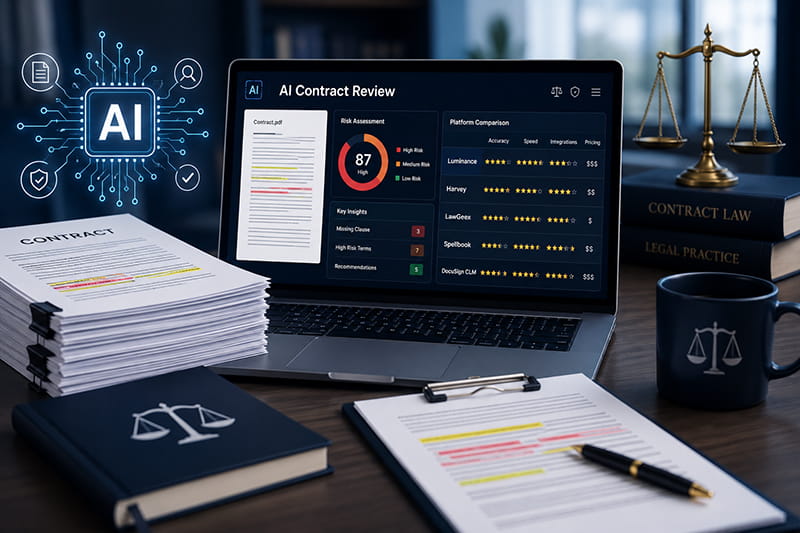
AI-powered contract review uses natural language processing and machine learning to read agreements, extract clauses, flag risk, and suggest redlines in minutes rather than hours. Legal teams deploying these platforms report review cycles shortened by 60 to 85 percent on routine agreements, with the technology handling first-pass analysis while attorneys retain final judgment on negotiation strategy and legal interpretation.
The market has split into two distinct camps. On one side sit established contract lifecycle management platforms — Ironclad, Evisort, LinkSquares, Kira — that were architected as workflow engines between 2014 and 2020 and have since layered generative AI on top of existing infrastructure. On the other side, a newer generation built around large language models from the ground up: Spellbook, Harvey, Robin AI, Legora, and Luminance. The distinction matters more than most vendor comparisons admit, because it determines whether the AI is a feature bolted onto a database or the actual engine driving the review.
Pricing across this category ranges from roughly $20 per user per month for solo practitioner tools to well past $1,200 per seat for enterprise deployments aimed at large firms. Nearly every serious platform hides its pricing behind a demo call, which makes honest budgeting difficult and comparison shopping slower than it should be.
What AI-Powered Contract Review Actually Does
Contract review software performs several distinct functions that often get bundled under one label. Clause extraction pulls specific provisions — indemnification, limitation of liability, governing law, termination, assignment — out of unstructured document text and maps them into structured fields. Risk flagging compares those extracted clauses against a defined standard, whether that standard is market norm, regulatory requirement, or an organisation’s own negotiation playbook.
Redlining goes a step further by generating proposed replacement language rather than simply identifying a problem. This is where generative models separated themselves from the earlier machine learning generation, which could classify clauses accurately but could not draft. Summarisation condenses a fifty-page master services agreement into a readable brief covering obligations, deadlines, and exposure.
Obligation tracking extends past the signature. Once an agreement is executed, the platform monitors renewal dates, notice periods, service level commitments, and payment milestones. Many teams discover this post-execution layer delivers more measurable value than the review itself, because missed renewal windows and unclaimed contractual rights represent quiet, recurring losses.
How AI Contract Review Technology Works
Older platforms relied on supervised machine learning trained on annotated contract corpora. A vendor would have attorneys label tens of thousands of clauses, then train classifiers to recognise similar language in new documents. This approach produced high accuracy on common clause types and poor performance on anything unusual, because the model had genuinely never seen it.
Current generation tools run on large language models — GPT, Claude, and proprietary variants — often layered with retrieval systems that ground responses in a firm’s own clause library or a curated legal corpus. The gain is generalisation: the model handles novel phrasing without retraining. The tradeoff is hallucination risk, which is why any responsible deployment includes verification workflows and why teams should audit your AI model for bias and hallucinations before trusting output on material transactions.
The strongest implementations combine both approaches. Deterministic extraction handles structured metadata where precision is non-negotiable — dates, parties, dollar figures — while generative reasoning handles interpretation, comparison, and drafting. Vendors that rely purely on prompting a general model without grounding tend to produce confident, plausible, and occasionally wrong analysis.
Best AI-Powered Contract Review Platforms
Spellbook
Spellbook operates entirely as a Microsoft Word add-in, which is its defining strength and its main constraint. Transactional lawyers who draft and negotiate inside Word get AI suggestions, redlines, and risk flags without leaving the document. The platform benchmarks clause language against a corpus spanning more than 2,300 contract types, giving negotiators an evidence base for whether a proposed term sits inside or outside market range. Pricing is not published; triangulated industry reporting places entry tiers near $99 per user monthly, professional plans around $149, and enterprise packages between $199 and $350 per seat with minimum commitments.
- Native Microsoft Word integration for drafting and redlining
- Clause benchmarking across 2,300+ contract types
- Custom playbook enforcement on negotiated positions
- Multi-document review for related agreement sets
- SOC 2 Type II, GDPR, and CCPA compliance
LegalOn
LegalOn targets in-house teams processing high volumes of inbound third-party paper. The platform reviews contracts against pre-configured playbook positions, suggests specific edits, and claims review acceleration of roughly 85 percent on routine agreements. Attorney-authored review standards sit behind the product rather than purely statistical training, which appeals to legal departments that want traceable reasoning. An individual plan is listed at $550 per month billed annually, with team and enterprise tiers quoted individually.
- Attorney-drafted review standards behind AI suggestions
- Playbook-based analysis of incoming counterparty drafts
- Word and browser-based review workflows
- Clause-level revision recommendations
- Published individual pricing, unusual in this category
Ironclad
Ironclad remains the enterprise default for full contract lifecycle management with AI review layered on top. Its strength is workflow: intake forms, conditional approval routing, obligation tracking, and deep integration with Salesforce, Slack, and DocuSign. Legal operations teams choose it when the problem is process governance across hundreds of stakeholders rather than pure document intelligence. Pricing is quote-based, with third-party estimates placing total annual cost between $25,000 and $75,000 or more depending on seat count and module selection.
- End-to-end contract lifecycle management
- Conditional approval routing and workflow automation
- Salesforce, Slack, and DocuSign integrations
- Unlimited contracts and workflows on standard terms
- SOC 2 Type II compliance with granular permissions
Luminance
Luminance built its reputation on due diligence, where reviewing thousands of agreements quickly under transaction deadlines is the core requirement. Semantic search across large contract sets surfaces anomalies without predefined queries, which suits M&A diligence and portfolio audits. The company reports adoption across more than 1,000 organisations and has moved toward agentic workflows that chain multiple review steps autonomously. Enterprise pricing is quoted per engagement.
- Semantic search across large document repositories
- Anomaly detection without predefined query templates
- Version comparison for consistency across drafts
- Due diligence and M&A transaction workflows
- Agentic multi-step review automation
Harvey
Harvey positions squarely at the large law firm and enterprise legal department tier, handling research, drafting, and analysis beyond contracts alone. Adoption has concentrated among firms with substantial transactional practices and the budget to support firm-wide licensing. Reported entry points begin around $1,200 per seat monthly, placing it outside consideration for most small and mid-sized teams. The breadth of legal work covered, rather than contract review specifically, justifies the premium for firms that can absorb it.
- Legal research, drafting, and contract analysis in one platform
- Firm-wide deployment with custom model configuration
- Agent-tier workflows for multi-step legal tasks
- Enterprise security and data residency controls
- Designed for large firm and in-house enterprise scale
Evisort
Now operating as Workday CLM, Evisort specialises in contract intelligence across historical repositories. Organisations sitting on a decade of executed agreements in shared drives use it to extract terms, obligations, and metadata retroactively, converting dormant documents into searchable data. Search and analytics capability consistently rates as the platform’s strongest dimension in user reviews. A free trial is available; production pricing is quoted based on repository size and user count.
- Retroactive extraction across historical contract archives
- Structured metadata fields from unstructured documents
- Renewal and obligation analytics at portfolio scale
- Advanced search across executed agreement sets
- Free trial access before commitment
Robin AI
Robin AI combines generative review with a proprietary legal semantics layer designed to improve risk assessment precision beyond generic model output. The platform summarises, redlines, and flags provisions across commercial agreements, aimed primarily at in-house teams managing recurring contract types. Its hybrid approach — AI review with optional attorney oversight on complex matters — appeals to departments unwilling to rely on unsupervised automation for material agreements.
- Legal Semantics Engine for risk classification
- Instant summarisation and redline generation
- Optional human attorney review layer
- Commercial agreement specialisation
- Word and web-based access
Legora
Legora emphasises collaborative AI, structuring review so multiple team members work against shared analysis rather than duplicating effort on the same document. Compliance credentials — GDPR alignment and ISO 27001 certification — feature prominently in its positioning, reflecting strong traction among European legal teams where data governance requirements are stringent. Teams evaluating platforms under European data rules should weigh this alongside broader AI governance obligations already applying to automated decision systems.
- Collaborative review across multiple team members
- ISO 27001 certification and GDPR alignment
- Drafting, review, and advisory workflows
- Document handling with audit trails
- European data residency options
LegalSifter
LegalSifter markets its ReviewPro product on measurable throughput claims — review cycles roughly 90 percent faster at accuracy above 95 percent. The platform serves a notably broad customer set including universities, insurance carriers, staffing agencies, and technology companies, which suggests configurability across contract types that differ substantially in structure. Combined AI and human review options are available for organisations wanting verified output on higher-stakes agreements.
- ReviewPro engine with published accuracy benchmarks
- Sector-specific configurations across multiple industries
- Combined AI and attorney review options
- Clause-level guidance during negotiation
- Integration with existing document workflows
Kira Systems
Kira pioneered machine learning clause extraction and remains widely deployed for due diligence and large-scale document review. Its models identify clauses, facts, and obligations across contract sets and compare them, making it a fixture in transaction diligence and lease abstraction work. The platform predates the generative wave, and its precision on structured extraction still exceeds several newer entrants, though drafting capability is comparatively limited.
- Trained clause and fact extraction models
- Cross-document comparison at scale
- Due diligence and lease abstraction workflows
- Custom model training on firm-specific clause types
- Established deployment base across large firms
Juro
Juro approaches contracts as collaborative documents rather than files, with a browser-native workspace supporting comments, approval status, and negotiation history in one view. Mid-market companies and scale-ups favour it because implementation is lighter than full enterprise CLM while still covering intake through signature. The value positioning is deliberate — meaningful capability at pricing that does not require a six-figure legal technology budget.
- Browser-native collaborative contract workspace
- Clause-aware commenting and approval tracking
- Template-driven self-service for business teams
- Native e-signature and storage
- Faster implementation than enterprise CLM platforms
Gavel Exec
Gavel Exec stands out for publishing its pricing openly — $160 per user monthly or $1,740 per user annually — in a category where opacity is standard. The product runs in Microsoft Word and as a web application, supporting playbook-based review, batch analysis, and multi-document comparison. Playbooks can be generated by AI, built from uploaded precedent, or started from templates authored by practising attorneys. A free tier of 25 queries per user requires no payment details.
- Published pricing at $160 per user monthly
- Word add-in plus full web application
- Batch analysis and multi-document comparison
- AI-generated or manually built playbooks
- 25 free queries without credit card
CoCounsel by Thomson Reuters
CoCounsel brings document review and contract analysis into the Thomson Reuters legal research ecosystem, connecting review output to Westlaw authority. Firms already committed to that stack gain workflow continuity that standalone tools cannot match. The Essentials tier targets smaller practices while the full CoCounsel Legal product serves larger deployments. Pricing is quoted by plan and seat count.
- Integration with Westlaw research infrastructure
- Document review and contract analysis modules
- Tiered plans from Essentials to full deployment
- Established enterprise security posture
- Transformation services for adoption support
Lawgeex
Lawgeex focuses narrowly on automated review of routine agreements against pre-approved positions, and published benchmarking has shown its performance on standard NDAs matching or exceeding human reviewers on speed and consistency. Organisations processing high volumes of repetitive third-party paper — vendor terms, NDAs, standard purchase agreements — capture the clearest return. Complex bespoke negotiation remains outside its intended scope.
- Automated approval or rejection against defined policy
- High-volume routine agreement processing
- Benchmarked accuracy on standard contract types
- Policy configuration by legal team
- Escalation routing for out-of-policy terms
Pricing Comparison Across AI Contract Review Platforms
The category spans a wider price range than almost any other legal technology segment. At the accessible end, tools aimed at solo practitioners and small firms sit between $20 and $100 per user monthly, typically offering review and drafting assistance without lifecycle management or deep integration. Gavel Exec at $160 per user monthly and Bind Starter near $90 per seat represent the transparent middle, where published pricing allows genuine comparison.
Mid-market platforms cluster between $150 and $500 per seat monthly. LegalOn’s individual plan at $550 monthly and GC AI’s published $500 per seat illustrate where feature-complete review capability currently prices. Spellbook occupies overlapping territory, though its refusal to publish rates means buyers report figures ranging from $99 to nearly $400 per seat depending on tier and commitment length.
Enterprise deployments break the per-seat model entirely. Ironclad implementations commonly land between $25,000 and $75,000 annually, and larger configurations exceed that substantially. Harvey’s reported $1,200-plus per seat targets firms where a single matter justifies the annual spend. At this tier, total cost of ownership includes implementation, integration engineering, and change management that frequently matches or exceeds licence fees — a pattern familiar to anyone who has run a rigorous enterprise SaaS cost review.
Quote-based pricing dominates because vendors price against the cost being displaced rather than against each other. A legal department spending $400,000 annually on outside counsel contract review will be quoted differently from a five-person team, regardless of identical feature usage. Buyers who arrive with documented current cost and volume data negotiate materially better terms than those who do not.
How to Choose the Right AI Contract Review Platform
Start with contract volume and repetitiveness. Teams reviewing hundreds of near-identical NDAs and vendor agreements get the fastest return from policy-based automation like Lawgeex or LegalOn, where the AI approves or escalates against defined positions. Teams handling fewer but more complex bespoke agreements benefit more from drafting assistance inside their existing editor, which favours Spellbook or Gavel Exec.
Assess where the work actually happens. Attorneys who live in Microsoft Word resist browser-based platforms regardless of capability, and adoption failures in this category trace to workflow disruption more often than to output quality. Conversely, business teams self-serving routine contracts need a browser workspace, because they will not install add-ins or learn legal software.
Weigh review capability against lifecycle requirements honestly. Contract review and contract lifecycle management are different products solving different problems, and vendors blur the line deliberately. If the pain is reading inbound paper faster, a review tool suffices. If the pain is contracts scattered across email with missed renewals and no approval trail, lifecycle management is the actual requirement and review is secondary.
Scrutinise security and data handling before feature comparison. Contract text contains commercially sensitive terms, pricing, and personal data. Confirm SOC 2 Type II certification, data residency options, whether inputs train vendor models, and retention policy on uploaded documents. Departments operating under strict governance should evaluate these platforms with the same rigour applied to enterprise AI security tooling generally.
Test on genuinely representative documents. Vendor demonstrations use clean, well-structured agreements that flatter the technology. Real inbound paper arrives as scanned PDFs, poorly formatted Word files, and documents with tracked changes from three prior rounds. Insist on trialling with actual counterparty drafts from the past quarter, including the difficult ones.
Model total cost against displaced spend rather than against competing licence fees. A platform costing $60,000 annually that eliminates $200,000 of outside counsel review is cheaper than a $20,000 tool that only removes $30,000. Calculate hours spent on first-pass review, blended internal rate, and external counsel spend on routine agreements before evaluating any vendor.
Current Market Prices and Deals
Free trial availability has become standard, though terms vary considerably. Gavel Exec offers 25 queries per user with no payment details required. GC AI provides a 14-day trial on the same basis. Spellbook routes prospects to a seven-day trial but typically requires a sales conversation first. Evisort and several lifecycle platforms offer trial access on request rather than self-service signup.
Annual commitments generally produce 15 to 25 percent savings against monthly billing, and multi-year agreements extend that further. Vendors chasing quarterly targets discount more aggressively near period close, which is worth timing procurement around when the purchase is not urgent. Seat count thresholds also trigger tier changes — moving from nine to ten seats sometimes unlocks enterprise pricing that reduces per-seat cost despite the larger commitment.
Bundling represents the most overlooked negotiation lever. Vendors selling review, lifecycle management, and e-signature separately will discount heavily to consolidate a customer onto multiple modules. Buyers who need only review should confirm they are not paying for bundled capability they will never configure, while those genuinely needing several components should negotiate them together rather than sequentially.
Free AI Contract Review Options
Genuinely free contract review exists but with meaningful constraints. Query-limited free tiers — Gavel Exec’s 25 queries, various starter allowances — provide enough capacity to evaluate output quality on real documents without commitment. These suit occasional review needs rather than ongoing operations.
General-purpose AI assistants can read and summarise contracts competently, and many solo practitioners use them for initial risk spotting. The limitations are consequential: no playbook enforcement, no clause benchmarking against market data, no audit trail, and uncertain data handling unless operating under an enterprise agreement with explicit terms. Uploading a client’s confidential agreement to a consumer AI product raises obligations that free access does not address.
Lower-cost dedicated tools priced under $20 monthly occupy useful middle ground for individual practitioners, covering review, generation, and legal questions without enterprise overhead. They will not satisfy an in-house department with compliance requirements, but for a solo commercial practice reviewing a handful of agreements weekly, the economics are compelling.
Limitations of AI Contract Review
These platforms do not replace legal judgment, and vendors who imply otherwise are overselling. AI identifies that an indemnification clause is unusually broad; it does not know whether accepting that term is acceptable given the commercial relationship, the counterparty’s leverage, or the deal’s strategic importance. Interpretation of ambiguous language against governing law remains attorney work.
Accuracy degrades on document types outside training distribution. Construction contracts, energy offtake agreements, and heavily regulated financial instruments contain conventions that general commercial models handle poorly. Teams working in specialised domains should test specifically on their contract types rather than trusting aggregate accuracy claims.
Liability allocation for AI-assisted errors remains unsettled. When an automated review misses a provision that later causes loss, responsibility distribution between the deploying firm, the reviewing attorney, and the platform vendor is governed by contract terms that most buyers never read closely. The emerging framework around agentic AI liability in software agreements deserves attention before deployment, not after an incident.
Pro Tips for Implementing AI Contract Review
Codify the playbook before deploying the tool. Most legal departments carry negotiation positions in senior attorneys’ heads rather than documented standards. AI review against an undefined standard produces generic output. Spending two weeks writing down acceptable, preferred, and unacceptable positions for the twenty most common clauses delivers more improvement than any platform choice.
Deploy on the highest-volume, lowest-complexity contract type first. NDAs and standard vendor agreements provide clean signal on whether the technology works in a specific environment, generate quick measurable wins that build internal support, and carry limited downside if early output requires correction. Starting with complex negotiated agreements guarantees disappointment.
Measure baseline metrics before go-live. Capture current average review turnaround, hours per contract, escalation rate, and outside counsel spend on routine work. Without this data, ROI arguments at renewal become anecdotal, and renewal negotiations without hard numbers favour the vendor.
Keep attorneys accountable for output regardless of AI involvement. Review sign-off should remain a named individual’s responsibility, not the platform’s. Teams that treat AI output as authoritative rather than as a first draft eventually ship an error that erodes confidence in the entire programme.
Retain the rejected suggestions. When attorneys override AI recommendations, that decision carries information about where the model misaligns with the organisation’s actual risk tolerance. Platforms supporting feedback capture improve measurably over months; those without it plateau.
Negotiate data terms as carefully as pricing. Confirm in writing whether uploaded contracts train vendor models, how long documents persist after deletion requests, and what happens to extracted data at contract termination. Verbal assurances during sales conversations are not enforceable terms.
Plan for the second-order workflow change. Faster review shifts the bottleneck elsewhere — usually to business stakeholder response times or approval routing. Departments that optimise review without addressing downstream process find total cycle time barely improves despite the technology performing exactly as promised.
Frequently Asked Questions
What is AI contract review?
AI contract review is the use of natural language processing and machine learning to analyse legal agreements automatically. The technology extracts key clauses, identifies deviations from preferred language, flags compliance and risk issues, generates summaries, and suggests redlines. It assists legal professionals with first-pass analysis while attorneys retain responsibility for interpretation, negotiation strategy, and final approval.
Is there a free AI for contract review?
Several platforms offer limited free access. Gavel Exec provides 25 free queries per user without requiring payment details, and various tools include starter tiers or trial periods. General-purpose AI assistants can summarise contracts at no cost, though they lack playbook enforcement, audit trails, and the data handling guarantees that confidential client documents require.
How much does AI contract review software cost per month?
Pricing ranges from roughly $20 per user monthly for solo practitioner tools to over $1,200 per seat for enterprise legal AI platforms. Mid-market options typically fall between $99 and $550 per user monthly. Enterprise lifecycle platforms often price annually, commonly between $25,000 and $75,000 depending on seat count and configuration.
Can AI replace lawyers for contract review?
No. AI handles pattern recognition, extraction, and first-pass risk flagging effectively, but cannot exercise legal judgment about whether identified risks are acceptable in context. Commercial relationships, negotiating leverage, regulatory nuance, and strategic priorities all require human assessment. The technology reduces time spent on mechanical review rather than eliminating professional responsibility.
How accurate is AI contract review software?
Leading platforms report accuracy between 90 and 95 percent on common commercial contract types, though vendor-published figures should be verified against a firm’s own documents. Accuracy drops meaningfully on specialised agreements — construction, energy, complex financial instruments — that fall outside typical training data. Testing on representative documents before purchase is essential.
What is the difference between contract review software and CLM?
Contract review software analyses document content: extracting clauses, flagging risk, suggesting edits. Contract lifecycle management handles process: intake, approval routing, negotiation tracking, signature, storage, and renewal monitoring. Many platforms now offer both, but the underlying problems differ. Teams struggling with reading speed need review; teams struggling with visibility and missed deadlines need lifecycle management.
Is AI contract review secure for confidential documents?
Established platforms maintain SOC 2 Type II certification, offer data residency options, and provide contractual commitments that customer documents do not train vendor models. Security posture varies considerably across vendors, particularly among newer entrants. Confirm certification status, retention policy, deletion guarantees, and model training terms in writing before uploading privileged material.
Which AI contract review tool is best for small law firms?
Small firms generally benefit from tools with published pricing and light implementation requirements. Gavel Exec at $160 per user monthly, Spellbook’s entry tier, and browser-based options like Juro avoid the procurement cycles and integration engineering that enterprise platforms demand. Free query allowances allow genuine evaluation before commitment.
Conclusion
The AI contract review market has matured past the point where any competent platform meaningfully outperforms the alternatives on raw extraction accuracy. Differentiation now comes from workflow fit, playbook depth, integration surface, and pricing transparency. The platform that succeeds in a specific legal department is usually the one that matches where attorneys already work rather than the one with the strongest benchmark scores.
Buyers face a market where most vendors hide pricing behind demo calls, which extends evaluation timelines and obscures genuine comparison. Arriving at those conversations with documented contract volume, current review hours, and outside counsel spend converts an opaque negotiation into a quantified one. Platforms that publish rates — Gavel Exec, GC AI, LegalOn’s individual tier — deserve consideration partly for that transparency, since it signals confidence in value delivered.
The durable gains come from process discipline rather than software selection. Codified playbooks, measured baselines, retained attorney accountability, and honest testing on messy real-world documents determine whether a deployment delivers the promised 60 to 85 percent time reduction or becomes expensive shelfware. The technology is genuinely capable now. Whether a legal team captures that capability depends less on which platform gets purchased than on the operational work done before and after the contract is signed.

Loading comments…