

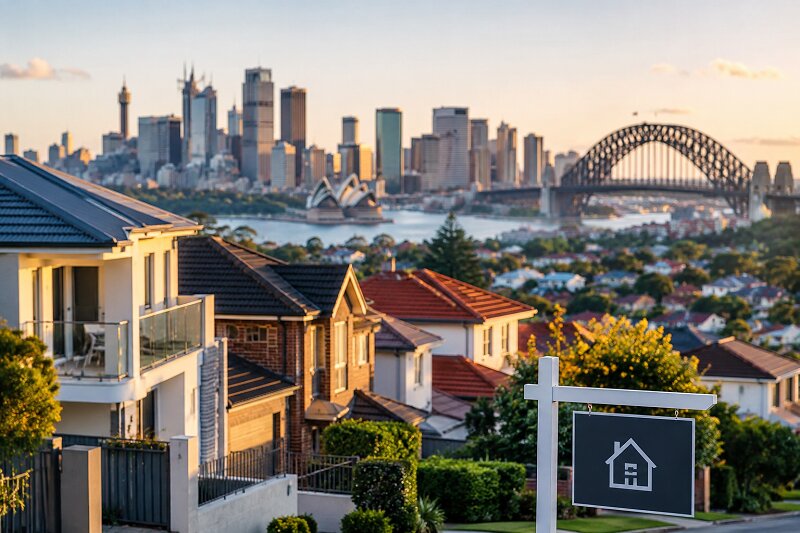
The Australian housing market has entered a new phase of complexity that defies the simple narratives that dominated coverage through the early part of this decade. Interest rate movements, population growth, chronic undersupply in major capital cities, and shifting migration patterns are all operating simultaneously — pulling prices in different directions depending on location, property type, and buyer segment. Understanding what is actually happening across Sydney, Melbourne, Brisbane, Perth, Adelaide, and the regional markets requires separating structural trends from short-term noise.
This guide covers current Australian housing market conditions comprehensively — capital city performance, supply dynamics, affordability pressures, rental market stress, the investment landscape, and what forward-looking indicators suggest about where conditions are heading. Whether buying a first home, upgrading, downsizing, investing, or simply tracking the market, the data and analysis here provides the foundation for informed decisions in what remains one of the world’s most closely watched residential property markets.
Current Market Overview
Australian residential property values have demonstrated sustained resilience through the rate tightening cycle that characterized the post-pandemic period. The Reserve Bank of Australia delivered 13 consecutive rate increases between May 2022 and November 2023, lifting the cash rate from a historic low of 0.10 percent to 4.35 percent — the most aggressive tightening cycle in a generation. Many forecasters predicted double-digit price declines as a result. The declines came, but they were shallower and shorter-lived than almost any mainstream forecast suggested, and the subsequent recovery was faster.
National dwelling values, as measured by CoreLogic, recovered all of their rate-cycle losses and reached new highs through 2024 and into the current period. The structural driver is straightforward: Australia’s population is growing faster than its housing stock, and this imbalance between supply and demand creates a price floor that monetary policy alone cannot displace without causing a demand destruction so severe it would damage the broader economy in ways no government or central bank is willing to tolerate.
The picture is not uniformly positive. Melbourne has underperformed relative to other capital cities, weighed down by state land tax changes, higher vacancy rates in the inner-city apartment market, and slower interstate migration inflows than Queensland and Western Australia have attracted. Sydney remains expensive by any measure but has shown renewed price momentum. Brisbane and Perth have been the standout performers, driven by population growth, resource sector activity, and housing stock that was undervalued relative to Sydney and Melbourne on an income-adjusted basis entering the current cycle.
Capital City Performance Breakdown
Sydney
Sydney remains the most expensive residential property market in Australia by median dwelling value, with the median house price sitting above $1.4 million across the greater metropolitan area. Affordability constraints have pushed demand toward the outer ring suburbs and the Central Coast, where buyers can access larger properties at median prices 40 to 60 percent below inner Sydney equivalents. The unit market in Sydney has strengthened relative to houses as affordability-constrained buyers substitute toward attached dwellings, and investor activity has picked up in established apartment precincts where rental yields have improved materially following several years of rental price growth.
Supply additions in Sydney remain constrained by planning system complexity, infrastructure contribution levies, and construction cost inflation that has made apartment development financially unviable at price points the market will clear. The state government’s planning reform agenda has progressed but implementation timelines mean new supply from rezoning decisions won’t materially affect stock levels for several years. In the near term, Sydney’s supply-demand imbalance continues to support values in established markets while creating ongoing affordability stress for first home buyers.
Melbourne
Melbourne’s residential market has been the most complex capital city story of the current cycle. Values declined from peak by a greater percentage than any other major capital city during the rate tightening period and have recovered more slowly. Multiple factors converged to create this underperformance: Victoria’s land tax changes imposed additional holding costs on investment properties, increasing investor selling pressure; the inner-city apartment market accumulated vacancy during the period when international student arrivals were restricted and has not fully normalized; and net interstate migration out of Victoria — a net negative that distinguishes it from Queensland and Western Australia — reduced organic demand growth.
Melbourne’s median house price remains significantly above pre-pandemic levels in absolute terms, but relative to Sydney and Brisbane, the valuation gap has narrowed. For investors and buyers willing to look past near-term headwinds, Melbourne’s underperformance relative to fundamentals — population, economic diversity, infrastructure investment — represents a potential relative value opportunity that several institutional property investors have begun acting on. The timing of any Melbourne re-rating depends significantly on state policy stability and whether the land tax settings change under political pressure from property owners.
Brisbane
Brisbane has been the headline performer among Australia’s major capital cities over the past three years. Strong interstate migration from New South Wales and Victoria — driven by lifestyle preferences, remote work flexibility, and the perception of relative affordability — generated demand growth that Brisbane’s constrained housing supply could not accommodate. The result was rapid price appreciation that has compressed, but not eliminated, the affordability advantage Brisbane held relative to Sydney and Melbourne.
The 2032 Olympic Games infrastructure investment program continues to support construction activity and employment, sustaining economic conditions that underpin housing demand. Specific precincts identified for Olympic infrastructure investment — including areas in inner Brisbane, the Gold Coast, and the Sunshine Coast — have attracted speculative buyer interest. The rental vacancy rate in Brisbane remains extremely low, supporting continued investor interest in an environment where finding a quality tenant is a matter of days rather than weeks.
Perth
Perth’s housing market has delivered the strongest price growth of any Australian capital city through the current cycle, driven by an extraordinary combination of factors that are largely specific to Western Australia. The resources sector boom — lithium, iron ore, gold, and critical minerals broadly — has sustained high-income employment at a time when Eastern Australia’s economies were grappling with the cost of living pressures from inflation. Interstate and international migration into Western Australia has accelerated, adding population faster than the construction sector can add housing.
Perth’s median house price has risen substantially from the lows that characterized the post-mining-boom period through the mid-2010s, and the city’s housing stock is now priced at levels that no longer represent the deep discount to Sydney and Melbourne that attracted interstate investors in the years immediately following the pandemic. Nevertheless, on a rental yield basis, Perth continues to offer some of the strongest returns of any Australian capital city, with gross rental yields on houses running materially above the Sydney and Melbourne equivalents.
Adelaide
Adelaide has emerged as a consistent performer that rarely generates the same headlines as Sydney, Melbourne, or Brisbane but has delivered strong compound price growth and remains one of the most affordable major capital cities by median dwelling value. Defence industry expansion — associated with the AUKUS submarine program, which has Adelaide as its primary construction hub — is generating sustained high-income employment growth that will underpin housing demand for decades. The lower median prices in Adelaide’s outer and middle-ring suburbs continue to attract first home buyers priced out of eastern capital city markets.
Supply Crisis: The Structural Driver of Australian Housing Conditions
No single factor explains current Australian housing market conditions more comprehensively than the structural supply deficit that has been building for more than a decade. The federal government’s National Housing Accord committed to building 1.2 million new homes over five years from 2024 — an ambitious target that most housing economists consider unlikely to be achieved given current construction capacity constraints, land availability bottlenecks, and planning system inefficiencies.
Construction cost inflation that peaked through the pandemic period has moderated but remains elevated relative to pre-2020 levels. Builder insolvencies continue to generate headlines, disrupting project pipelines and eroding consumer confidence in off-the-plan purchases. Trade labor shortages — particularly in carpentry, plumbing, and electrical — constrain the rate at which approved projects can be physically delivered even when development financing is available. The apprenticeship pipeline that would expand trade labor supply operates on timelines measured in years, not months.
Planning system complexity varies by state, but the common theme across New South Wales, Victoria, and Queensland is that rezoning decisions, infrastructure contribution negotiations, and development approval timelines add years and significant cost to residential supply additions. State government planning reform efforts have accelerated — the New South Wales Transport Oriented Development program, Victoria’s Housing Statement, and Queensland’s planning reforms all represent genuine attempts to increase supply delivery — but the gap between policy announcement and actual dwelling completions typically runs three to seven years.
The rental market has absorbed the most acute effects of the supply shortage. National rental vacancy rates reached historic lows below one percent in most capital cities, generating rental price growth that has materially reduced real household incomes for the one-third of Australian households who rent rather than own. The flow-through effect has been to make renting increasingly untenable as a permanent tenure option for middle-income households, which sustains demand for home purchase even as purchase affordability has worsened — compressing the demand at both ends of the tenure spectrum simultaneously.
Interest Rate Environment and Its Impact
The Reserve Bank of Australia’s cash rate decisions are the most closely watched input variable in Australian housing market analysis, and for good reason — with household debt-to-income ratios among the highest in the developed world, Australian housing prices are acutely sensitive to mortgage rate movements. The variable-rate mortgage structure that dominates the Australian market, unlike the 30-year fixed rate norm in the United States, means rate changes transmit directly and quickly into household cash flow positions rather than gradually through loan refinancing cycles.
The RBA began its easing cycle in early 2025, delivering rate reductions that have brought the cash rate down from its 4.35 percent peak. Each 25 basis point reduction adds approximately $75 to $80 per month of repayment capacity for the average Australian mortgage holder — a meaningful but not transformative improvement in affordability. The market consensus anticipates further rate reductions through the current cycle, with the terminal rate expected to settle somewhere in the low-to-mid three percent range, which would represent a meaningful improvement in borrowing capacity relative to the peak tightening environment.
The borrowing capacity improvement associated with lower rates is a double-edged dynamic in the Australian housing market. Lower rates increase the maximum loan size that households can service, which expands the pool of qualifying buyers and increases the effective demand ceiling for residential property. But this same dynamic — more buyers competing for constrained supply — translates directly into upward price pressure, partially or fully offsetting the affordability improvement that lower rates theoretically provide. The net affordability outcome depends on the speed and magnitude of price response relative to the rate reduction.
Rental Market Conditions
Australia’s rental market has experienced conditions through the current cycle that have no modern precedent in terms of sustained tightness and rental price growth. Vacancy rates below one percent in most capital cities create a landlord’s market where quality tenants compete aggressively for available properties and asking rents have increased by 20 to 40 percent in many markets over the past three years — a genuine household budget crisis for renters whose wages have not kept pace.
The causes of rental market stress are structural rather than cyclical. Population growth through net overseas migration — which has run at historically elevated levels through the post-pandemic period as Australia rebuilt its international student and skilled worker inflows — has added hundreds of thousands of new renter households to major capital city markets. Purpose-built rental supply has not kept pace because the economics of build-to-rent development have been challenged by the same construction cost inflation and financing constraints affecting the broader housing supply pipeline.
Government responses to rental market stress have included rental assistance payment increases, rental freeze and cap proposals at state level, and changes to tenancy legislation that have affected the investment calculus for small landlords. The unintended consequence of some of these policy responses — particularly where rental price controls or restrictions on rent increases have been implemented or proposed — has been to reduce the supply of rental properties as investors recalibrate their exposure to a market with increased regulatory risk. The tension between protecting existing tenants from unaffordable rent increases and maintaining the investment incentives that sustain rental supply is one of the most politically difficult housing policy challenges any state government faces.
Purpose-built student accommodation has expanded in inner-city precincts of Sydney, Melbourne, and Brisbane, partially offsetting the pressure on the private rental market from international student demand. Institutional build-to-rent development has gained momentum, with significant capital committed to large-scale rental apartment projects in the major capital cities. These projects take three to five years from commitment to occupancy, meaning the supply additions from current build-to-rent pipelines will not meaningfully reduce rental vacancy rate pressure until the latter part of this decade.
First Home Buyer Conditions
First home buyers face the most challenging entry conditions in the Australian housing market in decades. The combination of elevated dwelling prices — which have risen faster than household incomes for most of the past two decades — and higher mortgage rates relative to the near-zero rate environment of 2020 and 2021 has compressed the cohort of households that can realistically access homeownership without family wealth assistance.
The federal government’s Home Guarantee Scheme — which allows first home buyers to purchase with deposits as low as five percent without paying lenders mortgage insurance — has provided genuine assistance to tens of thousands of buyers who would otherwise have needed several additional years to accumulate a standard 20 percent deposit. The scheme’s property price caps have been adjusted upward to better reflect current market conditions in major capital cities, though affordability remains challenging even with the deposit assistance.
State government first home buyer stamp duty concessions and grant programs vary significantly by jurisdiction. New South Wales offers first home buyers the choice between stamp duty exemption on properties below $800,000 and an annual property tax, the latter of which reduces the upfront cost barrier at the expense of an ongoing land tax obligation. Victoria, Queensland, and Western Australia maintain stamp duty concessions and first home owner grants for new construction that partially offset purchase costs for qualifying buyers. The interaction between state concession programs and the federal Home Guarantee Scheme requires careful navigation, and the financial advice industry has seen significant demand for first home buyer guidance as a result.
The bank of mum and dad — parental financial assistance through gifts, loans, or guarantor arrangements — has become a structurally significant factor in first home buyer access, particularly in Sydney and Melbourne. Research from various industry bodies suggests that a majority of first home buyers in these markets receive some form of family financial assistance, which creates a two-tier market within the first home buyer cohort: those with access to family wealth who can compete in established markets, and those without who are either confined to outer ring locations, new housing estates on urban fringes, or indefinite rental tenure.
Property Investment Conditions
Residential property investment in Australia has recovered from the period of regulatory and tax uncertainty that characterized the late 2010s, when Labor opposition policies around negative gearing and capital gains tax discount changes generated significant investor caution. Those policy proposals did not proceed, and the current investment environment operates under the established framework of negative gearing full deductibility and a 50 percent capital gains tax discount for assets held more than 12 months — settings that continue to make leveraged residential property investment structurally attractive for middle and upper-income Australian taxpayers.
Rental yields have improved materially from the compressed levels that characterized the peak of the low-rate environment, when capital growth expectations drove investors to accept gross yields below three percent in Sydney and Melbourne. The combination of strong rental price growth and moderating capital growth in some markets has moved gross yields back toward the four to five percent range in many capital cities, with Perth and Adelaide offering above-average yields relative to eastern capital city equivalents.
The investor calculus on negative gearing has been complicated by the interest rate cycle. At the cash rate lows of 2021, investors could borrow at variable rates below two percent and generate strongly positive after-tax cash flows even on low-yielding properties. At the peak tightening cycle in 2023 and 2024, those same investors faced variable mortgage rates above six percent — a massive increase in holding costs that turned positive cash flow positions negative and forced a segment of leveraged investors to either refinance, sell, or absorb significant ongoing out-of-pocket costs. The partial rate reductions now underway are improving investor cash flow positions, but the environment of strongly positive leveraged returns that characterized 2020 and 2021 has not been restored at current rate levels.
Commercial property investors have noted with interest the growing institutional capital allocation to residential build-to-rent in Australia, which was a negligible sector five years ago but has attracted major commitments from superannuation funds, offshore institutional capital, and ASX-listed property groups. The federal government’s managed investment trust tax concession for build-to-rent — which reduced the withholding tax rate for foreign investors in qualifying projects — accelerated institutional interest in the sector and is beginning to generate visible project pipelines in major capital cities.
Regional Housing Markets
Regional Australia experienced extraordinary price growth through the pandemic period as remote work flexibility enabled urban households to relocate to coastal and inland regional areas without sacrificing employment income. This demand surge drove median prices in lifestyle destinations — the NSW South Coast, Queensland’s Sunshine Coast and Gold Coast hinterland, Victoria’s surf coast and central highlands — to levels that permanently reset regional affordability expectations.
The subsequent partial return to office mandates and the rate tightening cycle applied more correction pressure to regional markets than to capital cities in some cases, as the pool of buyers able to sustain regional purchases at inflated prices with higher mortgage costs narrowed. However, the correction in most sought-after regional markets has been limited — the fundamental lifestyle appeal and the stock of relocated households who have no intention of returning to cities maintains a demand floor that prevents the deep corrections some analysts anticipated.
Regional markets with genuine economic bases beyond lifestyle appeal — mining towns in Western Australia and Queensland, regional centers with diversified service economies, university towns — have shown more stability through the rate cycle than purely lifestyle-driven markets. Dubbo, Wagga Wagga, Bendigo, Ballarat, and Toowoomba represent this category: regional cities with populations large enough to sustain diverse local economies and housing markets that respond to local employment conditions as much as to capital city spillover demand.
Affordability Analysis
Australia’s housing affordability — measured by the ratio of median dwelling prices to median household incomes — sits at levels that are challenging by any historical comparison and extreme by international comparison in Sydney and Melbourne. The ratio of median Sydney house prices to median Sydney household income has exceeded ten times in recent years, a level that places Sydney among the least affordable major cities in the English-speaking world by standard international benchmarks.
The ANZ CoreLogic Housing Affordability Report and similar industry publications track dwelling value-to-income ratios, mortgage repayment serviceability as a share of household income, and deposit accumulation timelines — the latter being the most psychologically significant affordability metric for aspiring first home buyers. At current Sydney median prices and current savings rate assumptions for median-income households, the deposit accumulation timeline for a 20 percent deposit without family assistance exceeds a decade in most inner and middle-ring precincts.
Affordability has a geographical dimension that aggregate national or capital city statistics obscure. Within the Sydney metropolitan area, median prices in outer western suburbs like Campbelltown, Penrith, and Richmond remain significantly more accessible than the city-wide median. Within Melbourne, outer northern and western suburbs continue to offer entry points below $700,000 that are structurally more accessible than inner and middle-ring equivalents. Buyers willing to accept longer commutes or to invest in locations that reflect value relative to employment access rather than proximity to established amenities retain meaningful choices in what the headline statistics suggest is an inaccessible market.
The affordability conversation has increasingly incorporated superannuation as a potential deposit source. The federal government’s First Home Super Saver Scheme allows voluntary super contributions to be withdrawn for first home purchase, subject to caps. More controversial proposals to allow broader superannuation access for housing have been debated at federal level, with housing advocates arguing that such measures would stimulate demand without increasing supply and would therefore worsen rather than improve affordability for the cohort of buyers who don’t have superannuation to access.
New Construction and Development Trends
Australia’s residential construction sector is navigating a complex environment where strong underlying demand meets structural capacity constraints. Building approvals — a leading indicator of future dwelling supply — have run below the levels required to meet population-driven demand for multiple consecutive years, confirming that the undersupply story is structural rather than cyclical and will not self-correct without deliberate policy intervention or a sustained reduction in population growth.
Apartment development economics have been particularly challenged. Construction costs for multi-story residential buildings have increased 30 to 50 percent from pre-pandemic levels in most markets, while the prices that off-the-plan buyers are willing to pay have not increased commensurately — creating a viability gap that has left approved apartment projects shelved and reduced new apartment supply in the pipeline. Developer insolvencies have added additional uncertainty to the off-the-plan purchase market, and buyer caution about purchasing from developers without demonstrated financial strength has further compressed presale achievement rates needed to satisfy development finance conditions.
Modular and prefabricated construction has attracted growing policy and investor interest as a potential solution to the construction cost and timeline challenges facing conventional site-built housing. Several state governments have provided funding or land for pilot programs. The technology and manufacturing capacity exists, but the regulatory framework for modular construction — building code compliance, transport logistics, site connection infrastructure — has not yet evolved to support deployment at the scale required to make a material difference to housing supply outcomes.
Government Policy and Regulatory Landscape
Housing policy has risen to the top of the federal and state political agendas in Australia in a way that has no recent precedent. The combination of rental market stress, first home buyer exclusion from established markets, and the political salience of housing cost in cost-of-living survey data has forced sustained policy attention and a substantial expansion of government housing programs.
The National Housing Accord’s 1.2 million homes target has been backed by the Housing Australia Future Fund — a $10 billion endowment structure designed to generate returns that fund social and affordable housing construction — and by planning reform incentive payments to states that meet housing approval targets. The federal government’s Housing Support Program provides funding for the infrastructure enabling works that unlock higher-density development precincts. Taken together, these programs represent the most significant federal housing policy intervention in decades, though critics argue they are still insufficient relative to the scale of the supply gap.
Negative gearing and the capital gains tax discount remain politically untouchable for the current federal government despite the ongoing academic and housing policy debate about their effects on housing affordability. The evidence base for the effect of these tax settings on housing prices is genuinely contested among economists — some research suggests removal or modification would improve affordability through reduced investor demand, while other analysis suggests the supply-side effects of reduced investor participation in new construction would worsen overall housing outcomes. The political calculation is clear regardless: changes to negative gearing were a significant factor in the 2019 federal election result, and no party with memories of that outcome is eager to revisit the policy.
Foreign investment rules continue to limit residential property purchases by non-residents to new dwellings, with the Foreign Investment Review Board applying additional scrutiny to residential land acquisitions. These rules have been tightened and fees increased in recent years, with the stated policy intent of ensuring foreign capital flows into new housing supply rather than competing with Australian residents for established dwellings.
Market Outlook and Forward Indicators
The forward-looking indicators for Australian housing market conditions suggest continued price support in most markets, moderated by affordability constraints that limit the pool of buyers who can access purchase at current prices and mortgage rates. The rate easing cycle provides a demand tailwind; the supply constraint provides a price floor; affordability limits the magnitude of price increases that can be sustained without household income growth to match.
Population growth is the most powerful structural driver. Australia’s net overseas migration, while expected to moderate from the post-pandemic peaks, is projected to remain elevated relative to historical norms for the foreseeable future. Each additional household created by population growth requires housing, and the failure to add supply at the rate required to meet this demand continues to compound the undersupply position that has been building for a decade.
Interest rate forecasts from the major Australian banks project further cash rate reductions through the current easing cycle. Each 25 basis point reduction improves borrowing capacity for the average purchaser by approximately two to three percent, which expands the qualifying buyer pool and applies upward demand pressure to prices. The rate reductions expected through the current cycle are not sufficient to return affordability to early-2021 levels — mortgage rates are not going back to two percent — but they are sufficient to materially improve the cash flow position of existing mortgage holders and modestly expand first home buyer access.
Perth and Adelaide are broadly expected to continue outperforming the national average on price growth, supported by resource sector employment and population inflows that have not yet been fully absorbed by housing supply. Brisbane’s growth is expected to moderate from the extraordinary pace of the recent period but remain positive. Sydney is expected to maintain positive price momentum supported by supply constraints and rate improvements. Melbourne remains the market with the most contested outlook — potential upside from rate relief and relative undervaluation, potential headwind from policy settings and slower population growth relative to Queensland and Western Australia.
Key Data Points Shaping Current Conditions
Several data series provide the clearest current read on where Australian housing market conditions stand and where they are heading. CoreLogic’s daily home value index is the most timely measure of dwelling price movements across capital cities and regional markets. The ABS Housing Finance Statistics provide the most comprehensive picture of lending activity — how many loans are being written, at what values, to which buyer categories — and is a leading indicator of demand conditions. SQM Research’s weekly vacancy rate data provides the most current available measure of rental market tightness by suburb and city.
Building approval data from the ABS, released monthly with approximately a six-week lag, is the primary leading indicator of future housing supply. Persistently low approval numbers — relative to the population growth rate — confirm the supply constraint story and support the structural case for continued price support. When building approvals rise materially toward or above the long-run supply requirement, this is the signal that supply-side conditions are improving and may begin to moderate price growth in three to five years.
The RBA’s Statement on Monetary Policy and the quarterly house price expectations surveys conducted by the major banks, property research firms, and independent economists provide the forward guidance framework that most sophisticated market participants use. These surveys have consistently underestimated Australian housing price resilience through the current cycle — a pattern that itself contains information about the structural factors supporting prices that model-based forecasting approaches have historically underweighted.
Practical Guidance for Market Participants
For buyers
The decision to buy in the current environment depends more on personal circumstances than on market timing. Attempting to time the Australian housing market — buying before expected price increases, deferring purchase ahead of expected corrections — has historically produced worse outcomes than making a purchase decision based on personal financial capacity and housing need. The structural supply constraint that supports Australian housing prices does not create a market where waiting produces meaningful price reductions in most established locations.
Focus on serviceability at current rates rather than anticipated lower rates. Lenders apply serviceability buffers above the current rate — typically 3 percent — in their assessment calculations, which already prices in a rate increase scenario. Buyers who are approved at current assessment rates are structurally protected against modest rate increases and will benefit materially from rate reductions that improve their cash flow position without having made a purchase decision contingent on those reductions occurring.
For sellers
Listing supply in most Australian capital city markets remains constrained relative to buyer demand, which continues to support negotiating conditions for well-prepared vendors. Properties that are well-presented, accurately priced relative to recent comparable sales, and marketed during periods of higher buyer activity — typically the spring selling season from September through November in most capital cities — consistently achieve better outcomes than those marketed in less competitive conditions or with aspirational pricing that requires price reductions to generate genuine buyer interest.
For investors
The improving rate environment has begun restoring the cash flow arithmetic of residential property investment toward more attractive territory. Markets offering the combination of above-average gross rental yields and continued population growth — Perth, Adelaide, and outer Brisbane in particular — represent the strongest current investment fundamentals among Australian capital city markets. The tax treatment of investment property losses through negative gearing remains unchanged and continues to provide after-tax cash flow support for leveraged investors in higher income tax brackets. Long-term demographic fundamentals — population growth, household formation, supply constraint — continue to support the structural case for Australian residential property as an investment asset class.
FAQ
Are Australian house prices going to fall in the near term?
The consensus among Australian housing market economists is that meaningful price falls in most capital city markets are unlikely in the near term given the combination of rate reductions improving borrowing capacity, chronically low rental vacancy rates sustaining demand, population growth continuing to generate new households, and supply addition rates remaining below what is required to meet demand. Melbourne is the market most frequently cited as having downside risk relative to the national trend, due to state-specific policy settings and slower population growth than Queensland and Western Australia. Individual suburbs and property types within any city can underperform the aggregate regardless of overall market direction.
Which Australian city offers the best property investment returns currently?
Perth and Adelaide are consistently identified as offering the strongest current combination of gross rental yield, population growth, and continued price appreciation potential among Australian capital cities. Perth’s resource sector employment base, low vacancy rates, and population inflows from Eastern Australia and overseas continue to support demand. Adelaide’s defence industry expansion, relative affordability, and improving economic diversification are structural positives. Brisbane offers solid fundamentals but has experienced more of its price appreciation already. Sydney and Melbourne offer the deepest and most liquid markets but the lowest rental yields and the highest entry costs.
How does negative gearing affect Australian housing affordability?
The relationship between negative gearing and housing affordability is genuinely contested in Australian economic research. Critics argue that negative gearing channels investment capital toward established dwellings rather than new construction, increasing competition for existing housing stock and supporting prices at levels that disadvantage owner-occupier buyers. Proponents argue that negative gearing maintains the supply of rental properties by making investment in rental housing financially viable, and that removal would reduce rental supply and increase rents. The empirical evidence from Australia’s partial negative gearing restriction in the 1980s is contested in terms of whether it produced the rental market outcomes its proponents claimed.
What is the current rental vacancy rate in Australian capital cities?
Rental vacancy rates across most Australian capital cities have remained at or near historic lows, with rates below one percent in Perth, Adelaide, and Brisbane representing the tightest conditions. Sydney and Melbourne have slightly higher vacancy rates reflecting their larger rental markets and greater new apartment supply, but remain well below the three percent level that is generally considered to represent a balanced rental market. These extremely low vacancy rates have sustained strong rental price growth and maintained investor interest in residential property despite higher mortgage rates during the tightening cycle.
What government assistance is available for first home buyers in Australia?
First home buyer assistance operates at both federal and state levels. Federally, the Home Guarantee Scheme allows purchase with as little as a five percent deposit without lenders mortgage insurance, and the First Home Super Saver Scheme allows voluntary super contributions to be withdrawn for deposit purposes. At state level, stamp duty concessions or exemptions apply for first home buyers on properties below specified price thresholds — these thresholds and concession structures vary by state and are adjusted periodically. First home owner grants for new construction are available in most states. The combination of available assistance varies significantly by state and by whether the purchase is for new or established property.
Conclusion
Australian housing market conditions reflect the interaction of powerful structural forces — chronic supply undersupply, population growth, and the tax and regulatory framework governing property investment — with the cyclical influence of interest rate movements and short-term demand fluctuations. The structural forces are dominant over any timeframe longer than 12 to 18 months, which explains why the Australian housing market has consistently surprised pessimistic forecasters by demonstrating greater price resilience than monetary policy and affordability models predicted.
The near-term outlook is characterized by continued supply constraint, improving but not transformative rate relief, ongoing rental market stress, and differentiated capital city performance that rewards location-specific analysis over national generalizations. Perth and Adelaide lead on current fundamentals; Brisbane maintains solid support from Olympic infrastructure and migration; Sydney holds on supply constraint and economic primacy; Melbourne presents the most contested near-term picture with genuine both upside and downside scenarios depending on policy and migration outcomes.
For buyers, sellers, and investors engaging with the Australian housing market in the current environment, the most productive framework is one that focuses on structural fundamentals over market timing, personal financial capacity over speculative rate forecasting, and specific location analysis over aggregate statistics that obscure the substantial variation in conditions across cities, suburbs, and property types that characterizes Australia’s diverse residential property market.

Loading comments…