

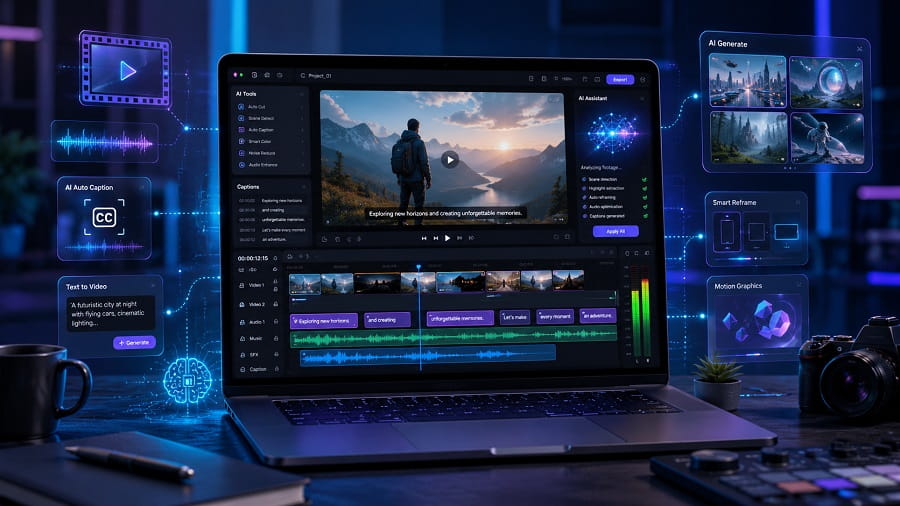
Video production has crossed a threshold that professionals barely saw coming. What used to require a full editing suite, a skilled colorist, and days of post-production can now be completed in under an hour using AI tools built specifically for video creation. The best AI video editors in the market today handle everything from script-to-screen generation, automatic captions, background removal, and even multi-shot cinematic storytelling — all without touching a timeline.
The demand is not limited to professional filmmakers. Marketers, educators, ecommerce brands, and solo content creators all now rely on AI-powered video platforms to produce consistent, high-quality output at scale. Choosing the wrong tool wastes money and creative time. This guide covers the top AI video editors and generators available, with verified pricing, real feature breakdowns, and clear recommendations for who each tool serves best.
Understanding what separates a genuinely useful AI video editor from a hyped-up tool requires looking at five dimensions: automation quality, output resolution, speed of generation, cost per video, and workflow fit. A tool that ranks high on one dimension but fails on another — say, stunning 4K output but a painfully slow generation time — may not be the right fit depending on volume and deadline pressure. The landscape has also shifted significantly: OpenAI retired the Sora consumer app in April 2026, and its API follows in September 2026, making migration to alternatives urgent for any pipeline built on that platform.
What Makes an AI Video Editor Worth Using
The benchmark for AI video tools has risen sharply. The 2024 bar was whether a platform had any AI feature at all. The current bar is far more specific: does the AI actually reduce workload without introducing quality trade-offs? Does it handle long-form repurposing, or only short clips? Does it support multi-shot storyboarding with consistent characters, or reset the visual style on every generation? Can it produce native audio, or does audio have to be layered in separately?
Platforms that answer all of those questions well are rare. Most tools occupy a focused niche — some are text-to-video generators built for creators who start from a script, others are repurposing engines that extract clips from existing long-form content, and a third category sits at the professional post-production end with AI-assisted timeline editing. The strongest picks in this guide come from each category, matched to the workflows where they genuinely outperform alternatives.
Resolution has become table stakes. Every serious platform now produces 1080p natively, and 4K is available across most premium tiers. The interesting differentiators in the current market are lip sync accuracy across multiple languages, character consistency across scenes, synchronized native audio generation without an extra tool, and cost per second of generated video. These are the variables that determine whether a tool fits a production workflow or becomes a bottleneck.
Top AI Video Editors and Generators
PixVerse AI
PixVerse AI has emerged as one of the most talked-about video generation platforms in the current cycle. The V5.6 update introduced native multi-shot storytelling, improved character consistency across angles and scenes, and built-in synchronized sound generation — a combination that sets it apart from tools that require a separate audio workflow. It transforms text prompts and images into cinematic-quality video clips in under 30 seconds, with output resolutions reaching true 4K on paid plans. PixVerse is built for creators who want expressive, stylized results fast, not for users who need frame-level editorial control. Paid plans start at $19/month, with a free tier offering 50 credits monthly — roughly 10 video generations — sufficient for testing before committing.
The strength of PixVerse lies in speed and creative range. Style options include realistic, anime, 3D animation, and cyberpunk modes. Its Character to Video feature keeps a subject visually consistent across multiple clips, which is especially useful for narrative content, branded series, or social media storytelling that needs a recurring cast without expensive actor coordination. The free tier prohibits commercial use; paid plans unlock commercial rights and remove watermarks. The credit system requires careful usage planning for longer or high-resolution outputs.
- Text-to-video and image-to-video generation in under 30 seconds
- V5.6 multi-shot storytelling with character consistency across scenes
- Built-in synchronized audio and sound effects generation
- Style modes: realistic, anime, 3D, cyberpunk, and more
- Free tier with 50 recurring monthly credits; paid from $19/month
Runway Gen-4.5
Runway holds the strongest position among AI video tools that combine generative video production with a built-in professional editing workflow. Gen-4.5 is the current flagship model, offering video-to-video editing, inpainting, motion brush controls, reference image inputs for brand-consistent character generation, and the Act-Two feature for phoneme-accurate lip sync on short dialogue. These are capabilities that competing models have not replicated at the same level of editorial precision. Runway is the most logical choice for marketing teams that need brand-safe output with creative control rather than purely generative clips. Standard subscription plans run $12–$15 per month on a credit system, which makes cost predictable at production volume compared to per-second pricing models.
The credit model means a single workflow manages both generation and editing without switching platforms. Runway Gen-4.5 generates a 5-second clip in approximately 30–60 seconds — the fastest in its class — and paid plans remove watermarks entirely. The per-credit cost of Gen-4.5 at $0.15/second positions it competitively against Veo 3.1 Fast at the same price point, while delivering superior editing toolkit integration. The primary limitation is that Runway’s model library is a single proprietary system; creators who need access to many different generation styles will find platforms with broader model access more flexible.
- Video-to-video editing, inpainting, and motion brush in one platform
- Act-Two lip sync with phoneme-accurate audio alignment
- Reference image inputs for consistent character and brand visuals
- Fastest generation time: 5-second clip in 30–60 seconds
- Credit subscription from $12–$15/month; clean output on all paid plans
Kling AI 3.0
Kling 3.0, developed by Kuaishou, is the most affordable premium AI video model available and consistently places among the top performers on independent benchmarks. It excels at multi-shot cinematic sequences with strong subject consistency at approximately $0.10 per second, which makes it the budget king among production-quality generators. Standard plans start at $6.99/month, with Premier and Master tiers available for higher volume. Paid plans on all tiers remove the Kling watermark that appears on free outputs. Kling 3.0 Omni leads the market specifically on native audio and dialogue, with multilingual lip sync covering five languages and a shared audio timeline across multi-shot sequences — a feature that was unavailable in earlier versions.
For agencies and freelancers producing social content across international markets, Kling’s multilingual lip sync changes the economics of localization significantly. A campaign that previously required separate shoots or expensive dubbing can now be adapted in-platform. Kling is not the strongest option for users who need the deepest editing toolkit; Runway outperforms it on editorial features. However, for generative video production at competitive cost with strong character consistency, Kling 3.0 is the most efficient choice in the current market.
- Multi-shot cinematic generation with consistent subject across scenes
- Native multilingual lip sync in five languages
- Shared audio timeline across multi-shot sequences
- Approximately $0.10/second — lowest cost among premium models
- Plans from $6.99/month; all paid tiers watermark-free
Descript
Descript pioneered transcript-based video editing and remains the gold standard for podcast producers, interview editors, and anyone working primarily with talking-head footage. The core mechanic — delete a sentence from the transcript and the corresponding video disappears from the timeline — compresses an hour of footage review into minutes. Underlord, its in-app AI co-editor, handles filler word removal, Studio Sound noise cleanup, automatic captions, and social clip extraction from long recordings in multi-step requests rather than single-feature toggles. As of May 2026, Descript added an MCP server that allows Claude to import media, run Underlord edits, and export finished video to a shareable link without opening the Descript interface. Free plans are available; paid plans start at $24/month per user.
The transcript-first workflow is both Descript’s greatest strength and its defining constraint. Creators who work with dialogue-heavy content — podcasts, interviews, webinars, explainer videos, client calls — will find Descript saves more time than any other tool in this list. Creators who work with cinematic b-roll, motion graphics, or generative video will find Descript’s paradigm poorly matched to those use cases. It covers all three core AI editor categories: AI-enabled features alongside the transcript editor, AI-led automation through Underlord, and AI-native access via MCP integration.
- Transcript-based editing — remove text to remove footage
- Underlord AI co-editor for filler removal, noise cleanup, and clip extraction
- MCP server integration for external AI workflow automation
- Automatic captions and Studio Sound audio enhancement
- Free plan available; paid from $24/month per user
Google Veo 3.1
Google Veo 3.1 holds the number three position on independent AI video leaderboards and is the strongest current option for 4K output with native audio generation. It produces 48kHz speech generation synchronized with video — the most capable native audio output among all current platforms — making it the leading choice for video ads and content where audio-visual alignment is non-negotiable. Veo 3.1 Standard costs $0.75 per second, placing it at the premium end of the market; Veo 3.1 Fast drops to $0.15/second for iterative testing and draft generation before committing to the full-quality render. Free tier outputs carry a visible Google watermark, which is removed on paid API and Pro plans. SynthID invisible watermarking remains embedded in all outputs regardless of tier — this is metadata, not a visible overlay, and does not affect commercial use.
Veo 3.1’s primary limitation is dialogue realism. On long passages and profile-angle shots, lip sync still reads slightly robotic compared to Runway’s Act-Two pipeline. For content that relies heavily on extended on-camera dialogue, Runway or Kling is a stronger choice. For non-dialogue cinematic content, product videos, brand imagery, and audio-rich social content, Veo 3.1’s quality-per-frame is unmatched at any price point.
- Native 4K output with 48kHz synchronized audio generation
- $0.75/second Standard; $0.15/second Fast for drafts
- SynthID watermarking on all outputs (metadata only, not visible)
- Strongest native audio generation among current AI video platforms
- Paid plans remove visible watermark; free tier shows Google watermark
Pictory
Pictory addresses a specific and common problem: turning text content — blog posts, articles, scripts — into professional-looking videos quickly and at scale. The platform is a text-first video generator, not a generative AI model in the Runway or Kling sense. Users paste a script or article, and Pictory handles AI scene creation, stock footage matching, voiceover, and caption generation in a workflow that requires no timeline expertise. This makes it the natural choice for content marketing teams, educators, and agencies that produce high volumes of explainer or repurposed content rather than original cinematic material. Pricing starts at $19/month on the Starter plan, with Team plans from $39/month for brand template access and collaboration features.
The platform’s output does not compete with generative models on visual originality — stock footage underlays are recognizable as such. However, for teams that prioritize consistent brand output, fast turnaround, and scalability without hiring editors, Pictory delivers reliably. Its strength is workflow efficiency for text-based content producers, not cinematic quality. Users who need original AI-generated visuals should look at Runway, Kling, or PixVerse instead.
- Blog-to-video and script-to-video with AI scene matching
- Automated voiceover, captions, and stock footage selection
- Brand templates for consistent team output
- No video editing experience required
- Starter from $19/month; Team from $39/month
CapCut
CapCut remains the dominant AI video editor for mobile-first creators and social platforms. Originally a ByteDance product for TikTok-style editing, it has expanded into a full-featured desktop and web editor with AI auto-captions, background removal, text-to-video generation, and automatic long-video-to-short-video clipping. The free version is generous enough to produce publish-ready social content without paying, making CapCut the most accessible entry point for individual creators. Pro plans start at $9.99/month. The auto-reframe feature adjusts horizontal content to vertical and square formats for platform-specific exports, which is a core workflow requirement for multi-platform publishing.
CapCut’s AI features are well-integrated into a consumer-friendly interface, but the tool is optimized for social output rather than long-form or cinematic production. For creators whose primary output is TikTok, Instagram Reels, or YouTube Shorts, CapCut offers more AI-assisted editing features per dollar than any other platform. For long-form producers or agencies that need multi-shot generative video, it is better suited as a supplementary export tool than a primary production platform.
- AI auto-captions, background removal, and auto-reframe for social formats
- Long-video-to-short-video AI clipping
- Text-to-video generation with style templates
- Cross-platform: mobile, desktop, and web
- Free plan available; Pro from $9.99/month
Pika Labs
Pika Labs has carved a distinctive position in the generative video market through its suite of highly specific AI effects: Pikaffects for motion and physics modifications, Pikaswaps for object replacement within existing clips, Pikadditions for adding new elements to footage, and Pikaformance for talking-image lip sync on static photos. These features are not available in combination on any competing platform and make Pika the strongest pick for social creators who want eye-catching visual effects on existing content rather than purely generative output from scratch. Plans start at $8/month. A free credits package is available on signup for immediate testing.
Pika’s strength is effect specificity. Rather than competing on raw generation quality against Kling or Runway, it occupies the space of creative augmentation — taking content that already exists and modifying it in ways that generate social engagement. The Pikaformance lip sync feature works particularly well on branded content and meme-adjacent formats. For users who generate entirely original clips from text prompts, Pika’s generation quality at mid-tier pricing is solid but not class-leading.
- Pikaffects: AI physics and motion modifications on existing clips
- Pikaswaps: object replacement within footage
- Pikaformance: talking-image lip sync on static photos
- Pikadditions: AI element insertion into existing video
- Free credits on signup; plans from $8/month
VEED.IO
VEED is a browser-based video editor with a strong emphasis on AI-powered transcription, automatic subtitles, and accessibility features. Its subtitle generation is among the most accurate available in a no-install web tool, supporting over 100 languages with automated translation for subtitle localization. VEED also includes AI background removal, text-to-video, avatar generation, and screen recording within a single interface. For teams that need compliant, accessible video output — particularly in education, corporate communications, and regulated industries — VEED’s transcription and subtitle workflow reduces manual captioning time dramatically. Free plan available; Pro plans start at $18/month.
VEED positions itself as an all-in-one online video editor rather than a generative model. Its AI features assist an editing workflow rather than replace it, which suits creators who want to maintain direct control over their content while automating the repetitive parts. The platform is not built for high-volume generative production; it is built for teams that want a clean, browser-accessible tool that handles captions, audio cleanup, and basic effects without a desktop install.
- AI subtitle generation in 100+ languages with automatic translation
- Browser-based: no installation required
- Avatar generation and text-to-video within one interface
- AI background removal and audio cleanup
- Free plan available; Pro from $18/month
InVideo AI
InVideo AI is built for speed above all else. The platform converts text prompts, scripts, or article URLs into finished videos using a combination of AI voiceover, stock footage, and automated scene assembly. Its primary audience is marketers and small business owners who need video content regularly but do not have the budget for a full production team or the time to learn a complex editor. The AI workflow is conversational — users describe the video they want, and InVideo assembles a draft, which can then be refined through follow-up text instructions. Plans start at $20/month. A free tier with watermarked exports is available.
InVideo’s output is stock-footage based, which means visual originality is limited compared to generative models. However, its iterative chat-based editing workflow makes it exceptionally accessible for non-editors. The platform is particularly well-suited for YouTube explainers, product descriptions, and marketing overview videos where the message matters more than cinematic aesthetics. Teams that need original AI-generated visuals should combine InVideo’s scripting workflow with a generative tool like PixVerse or Runway for the visual layer.
- Conversational text-to-video with refinement through chat instructions
- AI voiceover and automated scene assembly from scripts or URLs
- Stock footage library integration
- No editing experience required
- Free watermarked tier available; paid from $20/month
Wondershare Filmora
Filmora occupies the space between consumer-friendly editing and semi-professional AI augmentation. It includes an AI smart cutout, auto-beat sync, AI portrait, noise reduction, and a text-based editing feature that allows rough cuts from transcripts — a lighter version of the approach Descript pioneered. Filmora is a downloaded desktop application rather than a browser tool, which gives it performance advantages for longer timelines and higher resolution exports. It supports Windows and macOS. Annual plans start at $49.99/year, which works out to approximately $4.17/month — making it the lowest monthly cost for a full-featured desktop editor with AI capabilities in this list.
Filmora’s AI features are well-suited to education content creators, small businesses, and YouTube channels that produce regular medium-complexity videos. It does not match the generative depth of Runway or the transcript-editing intelligence of Descript, but it combines a familiar timeline interface with enough AI automation to meaningfully accelerate a mid-complexity editing workflow. For users who want a make money with AI approach on a tight budget, Filmora’s annual pricing is the most accessible professional desktop option available.
- AI smart cutout, noise reduction, and portrait enhancement
- Auto-beat sync for music-driven edits
- Text-based rough cut from transcript
- Available for Windows and macOS; full desktop performance
- Annual plan from $49.99/year (~$4.17/month)
Adobe Premiere Pro with Sensei AI
Adobe Premiere Pro remains the industry benchmark for professional video editing, augmented by Sensei AI features that automate the most time-consuming parts of a professional workflow: auto reframe for multi-platform exports, speech-to-text transcription, scene edit detection for assembling rough cuts from raw footage, and Generative Extend for seamlessly lengthening clips using AI frame interpolation. AI features across the Adobe suite are deeply integrated — Premiere connects natively with After Effects, Audition, Photoshop, and Adobe Stock in a single ecosystem. Pricing runs $54.99/month standalone or as part of the Creative Cloud All Apps plan at $89.99/month.
Premiere is not an AI-first tool in the way Runway or Descript are — it is a professional post-production platform with AI augmentation layered across a traditional timeline interface. Users who need to deliver broadcast-quality, feature-length, or highly color-graded work will find Premiere’s AI features save significant time without sacrificing the precision control that professional output demands. For individual creators or small teams with tighter budgets, the monthly cost is the primary barrier — it is the most expensive single-tool option in this list.
- Auto reframe and multi-platform export automation via Sensei AI
- Generative Extend for AI-assisted clip lengthening
- Scene edit detection for automated rough cut assembly
- Native integration with After Effects, Audition, and Adobe Stock
- $54.99/month standalone; Creative Cloud All Apps at $89.99/month
Pricing Comparison Across AI Video Platforms
The pricing structure across AI video tools has fragmented into three distinct models: per-second API billing, monthly credit subscriptions, and flat annual licenses. Per-second billing — used by Veo 3.1, Kling 3.0, and Sora 2 — creates variable costs that depend entirely on clip length and output resolution. At $0.75/second, a single 30-second Veo 3.1 Standard clip costs $22.50. Kling at $0.10/second brings that same 30-second clip to $3.00. Runway’s credit system sits at approximately $0.15/second for Gen-4.5, making a 30-second clip roughly $4.50 — with the significant advantage that the subscription cost is fixed and predictable month to month.
For casual users and individual creators, flat subscription tools like CapCut Pro at $9.99/month, Pika at $8/month, and VEED Pro at $18/month offer the most predictable cost structure. For teams producing dozens or hundreds of AI videos monthly, the per-second models become relevant, and Kling 3.0’s $0.10/second rate offers the best quality-to-cost ratio among production-grade generators. Desktop tools like Filmora at $49.99/year remove the per-video cost equation entirely, which works well for creators who generate a steady volume of edited content rather than purely generative clips.
How to Choose the Right AI Video Tool
The starting point for choosing an AI video editor is workflow type, not feature count. A platform optimized for generative text-to-video will frustrate a professional editor who needs frame-level timeline control. A transcript-based editor like Descript will underserve a marketer who needs original AI-generated visuals. Matching the tool to the workflow removes most of the confusion that comes from comparing feature lists across fundamentally different platforms.
Budget is the second filter. Per-second pricing creates unpredictable costs at volume; subscription pricing creates predictable monthly expenses. Teams that need to forecast creative production costs should prioritize credit-subscription platforms like Runway or flat-rate desktop tools like Filmora and Premiere over API billing models, unless per-video output is low enough that the math works in their favor.
Output quality requirements matter for destination format. Social content for TikTok and Instagram Reels does not require 4K output or native audio generation — CapCut and Pika serve that use case at low cost. Ad campaigns, product videos, and brand films that run on connected TV or YouTube pre-roll benefit from the higher output quality of Veo 3.1, Runway Gen-4.5, or PixVerse V5.6. Educational and corporate video benefits most from accurate transcription and captioning, which makes Descript and VEED the logical choices for those workflows.
Character consistency across multiple clips is the deciding factor for narrative content and branded series. Kling 3.0 and PixVerse V5.6 both offer character-to-video features that maintain visual identity across scenes. Runway’s reference image inputs serve the same purpose for marketers who need brand-consistent faces and environments. Platforms that lack character consistency features will produce series-level content that looks visually disconnected, which breaks viewer engagement on multi-episode formats.
Finally, consider audio requirements. Native audio generation — where sound is created alongside the video rather than added separately — is currently available at production quality only through Veo 3.1 and Kling 3.0 Omni. All other tools require a separate audio workflow, either through built-in voiceover libraries (Pictory, InVideo) or external audio tools. For campaigns where audio-visual sync is critical to message delivery, Veo 3.1 and Kling 3.0 have a clear structural advantage.
Pro Tips for Getting the Best Results from AI Video Tools
Prompt specificity directly determines output quality in generative video tools. Short, vague prompts produce generic clips with predictable motion. Including subject, action, setting, lighting mood, camera movement, and approximate clip length in every text-to-video prompt gives the model enough signal to produce something usable on the first or second generation rather than the fifth.
For image-to-video workflows, always start with high-resolution source images. Low-quality input photos create blurry animation output regardless of the model quality. A clear, well-lit headshot for character references and sharp product images for product animation will improve first-generation success rates significantly.
Use fast or draft modes in tiered platforms — Veo 3.1 Fast at $0.15/second rather than Standard at $0.75/second — for iterative prompt testing, then switch to full-quality renders only for final output. This single habit can reduce AI video production costs by 60–80% on platforms that offer tiered generation quality.
For long-form content repurposing, identify the 30-second highlight window first rather than letting the AI pick it from the full recording. Tools like Descript and Vizard can auto-extract clips, but providing a timestamp range based on engagement data from the original video’s analytics produces better clips than purely automated selection.
Watermarks on free tiers are a practical barrier for professional use — not just a cosmetic issue. Any content produced on a free plan that carries visible branding from the AI platform looks unprofessional in client-facing contexts. Budget at minimum $7–$15/month for whichever tool matches the workflow, and treat that cost as a production line item rather than a subscription.
Batch generation during off-peak hours improves generation speed on credit-based platforms. Most AI video platforms process jobs faster during low-demand windows, which is typically overnight in North American time zones. For teams generating dozens of clips weekly, scheduling batch generation runs overnight and reviewing output the next morning compresses the production-to-review cycle without reducing throughput.
Always test commercial licensing terms before publishing AI-generated video in paid ad campaigns. Licensing structures differ significantly: PixVerse free tier prohibits commercial use entirely, Kling free tier watermarks but does not prohibit commercial use, and Runway paid plans grant full commercial rights. Mismatched licensing can create legal exposure in commercial publishing contexts that far exceeds the cost of the paid plan.
Frequently Asked Questions
What is the best AI video generator for beginners?
CapCut and InVideo AI are the most accessible entry points for users with no video editing background. Both offer text-to-video generation, automated voiceover, and social-ready export in a straightforward interface that does not require timeline knowledge. CapCut’s free plan is particularly generous for individual creators producing short-form social content. PixVerse also offers a low-friction starting point for beginners interested in generative AI clips specifically.
Which AI video tool is best for marketing teams?
Runway Gen-4.5 is the strongest pick for marketing teams that need brand-consistent output, reference image controls, and a built-in editing workflow. Google Veo 3.1 is a close second for campaigns where native audio and 4K resolution are essential. For teams producing high volumes of text-based explainer content, Pictory and InVideo provide faster turnaround at lower per-video cost than generative models.
Can AI video tools replace professional video editors?
AI video tools reduce the time and cost of specific tasks — rough cuts, captions, clip extraction, short-form repurposing — but do not replace the creative judgment, color grading depth, and complex scene assembly that professional editors provide on long-form or broadcast-quality projects. The most efficient approach is using AI to handle repeatable, time-intensive tasks while preserving human editorial control over creative decisions and final quality checks.
How much does it cost to generate a 60-second AI video?
Cost depends entirely on the platform and quality tier. At Kling 3.0 rates of $0.10/second, a 60-second clip costs approximately $6. At Veo 3.1 Standard rates of $0.75/second, the same clip costs $45. Runway’s credit system at approximately $0.15/second places a 60-second clip at roughly $9. Subscription-based tools like CapCut Pro and Pika cover unlimited standard generations within a flat monthly fee, making them more cost-effective for high-volume short-form creators.
Is PixVerse AI free to use?
PixVerse offers a free tier with 50 recurring monthly credits — sufficient for approximately 10 video generations — which allows meaningful experimentation before purchasing a paid plan. The free tier prohibits commercial use. Paid plans starting at $19/month unlock commercial rights, higher resolution outputs, and additional generation credits. The PixVerse V5.6 model is accessible on paid plans with no separate upgrade required.
What happened to OpenAI Sora?
OpenAI retired the Sora consumer web app and standalone product on April 26, 2026. The Sora 2 API continues to operate and is scheduled for shutdown on September 24, 2026. OpenAI is integrating video generation capabilities into the broader ChatGPT product rather than maintaining Sora as a standalone platform. Any production pipeline built on Sora API should plan migration to an alternative — Veo 3.1, Kling 3.0, Runway Gen-4.5, or PixVerse — before the September 2026 deadline.
Current Market Prices and Where to Get Started
The AI video market spans from fully free tiers — CapCut, PixVerse, Pika, VEED, Descript — through to enterprise API pricing that scales with output volume. For individual creators, a monthly budget of $9.99 to $20 covers all major use cases. Kling 3.0 at $6.99/month is the most cost-effective premium generative model. Filmora at $4.17/month effective annual cost is the lowest-priced desktop editor with meaningful AI features. Runway at $12–$15/month offers the best-integrated editing-plus-generation toolkit for professional workflow needs.
For teams and agencies, per-second pricing models become relevant at high output volumes. Kling 3.0 at $0.10/second and Runway Gen-4.5 at approximately $0.15/second provide the best quality-per-dollar among production-grade generators. Veo 3.1 Standard at $0.75/second is premium-priced but justified for campaigns where 4K output and native audio generation directly affect commercial performance. PixVerse paid plans at $19/month balance generative quality and creative range against predictable cost, making it a strong default for creators who want AI-native video generation without per-second billing anxiety.
The best approach before committing to any paid plan is to test the free tier or trial credits on the specific output type — short social clips, long-form repurposing, generative cinematic content — that matches the actual workflow. Every platform in this list offers free access at some level, and the difference between tools is stark enough that hands-on testing produces clearer decisions than feature comparisons alone.
