

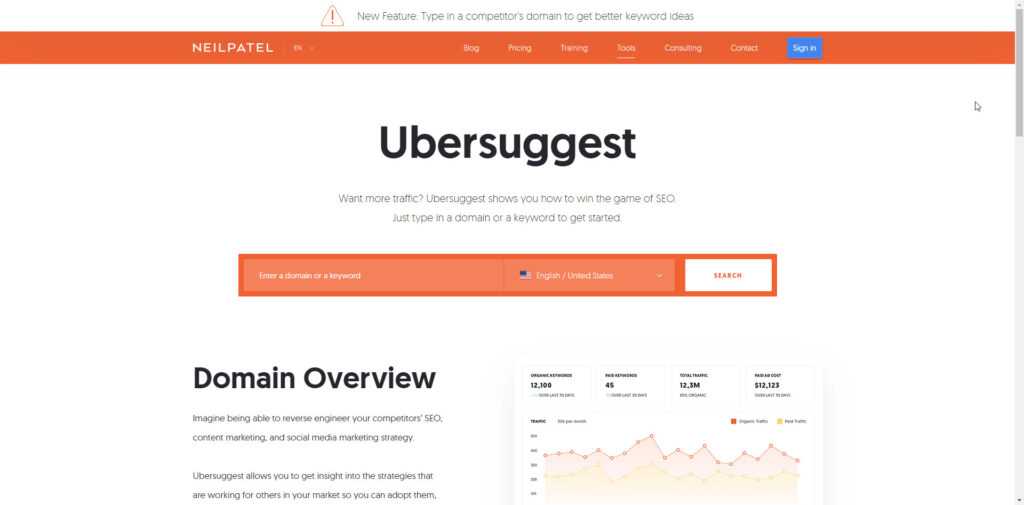
Ubersuggest is an all-in-one SEO and digital marketing platform created by Neil Patel, designed to help website owners, content creators, small businesses, and marketers improve their search engine rankings without paying the premium prices charged by tools like Ahrefs or Semrush. It combines keyword research, site auditing, competitor analysis, backlink tracking, rank monitoring, and AI-assisted content creation into a single, browser-based dashboard. For anyone serious about on-page SEO but working with a limited budget, Ubersuggest has become one of the most referenced starting points in the industry.
Originally launched in 2013 as a basic keyword suggestion scraper that pulled data from Google Suggest, the tool was acquired by Neil Patel in 2017 and expanded aggressively into a full SEO suite. Today it serves millions of users globally, supports 137 countries, and has grown to include features that directly compete with tools costing four to five times as much per month.
How Ubersuggest Works
Ubersuggest operates entirely in the browser as a cloud-based platform — no software installation required. After creating a free account and connecting a domain, users can run keyword searches, crawl their own site, analyze competitors, and track rankings directly from the dashboard. The tool works by crawling websites externally, similar to how Googlebot operates, which means it does not inject tracking scripts or affect page speed on any platform. It works equally well with WordPress, Shopify, Wix, or any custom-built site.
The platform is structured around projects. Each project represents a domain being tracked. Once a domain is added, Ubersuggest continuously monitors keyword rankings, indexes backlinks, and surfaces technical issues across that site. Users can set up multiple projects depending on their subscription plan, making it practical for freelancers and small agencies managing several clients at once.
Core Features of Ubersuggest
Keyword Research
The keyword research module is Ubersuggest’s most-used feature. Entering any keyword returns data on monthly search volume, SEO difficulty, paid difficulty, and cost-per-click. From there, the Keyword Ideas tab expands the results into hundreds of related phrases, long-tail variations, and question-based queries that users are actively searching. Paid plans support bulk analysis of up to 200 keywords simultaneously, which significantly speeds up content planning for established sites.
One addition that sets it apart from simpler tools is AI Prompt Ideas — a feature that generates content angles and topic suggestions tied directly to a keyword, pulling in data on user intent, top-mentioned brands, and trending source websites. This bridges the gap between raw keyword data and actual content strategy, which is where many keyword tools fall short.
Site Audit
The Site Audit tool crawls the entire domain and flags technical SEO issues across categories including broken links, missing meta tags, slow page speeds, crawl errors, duplicate content, SSL problems, and sitemap errors. Business plan users can audit sites with up to 25,000 pages. Each issue comes with a severity rating and a direct explanation of why it matters and how to fix it — a practical detail that separates Ubersuggest from tools that surface problems without providing direction.
The audit results can be exported as PDF or CSV on paid plans, making it straightforward to share findings with clients or team members. The tool also integrates with Google Analytics and Google Search Console, which allows it to pull real-time traffic and indexing data rather than relying purely on external crawl estimates.
Competitor Analysis
The competitor analysis section lets users enter any domain and pull a breakdown of its top organic keywords, most-trafficked pages, backlink profile, and estimated monthly traffic. This is particularly useful for reverse engineering what is working for competing sites. The Domain Overview report presents the data through digestible charts covering traffic trends and backlink growth, which makes identifying shifts in a competitor’s strategy far more visible than raw data tables.
The Top Pages report goes a step further — showing which individual pages on a competitor’s site drive the most traffic, along with the specific keywords sending that traffic. Clicking through on any page reveals the full keyword list it ranks for, which regularly uncovers search terms that would not have surfaced through standard keyword brainstorming.
Backlink Analysis
Ubersuggest provides a backlink overview for any domain, showing total backlinks, referring domains, domain authority score, and a filtered list of individual links. The Backlink Opportunities tool goes beyond reporting — it identifies sites that are already linking to multiple competitors in a niche, flagging them as high-probability outreach targets for link building. While the backlink database is smaller than Ahrefs’ index and produces fewer results on highly competitive queries, it provides a solid working picture for most independent sites and small businesses.
Rank Tracking
The Rank Tracking report monitors how a site’s keywords perform over time across both desktop and mobile. Rankings are updated daily, and the historical view lets users identify trends, seasonal fluctuations, and the impact of specific content or technical changes. Users can track rankings by location — useful for businesses targeting specific cities or regions — and can generate PDF reports to share with clients. The Individual plan supports tracking up to 300 keywords across up to 15 projects.
AI Search Visibility
One of the more recent additions is the AI Search Visibility module, which tracks how a brand appears inside large language model responses from tools like ChatGPT. It surfaces a Brand Visibility Percentage, an Industry Rank against competitors, trend charts over time, and the specific AI prompts where the brand is mentioned. As AI-generated search results become a larger part of how users discover products and services, this feature addresses a growing blind spot that traditional rank tracking tools have not yet fully solved. Users looking to strengthen their position in AI-driven search should also understand generative engine optimization strategies alongside traditional SEO.
AI Writer and Content Ideas
Ubersuggest includes an AI Writer that generates blog outlines, intro paragraphs, and full draft articles based on a target keyword. The Content Ideas tool, modeled after BuzzSumo’s concept, surfaces the highest-performing content in any niche based on social shares and backlinks — giving users a clear picture of what topics already have demonstrated audience demand before investing time in writing. Both features are more useful as starting frameworks than as finished outputs, and pairing them with the keyword research data produces more strategically grounded content plans.
Chrome Extension
The Ubersuggest Chrome extension overlays keyword metrics — search volume, SEO difficulty, CPC — directly inside Google, YouTube, and Amazon search results. Free users get a limited number of daily searches through the extension, while paid plans expand the cap significantly. It is particularly effective for quick competitive research during the browsing session, without needing to switch back to the main dashboard.
Ubersuggest Pricing Plans
Ubersuggest runs on a freemium model. The free tier allows up to three searches per day across the platform, one tracked project, approximately 25 tracked keywords, and one competitor with weekly updates. It is enough to test the interface but not enough for consistent SEO work.
Paid plans currently start at around $29 per month for the Individual plan, which supports up to 15 projects and 300 tracked keywords. The Business plan at approximately $49 per month expands this to 30 projects and 500 keywords and includes the larger site audit crawl limit of 25,000 pages. The Enterprise/Agency plan at around $99 per month is designed for larger agencies managing multiple clients simultaneously.
The plan structure that most distinguishes Ubersuggest from every major competitor is the lifetime deal option. A one-time payment of approximately $290 for the Individual lifetime tier eliminates monthly costs entirely — a meaningful advantage for site owners who want permanent access without recurring subscription pressure. Business and Enterprise lifetime tiers are priced at approximately $490 and $990 respectively. All paid plans come with a 7-day free trial.
Compared to Semrush’s starting price of around $119 per month and Ahrefs at $129 per month, Ubersuggest’s pricing positions it as a budget-accessible entry point that delivers the core SEO functionality most independent users and small businesses actually need. Understanding the full range of SEO strategies available helps clarify where a tool like Ubersuggest fits within a broader marketing plan.
What Ubersuggest Does Well and Where It Falls Short
Ubersuggest’s clearest strength is accessibility. The interface is deliberately simple — keyword data, competitor charts, and audit results are surfaced without requiring training. Beginners consistently highlight this as the primary reason they chose it over more complex platforms. The data quality for keyword volume and difficulty is generally reliable for everyday research, and the rank tracking is accurate enough to make meaningful strategic decisions.
Its limitations become visible at scale. The backlink database is smaller than Ahrefs’ index, which means some link opportunities will be missed. Traffic estimates for competitor domains can be inflated and should be treated as directional signals rather than precise figures. The tool does not surface engagement metrics or advanced SERP features like featured snippet data, knowledge panels, or People Also Ask tracking. There is no public API, which limits integration with custom workflows. Support relies on email only — no live chat on any plan — with typical response times in the 48–72 hour range.
The consensus among experienced users is that Ubersuggest delivers roughly 80% of what the premium tools offer at 20% of the cost. That ratio holds up for independent site owners, content marketers, freelancers, and small agencies. For enterprise teams that need granular backlink data, multi-seat collaboration, advanced SERP analysis, and deep integrations, the larger platforms become justifiable. It is also worth using Ubersuggest alongside tools for competitor analysis and dedicated technical auditing to cover gaps in its reporting depth.
How Ubersuggest Compares to Alternatives
Against Semrush, Ubersuggest trades a smaller data set for significantly lower cost and a faster learning curve. Semrush’s 20+ billion keyword database, PPC research tools, and social media management features are impossible to replicate at Ubersuggest’s price point, but those features are overkill for most content-focused sites. Against Ahrefs, the backlink database gap is the most notable difference — Ahrefs maintains the largest link index in the industry, which matters heavily for competitive link building campaigns. Against Moz Pro, the comparison is closer; Moz sits at around $49 per month and is stronger on local SEO, while Ubersuggest edges it out on project limits and the lifetime deal option.
One structural advantage worth noting is that Neil Patel’s company, NP Digital, also owns AnswerThePublic — a complementary tool focused on question-based keyword discovery and search intent mapping. While the two products are sold separately, many teams use them together: Ubersuggest for performance tracking and rank monitoring, AnswerThePublic for content ideation and audience question research.
Who Should Use Ubersuggest
Ubersuggest is built for a specific audience: website owners, bloggers, small business operators, freelance SEOs, and content marketers who need reliable SEO data without paying enterprise-tool prices. It is particularly well-suited for anyone starting out in SEO who needs a single platform to learn keyword research, understand competitor positioning, and diagnose technical site issues without being overwhelmed by feature complexity.
It is also a practical fit for developers and technical teams managing client sites who want a fast audit and ranking dashboard without adding multiple tools to the workflow. The WordPress compatibility and CMS-agnostic crawling model mean it slots into most existing tech stacks cleanly. For those managing their own site infrastructure, pairing it with a solid understanding of domain authority metrics helps put Ubersuggest’s scoring data in proper context.
Frequently Asked Questions
What is the purpose of Ubersuggest?
Ubersuggest helps website owners and marketers improve their search engine rankings by providing keyword research, site audit reports, competitor analysis, backlink data, and daily rank tracking — all within a single dashboard. The core purpose is to give smaller teams and independent site owners access to actionable SEO data at a price point significantly below premium tools like Semrush and Ahrefs.
Is Ubersuggest free or paid?
Ubersuggest offers a free tier that allows up to three searches per day, one tracked project, and approximately 25 tracked keywords. Most meaningful SEO workflows require a paid plan, which starts at around $29 per month. A 7-day free trial is available on all paid tiers. The platform also offers lifetime pricing options — a one-time payment starting around $290 — which eliminates recurring subscription costs entirely.
What are the pros and cons of Ubersuggest?
The main advantages are its affordability, beginner-friendly interface, daily rank tracking, solid keyword research data, and the availability of a lifetime deal. The key drawbacks are a smaller backlink database compared to Ahrefs, inflated traffic estimates for competitor domains, no live chat support, no public API, and feature depth that experienced enterprise-level users may find limiting after extended use.
How much does Ubersuggest cost?
Monthly pricing runs approximately $29 for the Individual plan, $49 for Business, and $99 for Enterprise/Agency. Lifetime options are available at roughly $290, $490, and $990 respectively for the same tiers. A 7-day free trial applies to all paid plans, and the free tier remains available with restricted daily limits.
Final Take
Ubersuggest occupies a clear and defensible position in the SEO tools market: it delivers the core features that drive real organic growth — keyword research, rank tracking, site auditing, competitor intelligence, and backlink analysis — at a price that does not require an agency budget to justify. The freemium model and lifetime deal option make it one of the few platforms that scales financially with its users, whether they are running a personal blog or managing a portfolio of client sites.
The limitations are real but predictable. Users who require a deep backlink index, granular SERP feature data, or advanced API integrations will eventually need to move to Semrush or Ahrefs. But for the large majority of independent site owners and small marketing teams, Ubersuggest provides everything needed to build and execute a solid SEO strategy without overcomplicating the process.
Starting with the free trial and connecting a live domain is the fastest way to evaluate whether the data depth and interface match the workflow. For most users, it will be enough — and the lifetime pricing means that once that decision is made, the cost question largely disappears.
