

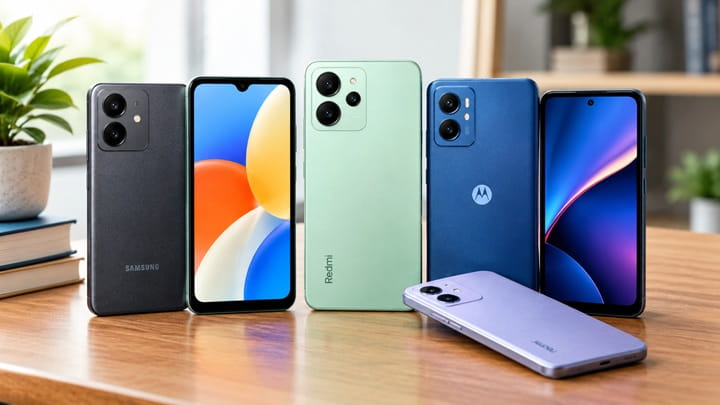
The best cheap phone for most people right now is the Google Pixel 10a at $499, but you don’t need to spend that much to get a good one. This list ranks 30 budget smartphones across every price band, from a sub-$100 Motorola to the cheapest current iPhone, and tells you what each one does well, who it suits, and the one weakness you should know about before buying.
The ranking weighs four things in this order: how many years of software updates the phone gets, everyday speed, battery life, and price. Update support comes first because a cheap phone that stops getting security patches after a year or two ends up costing more per year than a slightly pricier one supported for six or seven. Prices below come from retailer and review listings checked this month; budget phone prices move constantly, so treat them as a guide and check the seller before you buy.
Best Cheap Phones at a Glance
Use this table to jump to the right price band. Entries without a US price are mainly sold in the UK, Europe, or Asia.
| # | Phone | Best for | Typical price |
|---|---|---|---|
| 1 | Google Pixel 10a | Best overall | $499 |
| 2 | Samsung Galaxy A37 | Best Samsung value | $450 |
| 3 | Nothing Phone (4a) Pro | Best screen and battery | $499 |
| 4 | Apple iPhone 17e | Best cheap iPhone | $599 |
| 5 | Samsung Galaxy A57 | Long-term Samsung | $549.99 |
| 6 | Google Pixel 9a | Pixel on a discount | From about $465 |
| 7 | Samsung Galaxy S25 FE | Flagship speed for less | $650 list, often about $500 |
| 8 | Apple iPhone 16e | Cheaper iPhone deal | From $499 |
| 9 | Samsung Galaxy A56 | Discounted Samsung | From about $350 |
| 10 | Nothing Phone (3a) | Zoom camera under $400 | $379 |
| 11 | Motorola Edge 60 Fusion | Toughest mid-budget build | $379 |
| 12 | Samsung Galaxy A27 5G | Samsung under $350 | $349.99 |
| 13 | Motorola Moto G Power 5G (2026) | Durable all-rounder | About $300 |
| 14 | Motorola Moto G Stylus (2026) | Note-taking | Varies |
| 15 | CMF Phone 2 Pro | Best under $300 | $279 |
| 16 | Nothing Phone (4b) | Best UK budget pick | £299 |
| 17 | OnePlus Nord CE 5 | Fast charging | £299 |
| 18 | Poco X7 Pro | Gaming on a budget | Varies by region |
| 19 | Redmi Note 14 Pro+ | Main camera detail | Varies by region |
| 20 | Honor Magic 7 Lite | Multi-day battery | Varies by region |
| 21 | Samsung Galaxy A17 5G | Best around $200 | About $200-$260 |
| 22 | Motorola Moto G (2026) | Battery life under $250 | $199 at launch |
| 23 | Motorola Moto G56 | Water resistance under $200 | $199.99 |
| 24 | Xiaomi Redmi 17 4G | Biggest battery | $229.99 |
| 25 | Xiaomi Redmi 17C 5G | Cheap 5G outside the US | €199 |
| 26 | Motorola Moto G15 Power | Cheap battery champion | About £186 |
| 27 | TCL 50 Pro Nxtpaper | Reading | Varies by region |
| 28 | Motorola Razr (2024) | Cheapest flip foldable | $599 |
| 29 | Doogee Blade 10 | Rugged use | About $200 |
| 30 | Motorola Moto E15 | Best under $100 | $99.99 |
30 Best Cheap Phones Ranked
The list runs from the strongest overall value down to the cheapest usable phone. Higher-ranked phones cost more, but they also stay supported much longer, which is why a $450 Samsung outranks a $200 Motorola. If your budget is fixed, skip to the price band you can afford and read the weaknesses carefully.
1. Google Pixel 10a
The Pixel 10a is the best cheap phone overall because it pairs a strong camera with seven years of Android updates and security patches at $499. Its 6.3-inch 120Hz OLED reaches up to 3,000 nits, which makes it easy to read in direct sun. Battery life improved over the Pixel 9a, lasting just over 15 hours in Tom’s Guide’s test, and charging is faster too. It suits anyone who wants a phone they can keep for five years or more without thinking about it.
- Tensor G4 chip, 5,100mAh battery
- 30W wired and 10W wireless charging
- 48MP main and 13MP ultrawide cameras
- Seven years of OS and security updates
Weakness: it uses the same Tensor G4 chip as the Pixel 9a, so it is not a meaningful performance upgrade, and the display bezels are thick.
2. Samsung Galaxy A37
The Galaxy A37 starts at $450 and is the best value Samsung for most buyers. You get a larger 6.7-inch 120Hz AMOLED screen than the Pixel 10a, faster 45W wired charging, and six years of OS upgrades. It is the right pick if you want a bigger screen and Samsung’s One UI without paying A57 prices.
- Exynos 1480 chip built on a 4nm process
- 6.7-inch AMOLED, 120Hz, 1,900 nits peak
- 5,000mAh battery with 45W wired charging
- Six years of OS upgrades
Weakness: there is no wireless charging, and the screen is noticeably less bright than the Pixel 10a’s.
3. Nothing Phone (4a) Pro
At $499, the Phone (4a) Pro has the biggest and brightest screen in this price class: a 6.83-inch 144Hz AMOLED rated up to 5,000 nits. It lasted 18 hours in Tom’s Guide’s battery test, nearly three hours more than the Pixel 10a, and adds a telephoto camera the Pixel lacks. It suits heavy media users who care more about screen and battery than raw processing speed.
- Snapdragon 7 Gen 4 chip, 8GB or 12GB RAM
- 5,080mAh battery with 50W charging
- 50MP main plus 50MP telephoto camera
- Metal back and Glyph Matrix light display
Weakness: it has no official water-resistance rating, and the processor is slower than the Pixel 10a’s.
4. Apple iPhone 17e
The iPhone 17e is the cheapest current iPhone at $599, and it now starts with 256GB of storage, double what most Android rivals include. The A19 chip is the fastest processor on this list, and MagSafe returns after the iPhone 16e dropped it. It is the obvious pick if you already live in Apple’s ecosystem, and reviewers expect five to seven or more years of iOS updates.
- A19 chip, 256GB base storage
- 6.1-inch Super Retina XDR display
- 48MP single camera with 2x optical-quality zoom
- MagSafe and Qi2 wireless charging up to 15W, IP68
Weakness: the display runs at 60Hz, there is no ultrawide camera, and its battery life was the shortest of the phones Tom’s Guide tested.
5. Samsung Galaxy A57
The Galaxy A57 lists at $549.99 and is Samsung’s most polished budget model, with a slim glass-and-metal body that weighs only 179g despite a 6.7-inch screen. Performance is a big step up on the A56 thanks to the Exynos 1680. Samsung’s Galaxy A line gets up to seven years of updates, so this is a phone to keep long term.
- Exynos 1680 chip
- 6.7-inch AMOLED display with slimmer bezels
- Triple rear camera
- Galaxy AI features (a reduced set versus flagships)
Weakness: cameras are unchanged from the A56, there is no zoom lens, and the macro camera disappoints.
6. Google Pixel 9a
The Pixel 9a has been replaced by the 10a, but retailer deals around $465 to $489 make it worth a look if you find it cheaper still. It uses the same Tensor G4 chip as the 10a, so day-to-day speed is identical, and its cameras remain among the best at this price. It suits buyers who want Pixel photography and clean software for less.
- Tensor G4 chip, 8GB RAM
- 6.3-inch display
- 48MP main and 13MP ultrawide cameras
- 128GB or 256GB storage
Weakness: charging is slow and the fingerprint sensor is below par; it only makes sense at a clear discount to the 10a.
7. Samsung Galaxy S25 FE
The Galaxy S25 FE lists at $650 but is often discounted to about $500, at which point it delivers flagship-level performance for a mid-range price. It has a large screen, a big battery, and a telephoto camera that the A-series lacks. It suits gamers and power users who want speed more than a low sticker price.
- Flagship-class performance
- Telephoto camera
- Large display and battery
- 8GB RAM, 128GB base storage
Weakness: 128GB fills quickly, so the 256GB model is the safer buy, which pushes the price up.
8. Apple iPhone 16e
The iPhone 16e was Apple’s budget model before the 17e and is now showing up from $499, sometimes lower on limited-stock deals. Its A18 chip is still faster than most Android phones on this list, and its 48MP camera is excellent. It suits anyone who wants an iPhone and doesn’t need MagSafe.
- Apple A18 chip, 8GB RAM
- 6.1-inch display
- 48MP rear and 12MP front cameras
- 128GB, 256GB, or 512GB storage
Weakness: no MagSafe and half the base storage of the 17e, so only buy it well below the 17e’s price.
9. Samsung Galaxy A56
The Galaxy A56 is being replaced by the pricier A57, so deals from about $350 make it one of the best Samsung bargains available. Its metal frame looks more expensive than it is, the 6.7-inch 120Hz OLED is large and bright, and battery life is strong. It suits buyers who want a premium-feeling Samsung without the A57 price.
- Exynos 1580 chip
- 6.7-inch OLED, 120Hz
- 50MP main, 12MP ultrawide, 5MP macro cameras
- Metal build
Weakness: the cameras don’t come close to Samsung’s flagships, especially in low light.
10. Nothing Phone (3a)
At $379, the Phone (3a) is one of the cheapest ways to get a dedicated telephoto camera. It has a 120Hz AMOLED screen, 50W charging, and Nothing’s distinctive Glyph lighting on the back. It suits buyers who want something different from the usual Samsung and Motorola designs with solid everyday performance.
- Snapdragon 7s Gen 3, 8GB or 12GB RAM
- 5,000mAh battery with 50W charging
- 50MP main, 50MP telephoto, 8MP ultrawide
- Glyph lights and widget-based Nothing OS
Weakness: the plastic back attracts fingerprints and dust, and the 2x telephoto adds less than a longer zoom would.
11. Motorola Edge 60 Fusion
The Edge 60 Fusion costs $379 in the US and £299.99 in the UK, and it carries both IP68 and IP69 ratings, which is rare at this price. The curved pOLED screen looks premium and the 50MP main camera is good. It suits people who are hard on their phones but still want something that looks expensive.
- 6.67-inch curved pOLED display
- 50MP main and 32MP selfie cameras
- IP68 and IP69 dust and water resistance
- Range of colors and finishes
Weakness: only three years of updates, and the curved screen is awkward for gaming.
12. Samsung Galaxy A27 5G
The Galaxy A27 5G lists at $349.99 and sometimes drops to around $300 on sale. You get a large, colorful 120Hz display, all-day battery life, and six years of software and security updates. It suits buyers who want Samsung’s long support at the lowest price above the A17.
- Snapdragon 6 Gen 3 chip
- 120Hz display
- IP64 rating
- Six years of updates
Weakness: performance is sluggish, cameras are average, and water resistance is weaker than the A26 it replaced.
13. Motorola Moto G Power 5G (2026)
The Moto G Power 5G (2026) costs about $300 and is the toughest phone at its price, with IP68 and IP69 ratings. It has a sharp 1080p screen, 8GB of RAM, a headphone jack, and clean Android 16. It suits buyers who want durability and practical extras over a flashy screen.
- 1080p LCD display
- 8GB RAM, 30W charging
- 3.5mm headphone jack
- IP68 and IP69, Android 16
Weakness: only two years of OS updates, and the LCD looks flat next to AMOLED rivals.
14. Motorola Moto G Stylus (2026)
The Moto G Stylus (2026) is the only phone on this list with a built-in stylus, and the 2026 model’s pen adds pressure sensitivity and palm rejection. It also packs 68W charging, wireless charging, a headphone jack, and a microSD slot. It suits students and anyone who jots notes or signs documents on their phone.
- Active stylus with pressure sensitivity
- Snapdragon 6 Gen 3 chip
- 68W wired plus wireless charging
- microSD slot, IP68 and IP69
Weakness: a price hike over the previous model, weak benchmark results, and only two years of OS updates make it hard to justify unless you need the pen.
15. CMF Phone 2 Pro
The CMF Phone 2 Pro costs $279 (£219, €249) and is the best phone under $300 for most people. It has a 120Hz AMOLED screen, 8GB of RAM, a triple camera, and swappable cases and accessories. It now adds NFC and better water resistance over the first CMF phone.
- MediaTek Dimensity 7300-Pro, 8GB RAM
- 6.67-inch AMOLED, 120Hz
- 5,000mAh battery with 33W charging
- IP54, NFC, microSD slot
Weakness: the ultrawide camera is average and has no image stabilization, and there are no stereo speakers.
16. Nothing Phone (4b)
The Phone (4b) is Tech Advisor’s top budget pick in the UK at £299. It combines a distinctive design, strong battery life from a 5,200mAh cell, a good 50MP main camera, and clean software. US pricing was not available at the time of writing, so it is mainly a UK and European option.
- 5,200mAh battery
- 50MP main and 12MP ultrawide cameras
- 128GB storage
- Six years of security patches
Weakness: only three years of OS updates, a weak ultrawide camera, and no option above 128GB.
17. OnePlus Nord CE 5
The Nord CE 5 costs £299 and charges faster than anything else here at this price, with 80W wired charging. It has a large 6.77-inch 120Hz AMOLED, a premium-feeling build, and a polished interface. It suits UK buyers who hate waiting for a phone to charge.
- MediaTek Dimensity 8350 Apex
- 6.77-inch AMOLED, 120Hz
- 5,200mAh battery with 80W charging
- IP65
Weakness: the loudspeaker and haptics are weak, and low-light photos are poor.
18. Poco X7 Pro
The Poco X7 Pro is the strongest gaming phone at a budget price, thanks to MediaTek’s Dimensity 8400 Ultra and 12GB of RAM. It adds a 6,000mAh battery, 90W charging, and an IP68 rating, which is unusual for Poco. Pricing varies by region; it suits gamers outside the US.
- Dimensity 8400 Ultra, 12GB RAM, 512GB storage
- 6.67-inch OLED, 120Hz
- 6,000mAh battery with 90W charging
- 50MP stabilized main camera, IP68
Weakness: lots of preinstalled apps and a weak ultrawide camera. Poco is not officially sold in the US, so check carrier band support before importing one.
19. Xiaomi Redmi Note 14 Pro+
The Redmi Note 14 Pro+ has the most detailed main camera on this list, a 200MP sensor with optical stabilization. It also charges at 120W and has solid mid-range performance. Pricing varies by region; it suits photographers on a budget who mostly shoot with the main lens.
- Snapdragon 7s Gen 3
- 200MP main camera with OIS
- 5,110mAh battery with 120W charging
- 6.67-inch AMOLED, 120Hz
Weakness: secondary cameras are weak, there is a lot of bloatware, and it shipped on an older Android version.
20. Honor Magic 7 Lite
The Magic 7 Lite is built around a very large battery that Stuff rates for multi-day use. It also has a bright, sharp 120Hz AMOLED and a 108MP main camera that is good for the class. It suits light users who want to charge every two or three days.
- Snapdragon 6 Gen 1
- 6.78-inch AMOLED, 120Hz
- 108MP main camera
- 35W wired charging
Weakness: average performance, a dated curved-edge design, and a slower update promise than Samsung or Google.
21. Samsung Galaxy A17 5G
The Galaxy A17 5G is the best phone around $200 because nothing else this cheap gets six years of updates. The 4GB/128GB model was listed at $202.41 in October, and the 8GB/256GB model at $259.99. You get a 6.7-inch AMOLED, a microSD slot, NFC, and an IP54 rating. It suits anyone buying a phone to keep for years on a small budget.
- Exynos 1330 chip
- 6.7-inch Super AMOLED, 90Hz
- 5,000mAh battery, 25W charging
- Six years of updates, microSD, NFC
Weakness: the 4GB version is laggy, so buy the 8GB model if you can. There is also no eSIM.
22. Motorola Moto G (2026)
The Moto G (2026) launched at $199 and had the best battery life of any cheap phone Tom’s Guide tested, at over 19 hours. It also has stereo speakers, a headphone jack, near-stock Android 16, and a vegan leather back. Tom’s Guide notes its price has since risen, so it’s only a strong buy near its launch price.
- MediaTek Dimensity 6300, 4GB RAM
- 6.7-inch 720p display
- 5,200mAh battery, 30W charging
- Stereo speakers, headphone jack, IP52
Weakness: the 720p screen is soft and dim, it stutters during everyday tasks, and it gets only two OS upgrades.
23. Motorola Moto G56
The Moto G56 costs $199.99 and is Tech Advisor’s pick for battery life. It has an IP69 rating, a solid main camera, fast wired charging, and practical extras like a microSD slot and headphone jack. It suits buyers who want a waterproof, long-lasting phone without spending more than $200.
- Large screen
- IP69 water resistance
- microSD slot and headphone jack
- Clean Motorola software
Weakness: only two years of Android updates, some lag, and no 4K video recording.
24. Xiaomi Redmi 17 4G
The Redmi 17 4G has the largest battery on this list at 7,500mAh, with 45W charging to refill it. The 256GB model is listed at $229.99 in the US and around €185-€200 in Europe. It suits people who don’t need 5G and want two or more days between charges.
- 7,500mAh battery, 45W charging
- 120Hz HD display
- Stereo speakers, NFC, FM radio
- IP64, microSD slot
Weakness: no 5G, no 4K video, and a virtual proximity sensor that can misfire during calls.
25. Xiaomi Redmi 17C 5G
The Redmi 17C 5G costs €199 in Germany and ₹20,999 in India. It packs features rarely seen together at this price: 5G, a 6,000mAh battery, NFC, an IR blaster, a headphone jack, and an IP64 rating. It suits buyers in Europe and Asia who want cheap 5G with a big screen.
- 6,000mAh battery
- 120Hz display, 50MP main camera
- Android 16
- IR blaster, 3.5mm jack, microSD
Weakness: HD-only screen resolution and mediocre performance.
26. Motorola Moto G15 Power
The Moto G15 Power was listed at about £186 in the UK and is a battery-first phone with a 6,000mAh cell and 30W charging. It comes with 8GB of RAM and 256GB of storage, more than most phones at this price. It suits UK and European buyers who want endurance and storage over speed.
- 6,000mAh battery, 30W charging
- 1080p LCD display
- 50MP main and 5MP ultrawide cameras
- Stereo speakers, NFC, headphone jack
Weakness: the chipset is the weakest part of the phone, so performance is below par.
27. TCL 50 Pro Nxtpaper
The TCL 50 Pro Nxtpaper is the phone to buy if you read a lot on your phone. Its matte display cuts glare and can switch into E-Ink-style modes that feel closer to an e-reader. Battery life is excellent and the core specs are strong for the price. Pricing varies by region and US pricing was not listed.
- Matte, low-glare display
- Switchable E-Ink-style reading modes
- Long battery life
Weakness: disappointing cameras, weak speakers, and extra pre-installed apps.
28. Motorola Razr (2024)
The Razr (2024) is the cheapest flip foldable worth buying, at $599 and sometimes on sale for less. Its 3.6-inch outer screen is large enough for replies and maps without opening the phone, and the 6.9-inch main display is bright. It suits anyone who wants a foldable without paying flagship money.
- 6.9-inch main and 3.6-inch outer display
- 4,200mAh battery
- Better battery life than many flip phones
Weakness: low-light photos are weak, and it gets only three years of major Android updates.
29. Doogee Blade 10
The Doogee Blade 10 costs about $200 and is a true rugged phone, with MIL-STD-810H drop testing and IP68 and IP69K ratings. It has a 5,150mAh battery, NFC, storage expandable to 2TB, and a customizable button. It suits construction workers, hikers, and anyone who breaks normal phones.
- MIL-STD-810H, IP68 and IP69K
- Unisoc T606 chip, 4GB RAM
- 5,150mAh battery
- 6.56-inch 90Hz display
Weakness: few or no software updates, and at 10.7mm thick it is chunky and heavy.
30. Motorola Moto E15
The Moto E15 costs $99.99 (£69.98) and is the best phone under $100. It feels more premium than its price and has a large, bright 6.5-inch 90Hz display. It suits a first phone for a child, a backup phone, or an older relative who mostly calls and messages.
- 6.5-inch 720p display, 90Hz
- MediaTek Helio G81 Extreme
- 2GB RAM
Weakness: performance is low, and Motorola promises only one year of security updates, so it is not a phone for banking apps long term.
How to Choose a Cheap Phone
Start with how long you plan to keep the phone, then divide the price by those years. A $200 Galaxy A17 with six years of updates costs about $33 per supported year. A $200 Motorola with two OS upgrades and a few years of patches can cost far more per supported year, because you replace it sooner. This is the single most useful calculation when comparing budget phones, and most “best cheap phone” lists skip it.
Next, set a minimum for RAM. Reviewers repeatedly flag 4GB models as laggy, including the base Galaxy A17 and the Moto G (2026). If the 8GB version of a phone costs $40 to $60 more, it is usually the better buy. Storage matters less if the phone has a microSD slot, which many Motorola, Xiaomi, and Samsung A-series models still include.
Then decide which extras you actually use. Wireless charging is rare under $450 (the Pixel 10a and iPhone 17e have it; the Galaxy A37 does not). Headphone jacks survive mainly on Motorola and Xiaomi phones. If you want water resistance, look for IP67 or above; IP52 and IP54 only protect against splashes. For more battery-focused options, see this guide to budget phones with the best value and battery life.
Finally, check where the phone is sold. Several phones on this list, including Poco, many Redmi models, the Nothing Phone (4b), and the OnePlus Nord CE 5, are sold mainly in the UK, Europe, or India. Imported phones may miss 5G bands your carrier uses, and Android Central notes some imported models lack 5G on T-Mobile. Check the phone’s supported bands against your carrier before ordering.
Common Mistakes When Buying a Budget Phone
Buying last year’s model at full price is the most common mistake. The Galaxy A56, Pixel 9a, and iPhone 16e are good phones, but only at a real discount; at near-launch prices, their replacements are the better buy because they get more remaining years of support.
Ignoring the update policy is the second. A phone with one year of security updates, like the Moto E15, is fine for calls and messaging but a poor choice for banking or work apps once patches stop.
Trusting the spec sheet over real performance is the third. Big battery numbers and high-resolution cameras look good in a listing, but a slow chip with 4GB of RAM makes even simple apps stutter. If you already own a slow Android phone, this guide to fixing Android phone lag without a factory reset may buy you a few more months before upgrading.
Choosing on brand alone is the last. Samsung and Google lead on updates, but Motorola wins on durability and practical extras, and Nothing and CMF often give more screen and design for the money. If you are an iPhone user weighing a switch, these iPhone alternatives cover the Android side in more depth, and this roundup of the best Samsung Galaxy devices covers Samsung’s full range.
Frequently Asked Questions
What is the best cheap phone to buy right now?
The Google Pixel 10a is the best cheap phone for most people at $499. It has an excellent camera, a bright 120Hz OLED screen, and seven years of updates. Under $300, the CMF Phone 2 Pro is the best value, and around $200 the Galaxy A17 5G stands out because it gets six years of updates, far longer than rivals at that price.
Which budget phone lasts the longest?
For software support, the Pixel 10a leads with seven years, followed by Samsung’s Galaxy A phones with six years or more. For battery life on a single charge, the Xiaomi Redmi 17 4G has the largest cell on this list at 7,500mAh, and the Moto G (2026) lasted over 19 hours in Tom’s Guide’s testing, the best result among the cheap phones it tested.
Is it worth buying a 4GB RAM phone?
Only for light use such as calls, messaging, and social media. Reviewers describe 4GB versions of the Galaxy A17 and Moto G (2026) as laggy in everyday tasks. If the 8GB version costs around $50 more, it is the better long-term buy, because apps grow heavier with each Android update and the phone will feel slower over time.
Are cheap unlocked phones safe to buy?
Yes, as long as you buy a model sold officially in your country and check its update policy. Unlocked phones from Samsung, Google, Motorola, and Apple work on major US carriers. Risk rises with imported models that lack your carrier’s 5G bands, and with phones that get only a year of security updates, which leaves them exposed once patches stop.
Should I buy a cheap iPhone or a cheap Android?
Buy an iPhone if you already use a Mac, iPad, or Apple Watch, or want the fastest chip at this price; the iPhone 17e at $599 starts with 256GB. Buy Android if you want a 120Hz screen, more cameras, or a lower price. The Pixel 10a costs $100 less than the iPhone 17e and adds an ultrawide camera.
What is the cheapest phone that is still worth buying?
The Motorola Moto E15 at $99.99 is the cheapest worthwhile option for basic use, with a large, bright 90Hz screen. Its limits are 2GB of RAM and only one year of security updates. If you can stretch to about $200, the Galaxy A17 5G is a much better long-term phone.
Final Verdict: Which Cheap Phone Should You Buy?
If you can spend around $500, buy the Pixel 10a; it is the best balance of camera, screen, and long support. If you want Samsung, the Galaxy A37 at $450 is the sweet spot. Under $300, the CMF Phone 2 Pro gives the most phone for the money, and around $200 the Galaxy A17 5G is the safest buy because of its six-year update promise.
Before ordering, check three things: the RAM in the exact model you are buying, how many years of updates it gets, and whether it supports your carrier’s bands. Get those right and even a $200 phone will serve you well for years.
