
In the digital age, the need for high-quality, tangible business materials—such as business cards, flyers, envelopes, and stamps—remains a cornerstone of professional branding and communication. These items are often the first physical touchpoint a potential client or partner has with your business, making their design, quality, and presentation paramount. Fortunately, the process of sourcing these essentials has been revolutionized by a robust and competitive landscape of global and regional online printing services. Understanding where to buy these materials, the customization options available, and the logistical considerations for different regions is key to maintaining a professional image while optimizing cost and turnaround time.
The marketplace for printed business collateral is incredibly diverse, ranging from international giants offering vast product lines and quick shipping to specialized regional printers providing localized expertise and unique finishes. For businesses operating locally or globally, navigating this landscape effectively means selecting a provider that not only meets their quality and volume needs but also understands the nuances of regional delivery and postal requirements.
The following guide offers a comprehensive, step-by-step approach to identifying, designing, and procuring your essential business prints, including critical information on leading global and regional suppliers for business cards, flyers, envelopes, and custom stamps.

The Essential Business Communication Toolkit
Before diving into where to buy, it’s vital to understand the primary functions of each essential item in your business communication toolkit. Each serves a distinct purpose, and a consistent brand identity across all of them maximizes impact.
Business Cards: The Professional Introduction
A business card is more than just a piece of cardstock; it is a portable summary of your brand and contact information. In a world of fleeting digital contacts, a well-designed card provides a lasting, professional impression. The industry standard size for business cards in North America is 3.5 inches by 2 inches, while European standards often adhere to 85 mm by 55 mm (ISO/IEC 7810 ID-1 format). However, modern online printers offer a spectrum of sizes and shapes, including square, mini, and rounded-corner cards, allowing for creative differentiation.
Key considerations when purchasing business cards include paper stock weight (measured in points or GSM), finish (matte, gloss, soft-touch, or uncoated), and special finishes (foil stamping, spot UV, or raised print). Heavier stock, such as 16pt or 18pt (300-400 GSM), is generally associated with higher quality and durability.

Flyers and Brochures: Targeted Marketing Collateral
Flyers and brochures are versatile marketing materials used for announcing events, promoting products, or detailing services. A flyer is typically a single-sheet print, while a brochure is a folded document (like a bi-fold or tri-fold) offering more space for detailed information. The primary goal is mass distribution and high-impact visual appeal.
Online printing services offer various paper options for flyers, ranging from lightweight paper suitable for bulk mailing to heavier, glossy stock for premium promotional handouts. Common flyer sizes include letter (8.5” x 11” or A4), half-letter, and postcard sizes. Choosing the right paper weight and finish is crucial; a glossy finish makes colors pop, while a matte finish is better for text-heavy content or materials where writing may be required.
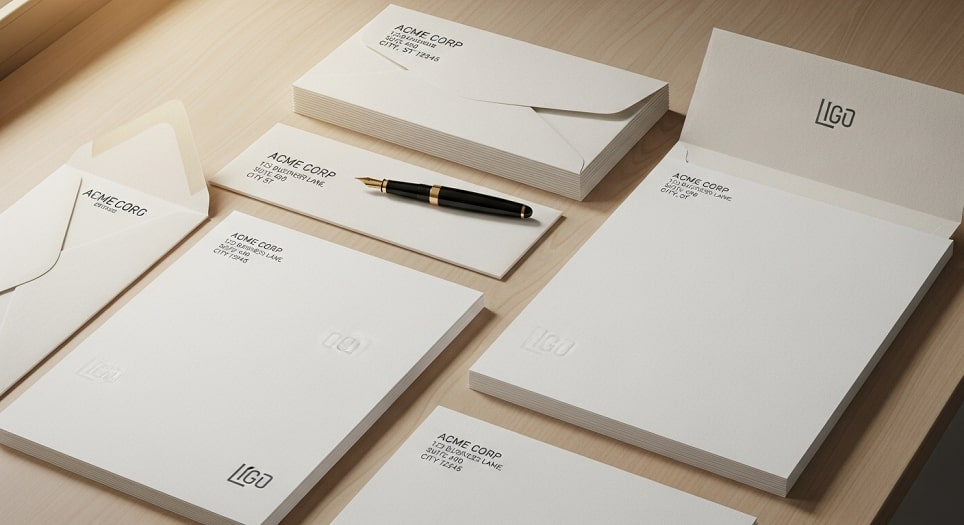
Envelopes and Letterheads: Corporate Correspondence
Custom envelopes and letterheads ensure that all official correspondence reinforces your brand identity. Using a custom-printed envelope with your logo and return address presents a professional image immediately upon arrival. Similarly, letterheads provide a consistent, branded template for contracts, official letters, and other important documents.
Envelopes are typically ordered in standard commercial sizes (such as #10 in the US or DL in Europe) and should be color-matched to your business’s overall stationery package. Customization usually involves printing the logo, return address, and, sometimes, an engaging message or design element on the front. Printing services often offer full-color or simpler one-color print options on various paper stocks for both letterheads and envelopes.

Stamps: Custom Branding and Functionality
The term ‘stamps’ can refer to two very different products in the context of business essentials: pre-paid postage stamps and custom rubber stamps/embossers. While pre-paid postage is usually purchased directly from postal services, online printing suppliers are an excellent source for custom rubber stamps. These can be used for:
- Business Card Stamps: Instead of printing new cards for every small change, a custom rubber stamp can be used to apply a logo, website, or contact number to existing or hand-made cards, offering a DIY and artisanal branding touch. This is a cost-effective solution for small businesses or for adding temporary information, such as a special event URL.
- Address Stamps: A professional-looking stamp for return addresses on envelopes and packages, saving the time and cost of custom-printing every piece of mail. Self-inking versions are particularly popular for high-volume use.
- Notary and Seal Stamps/Embossers: Essential for legal and professional services, these items provide official, tamper-resistant markings on documents. Online services can customize these according to state or national regulations.
- Loyalty and Coupon Stamps: Used by retail or service businesses to mark loyalty cards or discount coupons, offering a tactile and engaging way to run customer retention programs. The ability to customize the design, from simple logos to custom text, makes them a flexible branding tool.
The Global Landscape of Online Print Providers
The online printing industry is dominated by several key players who offer wide geographical reach, sophisticated design tools, and competitive pricing, alongside a network of specialized regional businesses.
Major International Online Printing Hubs
Several global and near-global platforms have established themselves as one-stop shops for all business printing needs. These companies are generally characterized by high volume, frequent sales, and extensive product catalogs. They often cater to small businesses and individuals who may not have in-house design capabilities.
VistaPrint and MOO (as indicated in external search results) are two of the most recognized brands, offering services across North America, Europe, and Australia. They excel in providing user-friendly online design tools and a vast selection of paper stocks and premium finishes. VistaPrint, in particular, is known for its budget-friendly standard options and high-volume capacity. MOO is often favored for its distinctive ‘MiniCards’ and premium, thick cardstock, appealing to design-conscious clients. Other major contenders include GotPrint and Overnight Prints, which often compete on speed and price, with some offering next-day or 2-day delivery options in specific regions, such as the US.
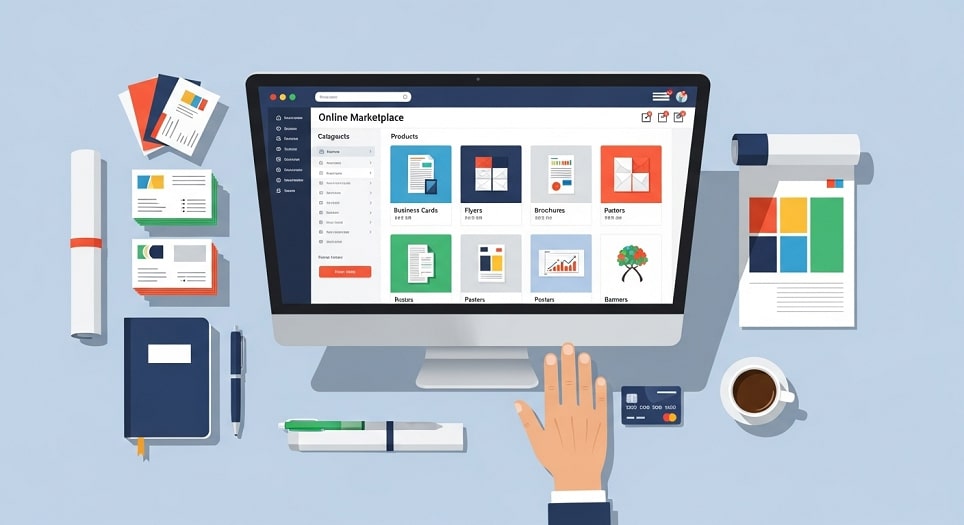
Print-Shop Aggregators and E-commerce Retailers
Beyond dedicated online printing companies, large e-commerce platforms and office supply retailers have integrated print services or offer a marketplace for printed goods. For example, the initial information provided points to Amazon and Ebay as places to buy general business card supplies. While they may not offer direct printing services, they serve as crucial marketplaces where smaller, independent printing vendors sell their services, or where pre-made, standardized supplies like envelopes and bulk stationery can be purchased.
Physical office supply chains with a strong online presence, such as Staples (active in North America and Canada) and FedEx Office, also offer full-service printing, often featuring same-day or in-store pickup options for quick-turnaround items like business cards and basic flyers. Their network of physical locations makes them a convenient hybrid option for customers needing both online ordering and local collection.
Regional and Specialized Suppliers
For businesses in specific geographic locations, regional printers offer competitive advantages, particularly in understanding local market preferences, compliance, and language. The initial user data highlights excellent examples of regional specialization:
- GR Drukkerij (Nederland): Catering specifically to the Dutch market, local providers like this often offer specialized services that align with European paper sizes (like A-series formats for flyers) and local business customs. This can lead to faster, more reliable shipping within the country and a customer service team familiar with local printing standards.
- StickerCanada (Canada): While the name suggests a focus on stickers, their offering of business cards and flyers indicates a dedicated Canadian printing service. Sourcing locally in Canada, often through services like StickerCanada or the Canadian branch of Staples, helps businesses avoid international shipping fees, customs delays, and currency exchange issues. Additionally, Canadian printers are well-versed in the specific paper weights and dimensions commonly used within the country.
- The UPS Store: While a physical chain, The UPS Store offers online ordering for business cards, flyers, and other materials, leveraging its network of franchised locations across North America for production and pickup. This model is particularly useful for small businesses that prefer to speak with a print expert in person or need to bundle printing with shipping and mailbox services.
- Instantprint (UK): Another example of a strong regional player, Instantprint, focuses on the UK market, offering specific paper stocks like ultra-thick 450gsm silk stock and being highly competitive on turnaround times within the region.
Choosing a regional supplier often results in a more personalized service experience and can contribute to supporting local economies, which can be a key value proposition for some brands.

Step-by-Step Guide to Procuring Your Business Essentials
A systematic approach to ordering your printed materials ensures consistency, quality, and cost-effectiveness. This guide focuses on the practical steps from design to delivery.
Step 1: Defining Your Brand Identity and Specifications
The first and most critical step is finalizing your design and technical specifications. Consistency is paramount. Your logo, color palette (often defined by CMYK codes for print), and font choices must be identical across all materials—business cards, flyers, and envelopes.
- Color Mode: Ensure all design files are set to the CMYK (Cyan, Magenta, Yellow, Key/Black) color model, which is the standard for professional printing. The RGB model, used for digital screens, will result in color shifts when printed. Professional printers offer tools to check this, but it is best to start the design in the correct mode.
- Resolution and Bleed: All images and designs must be set at a high resolution, typically 300 DPI (Dots Per Inch), to avoid pixelation. Additionally, design files must include a “bleed,” which is an extra margin of design that extends beyond the trim line. This ensures that minor cutting variations do not leave white edges on your final product. The standard bleed is 1/8 inch (3mm).
- Proofing and Review: Always request a digital proof (PDF proof) or, for large orders, a hard-copy sample before committing to the full print run. This allows for a final check of colors, text accuracy, and layout. This proofing stage is non-negotiable for maintaining quality control.
Step 2: Selecting the Right Online Printer
Selection depends on balancing four key factors: Geography, Speed, Price, and Specialization.
- Geographical Reach: If your business operates internationally, a global provider like VistaPrint or Canva Print (Source 1.1) might simplify ordering across different regions. If you are exclusively local, a regional specialist (like GR Drukkerij) will offer localized shipping and support advantages.
- Turnaround Time: For urgent needs, check for “same-day” or “next-day” options offered by players like FedEx Office or Staples (Source 1.2, 2.4). For standard orders, most online printers offer an economy delivery that takes 5-8 business days, often at a lower or free cost. Providers like Overnight Prints (Source 1.5, 4.2) prioritize speed as a core competitive edge.
- Customization and Specialty: If you require premium features like ultra-thick stock, colored edges, unique shapes (e.g., circle or oval business cards from VistaPrint), or sophisticated finishes like spot UV or foil, you must choose a printer specializing in those options. Not all budget-focused printers offer a full range of specialty finishes.
- Cost and Volume: Bulk ordering almost always reduces the cost per unit. Companies like PrintSafari (Source 3.3) specifically promote bulk printing services. Compare the total cost, including shipping and taxes, for your required volume across three different providers before making a final decision.
Step 3: Utilizing Online Design and Upload Tools
Online printers have invested heavily in tools to simplify the design process for non-designers.
- Template-Based Design: Platforms like VistaPrint, Canva Print (Source 1.1), and Adobe Express (Source 4.1) offer thousands of pre-designed, customizable templates. Users can simply plug in their logo and text, making the process fast and accessible. These tools automatically handle technical issues like bleed and safe zones.
- File Upload: For designers or businesses using professional software (Adobe Illustrator, InDesign), the preferred method is uploading a print-ready PDF file. This gives the highest degree of control over the final product. Always consult the printer’s specific “Artwork Guides” (as mentioned by Instantprint, Source 2.1) for file requirements.
- Integrating Stamps and Embossers: When ordering custom stamps, the process is similar. You upload a high-resolution, black-and-white design of your logo or text. The size of the stamp must correspond directly to the required imprint area. Specialist stamp providers, as found in the search results (Source 1.2, 2.2), often provide easy online customization for text-only stamps, simplifying the creation of address or loyalty stamps.
Step 4: Order Finalization, Shipping, and Fulfillment
Once the design is approved, focus shifts to logistics. A common pitfall is underestimating the production and shipping time, especially for items with specialty finishes, which may require longer production windows (e.g., 5 business days for premium cards at FedEx Office, Source 3.1).
- Shipping Options: Standard, economy, and express shipping options are available. Express shipping (often 1-3 business days) is significantly more expensive but necessary for tight deadlines. Many companies, such as VistaPrint, offer shipping promotions or free standard shipping above a certain order value.
- In-Store Pickup: For time-sensitive orders, using a hybrid service like Staples or FedEx Office that offers in-store pickup can save both time and money on shipping. This is an excellent option for local or regional businesses.
- Tracking: Always ensure you receive a tracking number for your shipment. This is crucial for managing inventory and delivery expectations with clients or events.

Pro Tips for Maximizing Print Quality and Value
To ensure your investment in business essentials yields the best results, consider these expert insights into design, material selection, and ordering practices.
- Invest in Premium Paper Stock for Business Cards: While a 14pt card is functional, an 18pt, 32pt (or thicker) card offers a tangible difference that communicates quality and luxury. The soft-touch laminate finish is an increasingly popular choice that gives the card a smooth, velvety feel, immediately elevating the perception of your brand.
- Utilize the Back of Your Business Card: The back side of a business card is a valuable, often-underutilized marketing space. Use it for a scannable QR code (which can be generated by a custom stamp, Source 2.2), a brief list of services, a compelling quote, or a clean, watermark-style logo. This transforms the card into a mini-flyer.
- Design Flyers with a Clear Call-to-Action (CTA): Flyers and brochures are worthless without a clear instruction for the reader. The CTA must be prominent and specific: “Visit our Website Today,” “Scan the Code for 10% Off,” or “Call Now to Book a Consultation.” Ensure the CTA uses a high-contrast color to draw the eye immediately.
- Bundle and Save: Many online printers offer discounted “starter kits” or bundles that include matching business cards, letterheads, and envelopes. Ordering all your stationery at once ensures color and paper consistency and often qualifies for bulk discounts or reduced shipping costs.
- Eco-Conscious Printing: If environmental impact is part of your brand value, look for printers offering recycled paper stocks (Source 1.3, 4.2) or using sustainable practices like waterless printing (Overnight Prints, Source 1.5). Clearly stating on your materials that they are printed on recycled paper can be a positive brand message.
- Understand Regional Size Differences: Be mindful of the difference between US standard sizes (inches) and the ISO 216 (A-series) standard used across Europe, Asia, and other regions. An A4 flyer is not the same size as a Letter-sized flyer. Ordering locally or confirming the exact dimensions is crucial for international distribution.
- Proofing for Custom Stamps: When ordering custom rubber stamps, especially for logos, ensure the uploaded design is vector-based or a high-resolution black and white image. Complex color gradients or very fine lines may not translate well into a clear stamp impression. Keep the design simple and bold for the best results.
- Use ‘Print-Ready’ PDFs: To eliminate potential errors, always export your final design as a high-quality, print-ready PDF with all fonts embedded and all image elements flattened. This minimizes the risk of design software rendering issues on the printer’s end.
Frequently Asked Questions (FAQ) About Business Printing
Addressing common queries helps businesses make informed decisions when procuring their essential printed materials.
Q1: What is the difference between Matte and Glossy finish for business cards and which is better?
- Matte Finish: This finish has a smooth, non-shiny texture. It is generally considered more professional and sophisticated, minimizes glare, and is best for designs that emphasize text or fine details. Matte stock is also easier to write on with a standard pen, making it suitable for appointment or loyalty cards.
- Glossy Finish: This finish has a high-shine, reflective coating. It makes colors appear more vibrant and saturated, making it ideal for designs with large photos or bright, bold graphics. The glossy coating also adds a layer of protection, making the card more durable. The choice depends entirely on your brand aesthetic and the content of the card; glossy for vibrancy, matte for elegance.
Q2: Can I order custom-sized flyers or is it better to stick to standard sizes?
- While most online printers offer custom sizing, it is nearly always more expensive than ordering standard sizes (e.g., A4, A5, or 8.5″ x 11″). Custom sizes require additional setup time for the printer’s cutting equipment, which translates to a higher unit cost.
- Sticking to standard sizes allows your order to be processed using mass production templates, leveraging economies of scale for significant cost savings. If you need a unique look, consider standard sizes with unique folds, perforations, or premium finishes instead of custom dimensions.
Q3: How can I ensure the colors on my printed materials match my brand colors?
- Color matching is a common challenge due to the difference between screen colors (RGB) and print colors (CMYK). The best way to ensure accuracy is to provide your printer with specific CMYK values for your brand colors. Do not rely solely on the visual appearance on your monitor.
- For mission-critical color accuracy, ask your printer if they can print using Pantone Matching System (PMS) colors, which are standardized, pre-mixed inks. While more expensive, PMS printing guarantees consistency across different print jobs and materials. Additionally, ordering a physical sample pack from the printer (like the free sample kits offered by 123Print or MOO) lets you see how your colors look on different paper stocks.
Q4: What is the “bleed” area and why is it important for my design files?
- The bleed is the portion of the design that extends past the trimming edge. Printers cannot cut perfectly to the edge of a design every single time; slight shifts in the cutting machine are inevitable.
- By extending your background colors and images into the bleed area (typically 1/8 inch or 3mm past the final cut line), you ensure that when the card is trimmed, the background color or image runs right to the edge without leaving an undesirable, thin white border. The content that should not be cut off should be placed within the “safe zone” (the inner margin).
Q5: Is it worth paying extra for expedited shipping?
- Expedited shipping is often the most expensive component of an online print order. It is generally only “worth it” if you have a non-negotiable, imminent deadline, such as a trade show, a major product launch, or a meeting with a high-value client.
- For non-urgent, regular re-orders, plan ahead by at least two weeks and opt for the standard or economy shipping to save significantly on your overhead costs. Many printers offer free economy shipping for large orders, making it the most cost-effective long-term strategy.
Conclusion
The contemporary marketplace for essential business print materials—business cards, flyers, envelopes, and custom stamps—is expansive, offering a solution for every budget, timeline, and quality requirement. From global giants like VistaPrint and MOO that provide extensive customization and wide international shipping, to hybrid services such as FedEx Office and Staples offering the convenience of in-store pickup, and highly efficient regional specialists like GR Drukkerij and Instantprint, businesses have unprecedented access to high-quality print production. Success in sourcing these materials hinges on a methodical approach: defining clear brand specifications in CMYK and 300 DPI with proper bleed, selecting a provider based on a strategic balance of price, speed, and specialization, and utilizing the sophisticated online design tools now available. By adhering to best practices—like investing in premium cardstock and leveraging the back of a business card for a clear Call-to-Action—businesses can ensure their physical communication tools leave a powerful, professional, and lasting impression in an increasingly digital world.