

Enterprise SaaS subscriptions and cloud infrastructure bills have a way of outpacing every budget projection. Engineers spin up GPU environments for a test and forget them. Vendors quietly adjust pricing mid-cycle. Seat counts creep upward automatically as teams grow. By the time the monthly invoice arrives, the damage has already compounded for weeks. The organizations that have solved this problem are not relying on end-of-month spreadsheet audits — they are deploying structured, often AI-driven FinOps disciplines that catch waste in real time and keep spending tied directly to business value.
AI-driven FinOps operates on two tracks simultaneously. The first is FinOps for AI — managing the volatile, GPU-intensive costs that AI workloads themselves generate, including cost-per-token tracking, spot instance orchestration, and model-level attribution. The second is AI for FinOps — using machine learning and autonomous agents to automate the financial management of all cloud and SaaS spend, not just AI workloads. The most effective organizations are running both tracks at once.
To map exactly what is working across real organizations right now, we collected expert insights from founders, CEOs, and operators actively managing these costs at scale. Each contributor shared the single most effective strategy they have implemented — and what makes it outperform everything else they have tried.
The 6 AI-Driven FinOps Strategies
- Detect Anomalies Then Trigger Rapid Reviews
- Use Domain Experts Over Automation
- Eliminate SaaS Dependencies at the Source
- Tie Cloud Spend Directly to Product Value
- Assign Ownership and Prioritize Contextual Decisions
- Authorize Agents to Terminate Idle Resources
Detect Anomalies Then Trigger Rapid Reviews
The standard approach to cloud cost management — reviewing a monthly bill and hunting for anomalies after the fact — is too slow for how modern infrastructure actually behaves. Runaway environments compound daily. Seat counts inflate weekly. Vendor pricing drifts mid-cycle without announcement. By the time a monthly review surfaces the problem, weeks of avoidable spend have already cleared.
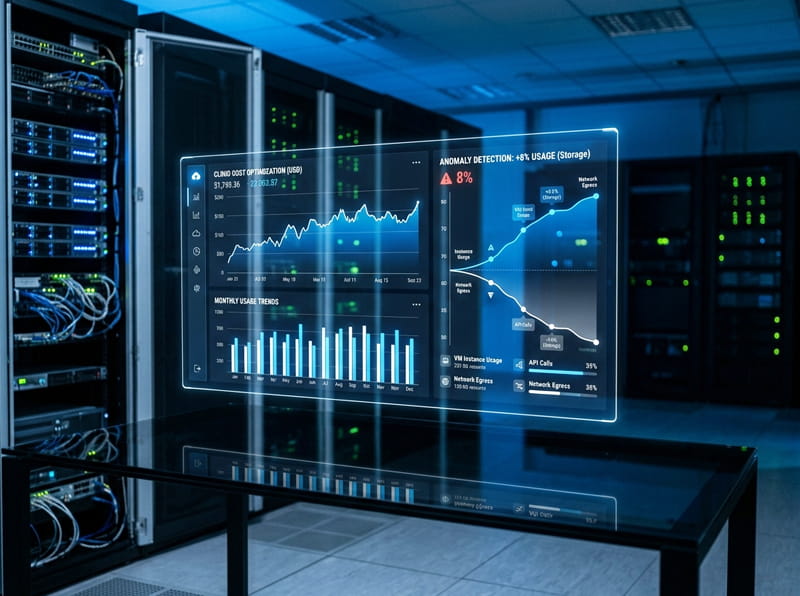
The strategy that has delivered the most consistent results across a 17-year span of managing SaaS and cloud spend is AI-driven anomaly detection on the daily run-rate of every subscription and cloud service, paired with a hard rule: any cost increase above 8% week-over-week triggers an immediate structured review. Every SaaS invoice and every cloud billing line item feeds into a data warehouse daily. The anomaly detector is trained on each service’s normal weekly variance — distinguishing between legitimate seasonal patterns and genuine cost spikes — and flags the FinOps lead within 24 hours when a run-rate jumps meaningfully above the trained baseline.
Three questions drive every triggered review: What changed in usage to cause this? Was the change intentional and justified? If not, what is the root cause and how is it eliminated? This structured response is what separates anomaly detection from anomaly awareness. Detection without a defined review process is just noise.
Three categories of waste have produced the largest savings under this model. First, runaway development environment costs — engineers provision infrastructure for a specific test, forget to terminate it, and costs compound for days or weeks before anyone notices. Daily anomaly detection catches this within 24 hours. Second, SaaS seat creep — tools with per-seat pricing that scales automatically as teams grow, with stale accounts that should have been deprovisioned accumulating silently. Third, mid-cycle vendor pricing changes — vendors applying usage-based increases or contract adjustments the customer was not anticipating, caught before the bill is paid rather than after.
The measured outcome across 24 months of this discipline: total SaaS plus cloud spend grew at roughly 4% annually while revenue grew at roughly 18% per year. Cumulative savings versus the historical growth trajectory reached the high six figures — produced not by any single dramatic intervention, but by consistently catching small problems before they compounded.
Use Domain Experts Over Automation
Not every FinOps problem is solved by adding more AI to the stack. For enterprise Microsoft licensing specifically, the most effective strategy is structured, exception-aware human analysis — not automated decision-making. The distinction matters because Microsoft license management has a volume of exceptions that consistently defeats generic AI agents operating on surface-level signals.
A user can appear inactive in cloud usage data because the organization runs a local offline directory and the cloud signal never registers. A user with an M365 E5 license can look downgradable to M365 E3 on paper, but in practice holds a role requiring E5-exclusive features that no dataset can surface without context. An AI agent that auto-acts on these signals creates expensive false positives at scale — deprovisioning active users, downgrading essential licenses, and generating remediation costs that exceed the original savings.
The approach that works is tooling that ingests license assignment and activity data from Microsoft data streams, categorizes accounts into groups — never active, inactive, double functionality, or downgradable — and then stops. It presents possibilities rather than executing actions. A domain consultant who understands Microsoft-specific semantics, suite versus component licenses, and EA true-up rules then works with the customer to determine which possibilities can actually be acted upon safely.
Generic AI-driven cost reduction tools without that domain context flag the same false leads quarter after quarter. The pattern seen repeatedly with mid-to-large Microsoft shops is that cost optimization in this environment is a domain knowledge problem, not an automation problem.
Eliminate SaaS Dependencies at the Source
The most aggressive FinOps strategy is also the simplest to state: do not accumulate enterprise SaaS spend in the first place. Every subscription should be treated as a problem to eliminate, not a line item to optimize. The best FinOps tool is not a dashboard reporting how much is burning — it is the discipline to ask whether AI can replace the vendor entirely before signing the contract.
Running a platform with millions of users as a two-person team is achievable without a six-figure Salesforce contract or five overlapping project management tools. When customer support infrastructure was needed, the choice was not to purchase a help desk platform and hire a FinOps analyst to track its seat licenses. AI-powered support was built internally, handling the vast majority of inbound volume without a single human agent seat or SaaS subscription attached to it.
For cloud infrastructure costs — the real cost center for GPU-intensive AI workloads — the approach is demand-aware scaling built on internal tooling. Usage patterns are monitored in real time and resources spin up or down based on actual generation queue depth, not projected averages. Before this system was in place, significant spend was burning on idle GPU capacity during off-peak hours. After implementation, waste dropped sharply — without any third-party FinOps platform involved in the decision.
The broader principle: if six figures annually goes toward software that monitors spending on other software, the structural problem has already been lost. The AI-native approach to enterprise cost management is not layering optimization software onto bloated infrastructure. It is staying lean enough that costs are legible to one person on one screen. The organizations that will win on cost efficiency are not the ones with the most sophisticated dashboards — they are the ones that never accumulated the complexity those dashboards were built to manage.
Tie Cloud Spend Directly to Product Value
Most organizations have cloud cost data. Fewer have cost data connected to the specific product decisions that generated it. That gap — between knowing how much is being spent and knowing why it is being spent — is where FinOps programs consistently fail to deliver lasting results. Moving from monthly cost review to real-time product governance closes that gap.
In practice this means tagging infrastructure at the point of provisioning so that every compute resource, storage allocation, and API call is attributable to a specific feature, customer workflow, or team. It means setting anomaly alerts at the feature level rather than just the account level. It means forecasting usage before major releases and giving engineering teams cost visibility inside their normal delivery toolchain — not in a separate finance dashboard they check quarterly.
The output this creates is genuinely useful: when a new AI feature increases compute spend, the team can see within hours whether that cost is tied to user adoption growth, inefficient model calls, storage accumulation, or architectural choices that could be revised. Cost becomes a design constraint with the same standing as performance, security, and scalability — not an afterthought addressed after the feature ships.
This is also how leading organizations are approaching agentic AI in enterprise workflows more broadly — the intelligence layer surfaces the signal, but clear ownership and product-level accountability determine what actually happens next. AI can identify the pattern. Teams still have to make the decision.
Assign Ownership and Prioritize Contextual Decisions
The most common reason enterprise SaaS and cloud costs accumulate uncontrolled is not a lack of data. It is a lack of ownership. Under subscription and consumption-based pricing models, costs grow continuously until someone specific assumes responsibility for the line items generating them. Inactive accounts, underutilized features, duplicate software categories, excess provisioned resources — all of these persist indefinitely until a named owner is accountable for eliminating them.
Assigning explicit cost ownership across departments, then deploying automated tooling to surface waste for those owners to act on, consistently outperforms centralized FinOps review cycles. The automated tools do the detection work. The department owners provide the business context that determines whether a flagged item is genuinely waste or a justified cost the data cannot interpret correctly. That combination — AI infrastructure tools doing detection, humans doing contextual judgment — is more reliable than either approach operating alone.
The discipline this requires is also a quality check on cost reduction itself. Cutting spend without understanding what it supports can degrade customer experience, reduce security coverage, or eliminate productivity infrastructure that was generating more value than it cost. The correct sequence is: analyze usage trends, identify abnormalities, correlate costs to measurable business outcomes, then make renewal and expansion decisions based on actual organizational need rather than line-item pressure. Technology should eliminate hidden friction and improve visibility. Leaders should make the decisions that require context.
Authorize Agents to Terminate Idle Resources
The final evolution in cloud cost management is the one most organizations are still reluctant to implement: giving AI agents actual authority to terminate idle resources rather than simply alerting humans to do it. The reluctance is understandable. Terminating the wrong environment carries real consequences. But the cost of hesitation — in the form of overnight processes left running, test environments that persist for weeks, and compute clusters no one remembered to shut down — consistently exceeds the cost of the occasional false termination that triggers a redeployment.
Even for small teams, cloud infrastructure costs scale exactly like enterprise operations when left unattended. The shift from dashboard monitoring to autonomous enforcement is what changes the economics. Instead of an alert that compute costs are spiking and a human who will investigate when they have time, an AI agent watches traffic patterns continuously and turns off environments that are not actively processing data. The expensive surprise invoice that arrives because someone left a heavy process running overnight is effectively eliminated.
This approach reflects the broader direction of multi-agent systems in enterprise operations — autonomous agents handling defined, bounded tasks within policy guardrails, freeing human attention for decisions that genuinely require it. The key design requirement is specificity: the agent needs clearly defined termination criteria, a whitelist of protected environments, and an audit log of every action taken. With those guardrails in place, autonomous termination of idle resources is one of the highest-ROI automations available to any cloud-dependent organization.
What the Most Effective FinOps Strategies Share
Read across all six strategies and the common architecture becomes clear. None of them rely on AI as a replacement for judgment — they use AI to shorten the feedback loop between when a cost event occurs and when someone responsible for it can act. The FinOps Foundation’s own framework for AI-driven cost management identifies the same pattern: inform and explain, analyze and detect, recommend, and then — only with appropriate guardrails — act and automate. The strategies described here map directly onto that progression.
The second common element is ownership. Every strategy that delivers durable results has a named human accountable for specific cost categories. Anomaly detection without a review owner generates alerts no one acts on. Idle resource termination without defined scope creates risk no one has accepted. Domain expertise without a client relationship to apply it through produces analysis that sits in a report. The automation works when accountability is already in place.
The third element is matching tool complexity to operational complexity. A two-person team with GPU infrastructure should not be building a multi-layer governance program before they have basic demand-aware scaling in place. An enterprise Microsoft shop with thousands of licenses cannot rely on one person reviewing one screen. The right FinOps strategy is the one calibrated to the actual operating environment — not the most sophisticated option available.
For any organization deciding where to start: identify one category of recurring waste — idle environments, seat creep, or vendor pricing drift. Assign one person to own it. Build the simplest detection mechanism that surfaces anomalies within 24 hours of occurrence. The savings from that first intervention will fund everything that comes next, and the discipline it builds makes every subsequent layer of automation more effective than it would have been without it.
Frequently Asked Questions
What is the difference between FinOps for AI and AI for FinOps?
FinOps for AI refers to applying financial operations discipline specifically to AI workloads — managing GPU costs, tracking cost-per-token, setting model-level quotas, and controlling the volatile spend that large language models and generative AI services generate. AI for FinOps is the reverse: using machine learning, anomaly detection, and autonomous agents to automate and improve the financial management of all cloud and SaaS spend. Both are active disciplines in leading organizations, and they are not mutually exclusive.
Why do AI anomaly detection systems outperform standard budget threshold alerts?
Standard budget alerts fire when a predefined dollar threshold is crossed — a blunt instrument that often triggers too late or generates too many false positives to act on reliably. AI anomaly detection is trained on each service’s historical variance, which means it distinguishes between a legitimate seasonal spike and a genuine runaway cost event. The result is faster detection, fewer false positives, and alerts that arrive within 24 hours of the cost event rather than at month end when the compounding has already occurred.
When does human domain expertise outperform automated FinOps tooling?
Automated tools perform well when cost signals map cleanly and reliably to decisions. They produce expensive false positives when the environment has many exceptions — as with enterprise Microsoft licensing, where a user appearing inactive in cloud data may be fully active through a local directory that the dataset cannot see. In those environments, domain expertise that understands platform-specific semantics consistently outperforms algorithms that auto-act on signals they cannot fully interpret.
What is the fastest single intervention to reduce cloud infrastructure waste?
Eliminating idle resources — environments provisioned for specific workloads and never terminated — delivers the fastest ROI with the lowest implementation cost. An AI agent authorized to shut down non-active environments removes this category of waste automatically. For teams not yet ready to deploy an autonomous agent, a daily review of compute run-rates against a seven-day rolling baseline catches most of the same issues within 24 hours, before overnight compounding turns a forgotten test environment into a meaningful line item.
How should engineering teams be given cost visibility without disrupting their workflow?
Cost visibility works best when it is embedded inside the tools engineers already use rather than surfaced in a separate finance dashboard they check infrequently. Tagging infrastructure at provisioning time and connecting that tag data to cost reporting means that when a feature ships, the team sees within hours whether the cost impact matches expectations — and can attribute that cost to a specific user workflow, model call pattern, or architectural decision rather than a generalized cloud bill.
What governance structure supports sustainable AI-driven FinOps at scale?
Sustainable FinOps governance requires cross-functional ownership that bridges data science, DevOps, and finance teams. The FinOps Foundation’s Crawl-Walk-Run maturity model provides a practical sequence: start by tagging all workloads and tracking usage manually, then introduce automated tagging and spot-instance orchestration, and finally integrate AI forecasting and autonomous optimization once the data foundation is clean and reliable. Skipping directly to autonomous optimization on top of untagged, unattributed infrastructure produces automation that accelerates noise rather than eliminating waste.
Article Contributors
The insights in this article were contributed by the following founders, CEOs, and operators who shared their expertise through Featured.com.
- Dane Maxwell, Founder, Paperless Pipeline
- Daan Brandt, M365 Licensing Consultant, LicenseQ
- Runbo Li, CEO, Magic Hour AI
- Cameron Woodford, CEO and Founder, Appello Software
- Shawn Mintz, CEO, MentorCity
- Kevin Lourd, Founder, Distribute.you

Loading comments…