

Exploring the vast landscapes of Hyrule in The Legend of Zelda: Breath of the Wild is a central part of the gaming experience, offering players a sense of wonder and discovery at every turn. However, as Link ventures further into dangerous territories like the volcanic slopes of Eldin or the frozen peaks of Hebra, the basic defense of his starting gear becomes insufficient. This is where the Great Fairies play a pivotal role. Unlike previous entries in the series where fairies might simply restore health or provide magic, the sisters in Breath of the Wild are essential for survival because they possess the unique power to enhance Link’s protective gear. Finding and unlocking these fountains is not just a side activity; it is a fundamental mechanic for any player hoping to withstand the onslaught of Guardians, Lynels, and the ultimate challenge within Hyrule Castle.
The journey to restore the Great Fairies is a recurring theme that ties into the lore of a world slowly recovering from the Calamity. These powerful beings have lost their strength over the century-long slumber of the Hero, and they require a monetary tribute to manifest their physical forms and resume their work. Each fountain you discover increases the collective power of the sisters, allowing them to push Link’s armor to higher tiers of defense and unlock special set bonuses. From the serene woods of Kakariko to the harsh sands of the Gerudo Desert, each location presents a different environmental challenge, making the act of finding them a quest in its own right. Understanding the specific costs, locations, and material requirements is the first step toward transforming Link into an unstoppable force.
In addition to the four primary sisters who manage armor upgrades, there exists a fifth, more mysterious entity known as Malanya, the Horse God. While technically distinct from the traditional Great Fairies, Malanya resides in a similar fountain structure and provides a service that is equally vital for many players: the resurrection of fallen horses. This guide will provide a comprehensive breakdown of where to find all five fountains, how to manage the escalating costs of unlocking them, and the strategic benefits of upgrading your gear to its absolute maximum potential. By following these steps, you can ensure that Link is properly equipped for every encounter the wild world of Hyrule throws his way.
Understanding the Costs and Progression of Great Fairy Fountains
The Great Fairy Fountains in Breath of the Wild operate on a progressive cost system that does not depend on which specific fairy you visit first. Instead, the price is determined by how many sisters you have already restored to their former glory. This flexibility allows players to approach the fountains in any order they choose, though most players naturally find the one nearest to Kakariko Village first. The financial burden of unlocking these fountains can be significant, especially in the early stages of the game when rupees are scarce and Link is still scavenging for basic supplies. It is important to plan your expenditures carefully to ensure you have enough funds to unlock the higher tiers when you need them most.
The escalating rupee requirements are as follows: the first Great Fairy requires a modest 100 rupees, the second asks for 500 rupees, the third demands 1,000 rupees, and the final sister requires a staggering 10,000 rupees. In total, you will need 11,600 rupees to fully restore all four sisters. While the first three are relatively affordable, the jump to 10,000 rupees often requires focused effort, such as selling rare gemstones, cooking high-value meals, or participating in mini-games like the snowling challenge. However, the investment is well worth it, as each unlocked fairy represents one more “star” or level of upgrade possible for every piece of upgradeable armor in your inventory. With only one fairy, you can only reach level one; with all four, you can reach level four.
Beyond simple defense boosts, the true power of the Great Fairies lies in the “Set Bonus” mechanic. Most armor sets in the game, when worn as a complete outfit (head, torso, and legs) and upgraded to at least level two, grant a unique passive ability. These range from “Unfreezable” to “Attack Up” or “Guardian Resist,” significantly altering how you interact with the environment and enemies. To achieve these bonuses, you must have unlocked at least two Great Fairies. As you progress, the materials required for upgrades transition from common monster parts to rare items like dragon scales, star fragments, and ancient cores. This creates a loop of exploration and combat that rewards the player for engaging with all aspects of the game world.
Detailed Locations of the Four Great Fairies
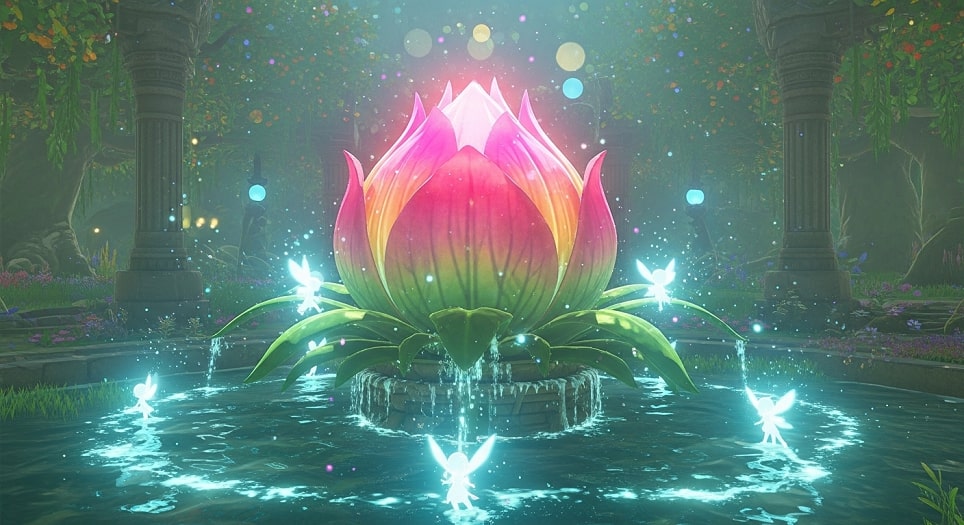
Locating the fountains requires a keen eye for environmental clues. From a distance, an unopened Great Fairy Fountain looks like a giant, shimmering flower bud, often orange or purple in color. These buds are usually surrounded by smaller, standard fairies that Link can catch to gain a “second life” in combat. Below are the specific directions and landmarks for each of the four sisters, listed in the order most players are likely to encounter them based on the natural flow of the main story quests.
Great Fairy Cotera – Kakariko Village (West Necluda)
Cotera is almost universally the first Great Fairy found by players because she is located just a short walk from Kakariko Village. After arriving in the village and speaking with Impa, you can head up the hill toward the Ta’loh Naeg Shrine. From the shrine, follow the path that leads deeper into the woods to the northeast. You will eventually come across a large, glowing bud in a clearing. Because this fountain is so close to a major hub, it serves as a convenient home base for armor upgrades throughout the early game. The 100-rupee cost is easily covered by selling a few items found in the surrounding hills.
Great Fairy Mija – Lake Akkala (Akkala Highlands)
Located in the northeastern Akkala region, Great Fairy Mija resides in a stunningly beautiful grove of autumn-colored trees. The most direct way to reach her is to travel to the Akkala Ancient Tech Lab or the Akkala Tower. From the tower, glide toward the east-southeast, looking for a small, circular pool of water on the cliffs overlooking Lake Akkala. The Dah Hesho Shrine is situated very close to her fountain, providing a perfect fast-travel point once you’ve discovered it. Mija’s fountain is a great place to farm Armoranth, a plant frequently used in defense-boosting recipes.
Great Fairy Kaysa – Piper Ridge (Tabantha Frontier)
Great Fairy Kaysa is found in the western reaches of Hyrule, situated on a high ridge in the Tabantha region. If you have already activated the Tabantha Tower, finding her is incredibly simple. Stand on top of the tower and look to the south; the giant flower bud is clearly visible on a nearby plateau known as Piper Ridge. You can glide directly from the tower to the fountain in seconds. If you haven’t reached the tower yet, she is located just south of the road leading to Rito Village. This area is rich with Mighty Thistles, which are essential for creating Attack Up meals.
Great Fairy Tera – Gerudo Great Skeleton (Gerudo Desert)
Tera is widely considered the most difficult Great Fairy to reach due to the extreme environmental conditions of the Gerudo Desert. She is located at the furthest southwestern tip of the map, tucked under the massive ribcage of the Gerudo Great Skeleton. To reach her, you must endure intense daytime heat or nighttime cold and navigate through a sandstorm that disrupts your Sheikah Slate map. It is highly recommended to use a Sand Seal to cross the dunes quickly. Once you reach the skeleton, the Hawa Koth Shrine is located right next to the fountain, allowing you to bypass the long trek through the desert for future visits. Tera is usually the fourth fairy players unlock due to the remote location and the high 10,000-rupee cost often associated with the final sister.
The Horse God Malanya: Location and Services
While not one of the Great Fairy sisters, Malanya is an ancient spirit who resides in a fountain nearly identical to the others. Known as the Horse God, Malanya does not care for armor; instead, he watches over the steeds of Hyrule. If one of your registered horses dies during your travels—whether by enemy fire, a tragic fall, or a stray lightning strike—Malanya can bring them back to life. This service is invaluable for players who have bonded with rare horses like the Giant White Stallion or the Royal White Stallion. Malanya’s personality is a bit more eccentric than his sisters, often “threatening” to eat Link if he suspects the horse’s death was intentional, but he is ultimately a benevolent guardian.
Malanya’s Spring is located in the Faron region, specifically south of the Highland Stable. To find it, follow the path from the stable that leads across the Horse God Bridge. The path terminates at a secluded spring at the end of a narrow canyon. Like the Great Fairies, Malanya requires a one-time payment to open his bud, which costs 1,000 rupees. Once unlocked, he will revive any of your registered horses for free, provided you have a slot available in your stable. If you find yourself in the Faron region, it is also worth noting that the surrounding area is one of the best places in the game to farm Endura Carrots, which can be found behind the fountain and used to give your horses extra stamina wheels.
Pro Tips for Managing Fountains and Resources
To maximize your efficiency when dealing with Great Fairies, consider the following expert strategies:
- Gemstone Economy: Never sell all your gemstones at once. While they are the fastest way to get the 10,000 rupees needed for the final fairy, you will also need many of them (especially Rubies, Sapphires, and Topaz) for high-level armor upgrades later in the game.
- Sneaking for Fairies: When approaching a fountain, always crouch and move slowly. Up to four small fairies will fly around the bud; if you run or make noise, they will vanish. These are vital for surviving tough boss fights as they automatically revive you with five hearts.
- Set Bonus Activation: Priority should be given to upgrading the Hylian Soldier set or the Ancient Armor set to level two first. The defensive boost and set bonuses (like Ancient Proficiency) provide the most significant gameplay advantages during the mid-game.
- Dragon Farming: Many of the level 3 and 4 upgrades require parts from the three dragons (Dinraal, Naydra, and Farosh). Learn their flight paths early so you can stock up on scales and horns while you wait to gather enough rupees for the next fountain.
- Stable Proximity: Always check the nearby stables before heading to a fountain. NPCs like Pikango often give quests related to the fountains, and other travelers might offer hints about where to find rare materials required for the next tier of gear.
- Wait for the Map: If you are struggling to find a fountain in a new region, unlock the local Sheikah Tower first. Looking down from a high vantage point is often more effective than wandering the ground level, as the fountains’ bright colors stand out against the landscape.
Frequently Asked Questions
Does the order in which I unlock Great Fairies matter?
No, the order does not matter for the quality of the upgrades. Every Great Fairy can perform the same level of upgrades. If you have unlocked two fountains, you can go to either one of them to upgrade your gear to level two. The only thing that changes is the price you pay to open the bud, which is strictly based on the number of fairies already freed.
Can I upgrade armor that doesn’t have a star symbol?
Most armor can be upgraded, but there are exceptions. Items like the Nintendo Switch Shirt, certain “vanity” items, or DLC masks (like Majora’s Mask) cannot be enhanced by the Great Fairies. If an item does not appear in the Great Fairy’s menu when you interact with her, it means that specific piece of gear is not eligible for upgrades.
What happens if I don’t have enough materials?
If you have the rupees to unlock the fairy but lack the materials for a specific upgrade, the Great Fairy will still open the fountain and offer her services. You can return at any time once you have gathered the necessary monster parts or plants. The “service” is permanent once the fountain is paid for.
How do I get more rupees quickly for the 10,000-rupee cost?
The most efficient way to earn money is by hunting “Gourmet Meat” in the Hebra region, cooking five pieces together to make a Meat Skewer, and selling it for 490 rupees. Alternatively, you can defeat Stone Talus bosses found throughout Hyrule, as they drop valuable ores like Diamonds and Luminous Stones that sell for high prices.
Conclusion
The Great Fairy Fountains are more than just a place to spend rupees; they are the key to Link’s growth and durability throughout his journey across Hyrule. By understanding the progressive cost system and knowing the exact locations of Cotera, Mija, Kaysa, and Tera, you can systematically build your defenses to meet any challenge. Whether you are gliding from Tabantha Tower or trekking through the sands of the Gerudo Great Skeleton, reaching these sisters should be a top priority for any adventurer. Don’t forget the Horse God Malanya, whose unique power ensures that your most loyal companions are never truly lost. With a fully upgraded set of armor and the knowledge of where to find these powerful beings, you will be well-prepared to face Calamity Ganon and restore peace to the kingdom of Hyrule.
