

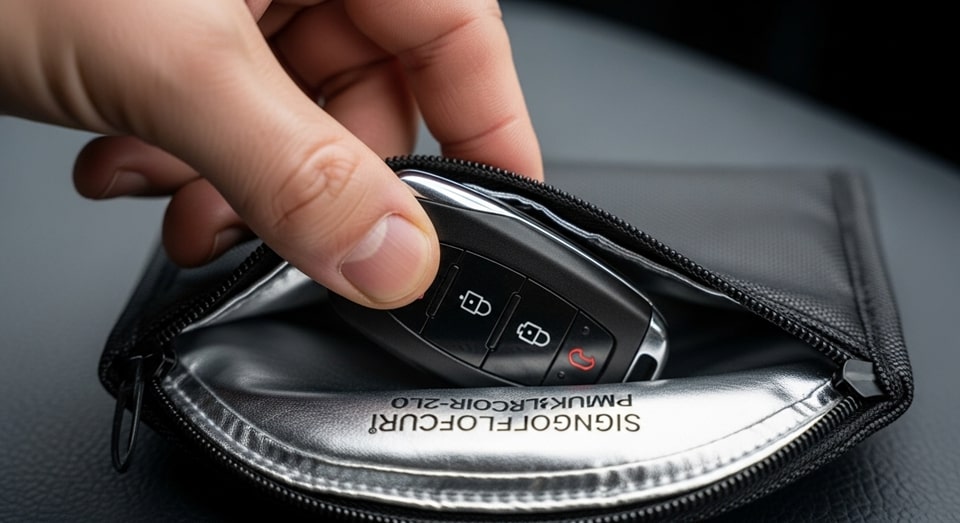
Modern vehicles depend on keyless entry systems to deliver the convenience drivers expect. A brief press of a button or a passive approach to the car triggers the door to unlock within seconds. That convenience, however, creates a specific and exploitable vulnerability: the key fob signal can be captured, amplified, and replayed by thieves without ever touching the physical key. A key fob signal blocker — typically a Faraday pouch, cage, or box lined with conductive shielding material — is the most direct and reliable countermeasure available to everyday drivers today.
How Keyless Entry Creates a Security Gap
A key fob communicates with the vehicle via radio frequency, broadcasting at 315 MHz in most North American cars and 433.92 MHz in European, Japanese, and Asian models. The car’s receiver picks up this signal and verifies it before unlocking the doors or enabling push-button start. The entire transaction is passive: the fob continuously emits a low-power signal whether the owner is actively using it or not.
This constant broadcast is what relay attackers exploit. Two thieves working together — one positioned near the home where the fob is kept, the second standing near the car in the driveway — use inexpensive relay amplifiers to extend the fob’s signal across a distance that would otherwise be impossible. The car cannot distinguish between the real key held a few feet away and a relayed signal captured from 50 feet inside the house. It unlocks, and the thieves drive away in under 60 seconds. According to testing conducted by the German General Automobile Club (ADAC), 230 of 237 keyless entry vehicles tested were susceptible to this exact attack. Relay amplifier kits are available online for as little as $20 to $300, requiring no special skills to operate.
A Faraday-shielded enclosure solves this problem completely at the physical layer. When the fob is stored inside a properly sealed pouch or box, the conductive material creates a cage that absorbs and reflects radio frequencies, preventing any signal from escaping. There is nothing to intercept, nothing to amplify, and no way for the relay attack to function.
What Makes a Key Fob Signal Blocker Work
The principle behind every key fob signal blocker is Michael Faraday’s 1836 discovery that a conductive enclosure distributes external electromagnetic fields around its surface rather than allowing them to pass through. Materials most commonly used include nickel-copper alloy fabric, woven stainless steel mesh, and aluminium alloy in rigid enclosures. Military-grade products such as Mission Darkness TitanRF Faraday Fabric are lab-certified to MIL-STD-188-125 and IEEE 299-2006 shielding effectiveness standards, providing attenuation of 80 dB or more across the frequency range from low MHz through 40 GHz.
What separates effective products from ineffective ones is construction quality at the seams and closure. A gap of a few millimetres along a Velcro fold or snap closure is enough for signal leakage. Dual-layer shielding with paired seam construction addresses this by overlapping the conductive material so no single weak point exists. The closure mechanism — whether roll-top, Velcro, magnetic snap, or traditional zip — must create a complete seal rather than merely approximate one.
Products vary in form factor to match different use cases. Fabric pouches are the lightest and most portable. Rigid aluminium vaults provide the most durable home-storage option and the strongest shielding due to the continuous metal construction rather than woven fabric. Hybrid combos pairing a rigid box with portable pouches cover both home and on-the-go scenarios in a single purchase.
Top 10 Key Fob Signal Blockers Worth Buying
The products below were selected based on verified shielding specifications, construction quality, closure design, and real-world effectiveness across the key fob frequency ranges used by the majority of passenger vehicles. The list covers the full price spectrum from budget-friendly basic pouches to precision-machined aluminium vaults built for long-term daily use.
1. Mission Darkness Keyfob Shield — Best Overall for Proven Law Enforcement-Grade Shielding
Mission Darkness supplies evidence-handling forensic equipment to federal agencies, and the Keyfob Shield is the same TitanRF technology offered to everyday drivers at $15 for a two-pack. The bag’s interior uses three layers of TitanRF Faraday Fabric with dual-paired seam construction, certified to MIL-STD-188-125 and IEEE 299-2006. The exterior is water-resistant ballistic nylon with a belt loop and keyring attachment. It blocks WiFi, Bluetooth, GPS, RFID, NFC, cellular including 5G, and key fob frequencies from low MHz to 40 GHz. At $15 for two bags, this is the strongest value-per-dollar option on the market.
- Three-layer TitanRF Faraday Fabric interior, lab-certified to MIL-STD-188-125 and IEEE 299-2006
- Dual-paired seam construction eliminates signal leakage at seams
- Fits two fobs or one fob with full keyring accessories
- Water-resistant ballistic nylon exterior with belt loop and keyring loop
- Blocks all signal types from low MHz to 40 GHz including 5G
The fold-and-tuck elastic closure works well once learned but takes slightly more attention than a magnetic snap to ensure a complete seal. The basic black nylon aesthetic is functional rather than stylish, and there is no particularly compact slim-wallet format. For pure shielding performance at a low price, nothing on this list competes.
2. GoDark Vault — Best Rigid Aluminium Cage for Home Storage
For vehicle owners who prefer the certainty of a solid metal enclosure over fabric shielding, the GoDark Vault is the definitive choice. Precision-milled from a 1/12-inch (2.1 mm) thick block of solid aluminium, the Vault creates a complete Faraday cage around the key fob with zero fabric seam gaps to worry about. A magnetic closure and sturdy hinge keep the lid sealed. The felt-lined interior protects the fob and prevents accidental button presses. Priced at $49, it costs more than fabric pouches but offers a different category of protection suited to home storage where bulk is not a concern.
- Solid aluminium construction, 1/12-inch (2.1 mm) thick, precision-milled
- Blocks 315 MHz, 433.92 MHz, WiFi, Bluetooth, GPS, RFID, NFC, 3G/4G/5G/LTE
- Magnetic closure with sturdy hinge keeps lid securely sealed
- Felt-lined interior prevents accidental activation and protects fob surface
- Also useful for ESD protection of crypto hardware wallets and USB keys
The Vault weighs 5.25 ounces and is designed for nightstand or shelf storage, not pocket carry. Larger fobs — particularly those with extended range or chunky buttons — may not fit within the 3.23 x 1.6 x 0.86-inch maximum interior dimensions, so checking the fob measurements before purchasing is essential.
3. SLNT Faraday Key Fob Bag — Best Patented Multishield Technology
Silent Pocket (SLNT) holds the only patented Faraday cage system for consumer products on the market and supplies signal-blocking solutions to US government clients. The key fob bag uses Multishield Faraday shielding material inside a 500D weatherproof polyester exterior. It is MIL-STD-188-125-2 compliant and exceeds IEEE 299-2006 standards from 1 to 40 GHz. At $21.95, it sits between budget pouches and premium vaults. The external keychain loop is a notable feature missing from many competitors.
- Patented Silent Pocket Faraday cage with Multishield lining, MIL-STD-188-125-2 compliant
- 500D weatherproof polyester exterior handles rain and moisture
- Dual snap closure creates a secure, consistent seal
- External keychain loop for attachment to bags or belt loops
- Blocks 315 MHz and 433.92 MHz key fob frequencies plus all wireless signal types
The SLNT key fob bag was listed as out of stock at the time of research, meaning availability through the official website may be intermittent. The extra-small size fits one key fob and is narrow in internal dimensions, so very large or thick fobs may be a tight fit. The price is fair given the patented technology and government-trust credentials.
4. TICONN Faraday Bag for Key Fob — Best Budget Two-Pack With Multiple Size Options
TICONN is one of the top-selling Faraday pouch brands on Amazon for good reason: the carbon-fibre-textured two-pack starts at $9.99 for the medium size and delivers consistent dual-layer shielding across all key fob frequencies. Three sizes — small at 3.25 x 4.75 inches, medium at 3.5 x 5.0 inches, and large at 7.75 x 4.25 inches — accommodate almost any fob, including the oversized remote starts common on trucks and SUVs. A second front pocket blocks RFID for credit cards.
- Dual-layer shielding material blocks WiFi, Bluetooth, GPS, RFID, NFC, and key fob frequencies
- Available in three sizes to accommodate compact fobs through large truck remotes
- Two pouches per pack — one for home, one for portable carry
- Front anti-radiation pocket for ID cards and contactless payment cards
- Carbon-fibre-textured exterior with integrated keychain hole and elastic flap closure
The PU leather or carbon-fibre fabric exterior is not fully waterproof — it handles light rain but will allow water penetration in heavy downpours. The elastic flap closure, while convenient, does not provide the same positive mechanical seal as a Velcro or snap system. For the price and the three-size selection, TICONN is the smart starting point for first-time buyers.
5. Samfolk Faraday Box with Portable Pouch — Best Home-and-Go Combination
The Samfolk offering pairs a wood-and-PU-leather box with a portable carbon-fibre pouch, providing both home storage and pocket carry in one package. The box measures 6.3 x 4.7 x 4 inches with dual-layer premium shielding lining and holds 6 to 8 car keys simultaneously, making it ideal for households with multiple vehicles. The included portable pouch covers on-the-go use. Lifetime warranty coverage is included. This is the most practical all-in-one solution for families, priced competitively in the $20 to $30 range depending on retailer.
- Wood and PU leather box holds 6 to 8 keys with dual-layer shielding lining
- Portable carbon-fibre pouch included for daily carry outside the home
- Blocks car key, phone, credit card, and smartwatch signals
- Lifetime warranty coverage included
- Signal blocking activates within two seconds of closure
The box’s wood-and-leather aesthetic, while attractive as a desktop or nightstand item, is not as durable as solid aluminium under hard knocks or drops. The portable pouch included with the combo is functional but built to a lower specification than a dedicated premium pouch — households wanting the best portable protection may wish to pair the Samfolk box with a Mission Darkness bag for carry use.
6. Lanpard Faraday Pouch — Best Snap-Closure Budget Option in Multiple Sizes
Lanpard’s two-pack consistently ranks as the top-selling key fob pouch on Amazon, and at $9.99 for two, it earns that position on value. The PU leather exterior snap-button closure creates a secure seal across small, medium, and large size options, allowing buyers to match the pouch precisely to their fob’s dimensions. Independent testing confirms complete signal blocking at both 315 MHz and 433.92 MHz when the snap is fully engaged. The two-pack supports one pouch for home storage and one for the bag or glove compartment.
- Snap-button closure provides consistent, easy-to-confirm seal
- Three sizes available: small, medium, and large
- Carbon-fibre-textured PU leather exterior with dual-layer shielding material
- RFID blocking for cards stored alongside the fob
- Two pouches per pack for home and portable use
PU leather longevity is the primary concern: the material will crack and wear faster than ballistic nylon or TPU under daily handling. The snap closure also introduces a single mechanical failure point — a weak or worn snap button reduces shielding effectiveness. That said, at under $10 for two pouches, Lanpard is the most accessible entry point in the market and a sensible choice for first-time buyers testing whether a Faraday routine fits their daily habits.
7. Faraday Defense Key Fob Jacket — Best Water-Resistant Option for Wet Environments
Faraday Defense uses triple-layer CYBER NC shielding — a nickel-copper composite — inside a TPU (Thermoplastic Polyurethane) water-resistant exterior. The roll-top closure with Velcro seal creates both a moisture barrier and a signal-blocking seal in a single mechanism. This pouch is purpose-built for drivers who frequently work outdoors, commute in wet climates, or keep their keys in a jacket pocket that regularly encounters rain. It is the only mainstream key fob pouch that explicitly addresses water resistance as a primary design requirement alongside signal blocking.
- Triple-layer CYBER NC (nickel-copper) shielding for complete frequency blocking
- TPU exterior resists water penetration, tested in rain and wet conditions
- Roll-top Velcro closure creates simultaneous moisture and signal seal
- Puncture-resistant and tear-resistant construction withstands daily abuse
- Accommodates one key fob plus a few cards
The roll-top design requires slightly more time to open and close than a snap or magnetic closure — approximately 10 extra seconds per use — which may feel cumbersome for drivers retrieving keys multiple times daily. The body of the pouch is marginally bulkier than standard fabric options due to the roll-top mechanism, making it less suitable for tight trouser pockets.
8. TICONN Faraday Box — Best Rigid Box for Desktop Use on a Budget
For buyers who want the solidity of a rigid Faraday box without spending $49 on the GoDark Vault, TICONN’s PU leather Faraday box delivers dual-layer shielding in a compact form available in three sizes. The magnetic closure creates a positive seal, and the carbon-fibre finish gives a premium appearance that works well as a desk or nightstand item. Pricing on the standalone box runs approximately $15 to $25 depending on size, making it significantly more accessible than solid aluminium alternatives while still providing rigid structure.
- PU leather rigid box with dual-layer shielding material and magnetic closure
- Three size options match most fob dimensions
- Blocks WiFi, Bluetooth, GPS, RFID, NFC, and key fob frequencies
- Carbon-fibre textured finish suitable for desk or nightstand placement
- TICONN also sells bag-and-box combo packs for combined home and carry use
PU leather construction will not match the durability of a precision-machined aluminium vault over multi-year use — the material can crack or peel under stress. The magnetic closure, while convenient, is less mechanically rigid than the aluminium-hinged closure of the GoDark Vault. For home storage where the box will not be dropped or subjected to physical stress, the TICONN box is an excellent value.
9. Vammcht Upgraded Faraday Bag — Best for Households With Multiple Cars
Vammcht’s upgraded two-pack targets households protecting multiple vehicles simultaneously. Each compact pouch at 5.12 x 3.15 inches uses dual-layer military-grade RF shielding cloth blocking WiFi, Bluetooth, GPS, RFID, NFC, GSM, and LTE signals. The colour-coded options — including red, blue, and black — let multiple household members distinguish their pouches at a glance without unmarking them. Pricing typically falls under $12 for the two-pack on Amazon, making it the best value option for a household of two with separate vehicles.
- Dual-layer military-grade RF shielding cloth, 5.12 x 3.15 inches per pouch
- Color options allow households to distinguish between multiple users’ fobs
- Blocks WiFi, Bluetooth, GPS, RFID, NFC, GSM, and LTE
- Two-second signal blocking confirmed from closure
- 30-day return guarantee with responsive customer support
The Vammcht pouch is compact and practical but lacks the premium construction of Mission Darkness or SLNT options. Long-term durability under daily handling has not been documented as thoroughly as higher-profile brands. Buyers who need more than two pouches may find purchasing multiple Vammcht two-packs still more economical than a single premium pair.
10. Generic Dual-Layer Carbon Fibre Faraday Pouch — Best Disposable Starter Option
Available from multiple sellers on Amazon and Walmart for as little as $4.49 to $6.21 for a two-pack, generic dual-layer carbon-fibre Faraday pouches represent the absolute lowest barrier to entry for key fob signal protection. These unbranded or lightly branded pouches use the same basic dual-layer shielding cloth found in mid-tier products and provide adequate blocking at 315 MHz and 433.92 MHz when the closure is properly sealed. They are appropriate as a first test before committing to a premium product or as an inexpensive replacement when a higher-quality pouch is lost or worn out.
- Dual-layer shielding material blocks key fob frequencies at 315 MHz and 433.92 MHz
- Priced at $4.49 to $6.21 per two-pack across major retailers
- Carbon-fibre-textured finish with basic snap or Velcro closure
- Suitable as a starter option or emergency replacement
- RFID blocking for credit cards when stored together with the fob
Construction quality is the main limitation. Shielding material density and seam integrity vary widely between unbranded manufacturers, and there is no third-party certification verifying attenuation performance. Closure mechanisms on the cheapest options degrade quickly under daily handling. These pouches serve their purpose adequately in the short term but should not be relied upon as a permanent protection strategy without periodic testing.
Pricing Comparison Across the Range
The key fob protection market spans from under $5 to $49 per unit, and the price differences correspond to measurable differences in material quality, shielding certification, and construction durability rather than branding alone. Generic two-packs from unverified sellers start at $4.49, with the Lanpard and Vammcht options in the $9.99 to $12 range offering a material step up in consistency. The Mission Darkness two-pack at $15 provides law-enforcement-grade shielding at a price point barely above the budget tier — it is the clearest value-per-dollar winner in the entire category.
The mid-range runs from $15 to $25 and includes the TICONN box and SLNT bag, both of which add specific features — rigid structure and weatherproofing respectively — that budget fabric pouches cannot replicate. The Samfolk box-and-pouch combo sits here as well, offering the most complete home-plus-carry system at a mid-tier price. At the premium end, the GoDark Vault at $49 represents a categorically different product: precision aluminium versus woven fabric, permanent home storage versus daily carry, and a level of material durability that will outlast any fabric pouch by years. For drivers who want a one-time purchase they will not replace, the Vault makes financial sense over repeated budget pouch replacements.
How to Choose the Right Key Fob Signal Blocker
The first question is use pattern: where does the fob spend most of its time when not in use? A key left on a kitchen counter overnight in a home with a car parked in the driveway is the highest-risk scenario for relay attack. A rigid box like the GoDark Vault or TICONN box placed permanently on the nightstand solves this completely. A driver who frequently transfers the fob between jacket pockets and a work bag needs a compact portable pouch — Mission Darkness or Lanpard in the appropriate size.
Closure mechanism matters more than most buyers realise. Velcro closures are durable and provide a wide sealing surface, but they can lose grip over time and catch on fabric. Magnetic snaps are fast and convenient but should be checked periodically to ensure the magnet remains strong enough to hold a complete seal. Roll-top designs eliminate closure failure points entirely but add a few seconds to every access. The best closure is whichever one the user will reliably engage on every single use — a premium pouch used inconsistently provides less real-world protection than a budget option used correctly every time.
Fob size is a practical constraint that surprises buyers who skip the measurement step. Compact Japanese fobs often fit easily in the smallest pouches, but American and European truck and SUV remotes — particularly those with remote-start buttons and multiple control buttons on both faces — may require the large TICONN size or the roomier GoDark Vault. Measuring the fob before purchasing saves the inconvenience of a return.
Households with multiple vehicles benefit from colour-coded or clearly labelled pouches to avoid placing the wrong fob in the wrong bag. Vammcht’s colour options and the GoDark Vault’s universal look both serve this need, but from different ends of the durability and price spectrum. Finally, buyers who also carry contactless credit cards, building access badges, or RFID-chipped travel documents alongside their keys gain additional value from any pouch with confirmed RFID blocking, which all products on this list provide.
Frequently Asked Questions About Key Fob Signal Blockers
Do I actually need a Faraday pouch if my car already has encryption?
Yes. Relay attacks bypass the vehicle’s encryption entirely by acting as an extension cord between the fob and the car’s receiver. The car verifies the encrypted signal correctly — it has no way to detect that the signal travelled 50 feet through a relay amplifier rather than from the key in the driver’s hand. The encryption is not the vulnerability; the always-on broadcast range is.
How do I know if my key fob signal blocker is still working?
The standard test requires nothing beyond the fob and the car. Place the sealed fob inside the closed pouch or box, walk to the car, and attempt to open the door with the handle. If the door does not respond, the blocker is working. If proximity unlock triggers, the closure was incomplete or the shielding has degraded. Repeat this test monthly for fabric pouches, especially if they see heavy daily use.
Can wrapping a key fob in aluminium foil work instead?
Aluminium foil provides some attenuation when wrapped in multiple thick layers with no gaps, but it tears on the first use and requires rewrapping every time the fob is accessed. Multiple layers are needed to achieve the same attenuation a dual-layer shielded pouch provides by design. The practical inconvenience makes foil a one-time emergency measure rather than a usable daily solution.
Will using a Faraday pouch drain my key fob battery faster?
No — the opposite is true. Most modern proximity fobs enter a constant polling cycle when near the vehicle, transmitting signals repeatedly to check for proximity detection. Storing the fob inside a signal-blocking pouch prevents this cycle entirely when the fob is away from the car, which extends battery life. Drivers who notice faster-than-expected battery drain may actually benefit from more consistent Faraday storage.
Which key fob frequencies need to be blocked?
North American vehicles predominantly operate at 315 MHz. European, Japanese, and most Asian vehicles use 433.92 MHz. A blocker that only addresses one of these frequencies will not protect vehicles in the other category. All products recommended on this page cover both frequencies as well as wider signal ranges including WiFi, Bluetooth, GPS, and cellular, ensuring protection regardless of vehicle origin.
Can a Faraday pouch protect other devices besides a key fob?
Yes. Any fob-sized pouch with confirmed RFID and NFC blocking also protects contactless credit cards, building access cards, student ID cards with embedded chips, and passports with e-passport chips. This makes the pouch a dual-purpose carry item. Larger Faraday pouches designed for phones provide additional protection for mobile devices but are separate products from key fob pouches and should not be confused with them in size selection.
Does the car manufacturer offer any built-in protection against relay attacks?
A small number of manufacturers — Ford among them — have introduced motion-sensing fobs that enter sleep mode when stationary for several seconds, significantly reducing the signal available for relay amplification. Ultra-wideband (UWB) technology, increasingly adopted by premium brands, uses precise distance measurement to confirm the fob is genuinely in proximity rather than relayed from a distance. Neither technology is yet universal, and even vehicles with motion-sensing fobs benefit from Faraday storage since the sleep mode is not always reliable in every position or temperature condition.
Pro Tips for Getting the Most From Key Fob Signal Protection
The location where the fob is stored at home matters as much as the pouch itself. Even without a blocker, placing fobs in the centre of the home — away from exterior walls and particularly away from front doors and windows — reduces the amplifiable signal range available to thieves standing outside. Adding a Faraday pouch to this interior-storage habit creates two overlapping layers of protection rather than relying on the pouch alone.
Test the specific pouch-and-fob combination on day one of ownership, not after a month of assuming it works. Fob sizes and housing materials vary enough between manufacturers that a pouch which seals perfectly for one vehicle’s remote may not achieve a complete seal for a bulkier remote with buttons on both faces. A test takes 30 seconds and eliminates any assumption of protection where none actually exists.
For households owning multiple vehicles, numbering or colour-coding pouches prevents the common error of storing Car A’s fob in Car B’s pouch and leaving Car A’s fob exposed on the counter. Simple cable-tie colour coding or a marker on the elastic flap takes seconds to implement and eliminates a gap that real thieves have exploited.
Fabric pouches — Velcro-closure types specifically — should be inspected every three to six months for seam separation and shielding material wear. The Faraday fabric inside the pouch is woven, not solid metal, and repeated compression and flexing gradually thin the fibres at stress points. A visual inspection is not sufficient; only a live door-handle test confirms the pouch still blocks the full signal.
Consider signal blocking as one layer in a broader vehicle security strategy rather than a complete solution on its own. Relay attack is the fastest and most common keyless theft method, but hardened thieves also use OBD port programmers to clone key codes, and physical wheel locks or GPS trackers address entirely different threat vectors. A Faraday pouch costs $10 to $50 and eliminates the relay attack risk completely — that is its exact, specific job, and it performs it well.
Conclusion
Key fob signal blockers address one of the most prevalent and technically straightforward vulnerabilities in modern vehicle security. Relay attack equipment is inexpensive, widely available, and effective against the vast majority of keyless entry systems on the road today. The solution — a properly sealed Faraday pouch or rigid enclosure — costs between $10 and $50, requires no technical knowledge, and delivers complete protection for the specific threat it targets the moment the fob is placed inside and the closure is sealed.
Mission Darkness remains the strongest value overall, delivering law-enforcement-grade TitanRF shielding at $15 per two-pack. The GoDark Vault is the right choice for drivers who want a permanent, zero-maintenance home-storage solution built from solid aluminium. SLNT suits drivers who value a patented, government-trusted fabric option with weatherproof construction. For households on a budget, the Lanpard or TICONN two-packs provide reliable performance at under $15 for two pouches. Whatever the choice, the critical variable is consistency: a Faraday pouch only protects the vehicle when the fob is inside and the closure is fully sealed.
