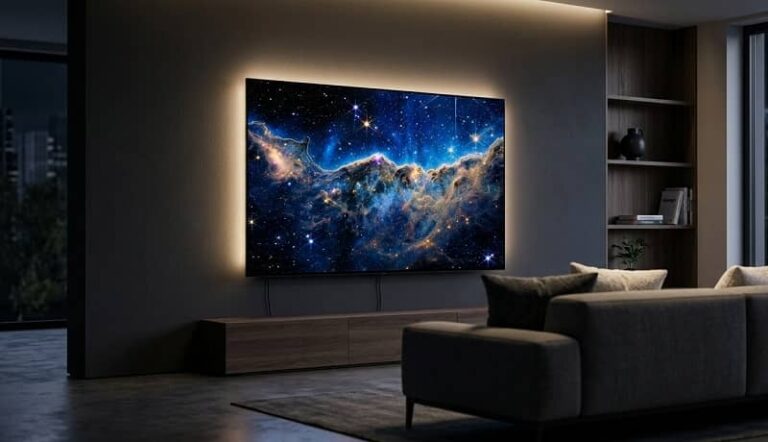
The best 4K OLED TVs available in 2026 represent the most dramatic leap the category has seen in years — and not just from one brand. Across the board, the 2025 panel generation introduced Primary RGB Tandem OLED technology alongside a substantially improved fifth-generation QD-OLED structure, pushing peak brightness figures past 3,000 nits on the most capable models while preserving the absolute black levels that make OLED fundamentally different from any backlit display.
Whether you’re building a dedicated home cinema, upgrading for next-generation console gaming, or simply replacing an aging LCD that no longer satisfies, the sets available right now — many carrying significant clearance discounts as retailers make room for 2026 models — offer exceptional value.
This guide covers the ten best 4K OLED TVs you can buy right now, with verified current pricing and everything you need to make the right call.
Why 2025’s OLED Generation Is a Genuine Leap Forward
Two things changed in the 2025 OLED model year that weren’t incremental updates — they were structural. First, LG Display commercialized Primary RGB Tandem OLED, a stacked panel design that layers two separate OLED structures to double the available light output without sacrificing black-level performance. The LG G5 and Panasonic Z95B both ship with this panel, and the brightness numbers it produces — reviewers measured the Z95B hitting over 2,100 nits in full-screen sustained brightness — are in a different category from anything WOLED achieved previously.
Second, Samsung Display’s fifth-generation QD-OLED panel made its own significant gains in color volume and peak brightness, powering the Samsung S95F and Sony Bravia 8 II. The S95F’s anti-glare matte coating, inherited from last year’s model but refined further, now genuinely neutralizes direct reflections without the black-level penalty that plagued early matte-coated displays. Taken together, the result is a class of televisions where even the mid-range models offer picture quality that would have been considered flagship-tier two years ago.
The 10 Best 4K OLED TVs to Buy in 2026
LG C5 OLED — Best Overall 4K OLED TV
The LG C5 carries on the C series tradition of being the benchmark recommendation for the widest possible range of buyers, and the 2025 iteration is the most convincing version yet. Its Alpha 9 Gen8 AI Processor brings a measurable brightness boost over the C4 alongside new AI-driven picture and sound enhancement features, while the underlying WOLED evo panel continues to deliver the class-leading viewing angles and color uniformity that have defined LG’s mid-range lineup. The C5 supports Dolby Vision, Dolby Vision Game Mode, HDR10, and HLG — a more comprehensive HDR format lineup than Samsung’s equivalent offering, which remains a meaningful advantage for streaming and Blu-ray content.
Gamers get all four HDMI ports running at full 2.1 bandwidth with 4K/144Hz support, VRR, ALLM, and Dolby Vision Gaming enabled simultaneously — a configuration that no other mainstream OLED TV matches as completely. WebOS 25 remains the most fluid and intuitive smart TV platform in the market, and the C5’s availability from 42 to 83 inches makes it the most size-flexible recommendation in the category. With retailers clearing 2025 stock aggressively ahead of 2026 launches, the 65-inch C5 has been selling at Best Buy for as low as $1,399.99 — down from an original $2,699.99 MSRP (verify current pricing at lg.com).
- Alpha 9 Gen8 AI Processor with AI Picture and Sound Pro
- Four full-bandwidth HDMI 2.1 ports, 4K/144Hz, Dolby Vision Gaming
- Dolby Vision IQ, HDR10, HLG — comprehensive format support
- WebOS 25 with hands-free voice control and cloud gaming
Available at LG.com, Best Buy, Amazon, Walmart, and Costco.
Samsung S95F QD-OLED — Best for Bright Rooms and Gamers
The Samsung S95F is what happens when a company takes its already-excellent QD-OLED technology and systematically addresses every criticism that ever appeared in a review. The 2025 flagship carries a fifth-generation QD-OLED panel, a refined version of the anti-glare matte coating that made the S95D a breakthrough, and a native 165Hz refresh rate that puts it ahead of every competitor for high-frame-rate PC gaming. RTINGS.com rated it the best overall OLED TV tested in 2025, citing its rare combination of top-tier image quality, gaming performance, and versatility across content types.
The One Connect Box design — relocating all ports and processing electronics to a separate unit connected by a single cable — keeps the display panel itself extraordinarily thin and makes cable management in wall-mount installations genuinely elegant. The NQ4 AI Gen3 processor handles scene optimization effectively, and Samsung Vision AI adds features like automatic picture adjustment based on real-time room lighting analysis. The trade-off that follows Samsung through every generation remains: no Dolby Vision support, with HDR10+ serving as the alternative. For buyers with Dolby Vision-heavy content libraries, that’s a consideration; for most living room setups, it rarely matters in practice. The 55-inch S95F retails at approximately $2,199.99 and the 65-inch at $2,999.99 (verify at samsung.com for current promotions).
- 5th-gen QD-OLED panel with refined matte anti-glare coating
- Native 165Hz refresh rate with AMD FreeSync Premium Pro
- One Connect Box for ultra-thin display and clean cable routing
- NQ4 AI Gen3 Processor with Samsung Vision AI
Available at Samsung.com, Best Buy, and B&H Photo.
Sony Bravia 8 II QD-OLED — Best Picture Processing Available
Sony’s Bravia 8 II took the top award at the What Hi-Fi? Awards 2025 and won Value Electronics’ expert TV shootout — not because it has the highest peak brightness (the LG G5 and Samsung S95F are both brighter), but because its XR Cognitive Processor produces a more three-dimensional, cinematic image than any competing television at any price. The 2025 model uses the same fifth-generation QD-OLED panel as the Samsung S95F, then runs it through Sony’s proprietary processing chain — and the difference in how the two sets render the same panel is consistently noticeable. Skin tones in particular are more natural on the Bravia 8 II; motion is handled with more nuance; shadow detail in dark scenes is more carefully preserved.
Studio Calibrated Modes for Netflix, Prime Video, and Sony Pictures Core deliver content with color science matched to the relevant streaming platform’s mastering environment — a genuinely useful feature for subscribers to those services. Acoustic Surface Audio+, which uses the screen panel itself as a speaker via actuators, creates a remarkably wide and stable sound stage without visible speaker grilles. The Bravia 8 II is available only in 55 and 65 inches, which limits its appeal for buyers seeking 77-inch options. The 55-inch launched at $1,999.99 and the 65-inch at $3,499.99 (check sony.com for current pricing and promotions).
- 5th-gen QD-OLED panel with XR Cognitive Processor
- Studio Calibrated Modes for major streaming platforms
- Acoustic Surface Audio+ with screen-as-speaker technology
- Dolby Vision, IMAX Enhanced, and Google TV with Chromecast
Available at Sony.com, Best Buy, Crutchfield, and Amazon.
LG G5 OLED — Best Premium OLED for Home Theater
The LG G5 marks the most significant generational upgrade in LG’s gallery lineup in years, replacing the MLA-enhanced WOLED of the G4 with the brand-new Primary RGB Tandem OLED panel. The result is dramatically higher full-screen brightness — a critical improvement over previous WOLED designs that struggled in sustained bright-scene performance — alongside richer color reproduction and a 165Hz native panel refresh rate that matches Samsung’s S95F. In What Hi-Fi?’s direct comparison of all four 2025 flagship OLEDs, the G5 placed third overall but received the strongest gaming endorsement, earning a recommendation specifically for buyers who prioritize gaming feature completeness.
The gallery-mount form factor ships standard with slim-fit and no-gap wall mounting hardware, allowing the G5 to sit flush against the wall with no visible gap — a genuine aesthetic advantage in living rooms where the television doubles as a design element. Four HDMI 2.1 ports, Dolby Vision IQ, and HDR10 Pro are all present. The G5’s one consistent weak point in testing is slightly raised black levels in ambient-lit rooms compared to the Bravia 8 II and Panasonic Z95B — a characteristic of the new Tandem panel that LG is actively addressing. The 65-inch G5 launched at approximately $3,299.99 and carries discounts at major retailers as 2026 models approach (verify at lg.com).
- Primary RGB Tandem OLED panel with 165Hz native refresh
- Gallery-series flush wall mounting included
- Four HDMI 2.1 ports with Dolby Vision Gaming at 4K/144Hz
- Alpha 9 Gen8 AI Processor with enhanced AI upscaling
Available at LG.com, Best Buy, Crutchfield, and Amazon.
Panasonic Z95B OLED — Best for Film Accuracy
The Panasonic Z95B uses the same Primary RGB Tandem OLED panel as the LG G5, but it’s tuned with a fundamentally different philosophy — accuracy over aggression. Where LG and Samsung push brightness and saturation hard, Panasonic calibrates for cinematic fidelity, producing images that reproduce the colorist’s intent with exceptional precision. Tom’s Guide’s reviewer described the Z95B as quickly becoming their top pick of 2025, crediting its combination of color accuracy, HDR performance, and audio — the built-in speaker system, which fires in multiple directions including upward and to the sides, genuinely outperforms the audio on any competing OLED set by a wide margin.
The Z95B runs Amazon’s Fire TV platform, which provides access to cloud gaming services alongside standard streaming apps — a useful addition for buyers who don’t own a dedicated gaming console. It also includes an ATSC 3.0 tuner for NextGen TV 4K broadcasts, a feature absent from LG and Samsung equivalents. The trade-off for Panasonic’s conservative calibration approach is that content looks more restrained than the LG or Samsung in casual viewing, which some buyers prefer and others find underwhelming. For dedicated cinema setups, it’s among the best displays money can buy. The 65-inch Z95B launched at $3,399.99 (verify at panasonic.com/us or authorized European retailers).
- Primary RGB Tandem OLED panel with cinema-accurate factory calibration
- Multi-directional speaker system with upward and side-firing drivers
- Amazon Fire TV with cloud gaming and ATSC 3.0 NextGen TV tuner
- Dolby Vision, HDR10+, and HDR10 Adaptive support
Available at Panasonic.com, Best Buy, and B&H Photo.
Samsung S90F QD-OLED — Best Mid-Range QD-OLED
The Samsung S90F occupies the sweet spot in Samsung’s 2025 OLED lineup — QD-OLED technology at a more accessible price than the S95F, without the premium anti-glare coating or 165Hz panel refresh rate. What it does carry is Samsung’s NQ4 AI Gen3 processor, four HDMI 2.1 ports supporting 4K/144Hz, AMD FreeSync Premium Pro, NVIDIA G-Sync compatibility, and an input lag figure that RTINGS measured at 9.2ms — excellent for the category. For buyers who want QD-OLED’s vivid color and brightness advantage over WOLED without paying the full S95F price premium, the S90F delivers the core experience at a meaningfully lower entry point.
Samsung Vision AI features are present on the S90F, and the Tizen OS is as fast and well-stocked as ever. The lack of a matte coating means bright-room performance is somewhat behind the S95F, and the 144Hz panel cap matters only for high-end PC gamers; console users won’t encounter it. Pricing is aggressive: the 55-inch S90F is listed at $1,299.99 and the 65-inch at $1,499.99 (verify at samsung.com or valueelectronics.com).
- QD-OLED panel with NQ4 AI Gen3 processor
- Four HDMI 2.1 ports with 4K/144Hz and VRR
- Samsung Gaming Hub for cloud gaming without a console
- AMD FreeSync Premium Pro and NVIDIA G-Sync compatible
Available at Samsung.com, Best Buy, Costco, and Amazon.
LG B5 OLED — Best Budget Entry into 4K OLED
The LG B5 is the clearest argument for choosing OLED over a premium LED display at the same price. It uses LG’s WOLED evo panel technology — the same fundamental self-emissive structure as the C5 and G5, without the brightness enhancements of the upper-tier models — and pairs it with an Alpha 8 Gen7 processor that handles upscaling and HDR tone mapping reliably for everyday content. All four HDMI ports support 2.1 bandwidth at 4K/120Hz, covering every current-generation gaming console without compromise. Dolby Vision is supported, which puts the B5 ahead of Samsung’s S85F equivalent in HDR format coverage.
For buyers stepping up from an LED television for the first time, the B5 produces the OLED revelation — perfect blacks, self-emissive pixel control, wide viewing angles — at a price that has dropped significantly since launch. The 48-inch B5 has sold for as low as $649.99 at Best Buy during clearance events, and the 65-inch model typically retails around $1,299.99 to $1,699.99 depending on retailer and timing (verify at lg.com). It may be one of the last opportunities to acquire this model before 2026 inventory replaces it entirely.
- WOLED evo panel with self-emissive pixel control
- Four HDMI 2.1 ports with 4K/120Hz across all inputs
- Dolby Vision and HDR10 support
- WebOS 25 with magic remote and cloud gaming
Available at LG.com, Best Buy, Walmart, and Amazon.
Philips OLED910 — Best Value Flagship OLED in Europe
The Philips OLED910 pulled off something unexpected in 2025: it brought Primary RGB Tandem OLED — the same panel technology found in the LG G5 — to market at a price that undercuts LG’s flagship by over £1,000 in the UK. TechRadar’s reviewer called it the brightest OLED they had ever measured, including in full-screen brightness, and awarded it a glowing assessment that placed it ahead of much more expensive competition. The fourth-generation four-sided Ambilight system, which projects colored light across the wall behind the screen in sync with on-screen content, adds a layer of immersive viewing that no other television brand offers and reduces perceived eye strain during extended sessions.
The Bowers & Wilkins-developed 81-watt 3.1-channel audio system is the best integrated sound on any OLED television reviewed in 2025, comfortably eliminating the need for a soundbar in rooms with standard acoustic properties. The P5 Gen9 AI processor handles picture optimization intelligently, and Google TV provides a familiar and comprehensive app ecosystem. The primary limitation versus the LG G5 and Samsung S95F is that only two of the four HDMI ports run at full 2.1 bandwidth, which constrains the most demanding gaming configurations. UK pricing sits at £1,799 for the 65-inch as of early 2026 — equivalent to roughly $2,200–$2,300 USD (verify at philips.com/en-gb or Currys).
- Primary RGB Tandem OLED panel with P5 Gen9 AI processor
- Four-sided Ambilight with real-time on-screen sync
- Bowers & Wilkins 81W 3.1-channel integrated audio
- Google TV with two HDMI 2.1 ports and 4K/120Hz gaming
Available at Philips.com, Currys, Richer Sounds, and MediaMarkt (European markets).
Sony Bravia 8 OLED — Best Mid-Range Sony OLED
For buyers who want Sony’s picture processing heritage and Google TV integration without the Bravia 8 II’s premium price, the Sony Bravia 8 provides the XR OLED Contrast Pro panel and XR Triluminos Pro color processing in a more accessible package. It runs on Sony’s XR processor — a generation behind the Bravia 8 II’s system but still producing picture quality that outperforms most competing mid-range OLEDs on real-world content. The Acoustic Surface Audio system, using screen-vibrating actuators for sound, creates better spatial audio than typical built-in speakers at the price point.
The Bravia 8 is the natural recommendation for households invested in the Google ecosystem — Android phones, Chromecast devices, Nest speakers — where native integration reduces friction in daily use. Gaming performance is solid with HDMI 2.1 support and 4K/120Hz, though it doesn’t match the four-port 2.1 configuration of LG’s lineup. As Sony’s prior-generation flagship transitions to clearance pricing, the value proposition strengthens considerably. The 65-inch Bravia 8 has been available for approximately $1,799.99 at major US retailers (verify at sony.com for current availability).
- XR OLED Contrast Pro panel with XR Triluminos Pro
- Acoustic Surface Audio for screen-integrated sound output
- Native Google TV with Chromecast and Dolby Vision
- HDMI 2.1 with 4K/120Hz and VRR gaming support
Available at Sony.com, Best Buy, and Amazon.
Philips OLED760 — Best Affordable OLED for European Buyers
The Philips OLED760 serves buyers in European markets who want OLED picture quality without flagship pricing — and it does so with Philips’ signature Ambilight feature intact, which immediately differentiates it from every other entry-level OLED competitor. It uses an OLED EX panel rated at approximately 1,000 nits peak, which is lower than the Primary RGB Tandem models higher in Philips’ lineup but still substantially brighter than earlier-generation WOLED panels. The 7th-generation P5 AI processor handles upscaling and tone mapping for typical streaming content effectively, and the three-sided Ambilight system provides the immersive ambient lighting experience at an accessible price point.
The OLED760 runs Titan OS rather than Google TV — a simpler smart platform that covers major streaming services but lacks some of the ecosystem integration of Google’s system. For buyers who primarily use external streaming devices connected via HDMI, the smart platform matters less. Three-sided Ambilight, solid OLED fundamentals, and a price that competes directly with premium LED sets make it a compelling case for OLED value in European markets. UK pricing starts at £1,199 for the 55-inch and £1,499 for the 65-inch (verify at philips.com/en-gb).
- OLED EX panel at approximately 1,000 nits peak brightness
- Three-sided Ambilight with on-screen content sync
- P5 Gen7 AI processor with upscaling optimization
- Titan OS with access to major streaming services
Available at Philips.com and European retailers including Currys and MediaMarkt.
Pricing Comparison Across the Best 4K OLED TVs in 2026
The 2025 OLED generation arrived with pricing that caused genuine surprise across the market — not because flagships got cheaper, but because competition from Sony and Panasonic at launch prices nearly identical to Samsung and LG forced a different kind of value calculation. The Samsung S95F and LG G5 launched in the $3,000–$3,500 range for 65-inch models, and so did the Sony Bravia 8 II and Panasonic Z95B. For the first time in years, the premium European-Japanese brands didn’t carry a price penalty for the privilege of cinema-accurate performance and superior audio. That dynamic has shifted the conversation from “which brand can I afford” to “which set best matches my priorities.”
At the mid-range tier — $1,300 to $2,000 for 55 to 65-inch panels — the LG C5, Samsung S90F, Sony Bravia 8, and LG B5 compete fiercely. The C5 offers the most balanced feature set in this range, the S90F brings QD-OLED color volume at a lower price than the S95F, and the Sony Bravia 8 delivers processing quality that exceeds its price bracket. The LG B5 represents the entry point to genuine OLED performance for buyers on the tightest budget, particularly now that clearance pricing has pushed 48-inch models below $700 at select retailers.
In European markets, Philips has complicated the conversation further by bringing Primary RGB Tandem OLED to the OLED910 at a price that substantially undercuts the LG G5 — which uses an identical panel. The OLED910’s £1,799 price point for the 65-inch, significantly lower than competing tandem-panel sets, makes it one of the strongest value propositions in any OLED category outside the US market. For buyers in the UK, Germany, and elsewhere in Europe, the Philips lineup deserves comparison alongside the standard LG-Samsung-Sony shortlist before any purchase decision is finalized.
How to Choose the Right 4K OLED TV for Your Home
Room lighting conditions should come first in the decision tree, before brand or budget. The Samsung S95F’s matte anti-glare coating is in a class of its own for rooms with windows or overhead lighting that can’t be controlled — it neutralizes direct reflections in a way that competing OLED sets, regardless of price, cannot replicate. Reviewers who placed it next to the LG G5 and Sony Bravia 8 II in lit conditions consistently found Samsung’s glare management decisive. If your viewing room is dark or well-controlled, the brightness advantage of the Tandem OLED panels in the LG G5 and Panasonic Z95B becomes more relevant, and the matte coating’s trade-off (slightly elevated black floors under ambient light) becomes a non-issue.
Gaming requirements can determine the purchase as definitively as room lighting. For PlayStation 5 and Xbox Series X owners, four-port HDMI 2.1 is a genuine quality-of-life feature that allows a console, Blu-ray player, and streaming device to all connect at full bandwidth simultaneously without a switch. The LG C5 and G5 lead here. PC gamers pushing 165Hz and beyond should look specifically at the Samsung S95F or LG G5, whose native 165Hz panels support frame rates that no current-generation console can produce but that high-end gaming PCs can. For buyers who game exclusively on consoles or don’t game at all, the Sony Bravia 8 II and Panasonic Z95B’s slightly reduced gaming specifications are practically irrelevant.
HDR format support affects daily viewing more than it appears on paper. Dolby Vision is present on LG, Sony, Panasonic, and Philips sets — and absent from all Samsung televisions, which use HDR10+ as their alternative. Dolby Vision is more widely supported across streaming services, 4K Blu-ray content, and gaming platforms including Xbox. For buyers with substantial Dolby Vision content libraries or Xbox ecosystems, Samsung’s exclusion of the format is a genuine consideration worth weighing against the S95F’s brightness and anti-glare advantages.
Smart TV platform affects the daily experience of using the television far more than marginal picture quality differences between comparable sets. LG’s WebOS 25 is consistently rated the fastest and most intuitive for navigating streaming services. Google TV on Sony sets integrates naturally with Android and Chromecast ecosystems. Samsung’s Tizen is polished and quick, with the addition of Samsung Gaming Hub for cloud-based gaming without a console. Amazon’s Fire TV on the Panasonic Z95B is comprehensive and adds cloud gaming access. None of these platforms is objectively poor — the choice should reflect what you already own and use.
Current Market Prices and 2026 Clearance Deals
Best Buy is actively clearing 2025 OLED inventory ahead of new 2026 model arrivals, and the discounts are exceptional by any historical standard. The LG C5 65-inch, which launched at $2,699.99, has sold for $1,399.99 — a $1,300 reduction representing nearly 50% off. The LG B5 48-inch has hit $649.99, a 50% discount from its $1,299.99 launch price. Samsung’s 65-inch S95F, which launched at approximately $3,299.99, has appeared at $2,499.99 with bundle promotions that sometimes include a Samsung soundbar at the base price.
Walmart has run parallel promotions on LG’s lineup, with some C5 configurations reportedly discounted over $1,500 from launch pricing. Costco’s OLED bundles frequently include extended warranty coverage as part of the package price — meaningful for four-figure electronics. Amazon’s price-match and third-party seller ecosystem means comparison shopping across platforms before purchasing is worth the twenty minutes it takes. In European markets, Currys and MediaMarkt are running similar clearance events, and the Philips OLED910’s already-competitive launch pricing has dropped further since its September 2025 release, making it one of the most compelling current values on that side of the Atlantic.
Pro Tips for Buying and Setting Up Your 4K OLED TV
Buy the largest screen your viewing distance and room allow. The most common post-purchase regret in television buying is choosing a screen that feels too small after a few weeks of use. A 65-inch OLED at a six-to-eight-foot viewing distance delivers a qualitatively different cinematic experience than a 55-inch at the same distance, and the price difference between the two sizes has compressed considerably as production scales. If the 65-inch and 77-inch options are both within budget, the 77-inch is almost always the better long-term decision.
Activate Filmmaker Mode or Cinema preset immediately after setup. Factory default settings on every television in this guide are calibrated for retail showroom conditions — bright, saturated, and motion-processed in ways that look artificial at home. Filmmaker Mode disables motion smoothing, corrects color temperature, and removes unnecessary picture processing in a single step. The resulting image more closely represents what the content creators intended, and for film and streaming content, the difference is immediately visible and permanently preferable.
Enable the panel’s built-in pixel maintenance routine and set it to run overnight on a regular schedule. LG calls it Pixel Refresher; Samsung and Sony have equivalent functions. Running this routine every few months — particularly if your usage includes static HUD elements from gaming or news tickers — equalizes pixel wear and prevents the gradual brightness differential that can appear in areas of persistent image retention.
Use HDMI eARC rather than optical for any soundbar or AV receiver connection. The optical output that ships on every television carries only compressed audio — it cannot transmit lossless Dolby Atmos or DTS:X bitstreams. HDMI eARC carries the full uncompressed audio signal, which produces a measurably better result on any Atmos-encoded content. Most soundbars released since 2022 support eARC; the connection requires only a single HDMI cable between the television’s eARC-labeled port and the soundbar’s HDMI input.
Calibrate with a Filmmaker Mode baseline first, then consider a professional ISF calibration if picture accuracy matters significantly. For most buyers, Filmmaker Mode plus a brief manual adjustment of brightness (OLED light level) to match room conditions produces excellent results. Buyers who want maximum accuracy — particularly relevant for the Sony Bravia 8 II and Panasonic Z95B, both of which have exceptionally accurate factory calibrations to work with — can hire an ISF-certified calibrator for a session that typically runs $250–$400 and optimizes the display for specific room conditions and viewing angles.
Frequently Asked Questions About 4K OLED TVs in 2026
What is Primary RGB Tandem OLED and how does it differ from standard OLED?
Primary RGB Tandem OLED stacks two separate OLED emitter layers on top of each other, effectively doubling the available light output compared to a single-stack design. Crucially, it also shifts from white OLED with color filters to a true RGB emitter structure that produces red, green, and blue light directly, eliminating the efficiency losses of color filtering. The result is dramatically higher full-screen sustained brightness — the Panasonic Z95B measured over 2,100 nits in full-screen sustained output in independent testing — alongside richer color volume at high luminance levels. The LG G5, Panasonic Z95B, and Philips OLED910 all use this panel technology in 2025.
Should I wait for 2026 OLED TV models or buy now?
If you can access one of the current clearance promotions, buying a 2025 model now is well justified for most buyers. The C5, S95F, Bravia 8 II, and Z95B will all produce outstanding picture quality for the entire foreseeable content landscape — 4K HDR Dolby Vision content, 4K/120Hz gaming, and any streaming format currently in distribution. The 2026 models will offer incremental improvements in brightness and processor generation, but they will also launch at premium prices. A C5 at $1,399.99 or an S95F at $2,499.99 during clearance represents exceptional value compared to paying launch prices for their successors six months from now.
Is burn-in still a risk with 2025 and 2026 OLED TVs?
Under normal mixed-use viewing conditions, permanent image retention is not a realistic concern for modern OLED panels. Every major brand includes multiple protective mechanisms: pixel shifting, automatic brightness limiters that activate on static content, periodic panel refresh routines, and screensavers. Long-term owner data across thousands of LG C and G series sets, Samsung QD-OLEDs, and Sony OLED sets shows that burn-in under typical household use — varied streaming content, gaming with occasional static HUD elements, and sports — is extremely rare. The scenarios that carry genuine risk involve thousands of hours of a single static high-contrast image at maximum brightness, which typical household viewing does not produce.
Is QD-OLED or Primary RGB Tandem OLED better?
The comparison depends on what you’re optimizing for. QD-OLED — as found in the Samsung S95F and Sony Bravia 8 II — excels at peak brightness in small highlight windows and offers Samsung’s unmatched matte anti-glare coating on the S95F. Primary RGB Tandem OLED — in the LG G5 and Panasonic Z95B — produces higher sustained full-screen brightness and maintains near-perfect blacks even in ambient-lit rooms, a trade-off where QD-OLED with matte coatings sometimes shows elevated black floors. Both technologies are exceptional, and the differences are meaningful primarily for specific use cases: bright rooms favor S95F; dark-room film accuracy favors Z95B; balanced living rooms can go either way.
Do I need four HDMI 2.1 ports, or is two enough?
For a single-console household with a soundbar connected via eARC, two HDMI 2.1 ports covers the setup with one port to spare. Four HDMI 2.1 ports become practically useful when you’re running multiple 4K/120Hz devices simultaneously — PlayStation 5, Xbox Series X, and a 4K Blu-ray player, for example — without routing any of them through a switch. The LG C5 and G5 are the only sets in this guide that provide four full-bandwidth HDMI 2.1 ports; for buyers with complex multi-source setups, that’s a meaningful practical advantage.
Which OLED TV is best for gaming specifically?
The LG C5 is the broadest recommendation for most gaming setups — four HDMI 2.1 ports, Dolby Vision Gaming, 4K/144Hz, sub-2ms input lag in game mode, and WebOS 25’s Game Optimizer are a complete package at a mid-range price. Buyers who prioritize PC gaming at maximum frame rates should consider the Samsung S95F or LG G5, both of which feature native 165Hz panels. Sony’s Bravia 8 II is an excellent gaming display with strong gaming specs, but its slightly higher input lag in game mode and lack of four HDMI 2.1 ports make it a secondary recommendation for gaming-first buyers.
How does OLED compare to Mini-LED in 2026?
Mini-LED has closed the brightness gap significantly — top-tier Mini-LED sets from Samsung and Sony now exceed OLED’s peak brightness by a substantial margin in the brightest scenes. What Mini-LED cannot replicate is OLED’s pixel-level control. Local dimming zones on Mini-LED panels produce blooming — a halo of light around bright objects on dark backgrounds — that is absent from OLED, where each pixel turns off independently. For dark-room viewing of film and drama, OLED’s contrast performance remains unmatched. For sports and gaming in bright rooms, flagship Mini-LED is a legitimate alternative. For buyers who primarily watch mixed content across varied conditions, OLED remains the more versatile technology.
What screen size should I choose for a living room?
The standard formula — viewing distance in inches divided by 1.6 — suggests that a 10-foot (120-inch) viewing distance supports a 75-inch screen comfortably. Most viewers significantly underestimate how quickly they adapt to larger screen sizes and how rarely a screen feels too large in an actual living room setting. If the choice is between 55 and 65 inches at a nine-foot viewing distance, the 65-inch is almost universally the better long-term choice. OLED’s exceptional off-axis performance — significantly better than edge-lit LCD — means that larger screens viewed from side angles still look excellent, further reducing the risk of buying too large.
Conclusion
The 4K OLED market entering 2026 is the strongest it has ever been, and the clearance window created by incoming new models is the best buying opportunity the category has offered in years. The LG C5 is the consensus best overall purchase for the majority of buyers — a complete, versatile, well-priced set that excels at every content type without meaningful compromise. Buyers prioritizing bright-room performance and maximum brightness should look seriously at the Samsung S95F, which addresses the one practical limitation OLED has historically carried. For those who want cinema-level accuracy and the finest integrated audio in any television, the Sony Bravia 8 II and Panasonic Z95B offer a different kind of excellence that no brightness specification captures. European shoppers should add the Philips OLED910 to any shortlist — it brings Primary RGB Tandem OLED technology to a price that seriously undercuts the competition and adds Ambilight and Bowers & Wilkins audio that no rival offers.
Whatever you choose from this list, the upgrade from an LCD or plasma television to a current OLED will be immediately and permanently visible on every piece of content you watch. Perfect blacks, pixel-precise HDR, and viewing angles that remain accurate well off-axis are not marketing abstractions — they are physically real properties that change the experience of watching a film, following a sports match, or spending a session in a game world. Invest thoughtfully, buy the largest size your room and budget allow, and the display will justify that investment every day you turn it on.