

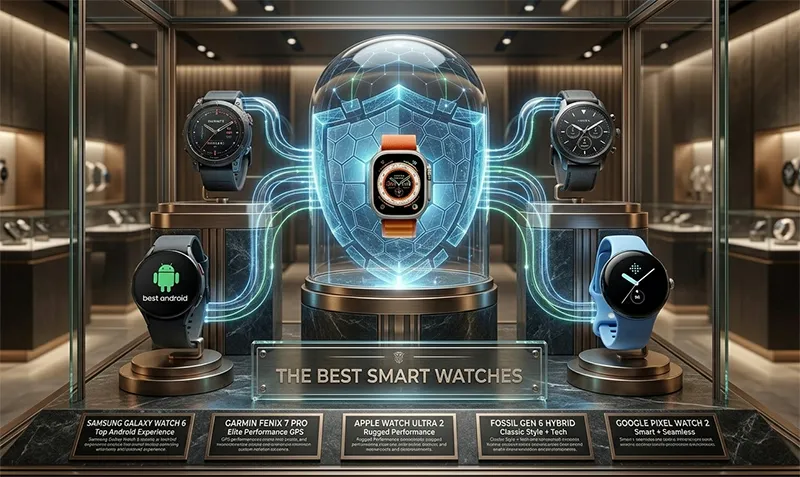
The best smartwatches in 2026 do far more than count steps. From ECG sensors that detect irregular heart rhythms to satellite SOS for off-grid emergencies, today’s wearables have become the most personal piece of tech most people own. The challenge is that no single smartwatch is best for everyone — the right choice depends on the phone in the pocket, the fitness goals on the calendar, and how much charging is acceptable. This guide cuts through the confusion with tested picks covering every budget, ecosystem, and use case.
How to Choose the Best Smartwatch
Before diving into individual picks, three decisions narrow the field dramatically.
Phone compatibility is the most important factor. Apple Watch works exclusively with iPhone — no Android compatibility, no exceptions. Samsung Galaxy Watch delivers its full feature set only when paired with a Samsung phone, though it functions at a reduced level with other Android devices. Google Pixel Watch integrates most deeply with Pixel phones but works with any Android 10+ device. Garmin, Amazfit, and Fitbit watches work with both iPhone and Android through their companion apps, making them ecosystem-agnostic choices.
Battery life is the second major dividing line. Flagship smartwatches from Apple, Samsung, and Google typically last one to two days — a daily charging habit is the trade-off for comprehensive app ecosystems and always-on displays. Garmin, Amazfit, and Huawei prioritize battery longevity, stretching to five to fourteen days on a single charge. The Garmin Fenix 8 reaches 27 days in battery-saver mode. For travelers and outdoor enthusiasts, this difference is not trivial.
Health feature requirements determine how far up the price ladder to climb. Basic heart rate monitoring and sleep tracking come standard on virtually every smartwatch at every price. ECG and AFib detection are available on Apple Watch Series 11, Samsung Galaxy Watch 8, and Google Pixel Watch 4 — all FDA-cleared. Advanced training metrics, multi-band GPS accuracy, and recovery tracking are Garmin’s stronghold. Blood pressure monitoring with full medical certification is currently unique to Huawei. Most major brands now include SpO2 blood oxygen monitoring as standard.
Best Smartwatches of 2026
1. Apple Watch Series 11 — Best Overall for iPhone Users
The Apple Watch Series 11 is the benchmark against which every other smartwatch is measured in 2026. Available in 42mm and 46mm sizes, it delivers the deepest iPhone integration available — handling calls, messages, Apple Pay, Siri, HomeKit, and the complete App Store ecosystem directly from the wrist. watchOS 26 adds refined watch faces, updated UI elements, and Wrist Flick gestures for dismissing alerts without lifting a finger.
Health tracking is among the most comprehensive of any consumer wearable. The Series 11 includes FDA-cleared ECG, AFib detection, sleep apnea detection, blood oxygen monitoring, skin temperature sensing, and crash detection. GPS accuracy is reliable for casual to intermediate runners, though serious endurance athletes will still find Garmin’s training metrics more detailed. Battery life reaches a realistic 24 to 28 hours in normal use with fast charging capable of delivering a full day’s power in around 30 minutes.
The aluminum model starts at approximately $299 for GPS-only. The GPS + Cellular version adds around $100 and enables calls, streaming, and emergency SOS without the phone nearby. Compatible with iPhone 11 and later, the Series 11 is the obvious answer for any iPhone user who does not require ultra-long battery life or professional-grade fitness analytics. Pairing the Apple Watch with AirPods through the Automatic Switching feature creates one of the tightest wireless audio and health ecosystems available.
2. Apple Watch Ultra 3 — Best Premium Outdoor Smartwatch
The Apple Watch Ultra 3 pushes Apple’s wearable capabilities to their physical limit. Built from aerospace-grade titanium with a 49mm case, it delivers 42 hours of standard battery life — expandable to 60 hours in low-power mode — making it the longest-lasting Apple Watch ever. Dual-frequency GPS (L1 and L5) provides precision tracking even in dense urban environments and deep canyons where standard GPS struggles. Satellite connectivity, previously reserved for iPhones, is now integrated directly, enabling emergency SOS messaging when no cellular or Wi-Fi signal is available.
The display reaches over 3,000 nits of peak brightness — readable in direct sunlight during mountain runs or water sports. Water resistance is rated to 100 meters, supporting diving as well as swimming. A dedicated Action button enables one-press access to workouts, Compass waypoints, or custom shortcuts. All health sensors from the Series 11 are included, plus enhanced precision for wrist temperature during sleep tracking.
At approximately $799, the Ultra 3 is priced for users who genuinely push their gear: triathletes, mountaineers, divers, and long-distance cyclists. For iPhone users who primarily run city routes and visit the gym, the Series 11 covers every practical need at less than half the price. The Ultra 3 makes sense when the battery duration and structural toughness of the device need to match the demands of the activity.
3. Samsung Galaxy Watch 8 — Best Android Smartwatch All-Rounder
The Samsung Galaxy Watch 8 brings a redesigned “squircle” case — round with straight sides — that is more comfortable against the wrist than previous Galaxy Watch designs. Available in 40mm and 44mm, it includes a 50% brighter display over its predecessor, a slightly larger battery, and Samsung’s most advanced health tracking suite to date. AI-powered wellness features include Samsung Running Coach, which builds personalized training plans based on fitness history, and Google Gemini integration for voice-controlled AI assistance.
Health monitoring covers ECG and AFib detection, sleep apnea detection, blood oxygen, continuous heart rate, and advanced sleep stage analysis. Multi-band GPS delivers outdoor tracking accuracy that rivals Garmin for casual athletes. Battery life reaches up to 40 hours with the always-on display enabled — stretching to around 10 days with raise-to-wake only, which is unusually strong for a full-featured Wear OS device.
Full ECG, irregular heart rhythm notifications, and sleep apnea detection require pairing with a Samsung phone — these features are disabled when the watch is paired with non-Samsung Android devices. Compatible with all Android phones running Android 10 or later. Pricing starts at approximately $399.99. For Samsung phone users, the Galaxy Watch 8 Classic at $499 adds a stainless steel case and the brand’s iconic rotating bezel, which many users consider the best physical interface on any Android smartwatch. The latest Android 15 updates improve background syncing and health data integration with Wear OS devices including Galaxy Watch.
4. Google Pixel Watch 4 — Best Wear OS Smartwatch
The Google Pixel Watch 4 fixed the battery problem that made earlier Pixel Watches difficult to recommend. At 60+ hours per charge in standard use — validated across multiple independent tests — the Watch 4 outlasts both the Apple Watch Series 11 and Samsung Galaxy Watch 8 by a significant margin while maintaining the Pixel’s signature domed Actua 360 display. Available in 41mm and 45mm sizes with five color options.
Fitbit’s health platform is now fully integrated into the Pixel Watch experience: Sleep Score, Daily Readiness, stress management, and heart rate zone training all work seamlessly within the Wear OS interface. Gemini AI handles voice commands faster than Siri or Bixby in independent comparisons. New to the Watch 4 is satellite SOS emergency assistance on the LTE version — a feature previously found only in the Apple Watch Ultra 3 and Garmin Fenix 8 Pro. The watch is compatible with any Android 10+ device but delivers the deepest integration with Pixel phones, where it picks up on device data for more accurate health insights.
Pricing starts at $349 for the 41mm GPS model. The 45mm LTE version tops out around $499. For Android users who are not on Samsung and want native Google ecosystem integration — Google Maps, Google Wallet, Google Assistant, and Gemini all running natively — the Pixel Watch 4 is the strongest choice in its class.
5. Garmin Fenix 8 — Best Smartwatch for Serious Athletes
The Garmin Fenix 8 is the standard against which every other multisport smartwatch is measured. Available in three case sizes (41mm, 47mm, and 51mm) with AMOLED or standard display options, it combines Garmin’s full suite of advanced training metrics — Training Readiness, Body Battery, VO2 Max, Training Status, Running Tolerance, Endurance Score — with multi-band GPS accuracy, topographic mapping, and the Elevate V5 heart rate sensor, which has proven highly accurate in independent accuracy testing.
Battery life reaches 27 days in smartwatch mode and maintains GPS tracking for over 14 hours in max accuracy mode. A built-in microphone, speaker, and voice assistant support mean it functions as a complete daily wearable, not just a sports computer. The Fenix 8 is one of the first Garmin watches to add satellite connectivity for emergency messaging in remote areas. It works equally well with iPhone and Android through the Garmin Connect app.
Pricing starts at approximately $949.99 and rises based on case size and display option. The Fenix 8 Pro with solar charging adds power management for multi-day expeditions. This watch is designed for runners, cyclists, triathletes, hikers, and swimmers who want data-driven training and are willing to invest in the depth that Garmin’s ecosystem provides. Casual fitness users will find more value in the Garmin Venu 4 or Vivoactive 6 at considerably lower prices.
6. Garmin Venu 4 — Best Smartwatch for Fitness with Long Battery
The Garmin Venu 4 is Garmin’s closest competitor to the Apple Watch and Galaxy Watch in terms of smartwatch feel — it features an AMOLED display with a refined, modern design and an updated interface previously reserved for the brand’s more expensive devices. Available in 41mm and 45mm, it includes a built-in LED flashlight — a practical feature that no Apple, Samsung, or Google watch offers — and an offline Spotify integration for music without a phone.
Health monitoring covers continuous heart rate with ECG, blood oxygen, advanced sleep tracking with Sleep Coach, Garmin Fitness Coach for AI-generated workout plans, and HRV status for recovery tracking. Battery life reaches 8 to 12 days in standard use — significantly longer than any Apple or Samsung option. Multi-band GPS is included for accurate outdoor tracking. Garmin Pay enables contactless payments. Compatible with both iPhone and Android.
Starting at $549.99, the Venu 4 occupies a sweet spot between Garmin’s athletic-focused Forerunner line and the Fenix’s extreme capability. It is the correct Garmin choice for users who want a stylish everyday watch with serious fitness tracking and battery life that survives a weekend trip without a charger. Fitness-focused wearable alternatives like Fitbit trackers offer longer battery at lower prices but lack the GPS accuracy and training depth the Venu 4 provides.
7. Apple Watch SE 3 — Best Budget Smartwatch for iPhone Users
The Apple Watch SE 3 delivers the core Apple Watch experience at roughly $199 — the most accessible entry point into the Apple wearable ecosystem. It includes the always-on display that was absent from the SE 2, upgraded motion sensors, and full compatibility with watchOS 26. Health features cover continuous heart rate, crash detection, fall detection, sleep tracking, and emergency SOS. ECG and blood oxygen monitoring are not included, which is the main functional difference between the SE 3 and the Series 11.
Battery life reaches two days in regular use, which is an improvement over the Series 11’s single-day runtime. For iPhone users who primarily want fitness tracking, notifications, Apple Pay, and smart home control — and are not interested in the advanced health monitoring of the Series 11 — the SE 3 covers all practical daily needs. Available in 40mm and 44mm aluminum only. Compatible with iPhone 11 and later.
8. Samsung Galaxy Watch FE — Best Budget Android Smartwatch
The Samsung Galaxy Watch FE brings most of the flagship Galaxy Watch feature set down to a sub-$200 price point. Running Wear OS with One UI Watch, it includes heart rate monitoring, ECG (Samsung phone required), GPS, sleep tracking, and Google Wallet for contactless payments. The design mirrors the Galaxy Watch 4, using a round aluminum case with a touch-sensitive bezel in 40mm.
Battery life reaches around 40 hours in standard use. While it lacks the newer AI features and health upgrades of the Watch 8, the Watch FE is a strong choice for Android users who want a recognizable smartwatch experience without paying flagship prices. Available for approximately $199. Works with Android 10 and later, with best compatibility on Samsung devices.
9. OnePlus Watch 3 — Best Battery Life in a Full-Featured Android Watch
The OnePlus Watch 3 is the battery life leader among full-featured Android smartwatches, delivering more than 100 hours in standard use according to OnePlus’s own testing — a figure that independent reviews have confirmed approaches three to four full days even with regular GPS use. Running Wear OS with Google services including Gemini and Google Wallet, it maintains a complete smartwatch feature set alongside its exceptional runtime.
The 47mm case carries a 1.43-inch AMOLED display with 3,000 nits brightness, health sensors including heart rate, SpO2, and sleep tracking, and multi-band GPS for outdoor activity. Built-in storage for music and NFC for payments round out the feature set. Priced at $299.99, it sits between the budget Samsung Galaxy Watch FE and the premium Pixel Watch 4 in the Android ecosystem, and is the best choice for Android users who find daily charging of smartwatches fundamentally impractical. The best gaming phones from OnePlus pair particularly well with this watch for a seamless Wear OS experience.
10. Amazfit Bip 6 — Best Budget Smartwatch Under $100
The Amazfit Bip 6 redefines what $79.99 can buy in a smartwatch. The headline upgrade over its predecessor is a shift to a 1.97-inch AMOLED display with 2,000 nits peak brightness — the kind of screen quality that was exclusive to watches costing three times the price just two years ago. An aluminum alloy frame replaces the all-plastic construction of the Bip 5, adding meaningful durability to a product that already survived real-world use better than its price implied.
Key features include built-in GPS, Bluetooth calling via a built-in microphone and speaker, offline maps for turn-by-turn navigation, 140+ workout modes, heart rate monitoring, SpO2 tracking, sleep analysis, and a 14-day battery life on a single charge. Water resistance is rated at 5ATM — safe for swimming and shallow snorkeling. Zepp Flow AI assistant enables voice-controlled navigation and notifications in supported regions.
The trade-offs are real: no ECG, no third-party app ecosystem, GPS accuracy that is adequate for casual use but not reliable for serious athletes, and a Zepp OS interface that is more limited than Wear OS or watchOS. For users who want a capable smartwatch for everyday health tracking and fitness without the daily charging ritual or the $300+ price tags of flagship devices, the Amazfit Bip 6 is the most compelling budget option available in 2026. Compatible with both iPhone and Android.
Smartwatch Buying Guide: Key Features to Compare
Battery Life Reality Check
Manufacturer battery claims are measured under optimal conditions — GPS off, always-on display disabled, minimal notification volume. Real-world battery life is consistently lower. Apple Watch Series 11 claims 18 hours but delivers 24 to 28 hours in practice with moderate use. Samsung Galaxy Watch 8 claims 40 hours with the always-on display but achieves closer to 48 hours in real conditions. Garmin Fenix 8 claims 27 days in smartwatch mode and generally meets that figure. For planning purposes, assume real-world battery life is 10 to 30 percent better than manufacturer specifications for Apple and Samsung, and broadly accurate for Garmin.
LTE Cellular vs GPS-Only
LTE-enabled smartwatches cost $50 to $150 more upfront and require a monthly carrier plan — typically $10 to $15 per month with a compatible carrier. The benefit is independence from the phone: calls, music streaming, emergency SOS, and maps all work when the phone is left behind. This matters most for runners, cyclists, and outdoor adventurers who regularly exercise without their phone. For most desk workers and casual users who always have their phone nearby, the GPS-only model is sufficient and more cost-effective over a two-year ownership period.
Health Monitoring Depth by Price Tier
Under $100: Heart rate, SpO2, sleep stages, step counting, basic GPS. Amazfit and Xiaomi dominate this tier. Between $200 and $350: All of the above plus ECG, AFib detection, crash detection, more accurate GPS. Apple Watch SE 3, Samsung Galaxy Watch FE, and Google Pixel Watch 3 operate here. Between $350 and $600: Advanced health analytics, FDA-cleared sensors, AI health insights, multi-band GPS, ECG, sleep apnea detection, skin temperature. Apple Watch Series 11, Samsung Galaxy Watch 8, Google Pixel Watch 4, and Garmin Venu 4 cover this range. Above $600: Everything in the previous tier plus satellite connectivity, professional athletic metrics, extreme durability, and extended battery. Apple Watch Ultra 3 and Garmin Fenix 8 Pro define this tier. For international travelers, checking international phone plans before activating a cellular smartwatch abroad can prevent unexpected roaming charges tied to the watch’s LTE connection.
FAQ: Best Smartwatches
Can an Apple Watch work with Android?
No. Apple Watch requires an iPhone running iOS 18 or later and cannot be used with Android devices under any configuration. There is no third-party workaround that provides full functionality. Android users considering an Apple Watch for its health features are better served by the Samsung Galaxy Watch 8, Google Pixel Watch 4, or Garmin Venu 4, all of which offer comparable or stronger health monitoring with full Android compatibility.
Which smartwatch has the longest battery life?
Among mainstream smartwatches, the Garmin Fenix 8 reaches 27 days in smartwatch mode and remains the leader for battery endurance. The Garmin Venu 4 reaches 8 to 12 days. Among Android smartwatches with full Wear OS feature sets, the OnePlus Watch 3 leads at over 100 hours. Budget options like the Amazfit Bip 6 achieve 14 days. Apple Watch Series 11 and Samsung Galaxy Watch 8 top out at roughly two days under normal conditions — acceptable with a fast charger nearby but limiting for multi-day travel.
Do smartwatches require a monthly subscription?
Most smartwatch features operate without any ongoing subscription. Health tracking, fitness logging, GPS recording, notifications, and smart home control are all included in the purchase price. The only ongoing costs are optional: a carrier plan for LTE-enabled models ($10 to $15 per month), music streaming subscriptions for services like Spotify or Apple Music, and premium tiers for third-party health apps. The core smartwatch experience on every device in this list is subscription-free.
Conclusion
The best smartwatch in 2026 starts with the phone in the pocket. iPhone users get the most complete experience from the Apple Watch Series 11, with the Ultra 3 for those who need extended battery and extreme durability. Android users have three compelling ecosystem options: the Samsung Galaxy Watch 8 for Samsung phone owners, the Google Pixel Watch 4 for the cleanest Wear OS experience, and the OnePlus Watch 3 for anyone who values battery life above all else. Garmin dominates for serious athletes across both platforms. Budget-conscious buyers on either ecosystem will find the Amazfit Bip 6 delivers genuine daily usefulness at a price that no flagship can match.
The sweet spot for most buyers remains the $350 to $450 range, where flagship health features — ECG, multi-band GPS, AI coaching, and sleep apnea detection — arrive in packages that handle daily notification management, Apple Pay or Google Wallet, and music playback without compromise. Below that threshold, trade-offs are meaningful but manageable. Above $600, the justification shifts from everyday utility to specialized durability or athletic performance.

Loading comments…