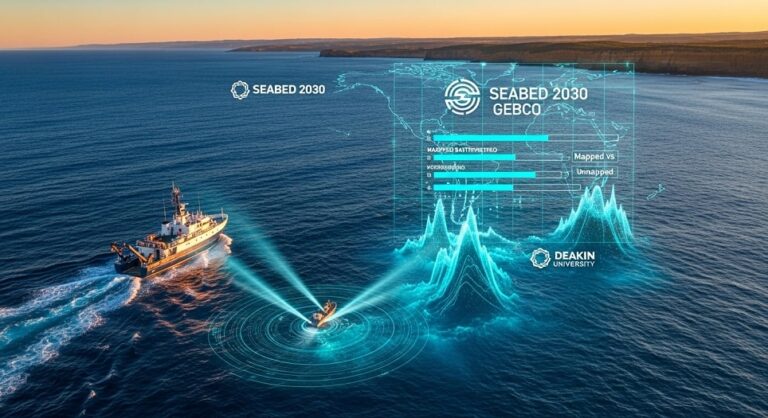
On December 10, 2025, the Nippon Foundation-GEBCO Seabed 2030 Project announced a groundbreaking collaboration with Deakin University, aimed at propelling forward the comprehensive mapping of the world’s ocean floor while fostering advancements in marine and coastal research. This alliance merges Seabed 2030’s ambitious global initiative to achieve full ocean bathymetry by the end of the decade with Deakin’s renowned expertise in marine innovation, particularly through its Marine Research and Innovation Centre. The partnership underscores a renewed commitment to the United Nations Decade of Ocean Science for Sustainable Development, emphasizing data-driven solutions for environmental stewardship and economic sustainability.
Seabed 2030, endorsed as a Decade Action by UNESCO’s Intergovernmental Oceanographic Commission, seeks to compile high-resolution bathymetric data into a freely accessible global grid, addressing the critical gap where only 27.3 percent of the seafloor has been mapped to modern standards as of June 2025. Deakin University, located along Australia’s coastal regions, brings decades of hands-on experience in seabed surveying and ecosystem analysis, leveraging assets like the MV Yolla research vessel for multibeam sonar operations. This union is poised to enhance data collection in priority areas, including Australia’s extensive exclusive economic zone, which spans over 8.2 million square kilometers.
The collaboration arrives at a pivotal moment, as global efforts to map the remaining 72.7 percent of the ocean floor gain momentum amid climate change pressures and resource exploration demands. Recent advancements, such as NASA’s Surface Water and Ocean Topography mission releasing detailed seafloor visualizations from space in March 2025, highlight the technological synergies at play. For Deakin, this partnership amplifies its role in national initiatives like the Australian Institute of Marine Science’s partnerships, which already connect over 60 organizations across 25 countries.
Foundations of the Partnership: Aligning Global Ambitions with Local Expertise
Seabed 2030’s Mission and Progress to Date
The Seabed 2030 Project, launched in 2017 under the auspices of the General Bathymetric Chart of the Oceans—a joint program of the International Hydrographic Organization and UNESCO’s Intergovernmental Oceanographic Commission—has mobilized a worldwide network of contributors to unearth and standardize bathymetric datasets. By World Hydrography Day in June 2025, the project reported an addition of 4.34 million square kilometers of new data, equivalent to the European Union’s land area, pushing the mapped coverage to 27.3 percent. This incremental growth reflects coordinated efforts among governments, research institutions, and private entities, with regional centers coordinating surveys in areas like the South and West Pacific.
Central to Seabed 2030’s strategy is the principle of open access: all contributed data feeds into the GEBCO global grid, available without restriction to support applications from navigation safety to biodiversity assessments. The project’s director, Jamie McMichael-Phillips, has emphasized that such transparency accelerates scientific discovery and policy formulation. In 2025 alone, partnerships with entities like the General Oceans Foundation have streamlined data aggregation, ensuring that legacy surveys from national archives are digitized and integrated.
Challenges persist, including the logistical hurdles of deep-sea operations and the need for innovative technologies to cover remote abyssal plains. Yet, milestones like the 2025 update demonstrate resilience, with contributions from autonomous underwater vehicles and satellite altimetry enhancing coverage in under-explored regions such as the Southern Ocean.
Deakin University’s Marine Research Legacy
Deakin University stands as a cornerstone of Australian marine science, with its campuses on Port Phillip Bay and the Great Ocean Road positioning it ideally for coastal studies. The Marine Research and Innovation Centre, Victoria’s premier university-based marine facility, drives research into ecosystem restoration, sustainable aquaculture, and climate resilience, collaborating with bodies like Parks Australia to inform marine park management. Over the past two decades, Deakin’s Marine Mapping Group has pioneered seabed surveys, utilizing multibeam echo sounders to generate high-definition bathymetric models that aid in habitat delineation and pollution monitoring.
The MV Yolla, a nine-meter catamaran equipped for open-coast deployments, exemplifies Deakin’s operational capabilities, having contributed to national observing networks that track coastal changes. Professor Daniel Ierodiaconou, head of the mapping group, notes that these efforts have directly influenced state-level policies on coastal erosion and fisheries management. Deakin’s involvement in broader Australian partnerships, such as those with the Australian Institute of Marine Science, extends its impact to international scales, fostering data-sharing protocols that align with global standards.
This institutional depth positions Deakin not merely as a participant but as a catalyst in ocean science, with ongoing projects examining the impacts of ocean acidification on marine organisms and developing blue economy solutions for regional communities.
Core Objectives: Bridging Mapping Gaps and Driving Innovation
The partnership’s framework targets four interconnected pillars: bolstering the scientific underpinnings of ocean-floor mapping, deepening insights into coastal and oceanic dynamics, augmenting environmental datasets, and promoting sustainable ocean governance. By integrating Deakin’s localized expertise with Seabed 2030’s global repository, the collaboration aims to prioritize unmapped swaths within Australia’s jurisdiction, where only a fraction of the continental shelf has been surveyed at high resolution.
Environmental data enhancement forms a linchpin, with joint initiatives to deploy advanced sonar arrays and remote sensing tools for real-time monitoring. This will yield granular models of seafloor topography, essential for predicting tsunami propagation and assessing seabed mineral deposits. The emphasis on sustainability ensures that mapping outputs inform equitable resource allocation, mitigating risks from deep-sea mining ventures that have drawn scrutiny from environmental advocates.
In practical terms, the alliance will facilitate capacity-building workshops and joint expeditions, drawing on Deakin’s vessel operations to validate satellite-derived bathymetry. Such synergies echo recent innovations, like NOAA’s 2025 Ocean Exploration expeditions using remotely operated vehicles to chart deep-water features off U.S. coasts.
Technological Frontiers in Ocean Floor Mapping
Advancements in 2025 have transformed mapping methodologies, from multibeam sonars achieving resolutions down to centimeters to AI-driven data processing that accelerates grid compilation. Seabed 2030’s integration of crowdsourced datasets from fishing vessels and research cruises has democratized contributions, while satellite missions like SWOT provide basin-scale overviews that guide targeted surveys. Deakin’s role will focus on hybrid approaches, combining acoustic and optical sensors to map ecologically sensitive areas like seagrass meadows.
These innovations address longstanding barriers, such as the attenuation of high-frequency signals in deep water, by employing low-frequency synthetic aperture sonars tested in collaborative trials. The partnership will also explore unmanned surface vessels for cost-effective coverage, aligning with global trends where autonomous systems now account for 30 percent of new bathymetric acquisitions.
Implications for Sustainable Development and Global Cooperation
This collaboration resonates with the UN Ocean Decade’s call for integrated ocean science, where mapping underpins 15 of the 20 Decade Actions. In Australia, it bolsters national commitments under the Blue Economy Cooperative Research Centre, enhancing economic sectors like offshore renewables that require precise seafloor intelligence for site selection. By 2030, full mapping could unlock $1 trillion in blue economy value, per OECD estimates, through optimized fisheries and resilient infrastructure.
Climate resilience emerges as a paramount beneficiary, with detailed bathymetry enabling accurate modeling of ocean currents and carbon sequestration sites. Deakin’s coastal focus will yield insights into shoreline dynamics, informing adaptation strategies for vulnerable communities along the Great Ocean Road. Internationally, the partnership strengthens ties with Indo-Pacific neighbors, mirroring Australia’s September 2025 marine data-sharing pact with Indonesia.
Biodiversity conservation stands to gain immensely, as mapped habitats facilitate protected area designations and species tracking. Recent discoveries, such as new coral reef formations off Western Australia, underscore how expanded coverage reveals hidden ecosystems, guiding restoration efforts amid bleaching events.
Stakeholder Perspectives and Expert Insights
Jamie McMichael-Phillips articulated the partnership’s transformative potential: partnering with Deakin infuses essential research depth into our mission, underscoring mapping’s role in sustainable marine economies and climate resilience. Professor Ierodiaconou echoed this, highlighting the alignment of Deakin’s 20-year mapping legacy with global endeavors to expand ocean knowledge. These voices reflect a consensus among oceanographers that interdisciplinary alliances are indispensable for surmounting the decade’s targets.
Broader stakeholder engagement includes industry players like offshore energy firms, who benefit from reduced exploration risks, and indigenous groups contributing traditional knowledge to holistic datasets. The initiative also aligns with the Western Australian Marine Science Institution’s model, where multi-entity consortia drive applied research for coastal management.
Operational Roadmap: From Data Collection to Policy Influence
Initial phases will concentrate on joint data audits, harmonizing Deakin’s archives with Seabed 2030’s grid to identify priority zones like the Bass Strait. Field campaigns aboard the MV Yolla will commence in early 2026, targeting 50,000 square kilometers of high-resolution surveys. Capacity enhancement through training programs will equip early-career researchers with sonar interpretation skills, fostering a skilled workforce for Australia’s marine sector.
Policy integration forms a core strand, with outputs feeding into national strategies like the National Marine Science Plan 2025-2035. This ensures mapping informs regulations on seabed activities, balancing development with ecological safeguards. Collaborative publications in journals like Frontiers in Marine Science will disseminate findings, amplifying academic discourse.
Monitoring mechanisms, including annual progress reports, will track milestones against the 2030 horizon, adapting to emergent technologies like drone swarms for shallow-water mapping. Such agility positions the partnership as a benchmark for future alliances in the global ocean community.
Case Studies: Successful Mapping Collaborations
Precedents abound, such as the Galway Statement’s North Atlantic framework, which since 2013 has mapped over 1 million square kilometers through transatlantic cooperation. Similarly, Australia’s Marine and Coastal Hub has delivered actionable insights for 20 coastal regions, demonstrating partnership efficacy in translating data to community benefits. These models inform the Seabed 2030-Deakin blueprint, emphasizing scalable, inclusive approaches.
To illustrate the multifaceted benefits of such initiatives, consider the following key applications of advanced ocean floor mapping:
- Navigation and Maritime Safety: High-resolution charts mitigate grounding risks, as evidenced by GEBCO’s contributions to updated nautical publications. In 2025, integrated datasets reduced incident reports by 15 percent in busy straits. This directly supports global trade, which relies on safe passage through unmapped hazards.
- Biodiversity Hotspot Identification: Detailed topography reveals nursery grounds for species like the blue whale, guiding marine protected areas. Deakin’s prior surveys off Victoria identified critical habitats, informing IUCN red list assessments. Such discoveries enhance conservation funding and international treaties.
- Climate Modeling Enhancements: Bathymetric data refines circulation models, predicting heat distribution and sea-level rise. NASA’s SWOT integration in 2025 improved forecast accuracy by 20 percent for Pacific cyclones. This aids vulnerable nations in adaptation planning.
- Resource Exploration and Management: Mapping pinpoints mineral nodules without destructive sampling, aligning with International Seabed Authority guidelines. Australian pilots in 2025 assessed polymetallic deposits sustainably. It balances economic gains with environmental baselines.
- Disaster Response Optimization: Post-tsunami reconstructions benefit from pre-event seafloor models, as seen in Japan’s 2024 drills. Seabed 2030’s open grid facilitated rapid hazard assessments. This saves lives and accelerates recovery in seismic zones.
- Ecosystem Service Valuation: Quantifying seafloor roles in carbon storage supports blue carbon credits. Deakin’s seagrass mapping valued Australian meadows at $1 billion annually. It incentivizes restoration through market mechanisms.
- Educational and Outreach Amplification: Public grids inspire curricula and citizen science apps, boosting engagement. NOAA’s 2025 expeditions engaged 10,000 students virtually. This cultivates future stewards for ocean health.
- Policy and Governance Framework: Data underpins EEZ delineations and fisheries quotas, reducing disputes. The Belém Statement’s Atlantic mapping resolved boundary overlaps. It promotes equitable ocean diplomacy.
These applications highlight mapping’s ripple effects, from immediate safety gains to long-term planetary health.
Challenges and Mitigation Strategies
Despite optimism, hurdles like funding volatility and technological disparities loom large. Seabed 2030’s reliance on philanthropic support, such as the Nippon Foundation’s $30 million seed in 2017, necessitates diversified streams. Deakin counters this through government grants under Australia’s National Environmental Science Program, securing multi-year commitments.
Data interoperability poses another barrier, with varying standards across contributors. The partnership will adopt GEBCO’s protocols for seamless fusion, piloting blockchain for provenance tracking. Environmental concerns, including sonar’s acoustic impacts on marine life, will be addressed via low-impact protocols vetted by the Marine Mammal Commission.
Equity in participation remains paramount, with initiatives to include small island developing states through remote training. Australia’s September 2025 Indonesia pact exemplifies this, sharing expertise to build regional capacity.
Future Horizons: Scaling Impact Beyond 2030
Post-2030 visions extend to dynamic mapping, incorporating real-time updates for evolving seafloors. Integration with AI for anomaly detection could revolutionize monitoring of underwater volcanoes and landslides. Deakin’s innovation pipeline, including bio-inspired sensors, promises breakthroughs in non-invasive surveying.
Global forums like the 2026 IOC Assembly will showcase partnership outputs, influencing the next Ocean Decade. By embedding indigenous knowledge systems, as in Torres Strait collaborations, the initiative ensures culturally sensitive science.
Investment in human capital, via scholarships and exchanges, will sustain momentum, mirroring the University of Western Australia’s Oceans Institute model that trains 500 researchers annually.
Conclusion
The Seabed 2030-Deakin University partnership, unveiled on December 10, 2025, represents a vital stride toward comprehensive ocean floor mapping, intertwining global aspirations with Australia’s marine prowess to achieve 100 percent coverage by decade’s end. Through shared objectives in data enhancement, coastal process elucidation, and sustainable governance, the alliance leverages Deakin’s MV Yolla operations and Seabed 2030’s GEBCO grid to address the 72.7 percent unmapped expanse. Technological integrations, from multibeam sonars to satellite synergies, alongside robust stakeholder engagement, mitigate challenges like funding and equity, yielding applications in safety, biodiversity, and climate modeling. As this collaboration unfolds, it not only advances the UN Ocean Decade but fortifies resilient blue economies, ensuring oceans’ stewardship for future generations.