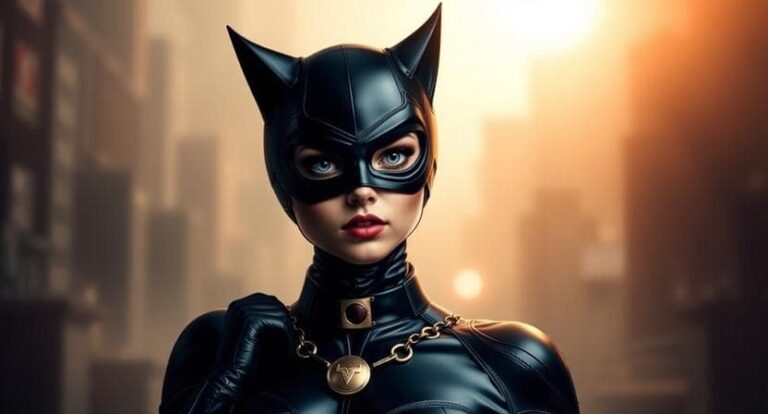
The character of Selina Kyle, better known to the world as Catwoman, has remained one of the most enduring and complex figures in the DC Universe since her debut in Batman #1 in 1940. Originally introduced simply as “The Cat,” she was a mysterious burglar with a penchant for high-stakes theft and a complicated moral compass that often blurred the lines between villainy and heroism. Over the decades, this character has transitioned from the printed page to the silver screen and television monitors, undergoing numerous reinventions that reflect the changing cultural landscapes of each era. The task of ranking these performances is not merely an exercise in nostalgia but an analysis of how different actresses have captured the feline grace, razor-sharp wit, and deep-seated trauma that define the character. To understand the “best” Catwoman, one must look at the historical context of each portrayal and how it contributed to the mythos of the Dark Knight’s most formidable foil.
The cinematic and televisual history of Catwoman is a journey through different genres of storytelling, ranging from the campy pop-art aesthetics of the 1960s to the gritty, grounded realism of modern noir. Each actress who has donned the ears and claws has brought a unique perspective to Selina Kyle’s psychology. Some have emphasized the playful, flirtatious nature of her relationship with Batman, while others have focused on her role as a social justice advocate for the forgotten denizens of Gotham City. This evolution has turned Catwoman into more than just a supporting character; she is a mirror to Batman’s own duality, representing the freedom of the night that Bruce Wayne often struggles to reconcile with his rigid code of justice. In this comprehensive analysis, we explore the definitive rankings of every major live-action Catwoman, examining the impact of their performances on pop culture and the legacy of the character.
The criteria for this ranking involve several key factors: faithfulness to the core spirit of the character, the chemistry with the respective Batman of that era, the visual design and costume effectiveness, and the lasting influence of the performance. While some versions favored the supernatural or the surreal, others stayed rooted in the skills of a master thief and gymnast. By looking at the trajectory of these portrayals, we can see how Selina Kyle has transformed from a mere love interest into a fully realized protagonist capable of carrying her own narratives. This ranking serves as a tribute to the women who have navigated the rooftops of Gotham, proving that while Batman may be the hero the city needs, Catwoman is the one it truly deserves.
The 1960s Trailblazers: Julie Newmar, Lee Meriwether, and Eartha Kitt
The 1960s Batman television series and its accompanying film were responsible for cementing Catwoman’s place in the public consciousness. Julie Newmar, the first to play the role in the series, established the “purr-fect” template that many would follow. Her performance was defined by a statuesque elegance and a playful, almost predatory flirtation with Adam West’s Batman. Newmar’s Catwoman was less of a hardened criminal and more of a sophisticated socialite with a mischievous streak. She brought a sense of humor and sexual tension to the show that was revolutionary for its time, making her the primary template for the character’s physical language—the arched back, the feline purr, and the graceful movement that made her feel truly cat-like.
Following Newmar, Lee Meriwether took over the role for the 1966 Batman feature film. Meriwether had the difficult task of following Newmar’s popular interpretation while fitting into a more expanded, high-stakes plot involving the United Underworld. Her version of the character was slightly more grounded and involved a disguise as a Soviet journalist named Miss Kitka to seduce Bruce Wayne. While she lacked some of the overt campy energy that Newmar brought to the weekly episodes, Meriwether succeeded in showing the character’s capacity for deception and high-level espionage. Her performance remains a vital bridge between the television series and the broader cinematic potential of the DC roster.
The casting of Eartha Kitt in the third season of the Batman series was a historic moment in television history. Replacing Newmar, Kitt brought an entirely new energy to the role, characterized by her distinctive voice and intense physicality. As a Black woman playing a prominent romantic foil to a white lead in the late 1960s, Kitt broke significant racial barriers. Her Catwoman was sharper, more dangerous, and possessed a literal “purr” that was unmatched. Kitt moved with a rhythmic, dance-like precision that emphasized the character’s predatory nature. Even though her tenure was short due to the show’s cancellation, her impact remains monumental, proving that the essence of Selina Kyle transcended race and focused instead on power and charisma.
The Burton Era Masterpiece: Michelle Pfeiffer
For many fans and critics, Michelle Pfeiffer’s portrayal in Tim Burton’s 1992 film, Batman Returns, remains the gold standard for the character. This version of Selina Kyle was a radical departure from the camp of the 1960s, leaning into the gothic, macabre sensibilities of Burton’s vision. Pfeiffer’s Selina begins the film as a shy, overlooked secretary who undergoes a violent transformation after being pushed out of a window by her corrupt boss. This “birth” of Catwoman is depicted as a psychological breakdown, where she literally sews her own costume from remnants of black latex. The resulting outfit, with its visible white stitches, became an iconic symbol of the character’s fractured psyche.
Pfeiffer’s performance is a tour de force of physical acting and emotional depth. She perfectly captures the duality of a woman struggling with dissociative identity disorder, oscillating between the vulnerable Selina and the chaotic, vengeful Catwoman. Her chemistry with Michael Keaton’s Bruce Wayne is palpable, rooted in their shared trauma and the realization that they are both “broken” individuals hiding behind masks. The scenes involving her whip work—which Pfeiffer famously learned to do herself—added a level of authenticity and threat to the character. Her Catwoman was not just a thief; she was a force of nature, a vengeful spirit targeting the patriarchal structures of Gotham City. Even decades later, this version is frequently cited as the most layered and visually striking interpretation ever filmed.
The legacy of Pfeiffer’s Catwoman also lies in her refusal to be a traditional villain. She kills, she destroys, and she creates chaos, yet the audience remains firmly on her side because her motivations are born from systemic abuse and a desire for agency. This portrayal moved Catwoman away from being a mere “female version of Batman” and into a space where she represented the feminine rage of the 1990s. The suit, the dialogue—including the legendary “Meow” before blowing up a department store—and the sheer commitment to the role’s insanity make Pfeiffer a perennial favorite in any ranking of the character’s history.
The Nolan Realism: Anne Hathaway
When Christopher Nolan announced that Catwoman would appear in the final chapter of his Dark Knight trilogy, fans were curious how the character would fit into his hyper-realistic world. Anne Hathaway stepped into the role of Selina Kyle in 2012’s The Dark Knight Rises, and she delivered a performance that was stripped of the supernatural and the camp. Hathaway’s Selina is a world-class cat burglar and con artist who is motivated by survival and a desire to erase her criminal past. Unlike previous versions, she is never explicitly called “Catwoman” in the film, though the media refers to her as the “Cat.” Her costume is functional, featuring high-tech goggles that flip up to look like cat ears and serrated heels that serve as weapons.
Hathaway brought a cool, calculating intelligence to the role. Her Selina is a survivor who views the wealthy elite of Gotham with disdain, making her a thematic fit for the film’s exploration of class warfare. One of the standout elements of her performance is her ability to switch personas instantly; she can play the “damsel in distress” to fool police officers and then immediately transition into a lethal hand-to-hand combatant. Her chemistry with Christian Bale’s Batman is built on mutual respect and the shared burden of living a double life. While she lacks the overt theatricality of Pfeiffer, Hathaway’s portrayal is lauded for its groundedness and its depiction of Selina as a highly skilled professional who is always three steps ahead of everyone else in the room.
Furthermore, Hathaway’s version of the character provides one of the few instances where Selina Kyle finds a path toward redemption. In the context of the Nolanverse, she represents the possibility of leaving the mask behind, a theme that is central to Bruce Wayne’s arc. By the end of the film, she is no longer a lone wolf but a partner in the fight for Gotham’s soul. This evolution from a self-interested thief to a hero who helps save the city provides a satisfying conclusion to her journey and solidifies Hathaway’s place as one of the most effective and sophisticated actresses to take on the mantle.
The Grounded Noir: Zoë Kravitz
The most recent live-action portrayal comes from Zoë Kravitz in Matt Reeves’ 2022 film, The Batman. This version returns the character to her roots in detective noir, presenting a Selina Kyle who is a cocktail waitress and a small-time thief working within the criminal underworld of Gotham. Kravitz’s portrayal is perhaps the most emotionally grounded and vulnerable of all the cinematic versions. She is driven by a personal quest for justice—specifically regarding the disappearance of her friend and her complicated relationship with her father, Carmine Falcone. This motivation gives her a clear moral center, even if her methods are outside the law.
Kravitz brings a lean, lithe physicality to the role that feels incredibly modern and realistic. Her costume consists of practical gear—motorcycle leathers and a simple balaclava with subtle ear-like points—reflecting a character who is still in the early stages of her development. The chemistry between Kravitz and Robert Pattinson’s Batman is the emotional heart of the film. They are two orphans of Gotham, one raised in a manor and the other on the streets, finding a rare connection in their shared loneliness. Kravitz captures the “stray cat” energy perfectly; she is defensive, cautious, but fiercely loyal to those she cares about. Her performance has been widely praised for its grit and for making Selina a truly three-dimensional person rather than a caricature.
The success of Kravitz’s interpretation lies in her restraint. She doesn’t need a whip or a vacuum-sealed suit to be intimidating; her power comes from her resolve and her ability to navigate the darkest corners of the city without losing herself. In The Batman, she serves as the emotional anchor that forces Bruce Wayne to realize that justice isn’t just about vengeance—it’s about the people caught in the crossfire. As the franchise continues, Kravitz has set a high bar for what a modern, socially conscious Catwoman should look like, blending the character’s classic allure with a contemporary sense of urgency and depth.
The Television Evolution: Camren Bicondova and Lili Simmons
The television series Gotham took a unique approach by focusing on the teenage years of Selina Kyle, played for the majority of the series by Camren Bicondova. Because the show served as an origin story, Bicondova had the task of showing how a homeless street urchin gradually acquired the skills and the attitude of Catwoman. Her performance was heavily influenced by dance, giving her a unique way of moving that felt organic to the character’s feline inspiration. Over the course of five seasons, viewers watched her navigate the politics of Gotham’s gangs, form a complicated bond with a young Bruce Wayne, and develop her own moral code. Bicondova’s portrayal is significant because it is the longest continuous performance of the character in live-action history, allowing for unparalleled character development.
In the series finale of Gotham, which featured a ten-year time jump, the role was taken over by Lili Simmons. While Simmons only appeared in one episode, she successfully channeled Bicondova’s established mannerisms while adding a more mature, refined edge to the character. This transition showed the ultimate “finished product” of the journey Bicondova had started. The Gotham version of Catwoman is notable for emphasizing the character’s independence. She was never just a sidekick to Bruce; she was a survivor who often had to teach the future Batman how the real world worked. This mentor-like dynamic added a new layer to their relationship that had rarely been explored in other media.
Both actresses contributed to a version of Selina Kyle that was deeply rooted in the environment of Gotham City. By focusing on her formative years, Gotham was able to justify her cynical worldview and her distrust of authority. Bicondova, in particular, received praise for her physical performance and her ability to hold her own against much older actors. Her portrayal ensured that a new generation of viewers understood that Catwoman was not just a product of a costume, but a product of a city that forces its people to become predators or prey.
The Standalone Departure: Halle Berry
No discussion of Catwoman is complete without mentioning the 2004 standalone film starring Halle Berry. However, this version is unique because it does not feature Selina Kyle. Instead, Berry plays Patience Phillips, a woman who is murdered and then resurrected by an Egyptian Mau cat, granting her supernatural cat-like powers. The film was largely disconnected from the Batman mythos and the DC Universe at large. While the movie was a critical and commercial failure, Berry’s performance has gained a sort of cult status over the years, often discussed for its sheer commitment to a bizarre script and questionable costume design.
Berry brought her Oscar-winning talent to the role, but the film’s direction leaned too heavily into literal feline behavior—such as eating tuna from a can and hissing at dogs—which many fans found jarring. The costume, featuring shredded leather and a heavy mask, was a stark departure from the sleek designs of the past. Despite the film’s negative reception, Berry has famously handled the backlash with grace, even showing up in person to accept her Golden Raspberry Award for the role. Her version of the character remains a fascinating outlier in the history of comic book movies, serving as a cautionary tale of what happens when a character is stripped of their source material’s context and history.
In recent years, some fans have revisited the 2004 film with a more camp-appreciative lens, noting that Berry’s physicality was impressive even if the narrative surrounding her was weak. However, in the context of a “best Catwoman” ranking, she usually sits at the bottom simply because the character she played was not actually the Catwoman from the comics. It stands as an experimental branch in the character’s tree that ultimately led to a dead end, paving the way for the more faithful interpretations that followed in the Nolan and Reeves eras.
The Voices of the Night: Animation and Voice Acting
While live-action portrayals get the most attention, the voice actresses who have brought Catwoman to life in animation have had an equally profound impact. Adrienne Barbeau provided the voice for Selina Kyle in Batman: The Animated Series in the 1990s. For many, this is the definitive voice of the character—sultry, intelligent, and capable of conveying both threat and tenderness. Barbeau’s Catwoman was a dedicated animal rights activist, a character trait that has since become a staple of the comics. Her performance helped define the character for an entire generation of children who grew up watching the show on Saturday mornings.
Other notable voice performances include Taneeka Gupta, Jennifer Morrison, and Elizabeth Gillies, each bringing a different flavor to the role in various animated films and series. In the world of video games, Grey DeLisle has voiced Catwoman in the Batman: Arkham series and the Injustice games. DeLisle’s performance is particularly noteworthy for its wit and the way she plays off Kevin Conroy’s Batman. These animated and gaming versions often have more screen time than their live-action counterparts, allowing for a deeper exploration of Selina’s skills as a thief and her role as a master strategist. They serve as a constant reminder that the character’s appeal is not just visual, but rooted in her personality and her voice.
Animation also allows for a more “comic-book accurate” portrayal of Catwoman’s gadgets and abilities. In the Arkham games, for example, the player gets to inhabit the character, experiencing her agility and her unique combat style firsthand. This interactive element has strengthened the bond between the audience and the character, making her more than just a figure on a screen. The voice actresses who have carried the mantle have ensured that even when there is no live-action film in production, Catwoman remains a vibrant and active presence in the DC multiverse.
Key Characteristics of a Top-Tier Catwoman Performance
When analyzing what makes a Catwoman performance truly successful, several recurring themes emerge. The most effective portrayals are those that balance the character’s internal conflict with her external confidence. To help categorize these elements, consider the following traits that define the best versions of the character:
- Physicality and Movement: A top-tier Catwoman must move with a specific kind of grace that suggests feline instincts. This includes the way she walks, climbs, and fights, using agility and speed rather than raw power.
- The “Purr” and Vocal Delivery: The character’s voice is a weapon; it should be used to disarm, seduce, or intimidate. The best actresses use a distinct vocal range that sets Selina Kyle apart from her civilian persona.
- Moral Ambiguity: Catwoman is most interesting when she is neither a hero nor a villain. A successful performance captures the tension of a woman who does the wrong things for the right reasons.
- Chemistry with Batman: The “Bat/Cat” dynamic is essential. There must be an underlying sense of mutual understanding and attraction that complicates their professional rivalry.
- Functional yet Iconic Costume: The suit should reflect the character’s needs—whether it’s for stealth, protection, or psychological warfare—while maintaining a visually striking silhouette.
- Social Commentary: The character often serves as a voice for the marginalized. The best versions of Selina Kyle use her criminal activities to highlight the corruption of Gotham’s upper class.
Current Market Trends and Popularity
The popularity of Catwoman has seen a significant resurgence in the 2020s, driven by the success of The Batman and a renewed interest in female-led anti-hero stories. In the current market, Catwoman collectibles, comic book variants, and media appearances are at an all-time high. On the secondary market, original props and costumes from the Michelle Pfeiffer era continue to fetch tens of thousands of dollars at auction, highlighting the lasting legacy of that specific design. Meanwhile, modern fans are gravitating toward the more practical and tactical “street-wear” aesthetic popularized by Zoë Kravitz and current comic book runs by writers like Tini Howard and Ram V.
Pros and Cons of Different Interpretations:
- The Campy Versions (1960s): Pros: Incredibly fun, iconic dialogue, established the character’s playfulness. Cons: Lack of deep character development, often treated as a “villain of the week.”
- The Gothic Versions (1990s): Pros: Visually stunning, high emotional stakes, psychological depth. Cons: Can sometimes feel too disconnected from the character’s comic book origins as a thief.
- The Realistic Versions (2010s-2020s): Pros: Relatable motivations, impressive tactical combat, strong character arcs. Cons: Can lose some of the “theatrical” magic that makes comic book characters unique.
Pro Tips for Fans and Collectors
For those looking to dive deeper into the world of Catwoman, there are several ways to engage with the character’s history. If you are starting a comic collection, look for “Batman: Year One” and “Catwoman: When in Rome” for essential reading on her origins and solo adventures. For movie buffs, watching the films in chronological order of release provides a fascinating look at the evolution of special effects and costume design. If you are a collector, focus on high-quality statues from companies like Sideshow Collectibles or Iron Studios, as these tend to hold their value well over time. Additionally, pay attention to the “Selina Kyle” appearances in television shows like Harley Quinn (animated), which offer a more comedic but still faithful take on her personality.
Frequently Asked Questions
Who was the very first actress to play Catwoman?
The first actress to portray Catwoman in a live-action setting was Julie Newmar in the 1966 Batman television series. While Lee Meriwether played her in the film released that same year, Newmar was the first to appear on screen in the role.
Is Catwoman a hero or a villain?
Catwoman is traditionally classified as an anti-hero. While she began as a villainous burglar, her modern incarnations often show her working alongside Batman or acting as a protector for the vulnerable in Gotham City, though she rarely follows the law.
Why did Michelle Pfeiffer’s costume have stitches?
In Batman Returns, the stitches were a visual metaphor for Selina Kyle’s fractured mental state. After her near-death experience, she “stitched herself back together” into a new, more dangerous persona, reflecting her internal trauma.
Does Catwoman have superpowers?
In most versions, including the primary DC Comics continuity, Selina Kyle does not have superpowers. She is a peak-human athlete, master gymnast, and skilled hand-to-hand combatant. The 2004 Halle Berry film is one of the few instances where she was given supernatural abilities.
Are Catwoman and Batman married?
In recent comic book history, specifically during Tom King’s run on Batman, the two characters came very close to marriage. While the wedding didn’t happen as planned, they remain one of the most significant and enduring couples in comic book history.
Conclusion
The ranking of every Catwoman actress reveals more than just a list of performances; it showcases the evolution of a cultural icon. From the playful camp of Julie Newmar to the psychological complexity of Michelle Pfeiffer and the grounded grit of Zoë Kravitz, Catwoman has proven to be a character of infinite versatility. Each actress has contributed a new layer to the character, ensuring that Selina Kyle remains relevant to every new generation. Whether she is portrayed as a vengeful spirit, a tactical thief, or a social justice advocate, the core of Catwoman remains her independence and her refusal to be defined by the men in her life. As we look forward to future iterations, it is clear that the shadow of the cat will continue to loom large over Gotham City, reminding us that the most compelling characters are often those who operate in the grey areas of life.