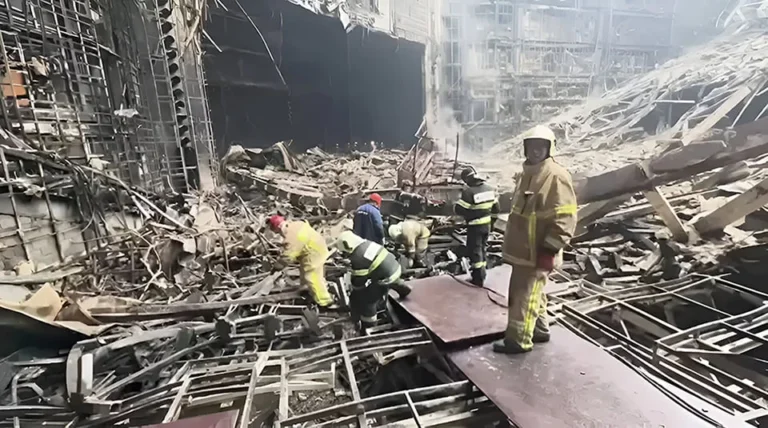
In one of the deadliest terrorist attacks in modern Russian history, armed assailants violently stormed the Crocus City Hall concert venue on the outskirts of Moscow on the evening of March 22, 2024, killing scores of civilians and injuring hundreds more. The attack — quickly claimed by the extremist group Islamic State — has prompted international condemnation, intensified Russian security operations, and sparked complex debates about terrorism, geopolitics, and public safety in Russia and beyond.
Attack Unfolds at Crocus City Hall
The assault began on the weekend evening when several gunmen, dressed in combat fatigues and carrying automatic weapons, entered Crocus City Hall, a large concert venue in Krasnogorsk, west of Moscow. Eyewitness accounts and video footage verified by multiple news agencies showed attackers firing indiscriminately at concertgoers, triggering panic and chaos as crowds scrambled for exits. Flames erupted inside the building amid explosions, and the roof partially collapsed under the blaze that followed the initial shooting.
Initial emergency reports indicated that dozens were killed and scores injured in the opening minutes of the assault. The sheer scale of the violence quickly overwhelmed first responders and medical facilities, with smoke and fire compounding the casualties from gunshot wounds.
Casualties and Emergency Response
Official figures from Russian authorities have evolved as the situation developed. Early reports cited at least 60 dead and 145 injured, as announced by the Federal Security Service. Subsequent updates from investigative bodies and local media placed the confirmed death toll higher, with multiple independent sources reporting over 130 fatalities. Hundreds more were listed as wounded, with many in critical condition. The majority of deaths were attributed to gunshot wounds and smoke inhalation following the rapid spread of fire inside the crowded concert hall.
Emergency services rapidly mobilized ambulances, firefighters, and law enforcement personnel. Hospitals in the Moscow region were placed on high alert as medical teams worked through the night to treat the influx of severely injured civilians. Authorities also recovered weapons and ammunition at the scene, underscoring the calculated nature of the assault.
Perpetrators and Terrorist Claims
The extremist group Islamic State — specifically its Khorasan faction, also known as IS-K — swiftly claimed responsibility for the attack. The group released statements on encrypted messaging channels asserting that its operatives had carried out the massacre and escaped the premises afterward. Western intelligence sources later confirmed the claim, supporting assessments that IS-K was behind the massacre.
Subsequent counterterrorism operations led to the detention of multiple suspects believed to be directly involved in planning and executing the attack. Some individuals were apprehended after attempting to flee toward Russia’s border regions. Court proceedings began months after the incident, with several accused assailants formally charged with terrorism offenses that carry life sentences under Russian law. State media reported that some admitted guilt during legal hearings, while others remained combative in their responses.
National Mourning and Political Reactions in Russia
In the wake of the attack, Russian authorities declared a period of national mourning. Citizens gathered to lay flowers and pay respects to the victims, while public vigils were held across major cities. President Vladimir Putin condemned the massacre and vowed that those responsible would face justice, emphasizing a reinvigorated focus on national security and counterterrorism measures.
Russian investigative agencies also made controversial claims implying that external state actors may have influenced the attack, though these allegations were dismissed by some international observers and intelligence agencies as lacking substantiated evidence. The Kremlin’s narrative, however, has shaped parts of the domestic discussion on terrorism and national defense policy.
International Condemnation and Diplomatic Response
Leaders around the world condemned the attack as a heinous act of terrorism targeting innocent civilians. Governments from the European Union, the United States, and beyond offered condolences and solidarity with Russia, even as geopolitical tensions persisted in other arenas. The White House publicly ruled out any involvement by Ukraine in the attack and affirmed that intelligence assessments attributed full responsibility to the Islamic State network. Allied nations called for unified efforts against global terrorism and reiterated commitments to intelligence sharing and security cooperation.
Human Impact: Families, Survivors, and Communities
The human toll of the Crocus City Hall massacre extends far beyond statistics. Families of the victims and those still missing have endured unimaginable heartbreak as authorities work to identify the deceased and account for loved ones. Survivors recount scenes of terror, confusion, and desperate attempts to evacuate as gunfire and smoke filled the venue. For many, the psychological trauma will persist long after physical wounds heal.
The attack has also triggered broader conversations about public safety and emergency preparedness at large entertainment venues. Experts note that while isolated terror incidents are rare in Russia compared to other regions, this assault starkly highlighted vulnerabilities in civilian protection and emergency response systems.
Analysis: Terrorism, Security, and Regional Implications
Security analysts characterize the Crocus City Hall attack as part of a troubling pattern of extremist violence that transcends regional borders. The Islamic State’s claim — specifically tying the operation to its external Khorasan network — aligns with the group’s broader strategy of striking high-visibility targets to sow fear and generate global attention.
Some geopolitical observers argue that the attack underscores the challenges faced by nations worldwide in combating decentralized terror networks that adapt and leverage digital platforms for recruitment and propaganda. The attack’s timing — coming amid ongoing geopolitical tensions and conflict involving Russia in other theatres — adds complexity to how governments interpret and respond to such threats.
Future Security Measures and Societal Resilience
In the attack’s aftermath, Russian authorities vowed to bolster counterterrorism capabilities, enhance surveillance on extremist affiliates, and tighten security protocols at public venues. While critics argue that heavy-handed security measures risk civil liberties, proponents maintain that robust protections are essential in an era where mass-casualty terror incidents remain unpredictable yet devastating.
Civic organizations and mental health professionals have also called for expanded support services for survivors and affected families. Community leaders emphasize the need for long-term healing initiatives that address both material loss and psychological trauma.
Conclusion
The Crocus City Hall concert hall attack stands as one of the most shocking and consequential terrorist incidents in Russia’s recent history. With a significant death toll, hundreds of victims, and international ramifications, the massacre not only devastated families and communities but also reignited urgent conversations about violent extremism, public safety, and geopolitical instability. As investigations continue and legal proceedings unfold, the world watches closely, seeking both justice for the victims and meaningful strategies to prevent similar tragedies in the future.