When the history of British science fiction is discussed, few figures loom as large or as distinctively as Jon Pertwee. As the actor who took over the role of the Doctor in 1970, Pertwee was tasked with reinventing a series that was facing dwindling ratings and a massive shift in production technology. His era, which spanned five seasons from 1970 to 1974, is often cited by historians and fans alike as the period that saved Doctor Who from cancellation. By grounding the Doctor on Earth and surrounding him with a consistent cast of military and scientific allies, Pertwee’s tenure transformed the wandering bohemian of the 1960s into a dashing, scientific hero of the 1970s. This transition was not merely a change in lead actor; it was a fundamental reimagining of the show’s DNA, introducing elements that remain central to the franchise today.
The transition from Patrick Troughton’s “Cosmic Hobo” to Jon Pertwee’s “Dandy” was marked by a dramatic shift in narrative stakes. Stripped of his ability to travel through time and space by the Time Lords, the Third Doctor was exiled to Earth, forced to assist the United Nations Intelligence Taskforce (UNIT) in defending the planet from extraterrestrial and terrestrial threats. This era is characterized by its sophistication, its focus on hard science, and a level of physical action never before seen in the series. Jon Pertwee brought a unique blend of authoritative gravitas and whimsical charm to the role, creating a character who was as comfortable in a laboratory as he was engaging in high-speed chases across the English countryside.
Analyzing the impact of the Pertwee era requires looking beyond the screen to the cultural and technical revolutions occurring in the early 1970s. This was the era of the first color broadcasts for the series, a change that allowed the production team to showcase the Doctor’s flamboyant wardrobe and the eerie, atmospheric landscapes of alien invasions. The collaboration between Pertwee, producer Barry Letts, and script editor Terrance Dicks created a “golden age” of consistency. Their vision for a more mature, action-oriented show resonated with a wide audience, securing the program’s future for decades to come. To understand why Jon Pertwee is frequently called the best Doctor ever, one must explore the intricate layers of his performance and the revolutionary storytelling of his five-year reign.
The Dawn of the UNIT Era and the Earth-Bound Exile
The beginning of the Third Doctor’s journey was defined by a radical departure from the established format. Following the black-and-white era’s conclusion, the 1970 season opened with Spearhead from Space, the first story filmed entirely on location and in color. This story introduced a Doctor who was physically vulnerable, recovering from regeneration in a hospital bed while the Earth faced an invasion from the Nestene Consciousness and their plastic Auton soldiers. The decision to trap the Doctor on Earth was born out of economic necessity—reducing the cost of building new alien sets every week—but it resulted in some of the most focused and grounded storytelling in the show’s history. By making the Doctor a consultant for UNIT, the show gained a stable home base and a recurring cast that felt like a family.
Central to this dynamic was the relationship between the Doctor and Brigadier Lethbridge-Stewart, played by Nicholas Courtney. While the Doctor was a man of science and peace, the Brigadier was a man of military duty and defense. Their ideological clashes provided a rich source of drama and humor, grounding the fantastical elements of the show in a recognizable reality. This period also introduced the concept of the “UNIT Family,” which included characters like Sergeant Benton and Captain Yates. These individuals provided a human perspective on the alien wonders the Doctor encountered, making the stakes feel personal and immediate. The Earth-bound era allowed for a deeper exploration of the Doctor’s character as he struggled with his loss of freedom while forming genuine bonds with his human companions.
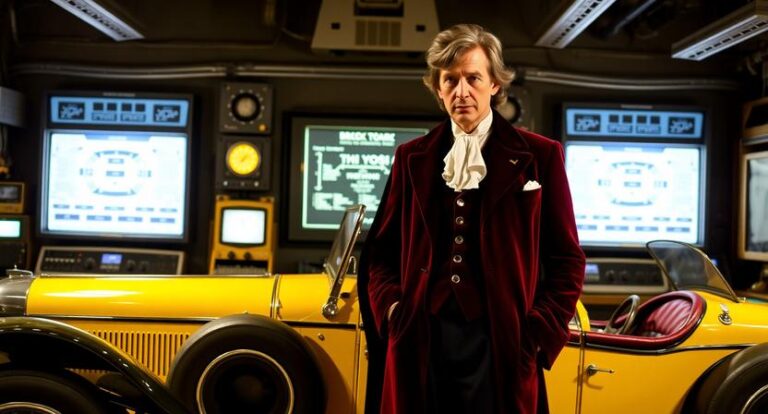
The exile also forced the Doctor to innovate. Without a functioning TARDIS, he turned to terrestrial technology, refining his iconic Sonic Screwdriver and building a variety of specialized vehicles. His yellow roadster, “Bessie,” became a symbol of his era, representing a Doctor who was intimately connected to the world he protected. This period of the show leaned heavily into the “techno-thriller” genre, influenced by the popularity of James Bond and contemporary spy fiction. The Doctor was no longer just a traveler; he was a defender, a scientist, and a man of action who utilized both his mind and his physical prowess to overcome the forces of evil.
Character Evolution: The Dandy and the Scientist
Jon Pertwee’s portrayal of the Doctor was a masterclass in contrast. He was famously dubbed “The Dandy” due to his elaborate costume, which included velvet smoking jackets, frilled jabots, Inverness capes, and bouffant hair. This sartorial elegance reflected a Doctor who was sophisticated, authoritative, and perhaps a bit more aristocratic than his predecessors. However, beneath the velvet exterior was a man of immense intellect and moral conviction. Pertwee’s Doctor was a dedicated scientist who spent hours in his laboratory at UNIT headquarters, tinkering with gadgets and analyzing biological samples. He brought a sense of real-world scientific inquiry to the role, often using actual scientific terminology (albeit sometimes modified for sci-fi) to explain his theories.
Beyond his intellectual side, the Third Doctor was the first “Action Doctor.” Jon Pertwee, a man of many talents in real life, insisted on performing his own stunts and showcasing his physical abilities. He introduced Venusian Aikido, a martial art that allowed the Doctor to disarm and disable opponents with minimal effort, emphasizing his role as a peacekeeper who only used force as a last resort. This physical presence made the Doctor feel more formidable and capable, a hero who could lead from the front lines. Whether he was riding a motorcycle, piloting a hovercraft, or engaging in a sword fight, Pertwee brought an energy and dynamism to the role that captivated younger viewers and redefined what the Doctor could be.
Despite his commanding presence, the Third Doctor also possessed a profound sense of justice and empathy. He was often the first to speak out against bureaucratic incompetence or military aggression. In stories like The Silurians or The Sea Devils, he advocated for peaceful coexistence with ancient Earth-dwelling species, only to be heartbroken when human fear led to violence. This moral complexity added layers to the character, showing a Doctor who was often at odds with the very authority figures he worked alongside. Pertwee’s ability to balance this stern authority with moments of genuine warmth and vulnerability—especially with his companions—created a deeply human and relatable version of the Time Lord.
The Introduction of The Master and Iconic Villains
One of the most significant contributions of the Pertwee era was the introduction of the Doctor’s greatest nemesis: The Master. Debuting in 1971’s Terror of the Autons, the Master was portrayed by Roger Delgado as a dark mirror to the Doctor. Where the Doctor was a renegade who sought to help others, the Master was a renegade who sought to rule. The chemistry between Pertwee and Delgado was legendary; they were close friends in real life, and that rapport translated into a screen rivalry that was sophisticated, witty, and genuinely menacing. The Master’s presence changed the show from a “monster-of-the-week” format to a more serialized battle of wits between two equal minds.
In addition to the Master, the Third Doctor era introduced several other iconic villains and species that have become staples of the franchise. These include:
- The Autons: Plastic-based life forms controlled by the Nestene Consciousness, famously hidden as shop-window mannequins. Their debut in 1970 and return in 1971 provided some of the show’s most terrifying and visually striking moments, utilizing the new color format to enhance the eerie nature of everyday objects coming to life.
- The Silurians and Sea Devils: These prehistoric reptiles were the original inhabitants of Earth, awakened from hibernation. Unlike traditional monsters, they had a legitimate claim to the planet, leading to complex moral dilemmas for the Doctor as he tried to broker peace between them and humanity.
- The Sontarans: Introduced in The Time Warrior, these clone warriors from the planet Sontar brought a new level of militaristic threat to the series. Their distinctive design and obsession with “the glory of battle” made them an instant hit and a recurring threat for future Doctors.
- The Omega: A legendary Time Lord and the father of stellar engineering, Omega was introduced in the tenth-anniversary special, The Three Doctors. His immense power and tragic backstory provided a cosmic scale to the show, linking the Doctor’s past to the fate of the universe.
- The Drashigs: Giant, multi-eyed predators from Carnival of Monsters that showcased the show’s ability to create memorable and frightening alien creatures on a limited budget. They represented the dangerous “wilderness” of the universe that the Doctor so loved to explore.
Pioneering Production and Visual Innovation
The 1970s represented a period of immense technological experimentation for the BBC. Under the guidance of producer Barry Letts, Doctor Who became a testing ground for new visual effects. One of the most prominent was Colour Separation Overlay (CSO), a primitive version of modern “green screen” or “chroma key” technology. This allowed the production team to place actors in alien environments or shrink them down into miniature sets without the need for expensive location shoots. While the technology was in its infancy and sometimes produced “fringing” around the actors, it opened up a world of possibilities for imaginative storytelling that would have been impossible just a few years earlier.
Directing also saw a shift during the Pertwee years. Directors like Douglas Camfield and Christopher Barry brought a cinematic sensibility to the show, utilizing more location filming and sophisticated camera movements. The move to 16mm film for location work gave the show a gritty, realistic feel that contrasted beautifully with the polished, multi-camera videotape used for studio scenes. This “dual-format” look became a hallmark of British television during this era. Furthermore, the score for the show evolved. The BBC Radiophonic Workshop, led by composers like Dudley Simpson and Malcolm Clarke, created avant-garde, electronic soundtracks that heightened the tension and reinforced the sci-fi atmosphere of the stories.
The production design also took a leap forward. The TARDIS interior was redesigned to be more streamlined and futuristic, and the costumes became more detailed and character-driven. The makeup department, tasked with creating convincing aliens like the Silurians or the Alpha Centauri, pushed the boundaries of what could be achieved on a television budget. These technical advancements, combined with the strong scripts and acting, created a polished and professional product that appealed to both children and adults. The Pertwee era proved that science fiction could be visually stunning and intellectually engaging, setting a high standard for all subsequent eras of the show.
The Companions: Intellectual Equals and Emotional Anchors
The Third Doctor’s companions were instrumental in defining his character and the tone of his era. Liz Shaw, played by Caroline John, was a departure from the traditional “screaming” companion. A brilliant scientist and researcher from Cambridge, she was the Doctor’s intellectual equal. Her presence highlighted the Doctor’s own scientific prowess and allowed for high-level technical dialogue. While she only stayed for one season, her character paved the way for more independent and capable companions in the future. She grounded the first season in a sense of academic realism that set the stage for the UNIT era.
Following Liz was Jo Grant, played by Katy Manning. Jo was the heart of the UNIT family—enthusiastic, loyal, and incredibly brave. While she may not have had Liz’s scientific background, she possessed a different kind of strength, often putting herself in danger to help the Doctor. The relationship between the Third Doctor and Jo Grant is one of the most beloved in the show’s history, evolving from a mentor-protégé dynamic into a deep, platonic bond. When Jo eventually left to marry a scientist in The Green Death, the Doctor’s silent departure in his car, driving off into the sunset alone, remains one of the most poignant moments in the series, showcasing the Doctor’s hidden loneliness.
The final companion of the Pertwee era was Sarah Jane Smith, portrayed by Elisabeth Sladen. Sarah Jane was a feminist journalist who brought a new level of skepticism and investigative rigor to the show. She challenged the Doctor and the Brigadier, refusing to be sidelined by the men in the room. Her introduction in The Time Warrior marked the beginning of one of the longest and most iconic tenures in Doctor Who history. Sarah Jane’s character was a bridge between the Pertwee and Tom Baker eras, and her enduring popularity eventually led to her own spin-off series, The Sarah Jane Adventures, decades later. These three women provided the Doctor with the emotional and intellectual support he needed to navigate his exile and his eventually restored travels.
Social Commentary and the “Green” Doctor
One of the most enduring legacies of the Jon Pertwee era is its commitment to social and political commentary. The writers of the time, particularly Malcolm Hulke and Robert Sloman, used the show to address contemporary issues such as environmentalism, corporate greed, and political corruption. In The Green Death, the show tackled the dangers of industrial pollution and the ethical responsibilities of corporations, featuring a giant “super-computer” and mutant maggots as metaphors for ecological collapse. This story is often cited as one of the first major examples of environmentalist messaging in mainstream television, and it resonated deeply with the burgeoning green movements of the 1970s.
Similarly, stories like The Curse of Peladon and The Monster of Peladon used the setting of a primitive planet negotiating entry into a galactic federation as an allegory for Britain’s entry into the European Economic Community (the Common Market). These narratives allowed the show to explore complex ideas about sovereignty, tradition, and progress in a way that was accessible to a general audience. The Doctor often acted as a mediator, advocating for diplomacy over conflict and warning against the dangers of xenophobia and isolationism. This “political” Doctor was a direct reflection of the turbulent times in which the show was produced, making it feel relevant and urgent.
The era also explored the ethics of science and warfare. The Silurian and Sea Devil stories are classic examples of “grey morality,” where both sides have valid grievances, and the Doctor is caught in the middle. These stories refused to provide easy answers, often ending in tragedy and questioning the military’s “shoot first” mentality. By addressing these heavy themes, the Pertwee era elevated Doctor Who from a simple children’s adventure show to a sophisticated drama that respected its audience’s intelligence. This legacy of social consciousness continues to be a defining characteristic of the series to this day.
Pro Tips for Watching the Jon Pertwee Era
For those looking to dive into the Third Doctor’s adventures for the first time, or for seasoned fans wanting to revisit the highlights, these tips will help you navigate this rich period of television history. The Pertwee era is remarkably consistent, but certain stories stand out for their historical importance and narrative quality. Understanding the context of the 1970s production will also enhance your appreciation for the creative risks the team took during this time.
- Start with Spearhead from Space: This is the perfect entry point. It is the only story of the original series filmed entirely on film, giving it a unique visual quality. It introduces the Third Doctor, the Brigadier, and the Autons, setting the tone for everything that follows.
- Pay Attention to the UNIT Family Dynamics: The chemistry between Jon Pertwee, Nicholas Courtney, John Levene (Benton), and Richard Franklin (Yates) is the glue that holds the era together. Watching their relationships grow over five seasons provides a sense of continuity and warmth that is rare in early Doctor Who.
- Don’t Miss the Delgado Master: Every story featuring Roger Delgado’s Master is worth watching. Start with Terror of the Autons and follow their rivalry through stories like The Daemons and The Sea Devils to see one of the best hero-villain dynamics in TV history.
- Appreciate the “Action” Stunts: Remember that Jon Pertwee did most of his own driving and physical stunts. Look for his custom-built Whomobile and the various motorbikes and boats he uses; these weren’t just props, but reflections of Pertwee’s real-life passions.
- Watch The Three Doctors for the Tenth Anniversary: This story is a landmark event, bringing back William Hartnell and Patrick Troughton to work alongside Pertwee. It’s a fun, cosmic adventure that also expands the lore of the Time Lords and Gallifrey.
- Observe the Evolving Role of Women: Trace the progression from Liz Shaw to Jo Grant to Sarah Jane Smith. Each represents a different facet of 1970s womanhood and shows how the show’s writers were gradually becoming more progressive in their characterization.
Frequently Asked Questions About Jon Pertwee’s Doctor
Why was the Doctor exiled to Earth during the Jon Pertwee years?
The exile was a narrative decision made by the outgoing production team at the end of the Second Doctor’s era (*The War Games*). It was primarily driven by budget constraints at the BBC; by keeping the Doctor on Earth, the show could reuse sets and film on location more easily, reducing the costs associated with creating new alien worlds every week. However, this limitation became a creative strength, leading to the beloved UNIT era.
What is Venusian Aikido, and why did the Doctor use it?
Venusian Aikido is a fictional martial art that Jon Pertwee’s Doctor practiced. Pertwee was an active man who wanted to bring more physical action to the role. The martial art allowed the Doctor to defend himself and others without using lethal weapons, fitting his character as a man of peace who nevertheless possessed the skills to neutralize threats when necessary.
Was Jon Pertwee’s Doctor the first to use the Sonic Screwdriver?
No, the Sonic Screwdriver was actually introduced during the Second Doctor’s era in the story *Fury from the Deep*. However, it was during Jon Pertwee’s tenure that it became a multi-purpose, indispensable tool. The Third Doctor used it for everything from picking locks to detonating landmines, cementing its place as an iconic part of the Doctor’s arsenal.
How did Jon Pertwee influence the wardrobe of the Doctor?
Jon Pertwee was heavily involved in designing his Doctor’s look. He brought many of his own flamboyant clothing items to the production and worked with the costume department to create the “dandy” aesthetic. He wanted a look that was both authoritative and slightly eccentric, reflecting the character’s high-born Time Lord origins and his love for Earth’s finer things.
Which story is considered the definitive Jon Pertwee adventure?
While opinions vary, *The Daemons* is frequently cited as the quintessential Third Doctor story. It features the Master, the UNIT family, a blend of science and the supernatural, a rural English setting, and the Doctor at his most authoritative and resourceful. It captures all the hallmarks of the era in a single, five-part epic.
Conclusion
Jon Pertwee’s tenure as the Doctor remains a cornerstone of the Doctor Who legacy. By successfully navigating the transition to color, grounding the show with the UNIT family, and introducing iconic elements like the Master and the Sontarans, Pertwee ensured the series’ survival and growth during a period of great change. His portrayal of the Doctor as a dashing, scientific man of action provided a template for heroism that balanced intellect with physical prowess. Even decades later, his era is remembered for its sophisticated storytelling, social relevance, and the profound sense of companionship and family it fostered. Jon Pertwee wasn’t just a placeholder between two giants; he was the revolutionary force that defined the modern era of the show. His influence continues to be felt in every episode of the contemporary series, proving that the Third Doctor’s spirit is indeed eternal.