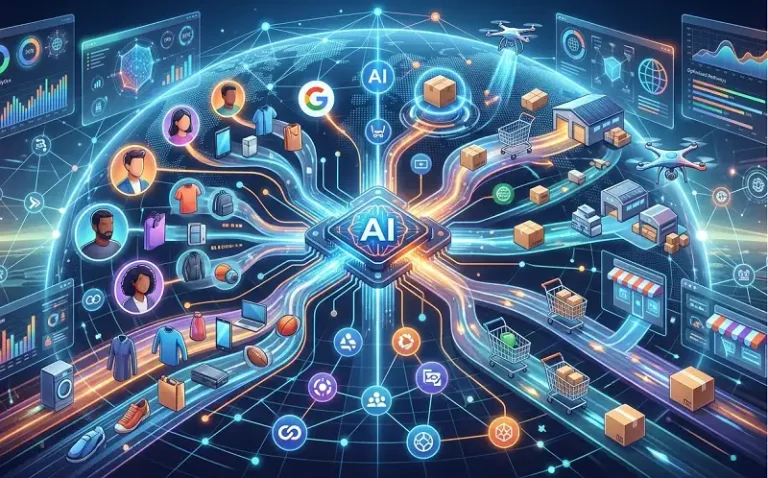
The e-commerce sector is currently undergoing its most significant transformation since the invention of the mobile shopping cart. In the current technological landscape, we are moving away from traditional keyword-based searches and toward Agentic Commerce. At the center of this shift is the Universal Commerce Protocol (UCP) and Google AI Mode, a duo designed to turn conversational discovery into instant transactions.
For store owners, this change means that your storefront is no longer just a destination for humans; it must now serve as a high-fidelity data source for AI agents. If your product information is not structured for these systems, your brand effectively ceases to exist in the new generative search ecosystem.
What is the Universal Commerce Protocol (UCP)?
The Universal Commerce Protocol is an open-source standard developed by Google in collaboration with industry giants like Shopify, Walmart, and Wayfair. Its primary purpose is to create a “common language” that allows AI agents to communicate directly with merchant commerce systems. Unlike traditional web scraping, UCP provides a standardized orchestration layer where an AI can check real-time stock, verify materials, apply discounts, and execute a native checkout.
In the current technological landscape, many retailers are finding that their WordPress guide for site optimization must now include specific technical hooks for UCP. This protocol ensures that whether a user is asking Gemini for a recommendation or using AI Mode in Search, the transaction remains frictionless.
Understanding Google AI Mode: The New Storefront
Google AI Mode is a conversational environment that replaces the traditional list of blue links with a synthesized response. When a shopper asks for a “waterproof hiking boot for wide feet,” the AI does not just show ads; it reasons through your product specifications to present a curated shortlist of 3 to 5 options. This “Zero-Click” shopping journey is powered by the data hygiene of your product feed.
Success in this environment requires more than just high-quality images. It requires Factual Density. AI agents do not care about flowery marketing copy; they care about grounded data points like [insulation: 200g] or [material: Gore-Tex]. If your site hasn’t undergone a thorough WordPress database cleanup to ensure fast API responses, the AI agent may skip your products in favor of a more responsive competitor.
Key Pillars of AI-Ready E-commerce
1. Structured Data Attributes Over Keywords
The days of stuffing product titles with dozens of synonyms are over. In the current technological landscape, AI models decompose user requests into specific intent signals. Your product feed must explicitly contain attributes that match these signals. For example, a “sustainable” tag is less effective than structured data indicating [recycled_content: 80%].
2. Real-Time Inventory and “Agentic” Accuracy
AI agents are programmed to avoid recommending out-of-stock items. If your inventory levels are not updated in real-time, your visibility in AI Mode will plummet. Reliability is a core ranking factor for GEO (Generative Engine Optimization). Businesses must ensure their backend systems are robust enough to handle high-frequency status pings from Google’s shopping agents.
3. The Role of Business Agents
Google is now allowing retailers to deploy their own Business Agents directly within Search. These are virtual sales associates trained on your unique brand voice and documentation. They can handle complex customer objections, such as “Will this fit in a small apartment?” or “What is your return policy for international shipping?” providing 24/7 high-level support that drives conversion without human intervention.
Optimizing the Checkout Journey
One of the most revolutionary aspects of UCP is Native Checkout. This allows users to complete a purchase using payment methods saved in their Google account without ever leaving the AI conversation. For the merchant, this reduces basket abandonment significantly. However, you must remain the “Merchant of Record,” meaning you still control the data, the after-sales support, and the customer relationship.
For those managing complex inventories, following WooCommerce create product programmatically guides will be essential for ensuring that every new item is instantly tagged with the correct UCP-compliant metadata. Automation is the only way to maintain the level of detail required by 2026-era search engines.
The Impact of “Direct Offers”
Google is piloting a feature called Direct Offers, which surfaces personalized incentives within AI Mode. If an agent detects high purchase intent, it can pull a specific discount code or limited-time promotion from your feed. This is not traditional keyword bidding; it is context-aware promotion. Retailers who master this will see a dramatic increase in conversion rates among high-intent shoppers.
Preparing Your Business for the Agentic Era
To thrive in the age of UCP and AI Mode, retailers should focus on three immediate actions:
- Audit Data Hygiene: Ensure every “ghost attribute” in your Merchant Center (like material, pattern, or occasion) is filled with accurate data.
- Enhance E-E-A-T: AI agents prioritize trusted sources. Build your review volume and ensure your 10 simple ways to improve customer trust are implemented throughout your digital presence.
- Monitor Scraper Traffic: Protect your proprietary data from aggressive scrapers while ensuring that verified Google bots have a “Safe Lane” to access your real-time pricing and stock levels.
Conclusion
The Universal Commerce Protocol is not just a new technical standard; it is the infrastructure for the future of trade. In the current technological landscape, the gap between “searching” and “owning” is closing. By adopting UCP and optimizing for Google AI Mode, e-commerce businesses can ensure they are not just seen, but chosen by the AI agents that are increasingly making decisions for the consumer.