

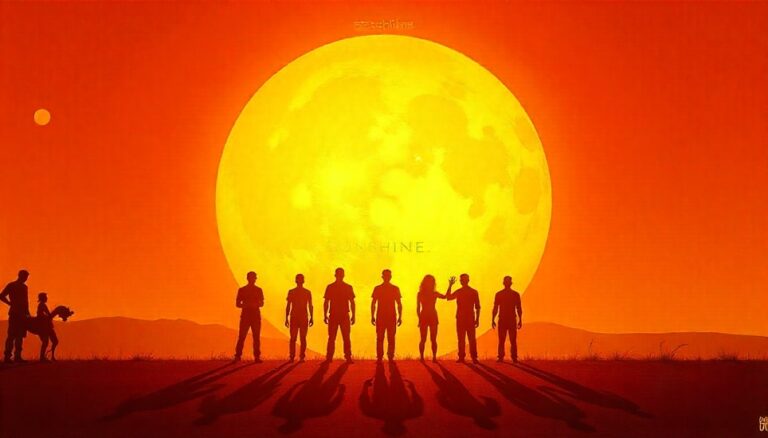
In the vast landscape of science fiction cinema, few films have been as criminally overlooked yet profoundly impactful as Danny Boyle’s Sunshine. Released in 2007, this ambitious space thriller starring Cillian Murphy and Chris Evans has gradually earned its reputation as one of the most underrated sci-fi films of the 21st century. While it struggled at the box office, grossing only around 35 million dollars against a 40 million dollar budget, the film has since cultivated a devoted following that recognizes its unique blend of hard science fiction, psychological horror, and existential philosophy.
Directed by the visionary Danny Boyle, known for his genre-hopping prowess with films like Trainspotting and 28 Days Later, and written by acclaimed screenwriter Alex Garland, Sunshine represents a bold attempt to create a thinking person’s science fiction film. Set in the year 2057, the story follows the crew of the Icarus II spacecraft on a desperate mission to reignite Earth’s dying sun with a massive stellar bomb. The film features an ensemble cast including Rose Byrne, Cliff Curtis, Michelle Yeoh, Hiroyuki Sanada, Troy Garity, Benedict Wong, and Mark Strong, with Murphy playing physicist Robert Capa and Evans portraying engineer James Mace.
The Genesis of Sunshine: Alex Garland’s Vision
The conceptual foundation of Sunshine emerged from Alex Garland’s fascination with cosmological concepts and humanity’s ultimate fate. After reading an article in an American scientific periodical about the heat death of the universe from a physics-based perspective, Garland became captivated by a singular question: what would happen if the entire planet’s survival rested on the shoulders of one person, and how would that immense responsibility affect their psyche? This philosophical inquiry became the emotional core of the screenplay.
Garland brought his ambitious script to Danny Boyle, who had long harbored a desire to direct a science fiction film set in space. The collaboration proved fruitful, with both filmmakers working on the screenplay for an entire year, producing 35 different drafts as they experimented with various approaches to the material. To ensure scientific accuracy, the production team consulted extensively with Dr. Brian Cox, a physicist from CERN, who served as the film’s scientific adviser throughout development and production.
Interestingly, Boyle viewed Sunshine as a counterintuitive approach to contemporary discussions about global warming. Instead of depicting a world threatened by rising temperatures, the film presents a chilling scenario where the sun’s diminishing energy plunges Earth into a new ice age. This reversal of expectations reflected Boyle’s interest in subverting audience assumptions and exploring familiar themes from unexpected angles.
Assembling an International Ensemble Cast
Danny Boyle made a deliberate choice to assemble an international ensemble cast for Sunshine, drawing inspiration from Ridley Scott’s Alien. The director believed this approach would create a more democratic process on screen, reflecting the mission’s purpose of acting on behalf of all humanity rather than a single nation. The cast was carefully selected to represent various nationalities, with a particular emphasis on American and Asian actors, based on the filmmakers’ belief that American and Chinese space programs would be the most economically empowered and technologically advanced fifty years into the future.
Cillian Murphy, fresh from his breakout role in Batman Begins, took on the central character of Robert Capa, the physicist responsible for operating the massive stellar bomb. Murphy approached the role with remarkable dedication, consulting extensively with physicist Brian Cox to understand advanced physics concepts. He even toured the CERN facility in Switzerland, observing real scientists and copying their mannerisms to bring authenticity to his performance. Cox later praised Murphy’s portrayal as brilliant and an excellent representation of how physicists actually think and behave. Murphy’s involvement in the film reportedly influenced his personal philosophy, shifting his views on religion from agnosticism to atheism.
Chris Evans, then primarily known for his role in the Fantastic Four films, portrayed James Mace, the ship’s engineer. Evans described his character as possessing a level head that enabled him to operate coherently under extreme pressure. The actor appreciated Boyle’s collaborative approach to filmmaking, noting that the cast spent over a month rehearsing in London before shooting began. The actors lived together in dormitory-style accommodations to create authentic chemistry and replicate the sensation of shared space that their characters would experience. The cast also participated in scuba diving training and attended lectures to prepare for their roles, with Evans praising Boyle’s actor-first methodology that treated the production like theatrical rehearsal.
Visual Innovation and Production Design
Sunshine stands as a testament to what visionary filmmakers can achieve with a relatively modest budget and innovative techniques. Despite working with approximately 40 million dollars, significantly less than typical Hollywood blockbusters, Boyle and his team created visual effects that continue to impress audiences nearly two decades after the film’s release. The production featured 750 visual effects shots, all handled by London’s Moving Picture Company.
Director of Photography Alwin Küchler collaborated closely with Boyle to create the film’s distinctive visual aesthetic, which alternates dramatically between pitch darkness and overwhelming light. This visual approach serves both practical and thematic purposes, emphasizing the sun’s dual nature as both a life-giving force and an existential threat. The filmmakers drew inspiration from classic science fiction cinema, particularly Stanley Kubrick’s 2001: A Space Odyssey, Andrei Tarkovsky’s Solaris, and Ridley Scott’s Alien, while also citing Wolfgang Petersen’s Das Boot as an influence for the claustrophobic atmosphere.
The production team employed practical effects whenever possible to maintain authenticity. In one memorable sequence where Capa dreams of falling into the sun, Murphy was placed in a gantry surrounded by 20 assistants who rotated an assembly of bright lights around him. Another scene depicting a character’s death from solar exposure utilized massive wind turbines to propel biodegradable dust at the actor, allowing computer-generated effects to follow the actor’s movements rather than the reverse. Boyle explained that this approach helped viewers connect more deeply with the action, avoiding the mental compartmentalization that often occurs when audiences recognize obviously artificial effects.
The Sun as Character: Scientific Consultation and Visual Design
One of Sunshine’s most remarkable achievements is its portrayal of the sun itself, which functions almost as a character within the narrative. The visual effects team based their stunning solar designs on actual data from NASA and solar observatories, creating what remains one of the most scientifically informed and visually striking depictions of our star in cinema history. The sun’s overwhelming presence dominates the film, appearing simultaneously beautiful and terrifying, captivating yet deadly.
The relationship between the crew and the sun forms a central thematic element. Dr. Searle, the ship’s psychological officer played by Cliff Curtis, becomes obsessed with observing the sun, spending excessive time on the observation deck. His perma-tanned, panda-eyed appearance serves as a visual manifestation of this dangerous fascination. The film explores how proximity to such immense cosmic power affects human psychology, suggesting that some phenomena are simply too vast and magnificent for the human mind to process safely.
While the film’s scientific content received some criticism from specialists, particularly regarding the feasibility of reigniting a dying star with a nuclear device, Dr. Brian Cox defended the film’s approach. He noted in the DVD commentary that several scientific inaccuracies were deliberately permitted to serve the plot, emphasizing that Sunshine is not a documentary but rather an artistic exploration of what it feels like to be a scientist facing impossible odds. Cox dismissed critics who focused excessively on technical details like gravitational accuracy, arguing that such critiques missed the film’s broader ambitions.
Sound Design and Musical Score: Creating Atmosphere
The auditory landscape of Sunshine deserves recognition as one of the film’s most powerful elements. The score, created through a unique collaboration between electronic music group Underworld and composer John Murphy, draws heavily from avant-garde composer György Ligeti, whose work famously featured in 2001: A Space Odyssey. Underworld members Karl Hyde and Rick Smith were specifically influenced by Ligeti’s Lux Aeterna, allowing those classical influences to shape their electronic compositions.
The final soundtrack represents a hybrid creation, with Underworld recording their portions before passing the material to John Murphy for completion. The indie band I Am Kloot also contributed to the score with their track Avenue of Hope. Despite enthusiastic reception from fans, the soundtrack faced significant delays before its eventual release on iTunes USA in November 2008, reportedly due to legal disputes between Underworld’s lawyers and Fox Searchlight.
Beyond the musical score, Sunshine features extraordinary sound design that immerses viewers in the spacecraft environment. Every element, from the sun’s burning to the ship’s engines to the ambient sounds of the interior spaces, received meticulous attention. The sound production creates such a convincing sense of place that many viewers report feeling physically present aboard the Icarus II. The film’s soundscape proves particularly effective during exterior action sequences, including a tense suitless spacewalk and a dangerous repair mission on the enormous curved golden shield protecting the ship from solar radiation.
Philosophical Themes and Existential Questions
Beneath its spectacular visuals and tense thriller elements, Sunshine grapples with profound philosophical questions about humanity’s place in the universe. The film explores themes of sacrifice, mortality, existentialism, religious faith, and the psychological effects of isolation. Each crew member must confront the reality that their mission is essentially suicidal, with success requiring their deaths as the stellar bomb detonates. This framework forces characters and viewers alike to consider what gives life meaning when survival is impossible.
Alex Garland’s screenplay deliberately places the crew in situations where pure logic proves insufficient, requiring them to navigate the murky territory between reason and intuition, between scientific calculation and human emotion. The film suggests that even humanity’s finest scientific minds cannot function on logic alone when facing decisions with such catastrophic consequences. Right choices lead to disaster through human error, while seemingly irrational decisions sometimes offer the only path forward.
The character of Captain Pinbacker, played by Mark Strong, embodies the film’s exploration of religious mania and the psychological breaking point that can occur when humans confront cosmic scales beyond their comprehension. Pinbacker, the captain of the failed Icarus I mission, becomes convinced that humanity’s extinction represents divine will, that interfering with the sun’s death is blasphemy against God’s plan. His presence in the third act transforms the film from hard science fiction into something approaching cosmic horror, a shift that divided audiences and critics but perfectly encapsulates Garland and Boyle’s thematic interests.
The Controversial Third Act Transformation
No discussion of Sunshine would be complete without addressing its polarizing final act. After establishing itself as a methodical, scientifically grounded space thriller for approximately two-thirds of its runtime, the film shifts dramatically into psychological horror territory with Pinbacker’s introduction. This tonal transformation has sparked debate among fans and critics since the film’s release, with some viewing it as a creative misstep that undermines the preceding excellence, while others argue it represents the logical culmination of the film’s thematic exploration.
The disagreement over the third act actually reflects creative tensions between Boyle and Garland during production. Garland favored a more ambiguous, open-ended conclusion that would leave space for interpretation, while Boyle pushed for a more definitive resolution with clear antagonistic forces. The introduction of Pinbacker as a quasi-supernatural threat served as something of a compromise between these visions. Boyle later acknowledged the challenge of working in science fiction, noting that he became obsessed with inventing every detail of the world, which proved spiritually exhausting.
Despite the controversy, many defenders of the film argue that the horror elements actually strengthen Sunshine’s central themes. The shift mirrors the crew’s psychological deterioration as they approach the sun, with the film’s structure itself breaking down just as the characters’ sanity fragments. Pinbacker represents the madness that can consume anyone who stares too long into the cosmic abyss, literalizing the psychological dangers that have been building throughout the narrative. His distorted, overexposed appearance creates an unsettling visual effect that suggests he has somehow merged with the solar radiation itself.
Reception, Legacy, and Cultural Impact
Sunshine’s theatrical release proved disappointing from a commercial standpoint. The film opened on just ten screens in the United States in July 2007, earning a mere 242,964 dollars during its opening weekend. Despite expanding to wider release, Sunshine ultimately grossed approximately 32 to 35 million dollars globally against its 40 million dollar production budget, marking it as a box office failure. The limited commercial success effectively ended discussions of the planned trilogy that Boyle and Garland had outlined, which would have explored additional planetary stories within the same universe.
Critical reception proved more mixed than outright negative. The film holds a 76 percent approval rating on Rotten Tomatoes based on 169 reviews, with an average rating of 6.8 out of 10. Many critics praised the film’s ambition, visual splendor, and powerful first two acts while expressing reservations about the controversial finale. Roger Ebert gave the film three out of four stars, appreciating its intellectual approach and willingness to engage with genuine scientific concepts rather than purely fantastical elements.
In the years since its release, Sunshine has undergone significant critical reevaluation, with many film scholars and science fiction enthusiasts recognizing it as an unfairly overlooked masterpiece. The film has developed a devoted cult following that appreciates its unique position within the science fiction genre, occupying a rare middle ground between hard science and metaphysical speculation. Prominent figures like Quentin Tarantino have praised the film despite acknowledging its flaws, recognizing its ambition and the emotional power of its best moments.
The film’s influence can be traced through subsequent science fiction cinema, particularly in works that blend existential philosophy with space exploration. Its approach to depicting the psychological toll of deep space missions and the awesome terror of cosmic phenomena has informed numerous later projects. The visual design of the sun itself remains iconic, frequently cited as one of the most striking depictions of stellar phenomena in film history.
The Boyle-Garland Collaboration: Sunshine’s Place in Their Partnership
Sunshine represents a crucial chapter in the creative partnership between Danny Boyle and Alex Garland, one that nearly ended their collaboration entirely. The creative disagreements during production created tension between the two filmmakers, with Boyle later recalling a particularly heated argument with studio executive Tom Rothman about the film’s bleak tone. Rothman complained about Boyle killing off hope at every turn, specifically citing a scene where Michelle Yeoh’s character finds a small green plant shoot in the oxygen garden, only to die moments later.
Following Sunshine’s completion, the strained relationship between Boyle and Garland led to an 18-year gap before their next collaboration. Garland reportedly sent Boyle a thoughtful note apologizing for the miserable experience they had shared during production, expressing hope that Boyle’s next film would prove more enjoyable. This gesture, while appreciated, couldn’t immediately repair the creative rift that had developed.
The reconciliation eventually came years later when Garland was preparing to direct Ex Machina, his directorial debut. He felt compelled to show the project to Boyle and seek his opinion, leading to a renewed connection between the two filmmakers. This reconnection eventually resulted in their reunion for 28 Years Later, the long-awaited sequel to 28 Days Later, which was released in 2025. Interestingly, Boyle has revealed that Garland’s natural instinct as a storyteller is to create expanding universes, which is why 28 Years Later was developed as the first part of a new trilogy rather than a standalone sequel.
Technical Achievements and Practical Filmmaking
One of Sunshine’s most impressive achievements lies in how Boyle and his team maximized their limited resources through innovative practical filmmaking techniques. Rather than relying entirely on computer-generated imagery, the production emphasized tangible effects and real environmental conditions whenever possible. The cast experienced genuine physical challenges during filming, with set lighting creating authentic heat that helped actors convey the sensation of being dangerously close to the sun.
The spacecraft interiors were designed with meticulous attention to detail, creating a lived-in environment that feels both futuristic and believable. Production designer Mark Tildesley drew inspiration from real space program aesthetics while extrapolating forward fifty years to imagine how technology might evolve. The ship’s design emphasizes functionality over flash, with every element serving a practical purpose within the narrative. This grounded approach extends to the costumes, which feature minimal styling and makeup to reinforce the utilitarian nature of the mission.
Filming took place primarily at 3 Mills Studios in east London, with the production team constructing elaborate sets to represent the various sections of the Icarus II spacecraft. The final scene’s snowy landscape was shot in Stockholm, Sweden, with a composite shot combining Stockholm’s background with the Sydney Opera House to create the film’s concluding image. An alternative ending was also filmed but ultimately rejected by Boyle, who felt it didn’t properly serve the story. This alternate ending was later included on the film’s DVD release, allowing fans to compare Boyle’s final vision with the road not taken.
The Film’s Scientific Accuracy and Artistic License
The tension between scientific accuracy and dramatic necessity forms one of Sunshine’s most interesting aspects. While the film strives for realism in many areas, particularly in its depiction of space travel conditions and the psychological effects of isolation, it necessarily takes significant liberties with the core premise. The concept of reigniting a dying sun with a nuclear device has no basis in actual physics, with scientists noting that billions of such devices would be required to have any theoretical effect, and even then, the concept remains purely speculative.
The film’s scientific consultant, Dr. Brian Cox, acknowledged these compromises while defending the overall approach. In his DVD commentary, Cox explains that Sunshine introduces the concept of a Q-ball, a theoretical particle that CERN scientists were investigating at the time, as the cause of the sun’s premature death. The stellar bomb is intended to blast this Q-ball into its constituent parts, which would then naturally decay, allowing the sun to return to normal function. While this remains speculative science at best, Cox appreciated Garland’s attempt to ground the premise in actual theoretical physics rather than pure fantasy.
Other scientific liberties include the lack of artificial gravity on the spacecraft, the unrealistic depiction of solar observation safety protocols, and various details about radiation exposure and space travel physics. Solar physicist Anjana Ahuja, writing for The Times, criticized these inaccuracies, suggesting that Boyle could have achieved the same level of scientific fidelity by giving a calculator to a schoolboy. However, Ahuja praised the film’s psychological aspects, acknowledging that the depiction of extended space travel’s mental toll felt authentic and well-researched.
Cast Performances and Character Development
The ensemble cast of Sunshine delivers uniformly strong performances that ground the film’s spectacular visuals in genuine human emotion. Cillian Murphy anchors the film with a nuanced portrayal of Capa, conveying the character’s intellectual brilliance while also revealing his growing psychological strain as the mission progresses. Murphy described Capa as a silent outsider, isolated by his unique understanding of the bomb’s true power and purpose. The actor’s naturally intense screen presence proves perfectly suited to a character who must carry the weight of humanity’s survival on his shoulders.
Chris Evans demonstrates unexpected range in his role as Mace, moving beyond his previous work in more straightforward action films. His portrayal of the pragmatic engineer who frequently clashes with Capa over mission priorities adds essential conflict to the crew dynamics. The evolution of the relationship between Mace and Capa forms one of the film’s emotional throughlines, with initial hostility gradually giving way to grudging respect and ultimately mutual sacrifice.
The supporting cast contributes memorable performances that flesh out the crew’s international composition. Michelle Yeoh brings quiet dignity to Corazon, the ship’s biologist who tends the oxygen garden. Hiroyuki Sanada’s Captain Kaneda embodies stoic leadership facing impossible decisions. Rose Byrne’s Cassie serves as the crew’s conscience, questioning the ethical implications of their choices. Cliff Curtis creates a haunting portrait of psychological deterioration as Dr. Searle, whose obsession with observing the sun foreshadows the madness that will later consume Pinbacker. Benedict Wong and Troy Garity round out the crew with solid supporting work.
Sunshine’s Influence on Modern Science Fiction
While Sunshine may not have achieved commercial success upon its initial release, its influence on subsequent science fiction cinema has proven substantial. The film’s approach to depicting space travel as psychologically grueling rather than romantically adventurous has informed numerous later projects. Its visual style, particularly the striking use of light and shadow to create both beauty and terror, has been widely imitated. The film demonstrated that audiences could engage with science fiction that prioritizes philosophical questions over action spectacle, even if that audience remained relatively small.
The movie’s exploration of humanity’s insignificance against cosmic scales anticipated similar themes in later films like Gravity, Interstellar, and Ad Astra. Its willingness to blend genres, incorporating elements of psychological horror into hard science fiction, paved the way for more experimental approaches within mainstream cinema. The emphasis on practical effects and authentic-feeling environments influenced a generation of filmmakers seeking alternatives to purely computer-generated spectacle.
Sunshine also demonstrated the viability of international co-productions for ambitious science fiction projects. The film’s British production with modest budget proved that compelling sci-fi didn’t require Hollywood blockbuster resources, inspiring similar efforts in other countries. The success of subsequent projects like Ex Machina, directed by Alex Garland, owes something to the groundwork laid by Sunshine in proving that thoughtful, philosophical science fiction could find an audience willing to engage with challenging material.
The Missed Opportunity: The Planned Sunshine Trilogy
One of the most intriguing what-might-have-beens in science fiction cinema involves the Sunshine trilogy that never came to fruition. In recent interviews, Danny Boyle has revealed that Alex Garland originally wrote outlines for two additional films that would have continued the story as a planetary trilogy exploring different aspects of humanity’s relationship with the sun and other celestial bodies. While Garland only completed detailed outlines rather than full scripts, Boyle has characterized the ideas as extraordinary and ambitious.
The commercial failure of the first film effectively killed any possibility of continuing the series, despite the creative team’s enthusiasm for the material. Boyle noted with some humor that the movie did no business at all, making it impossible to convince studios to invest in sequels. The director has expressed mixed feelings about this outcome, acknowledging both disappointment at the lost opportunity and relief at not having to endure the spiritually exhausting experience of science fiction production again.
Nevertheless, Boyle maintains deep affection for Sunshine, frequently expressing pride in what the team accomplished. He notes that many people genuinely think about and love the film in ways they don’t with some of his other works, despite its commercial failure. When rewatching the film years later, Boyle found himself impressed by sequences he had created, momentarily forgetting his own involvement. This perspective offers insight into how filmmakers can appreciate their own work with fresh eyes after sufficient time has passed.
Conclusion
Sunshine stands as one of the most ambitious and visually stunning science fiction films of the 21st century, a work that has gradually earned recognition as an underrated masterpiece despite its initial commercial disappointment. Danny Boyle and Alex Garland’s collaboration produced a unique film that occupies a rare middle ground between hard science fiction and metaphysical speculation, between intellectual rigor and emotional intensity. The film’s willingness to embrace complexity and ambiguity, even at the cost of mainstream accessibility, marks it as a significant achievement in genre cinema.
The performances by Cillian Murphy, Chris Evans, and the ensemble cast ground the spectacular visuals in genuine human emotion, while the innovative production design and practical effects create a convincing vision of humanity’s desperate attempt to prevent extinction. The score by Underworld and John Murphy perfectly complements the film’s blend of wonder and terror, creating an immersive soundscape that lingers long after viewing.
While the controversial third act continues to divide audiences, it represents an integral part of the film’s thematic exploration of madness, faith, and humanity’s psychological limits when confronting cosmic scales beyond comprehension. The film’s influence on subsequent science fiction cinema has proven substantial, demonstrating that thoughtful, philosophical approaches to the genre can resonate with audiences willing to engage with challenging material.
Nearly two decades after its release, Sunshine deserves recognition as a bold and deeply resonant piece of science fiction that captures cosmic wonder and existential dread with exceptional clarity and emotional impact. For viewers seeking science fiction that prioritizes ideas and atmosphere over action spectacle, Sunshine remains essential viewing and a testament to what visionary filmmakers can achieve when they refuse to compromise their artistic vision for commercial considerations.
