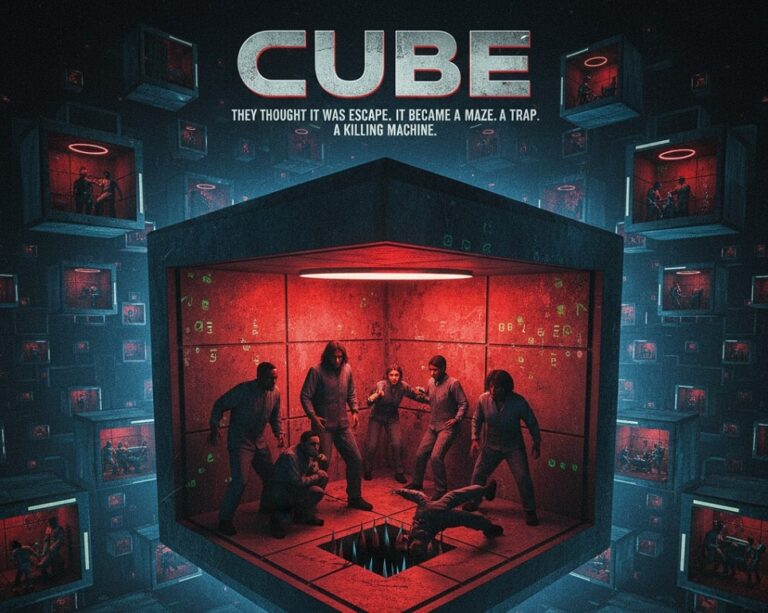
The release of Vincenzo Natali’s Cube in 1997 marked the beginning of a cinematic phenomenon that would quietly redefine low-budget horror for generations. As the film celebrates its 25th anniversary, it remains a testament to the power of minimalist storytelling, where a simple premise—a group of strangers trapped in a deadly maze of cube-shaped rooms—unleashes profound explorations of fear, trust, and the human condition. In an era dominated by high-octane blockbusters, Cube’s enduring appeal lies in its intellectual rigor and unflinching gaze at mortality, drawing new viewers through streaming services and anniversary retrospectives.
Premiering at the Toronto International Film Festival on September 9, 1997, the movie emerged from the Canadian Film Centre’s First Feature Project, a program designed to nurture emerging talent. With a production budget of merely $365,000 Canadian dollars, the team crafted a labyrinthine world using just two interconnected sets, rotating them to simulate an infinite structure. This ingenuity not only solved logistical hurdles but also amplified the film’s core theme of disorientation, making every transition feel perilously unpredictable.
The narrative centers on six individuals who awaken in identical industrial chambers, each door leading to potential salvation or slaughter. Devoid of backstory or external aid, they must pool their unique skills—a mathematician’s logic, an architect’s insight, a doctor’s compassion—to decipher the maze’s cryptic numbering system and evade gruesome traps. The result is a 90-minute descent into paranoia, where alliances shatter and survival instincts expose the darkest facets of personality.
What elevates Cube beyond standard genre fare is its philosophical undercurrent, questioning the absurdity of existence itself. Director Natali has described the cube as a metaphor for bureaucratic indifference, a “headless blunder” where purpose evaporates, leaving only raw endurance. This resonates deeply in retrospective viewings, especially as global events like pandemics echo its themes of enforced isolation and arbitrary suffering.
Production Insights: Crafting Terror on a Shoestring
The journey to bring Cube to life was as precarious as its plot. Vincenzo Natali, then a 27-year-old novice, co-wrote the screenplay with Andre Bijelic and Graeme Manson over several years, initially envisioning it as a short film. The script’s evolution incorporated influences from existential literature and surreal cinema, blending Kafka’s Trial with the mechanical whimsy of Gilliam’s Brazil, but grounded in visceral horror.
Filming commenced in Toronto’s underbelly, utilizing abandoned warehouses for authenticity. Cinematographer Derek van den Bogert employed stark fluorescent lighting to mimic institutional sterility, while practical effects—wire-frame blades, corrosive sprays, and flamethrowers—were built by a small props team led by Rob Bryson. The crew’s 20-day shoot demanded endurance, with actors navigating harnesses and pyrotechnics in sweltering confines, fostering the on-screen tension organically.
Post-production proved equally inventive; editor John Sanders used rapid cuts and echoing audio mixes by Mark Korven to heighten unease, eschewing a traditional score for ambient industrial drones. Sound designer Peter Sawade layered metallic scrapes and distant mechanisms, creating an auditory maze that lingers in the mind. These choices, born of necessity, contributed to the film’s raw, unpolished charm, which critics later hailed as a strength rather than a flaw.
Distribution hurdles nearly derailed the project, but Lionsgate’s acquisition for U.S. rights in 1998 propelled it into video stores, where word-of-mouth built its cult following. Box office returns were modest at $501,818 domestically, but international rentals pushed global earnings to nearly $9 million, validating the gamble and launching sequels.
The 25th anniversary editions, including remastered Blu-rays from 2017 and fan-restored 4K versions circulating online, preserve this DIY ethos. Collectors prize the 15th-anniversary release for its commentary track, where Natali recounts near-misses like a trap malfunction that singed an actor’s sleeve.
Technical Breakdown: Sets, Effects, and Innovations
The cube’s design was a marvel of modular engineering: each 14-foot room featured interchangeable panels, allowing 17,576 theoretical configurations without rebuilding. This scalability mirrored the plot’s mathematical core, where room coordinates dictate fate. VFX supervisor Tom Turnbull integrated subtle CGI for sliding walls, a rarity for 1997 indies, blending seamlessly with practical gore.
Costume designer Mary McLeod outfitted the cast in utilitarian jumpsuits, dyed in muted grays to evoke anonymity. Makeup artist Amber Karmin crafted prosthetics for disfiguring injuries, using silicone molds tested for realism under harsh lights. These elements coalesced into a cohesive aesthetic that feels oppressively lived-in, enhancing immersion.
Natali’s direction emphasized long takes to capture improvisational sparks, like ad-libbed arguments that deepened character arcs. This spontaneity, combined with rehearsal-free blocking, yielded performances teetering on hysteria, a hallmark of the film’s psychological authenticity.
Character Portraits: The Human Element in the Machine
Maurice Dean Wint’s portrayal of Quentin, the authoritative cop, anchors the ensemble with a blend of bravado and brittleness. His character’s descent from leader to liability underscores themes of unchecked power, drawing from real-world authority figures. Wint, a Toronto stage veteran, brought physicality honed from theater, making each confrontation palpably volatile.
Nicole de Boer embodies Leaven, the architecture student whose analytical mind becomes the group’s lifeline. Her quiet determination evolves into fierce resolve, reflecting Natali’s intent to subvert gender tropes in horror. De Boer’s chemistry with co-stars, forged during intense table reads, infuses scenes with genuine camaraderie turned toxic.
Wayne Robson’s Holloway, the outspoken doctor, injects moral urgency, her conspiracy-laden rants voicing collective outrage. Robson’s background in Canadian TV lent her fiery delivery authenticity, while her character’s sacrificial arc amplifies the film’s critique of altruism in crisis.
David Hewlett’s Worth, the disillusioned designer, provides cynical levity, his revelations peeling back the cube’s facade. Hewlett’s wiry energy, familiar from sci-fi roles, suits the role’s intellectual detachment. Julian Richings’ brief but haunting opener as Alderson sets a fatalistic tone, his silent agony a prelude to the chaos.
Andrew Miller’s Kazan, the autistic savant, navigates non-verbal communication with poignant subtlety, avoiding caricature through Miller’s research-driven preparation. His arc challenges ableism, positioning vulnerability as unexpected strength. Together, the cast’s interplay—marked by overlapping dialogue and physical clashes—drives the narrative’s emotional core.
Performance Highlights and Actor Reflections
Standout moments include a heated debate on escape ethics, where layered blocking captures escalating distrust. Post-release, the cast reunited for anniversary panels, with Wint noting in a 2022 Variety feature how the role humanized law enforcement portrayals.
De Boer credited the film’s intimacy for lasting bonds, while Robson, before her 2013 passing, praised its empowerment of female voices in genre spaces. These reflections highlight Cube’s off-screen legacy as a collaborative triumph.
Hewlett humorously lamented in podcasts the “cube curse” of typecasting, yet expressed pride in its inspirational reach for aspiring actors.
Thematic Depths: Existential Horror Unpacked
Cube transcends its premise to interrogate life’s arbitrariness, with the maze symbolizing a universe indifferent to suffering. Characters’ skills—logic, empathy, intuition—prove futile against systemic cruelty, echoing Camus’ absurdism. This layer invites repeated viewings, as audiences unearth new interpretations amid shifting alliances.
Paranoia permeates every frame, from shadowed corners to whispered accusations, mirroring societal divisions. The film’s refusal to resolve the cube’s origins—government experiment? Corporate folly?—fuels endless speculation, a deliberate ambiguity Natali defended as “the point of the pointlessness.”
Mathematical motifs, like prime power decoding, blend intellect with instinct, critiquing overreliance on reason. Traps serve as metaphors for unforeseen consequences, their randomness underscoring privilege’s illusion in survival games.
Social commentary emerges in character prejudices, from ableism to sexism, exposed under duress. Holloway’s rants on institutional evil parallel real critiques of power structures, making Cube prescient for 21st-century discourses.
Philosophically, it probes free will versus determinism, with shifting rooms defying control. This resonates in therapy sessions and philosophy classes, where educators use clips to discuss resilience.
Social and Philosophical Interpretations
Scholars liken the cube to Foucault’s panopticon, a surveillance state internalized as self-policing. Fan essays on platforms like Medium explore eco-allegories, viewing traps as environmental reckonings.
Natali’s 2023 reflections emphasized its anti-authoritarian bent, born from 90s disillusionment. Global audiences adapt these lenses culturally, from Japanese remakes stressing collectivism to Latin American views on inequality.
The film’s gore, restrained yet inventive, punctuates intellectual beats, ensuring visceral recall without desensitization.
Franchise Expansion: From Original to Global Adaptations
Cube 2: Hypercube (2002) escalated the stakes with a four-dimensional tesseract, where time loops and gravity flips confound captives. Directed by Andrzej Sekuła, it introduced Kate, a detective unraveling corporate machinations, grossing $1 million on a similar budget but critiqued for diluting mystery.
Cube Zero (2004), Ernie Barbarash’s prequel, shifts perspectives to handlers in a sterile observatory, revealing religious zeal and ethical lapses. Featuring Zach Galligan, it earned mixed praise for world-building but faulted for demystifying the original.
The trilogy’s direct-to-video model sustained profitability, with combined earnings exceeding $10 million. Collector’s box sets bundle them, appealing to completists.
The 2021 Japanese Cube, directed by Yasuhiko Shimizu, transplants the premise to a snowy facility, emphasizing interpersonal bonds amid traps. Masaki Suda leads a diverse cast, with cultural twists like honor codes influencing decisions. Released amid lockdowns, it grossed ¥200 million domestically, streaming internationally on Screambox.
Lionsgate’s reboot pursuits, announced in 2022, seek diverse pitches blending horror with social relevance. Potential directors eye VR integration for immersive dread.
Impact on Pop Culture and Horror Tropes
Cube’s trap lexicon—laser grids, acid pits—influenced Saw’s Jigsaw, with Leigh Whannell citing it as a blueprint in 2004 interviews. Video games like Cube Escape series homage its puzzles, while escape rooms worldwide replicate chambers.
Literary nods appear in Cixin Liu’s Dark Forest, paralleling dark forest theory with maze isolation. TV episodes from Black Mirror to The Twilight Zone echo its confined ethics.
Anniversary merchandise, from enamel pins to apparel, thrives on Etsy, while fan films expand lore on YouTube.
In 2025 retrospectives, outlets like Inverse hail it as indie horror’s gold standard, inspiring micro-budget creators via festivals like Fantasia.
Critical Acclaim and Audience Legacy
Upon release, Cube earned an 81% on Rotten Tomatoes, lauded for “ingenious concept and claustrophobic tension” by Variety. Roger Ebert noted its “Kafka meets escape room” vibe, while The Guardian praised its “unflinching misanthropy.”
Audience scores hover at 7.1/10 on IMDb, with 100,000+ ratings reflecting sustained engagement. Forums buzz with ending debates, from triumphant irony to bleak nihilism.
Academic papers in journals like Horror Studies analyze its spatial semiotics, while podcasts like “The Faculty of Horror” dissect gender dynamics.
Awards, Festivals, and Milestones
TIFF’s Best First Feature win launched Natali’s career, leading to projects like Splice. Brussels’ Jury Prize affirmed its fantasy credentials.
Anniversary events included 2022 virtual marathons and 2023 director Q&As at SXSW. Sundance’s 2025 homage featured restored prints, drawing 500 attendees.
Playback’s 2001 poll ranked it eighth among Canadian films, a spot reaffirmed in 2022 updates.
Modern Relevance: Cube in a Connected World
Streaming algorithms pair Cube with contemporaries like The Platform, boosting views amid “cozy horror” trends. Its brevity suits short-attention spans, yet depth rewards rewatches.
Pandemic parallels—quarantine as cube—spurred TikTok essays, amassing millions of views. Mental health advocates cite it for portraying trauma’s ripple effects.
Educational tie-ins use math puzzles for STEM classes, with teachers adapting coordinates for interactive lessons. VR adaptations prototype on Oculus, simulating navigation.
As climate anxieties rise, eco-readings frame traps as planetary warnings, per 2024 Guardian op-eds.
Fan communities on Reddit’s r/Cube host AMAs, while cosplay at Comic-Con recreates jumpsuits.
Where to Watch and Collect
Available on Shudder, Tubi, and Prime Video, Cube streams in HD. Physical media includes Criterion’s 25th-anniversary set with essays and deleted scenes.
International editions vary, from French dubs to Asian subbed remasters. Rental options on iTunes ensure accessibility.
Exploring Similar Cinematic Traps
Cube’s legacy inspires a trove of confined thrillers, each riffing on its formula with unique twists. For fans seeking comparable chills, consider these standout entries, each unpacking human frailty in bounded hells:
- Exam (2009): In a sterile boardroom, job candidates face a blank paper test with life-altering stakes, devolving into alliances and sabotage. Stuart Hazeldine’s taut script, inspired by psychological experiments, mirrors Cube’s skill-dependent survival but trades gore for cerebral standoffs. Its 2009 release earned cult status for twisty revelations that linger like unsolved equations.
- Fermat’s Room (2007): Four geniuses compress in a hydraulic chamber, emailing riddles to halt the crush. Luis Piedrahita and Rodrigo Sopeña infuse Spanish wit into the frenzy, echoing Cube’s numerical decoding amid personal vendettas. The film’s clockwork pacing and ensemble sparks make it a puzzle aficionado’s delight, with endings that provoke heated debates.
- The Platform (2019): A vertical prison feeds upper levels first, starving lowers in a brutal rationing metaphor. Galder Gaztelu-Urrutia’s visceral satire amplifies Cube’s futility with class warfare, featuring Ivan Massagué’s harrowing descent. Netflix’s hit sparked global discourse on inequality, blending horror with hunger pangs.
- Circle (2015): Strangers in a dark arena vote executions every two minutes, exposing democratic hypocrisies. Aaron Hann’s low-fi experiment, shot in one location, parallels Cube’s group votes with escalating moral erosion. Its 85-minute runtime delivers punchy commentary, ideal for binge-watch marathons.
- House of 9 (2005): Nine reality-show contestants locked in a mansion must kill for prize money, per broadcast rules. Deniza Gabuni’s ensemble, boasting Dennis Hopper and Kelly Brook, heightens Cube’s interpersonal betrayals with voyeuristic flair. Underrated for its 2005 direct release, it critiques fame’s bloodlust effectively.
- Identity (2003): Rain-soaked travelers at a remote motel fall to a killer, linked to a courtroom drama. James Mangold weaves multiple timelines like Cube’s shifting rooms, starring John Cusack in a meta-mystery. The film’s shower-noir homage to Psycho adds layers, making it a gateway to twist-heavy thrillers.
- Meander (2020): A hitchhiker enters a tubular death trap on wheels, solving clues solo. Mathieu Turi’s claustrophobic vehicle confines Virginie Ledoyen’s plight, intensifying Cube’s isolation sans ensemble. French precision in effects and pacing yields a lean, mean scare machine.
- The Belko Experiment (2016): Corporate drones in a Bogota high-rise slaughter per intercom demands. Greg McLean’s gorefest, penned by James Gunn, escalates Cube’s office-as-prison with quota kills. John C. Reilly’s everyman rage fuels the frenzy, satirizing white-collar woes brutally.
These films extend Cube’s blueprint, offering fresh angles on entrapment while honoring its intellectual spine.
Conclusion
Twenty-five years after its debut, Cube endures as a beacon of inventive horror, proving that profound terror blooms from sparse seeds. From its groundbreaking production to thematic richness, Vincenzo Natali’s vision captures the essence of existential dread, influencing a subgenre of confined nightmares and sparking endless discourse. As sequels, remakes, and homages proliferate, the original’s raw power reminds us that in the face of absurdity, survival demands not just cunning, but unflinching humanity— a lesson as vital today as in 1997.