
Blockchain technology has moved well past the cryptocurrency hype cycle. Across the United States, it is now embedded in enterprise supply chains, financial infrastructure, healthcare data systems, and government services — operating quietly but with measurable impact on cost, fraud, and operational speed. The U.S. market for blockchain technology is part of a global sector valued at $41.14 billion in 2025, projected to expand at a compound annual growth rate of 90.1% through 2030, driven by institutional adoption, regulatory clarity, and a new generation of scalable infrastructure.
What separates the current phase from earlier blockchain experimentation is deployment depth. Companies are no longer running isolated pilots. Walmart tracks food safety at scale. JPMorgan’s Onyx platform settles over a trillion dollars in tokenized assets daily. BlackRock’s tokenized fund holds billions in U.S. Treasuries accessible to retail investors. These are not proofs of concept — they are production systems reshaping how American business operates.
The Regulatory Shift Accelerating U.S. Blockchain Adoption
For years, regulatory ambiguity was the primary brake on enterprise blockchain investment in the United States. That dynamic shifted significantly with the passage of the Deploying American Blockchains Act of 2025, bipartisan legislation designed to position the U.S. as a global leader in distributed ledger technology. The Act directs federal agencies to assess and adopt blockchain for government operations, creates clearer frameworks for token classification, and signals congressional support for domestic blockchain infrastructure development.
The Financial Innovation and Technology for the 21st Century Act, known as FIT21, added further clarity to the DeFi landscape by establishing jurisdictional boundaries between the SEC and CFTC for digital assets. Combined, these legislative moves have reduced the compliance uncertainty that previously kept institutional capital on the sidelines. U.S.-based DeFi platforms now manage hundreds of billions in assets, a figure that continues to grow as banks and financial institutions enter the ecosystem directly.
The Chambers and Partners 2025 Blockchain Practice Guide notes that the U.S. had put its global leadership position at risk through earlier adversarial regulatory postures — but the current legislative trajectory has reversed that trend, creating one of the more business-friendly environments for blockchain deployment among developed economies.

Key Blockchain Innovations Driving U.S. Business Transformation
Six distinct innovations account for the majority of measurable business impact blockchain delivers across American industries. Each addresses a different category of operational friction — and each is now deployed at enterprise scale.
Smart Contracts
Smart contracts are self-executing agreements encoded directly on a blockchain network, triggering actions automatically when predefined conditions are met. In U.S. business applications, this eliminates intermediaries across a wide range of processes: vendor payment automation, insurance claim processing, loan origination, and complex compliance enforcement. A Texas-based insurance firm that automated claims processing via smart contracts reduced approval times from weeks to hours, saving roughly $10 million annually. The DeFi platform Aave processes $12 billion in daily lending activity using smart contract logic, with U.S. users representing a significant share of that volume. Compared to paper-based contracts, smart contracts are tamper-proof and reduce downstream legal dispute rates substantially.
Asset Tokenization
Tokenization converts ownership rights in real-world assets — real estate, commodities, private equity, art, U.S. Treasuries — into digital tokens on a blockchain, enabling fractional ownership, near-instant settlement, and 24/7 liquidity. BlackRock’s tokenized fund holds $6 billion in U.S. Treasuries, making government debt accessible to retail investors in fractional amounts that traditional markets prohibit. A Seattle developer tokenized a $15 million residential building, distributing ownership shares across 200 individual investors. RealT, a Boca Raton-based firm, has made fractional property ownership in U.S. real estate accessible to international investors through blockchain-based tokens — a model that simply did not exist five years ago.
Decentralized Finance
DeFi platforms replace traditional financial intermediaries with automated, blockchain-based protocols for lending, borrowing, trading, and yield generation. Uniswap and Aave collectively manage hundreds of billions in on-chain assets. The structural advantage DeFi offers American businesses is speed and cost: cross-border payments that take multiple days through SWIFT can settle in seconds through blockchain-based rails at a fraction of the transaction fee. JPMorgan’s Onyx platform — a permissioned, enterprise-grade blockchain — processes over $1.3 trillion in daily institutional settlements, demonstrating that even traditional financial giants have concluded blockchain infrastructure is non-negotiable for competitive operations.
Zero-Knowledge Proofs
Zero-knowledge proofs allow one party to verify the truth of a claim to another party without revealing the underlying data. For U.S. businesses operating in regulated industries, this is a privacy breakthrough: a company can prove regulatory compliance, confirm identity, or validate creditworthiness without exposing sensitive records. New York financial institutions have begun integrating ZK-SNARK proofs into audit workflows, satisfying compliance requirements while protecting client data from third-party exposure. As data privacy regulations tighten — particularly around HIPAA, CCPA, and financial reporting — zero-knowledge architectures are likely to become standard infrastructure rather than an advanced option.
Layer-2 Scaling Solutions
Ethereum’s base layer processes approximately 15 transactions per second — a bottleneck that made mass commercial adoption impractical. Layer-2 solutions like Optimism, Arbitrum, and Polygon process up to 2,500 TPS while inheriting Ethereum’s security guarantees, and have reduced per-transaction costs by over 90% compared to mainnet fees. For U.S. SMEs that previously found blockchain economically inaccessible, layer-2 infrastructure changes the business case entirely. A Chicago fintech firm scaled its payment processing to 10,000 daily transactions using Polygon after finding mainnet Ethereum costs prohibitive at growth stage.
Enterprise Blockchain Networks
Private permissioned blockchains — where participants are known and access is controlled — allow competing companies within the same industry to share a trusted data layer without surrendering proprietary information to a central authority. Hyperledger Fabric, maintained by the Linux Foundation, is the dominant enterprise framework. Banks use it for internal audit trails. Pharma companies use it for drug provenance across multi-party supply chains. Retailers use it to share inventory and logistics data with suppliers. The structural advantage over traditional EDI or shared databases is immutability: no single participant can alter historical records, which eliminates disputes over transaction history.

How U.S. Industries Are Applying Blockchain at Scale
Finance and Banking
Financial services remain the single largest sector for blockchain adoption, accounting for 46% of global blockchain market revenue. The operational logic is straightforward: finance is fundamentally a data management problem — tracking who owns what, who owes what, and who transferred what — and blockchain handles all three with greater auditability than legacy systems. Real-time gross settlement systems powered by blockchain are eliminating the T+2 clearing cycles that have defined securities markets for decades. Goldman Sachs has tokenized bond instruments for near-instant trading. Stablecoins like USDC, pegged to the U.S. dollar, facilitate hundreds of billions in annual transaction volume for both retail and institutional users.
Cross-border payments represent one of the clearest efficiency gains. RippleNet enables banks to settle international transfers in seconds rather than days, with fee reductions in the range of 60% compared to SWIFT corridors. For any entrepreneur building a business with international payment exposure, blockchain-based settlement infrastructure is now a competitive necessity rather than a technical curiosity.
Supply Chain and Logistics
The U.S. leads globally in enterprise-scale blockchain deployment for supply chain, particularly in pharmaceutical traceability under DSCSA compliance requirements, food safety under FDA mandates, and defense logistics. IBM Food Trust, used by Walmart, reduces food recall investigation times from days to seconds by providing an immutable, timestamped chain of custody from farm to shelf. Amazon, FedEx, and major retail chains have each launched blockchain pilots for freight tracking and sourcing verification. The MediLedger Project has become the pharmaceutical industry’s standard for drug provenance verification, preventing counterfeit medications from entering the supply chain.
IoT integration amplifies blockchain’s supply chain value considerably. Sensor data from temperature monitors, GPS trackers, and humidity detectors can be written directly to a blockchain ledger in real time, creating an automated audit trail that requires no human data entry and cannot be retroactively altered. Texas-based logistics firms have deployed this architecture for cold chain compliance, ensuring pharmaceutical and food shipments maintain required temperature ranges throughout transit with verifiable proof for regulators.
Healthcare
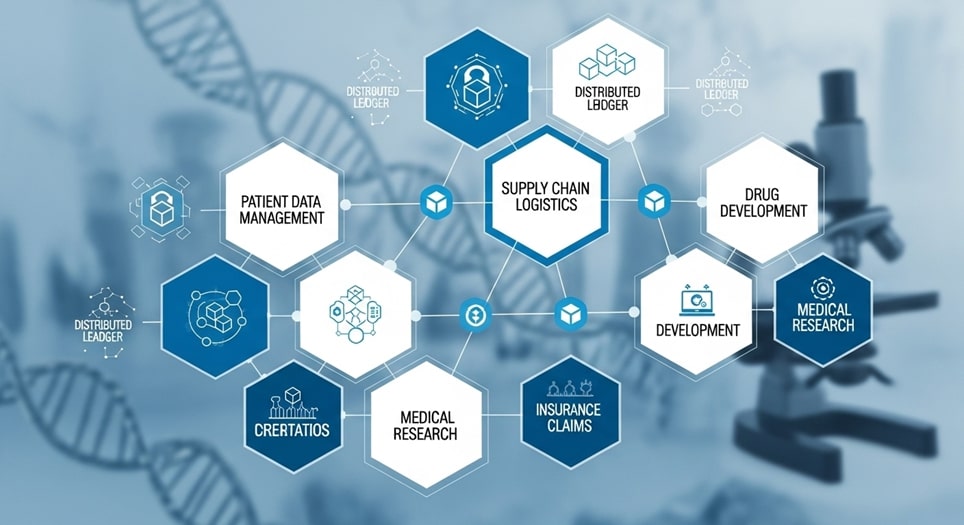
Healthcare is the fastest-growing sector for blockchain adoption through 2030, driven by data privacy regulations, post-pandemic digitalization investment, and chronic interoperability failures across U.S. health systems. The core problem blockchain addresses is straightforward: patient records are siloed across hundreds of incompatible EHR systems, creating dangerous gaps in clinical history when patients move between providers. Blockchain-based health data platforms allow patients to control access to their records across systems without requiring centralized storage that creates single points of failure and breach exposure.
MIT’s MedRec pilot demonstrated reduced data errors by 32% in Boston hospital networks. Akiri’s network-as-a-service platform uses blockchain protocols to enable secure, policy-governed health data sharing without storing patient records on the chain itself — addressing HIPAA compliance requirements directly. Pfizer has deployed blockchain for clinical trial data integrity, creating tamper-proof audit trails for FDA submissions. Pharma supply chains also use blockchain to trace drug provenance from manufacturer to dispensing point, with every custody transfer logged immutably.
Real Estate
Property transactions in the U.S. involve an extraordinary amount of paper, intermediaries, and delay. Title searches, escrow management, deed recording, and financing coordination routinely add weeks and thousands of dollars in transaction costs. Blockchain-based property platforms are compressing this process by recording ownership on an immutable ledger accessible to all parties simultaneously. A San Francisco startup tokenized commercial real estate and raised $60 million from fractional investors — a transaction structure that required neither a traditional brokerage nor a minimum accredited investor threshold. Blockchain is also being explored for municipal land registry systems, where immutable ownership records could permanently eliminate title fraud.
Step-by-Step Guide to Implementing Blockchain for U.S. Businesses
Step 1: Assess Blockchain Readiness
Start by identifying processes inside the business where fraud risk, data reconciliation disputes, multi-party trust gaps, or slow settlement cycles create measurable cost. These are the highest-ROI entry points. A SWOT analysis mapped against blockchain’s core strengths — immutability, shared access, automated contract execution — surfaces which workflows are genuine candidates versus those better served by conventional software. Blockchain pilots in 2025 average approximately 15% cost savings across industries, but that figure varies significantly by use case and implementation quality. Involve finance, legal, and IT stakeholders early; alignment across departments is consistently the most common failure point in enterprise blockchain projects, not the technology itself.
Step 2: Choose the Right Blockchain Platform
Platform selection depends on whether the use case requires public verifiability or private access control. Ethereum and its layer-2 networks suit applications requiring open participation, programmable smart contracts, and interoperability with DeFi ecosystems. Hyperledger Fabric suits regulated enterprise environments where participants are known, privacy is mandatory, and governance needs to remain within a consortium. Hyperledger Fabric documentation provides implementation guidance for enterprise deployments. Polygon and other layer-2 solutions work well for cost-sensitive, high-volume applications where Ethereum’s security model is required but mainnet fees are prohibitive. Evaluate transaction throughput requirements, existing API compatibility, developer community size, and gas fee structures before committing to a platform.
Step 3: Build and Test on a Staging Environment
Never deploy directly to a production blockchain network. Use testnets — Ethereum’s Sepolia, or equivalent test environments for whichever platform is chosen — to validate smart contract logic, test transaction throughput under realistic load, and identify edge cases before real assets are at stake. Smart contract vulnerabilities cannot be patched after deployment on a public chain — code bugs become permanent exploits. Security audits from firms specializing in smart contract review are not optional for any application handling financial assets or sensitive data. Budget for a formal audit before any mainnet deployment.
Step 4: Pilot at Departmental Scale Before Enterprise Rollout
Contain the initial deployment to a single department or a defined segment of the supply chain. Measure transaction speed, error rates, reconciliation time savings, and user adoption friction against pre-blockchain baselines. A 90-day pilot generates enough data to project full-scale ROI and surface integration issues with existing ERP, CRM, or logistics systems before they become enterprise-wide problems. Collect structured feedback from every user group — technical teams, operations staff, and external partners — and incorporate findings before scaling. Monitoring tools like Chainalysis provide on-chain analytics for anomaly detection and compliance tracking during and after the pilot phase.
Step 5: Scale with Layer-2 Infrastructure
Once the pilot validates the use case, scale using layer-2 infrastructure rather than mainnet Ethereum to manage costs. Optimism and Arbitrum both support EVM-compatible smart contracts, meaning code written for the Ethereum mainnet runs without modification on layer-2 — the migration is primarily a configuration change rather than a rebuild. For generating business leads and customer acquisition in B2B blockchain platforms, publishing verifiable on-chain performance metrics from the pilot phase provides credibility that no marketing claim can match. Transactions processed, settlement times achieved, and fraud incidents prevented are concrete, auditable proof points.
Challenges Slowing Blockchain Adoption in U.S. Business
Despite strong momentum, three structural challenges continue to constrain the pace of enterprise blockchain adoption. Scalability has improved dramatically with layer-2 solutions, but interoperability between different blockchain networks remains genuinely unresolved. A supply chain spanning multiple industry participants may need to connect Hyperledger Fabric, Ethereum, and a retailer’s proprietary chain — and doing so without data integrity loss or security exposure requires cross-chain bridge infrastructure that is still maturing. Cosmos’s Inter-Blockchain Communication protocol and Polkadot’s parachain architecture are the leading approaches, but neither has achieved the seamless composability that enterprises require for mission-critical systems.
Regulatory clarity, while significantly improved, is not yet complete. Token classification disputes between the SEC and CFTC continue for certain asset categories. Businesses operating at the intersection of blockchain and financial services still require specialized legal counsel to navigate compliance — particularly for anything touching securities, lending, or consumer financial products. Energy consumption remains a concern for ESG-focused enterprises, though proof-of-stake networks like Ethereum (post-Merge), Cardano, and Solana have reduced energy usage by 99% compared to proof-of-work chains, largely addressing the criticism for most enterprise use cases.
Frequently Asked Questions
How is blockchain technology transforming industries in the United States?
Blockchain is transforming U.S. industries by replacing trust-dependent intermediaries with automated, cryptographically verified systems. In finance, it enables near-instant cross-border settlement and decentralized lending. In supply chain, it provides end-to-end traceability that eliminates counterfeiting and recall delays. In healthcare, it enables secure, patient-controlled data sharing across fragmented provider networks. The common thread is that blockchain reduces the cost of establishing trust between parties who do not share a centralized authority — which describes virtually every multi-party business transaction.
Can blockchain secure America’s dominance in the digital economy?
The passage of the Deploying American Blockchains Act of 2025 reflects congressional recognition that blockchain infrastructure is a national competitiveness issue. The U.S. Digital Chamber’s blockchain roadmap frames distributed ledger technology as critical to economic competitiveness, financial modernization, and cybersecurity. With over 11,000 blockchain patents filed domestically and the world’s largest concentration of blockchain developer talent, the U.S. has structural advantages — but realizing them depends on sustained regulatory clarity and continued public-sector adoption.
What is the difference between public and private blockchain for business use?
Public blockchains like Ethereum are permissionless — anyone can participate, validate transactions, or deploy applications. They offer maximum transparency and decentralization but require careful privacy management since all transaction data is visible on-chain. Private or permissioned blockchains like Hyperledger Fabric restrict participation to vetted parties, making them appropriate for regulated industries where data confidentiality is mandatory. Most enterprise deployments favor private chains or hybrid architectures that use private chains for sensitive internal operations and public chains for customer-facing verification or asset liquidity.
The Future of Blockchain in U.S. Business
The trajectory is clear. Blockchain market value is projected to contribute over $360 billion in business value by 2026 and exceed $3.1 trillion by 2030, per Gartner forecasts. Central bank digital currency pilots, including the Federal Reserve’s ongoing digital dollar research, will integrate blockchain settlement infrastructure into mainstream retail payments. Human-in-the-loop governance frameworks are emerging as a critical design pattern for AI-blockchain integrated systems, ensuring that automated smart contract execution maintains auditability and human override capability in high-stakes financial and healthcare contexts.
Quantum-resistant encryption will eventually become a requirement for any blockchain network storing long-term financial or identity data, as post-quantum cryptography standards from NIST move toward ratification. The businesses positioning for this now — evaluating their blockchain infrastructure against NIST’s post-quantum algorithm recommendations — will face significantly lower migration costs than those who defer until the threat becomes active.
The integration of AI with blockchain creates a compounding effect that neither technology achieves independently. AI-powered smart contracts can self-adjust based on real-time market data. AI analytics running against on-chain supply chain records can predict disruptions before they materialize. Python programming frameworks like Web3.py have made it substantially easier for development teams already skilled in data science to build AI-augmented blockchain applications without learning an entirely new technical stack.
The businesses gaining the most from blockchain innovation are not necessarily the largest. The tokenization of real estate, fractional investment access, and DeFi lending have democratized financial tools that were previously institutional-only. An entrepreneur in any U.S. state can now access the same blockchain-powered financial infrastructure that JPMorgan uses — the competitive leveling effect is one of blockchain’s least discussed but most consequential contributions to the American business landscape.