

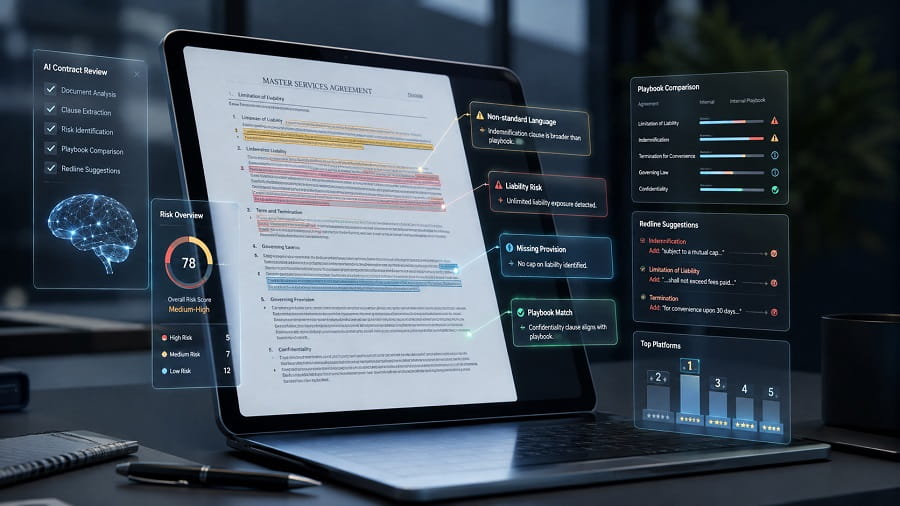
AI contract review software has moved from experimental to essential inside legal teams at every size. The technology extracts key clauses, flags non-standard language, identifies liability risks, compares terms against internal playbooks, and produces redlines — tasks that previously consumed hours of attorney time now completed in minutes. But the market has fragmented sharply, with purpose-built review tools competing against full contract lifecycle management platforms, enterprise deployments sitting alongside affordable solo-lawyer options, and legacy vendors retrofitting AI against genAI-native entrants built from scratch on large language models.
This guide ranks the ten best AI-powered contract review platforms currently available, with verified pricing where vendors have disclosed it, honest assessments of what each tool does well and where it falls short, and clear guidance on which type of organization each platform actually suits.
What AI Contract Review Software Actually Does
Before comparing platforms, it is worth being precise about what the technology handles. AI contract review software ingests a contract — PDF, Word document, or scanned file — converts it to machine-readable text, then applies natural language processing and machine learning models to identify and categorize clauses. The system compares those clauses against a pre-defined playbook containing your organization’s acceptable positions on indemnification, liability caps, termination rights, governing law, and similar provisions, flags deviations, and in many cases proposes alternative language or redlines automatically.
The most capable platforms go further: they extract structured data like party names, effective dates, payment terms, and renewal dates; they score contracts by risk level; they track obligations across an entire portfolio; and some now use agentic AI that can conduct multiple rounds of review and negotiation without requiring human input at each step. What the technology does not yet do is replace legal judgment on genuinely novel or complex contractual situations — it accelerates and systematizes the review of known risk categories and does not invent legal strategy.
Organizations implementing AI contract review consistently report 45–90% reductions in review cycle times, with industry benchmarks showing a 63% average time saving across deployment types. For firms processing over 2,500 contracts per year, the annual productivity benefit can exceed $2 million. The legal framework around AI liability in SaaS contracts is still evolving, so understanding what your chosen platform does with your contract data — which AI models process it, whether data leaves your network, and what the vendor’s training data commitments are — matters as much as the feature list itself.
How These Platforms Were Evaluated
Rankings reflect a combination of review accuracy, playbook configurability, integration with existing workflows (particularly Microsoft Word and email), security and data handling commitments, pricing transparency, implementation complexity, and user satisfaction scores from G2 and Capterra. Platforms were also evaluated on whether they are purpose-built for contract review or whether review is one feature inside a broader contract lifecycle management system — a distinction that matters significantly for teams who need a specialist tool versus those building out a complete contracting infrastructure.
Kira Systems (now part of Litera)
Best for: Large-scale legal due diligence | Pricing: Enterprise — typically $50,000+ annually
Official site: Litera.com
Kira was one of the first AI contract review tools built specifically for large-scale legal due diligence. Acquired by Litera in 2022, it operates a clause library of over 1,400 trained models across 40+ legal categories — the deepest extraction capability in the market. If your use case involves reviewing a data room with 500 contracts during an M&A acquisition, Kira is purpose-built for that scenario. It processes hundreds or thousands of documents simultaneously, extracting and analyzing provisions with a thoroughness that general-purpose tools cannot match at speed.
Pros: Deepest clause library in the category; unmatched for high-volume due diligence workflows; strong track record with Am Law 100 and Big Four accounting firms; handles multiple jurisdictions and languages. Cons: Enterprise pricing puts it out of reach for all but the largest organizations; 3–6 month implementation timeline is typical; less useful for ongoing vendor contract management than for discrete M&A or audit projects; now part of a broader platform suite which may affect independent roadmap priorities.
Icertis
Best for: Fortune 100 enterprise contract management at global scale | Pricing: Custom enterprise quote — typically 2–3× higher than comparable mid-market platforms
Official site: Icertis.com
Icertis manages contracts for over a third of the Fortune 100 and has been named a Leader in both the 2025 Forrester Wave and Gartner Peer Insights for CLM. Its Vera AI suite handles automated redlining, contract summarization, and key term extraction, while Vera Copilot allows users to interact with contracts using natural language queries. The platform’s agentic workflows can automatically verify and fulfill contractual commitments without manual intervention — a genuine operational advantage for organizations managing thousands of active agreements across multiple geographies simultaneously.
Pros: Enterprise-grade scale and security; proven with complex multi-geography contract portfolios; agentic workflows reduce manual operational overhead; strong compliance and audit trail functionality. Cons: Implementation typically runs 4–6 months; cost runs 2–3× higher than comparable alternatives; not suited for teams under 50 contracts per month; the feature depth that makes it powerful also makes it complex to configure correctly without dedicated implementation support.
Ironclad
Best for: In-house enterprise legal teams needing complete contract lifecycle management | Pricing: Starting approximately $30,000/year; full enterprise deployments typically $30,000–$250,000+
Official site: Ironcladapp.com
Ironclad was named a Leader in the 2025 Gartner Magic Quadrant for CLM, and a Forrester study documented 314% ROI for its customers. The platform’s AI capabilities grew substantially with the introduction of Ironclad AI and Jurist — a conversational AI legal assistant built on their open-source visual programming platform, Rivet. Jurist automatically tags and indexes contract data, researches recent legislation, and handles high-volume analysis across complex workflows. The 2024 introduction of Jurist marked a meaningful step-change, moving Ironclad from workflow automation toward genuine legal intelligence embedded in the review process.
Pros: Complete CLM with a strong AI layer; Jurist is genuinely useful for non-lawyers in sales and procurement; consistently named a Gartner Leader; deep enterprise integrations including Salesforce and Slack; ISO 27001 certified. Cons: High price point with 2–9 month implementation; AI review accuracy lags behind specialist tools like LegalOn on pure clause-level precision; designed exclusively for in-house legal operations — not suited to law firms or solo practitioners; customization restrictions can limit workflow configurations for specific industries.
Juro
Best for: Growing companies wanting browser-native contract collaboration | Pricing: Custom enterprise pricing; reported average approximately $34,500/year
Official site: Juro.com
Juro takes a different architectural approach by making the entire contract process browser-native. Rather than working within Microsoft Word, teams create, negotiate, review, and approve contracts inside Juro’s interface. Its AI reviews incoming contracts against the company’s standard positions and flags deviations, with findings flowing directly into the redlining and negotiation stage rather than existing as a separate analysis step. The platform is particularly well suited to business-led contracting — sales and procurement teams can self-serve on standard agreements while legal retains oversight through approval workflows and playbook enforcement.
Pros: Clean browser-native interface with real-time collaborative redlining; AI review integrates naturally into the negotiation workflow; good fit for scaling companies where commercial teams handle standard agreements without legal involvement at every step. Cons: Requires significant playbook configuration before AI review delivers meaningful value; review quality depends heavily on playbook definition quality; some users report performance issues at high contract volume; enterprise pricing requires a demo call; less suited to law firms than in-house legal teams.
ContractPodAi
Best for: Enterprise legal teams wanting AI review inside a full CLM system | Pricing: Enterprise custom quote; implementation typically 3–6 months
Official site: ContractPodAi.com
ContractPodAi is an all-in-one CLM platform with AI review built natively into the workflow. Its AI assistant, Leah, flags risky clauses, proposes redlines, and runs compliance checks against clause libraries. The platform integrates with Microsoft Word and supports full negotiation workflows inside its CLM environment — one of the more complete solutions for legal teams that want review, drafting, approval routing, and repository management in a single system rather than across multiple point tools. The enterprise security posture includes ISO 27001 certification, making it viable for regulated industries handling sensitive agreements.
Pros: Genuinely integrated AI review and CLM in one platform; Leah AI handles clause flagging and automated redlines; Microsoft Word integration; ISO 27001 certified; strong for large-scale contract portfolios across multiple business units. Cons: Complex implementation that is not yet fully structured according to some users; onboarding requires significant internal resource investment; enterprise-only pricing with no self-serve entry point; pure review accuracy trails specialist tools in head-to-head clause analysis benchmarks.
Luminance
Best for: Large legal teams needing proprietary AI with maximum data control | Pricing: Enterprise custom quote; built and priced for high contract volume
Official site: Luminance.com
Luminance runs on proprietary machine learning models trained on more than 150 million legal documents, rather than routing contract data through a third-party LLM provider like OpenAI or Anthropic. That architectural decision has a significant practical implication: your contract data is not processed by any external foundation model. For organizations handling M&A agreements, employment litigation documents, or trade secret-sensitive contracts, this distinction is not a marketing point — it is a genuine data governance decision. The platform’s institutional memory feature, launched in early 2026, retains negotiation history and prior legal decisions across all of an organization’s contracts. Its multi-agent system recognizes deal state and automatically triggers the next workflow step without manual prompting.
Pros: Proprietary AI with no third-party LLM data exposure; institutional memory across contract history is a meaningful differentiator for repeat counterparty negotiations; multi-agent system handles complex workflow automation; strong for organizations with strict data sovereignty requirements. Cons: Priced and built exclusively for enterprise contract volume; standard NDAs and MSAs at moderate volume are not the use case this was designed for; custom pricing requires a full enterprise sales process with no public pricing available.
Agiloft
Best for: Mid-market to enterprise teams wanting a proven, configurable CLM with strong AI | Pricing: Approximately $5,000–$30,000/year depending on team size and selected modules
Official site: Agiloft.com
Agiloft has been named a Gartner CLM Leader for six consecutive years — a consistency record no other platform in this category matches. In February 2025, Agiloft expanded its generative AI capabilities with three meaningful additions: GenAI Prompt Lab for custom AI configuration, ConvoAI Document Q&A for natural language contract interrogation, and Screens for structured data entry using AI extraction. The platform’s no-code configuration engine allows legal operations teams to build custom workflows without developer involvement, which reduces implementation cost and timeline significantly compared to competitors requiring IT-heavy deployments. The broader comparison of AI tool pricing across categories confirms Agiloft sits at the more accessible end of enterprise CLM pricing.
Pros: Six consecutive Gartner CLM Leader recognitions; no-code configuration accessible to legal ops teams without IT dependency; strong 2025 generative AI additions; competitive pricing for mid-market teams relative to pure enterprise alternatives; broad integration library. Cons: Feature depth can overwhelm smaller teams with straightforward review needs; AI review accuracy is strong but below specialist-level tools on pure clause analysis; implementation still requires 4–8 weeks for complex workflow configuration; some users find the interface less modern than newer entrants.
SpotDraft with VerifAI
Best for: Mid-market legal teams wanting in-Word AI review with strong data privacy | Pricing: $5,000–$50,000+/year for the CLM platform; VerifAI add-on adds $5,000–$15,000/year
Official site: SpotDraft.com
SpotDraft built its reputation on VerifAI — a Microsoft Word add-in that reviews contracts against custom playbooks using generative AI without requiring attorneys to switch platforms or relearn their workflow. Users write their review criteria in plain English; VerifAI highlights non-compliant clauses and key risks in one click. The platform claims 70% faster contract review compared to manual processes, consistent with independent benchmarks for playbook-driven AI review in Word-native environments. The standout development in early 2026 is on-device AI: backed by an $8 million investment from Qualcomm Ventures, SpotDraft now runs VerifAI locally on Qualcomm Snapdragon laptops. No contract data leaves the device — a meaningful differentiator for organizations handling sensitive agreements who cannot accept cloud data exposure.
SpotDraft holds a 4.5/5 rating on both G2 and Capterra — one of the highest satisfaction scores in the CLM category at this price point. Its documented no-training-data commitment gives legal teams an auditable privacy baseline that many enterprise buyers now require as a procurement condition. Understanding the CFO-level assessment of SaaS legal tool costs is important when budgeting — the VerifAI module is a separate line item on top of the base CLM subscription.
Pros: VerifAI in-Word integration fits existing attorney workflows without retraining; on-device AI option is unique in this category and eliminates cloud data exposure; documented no-training-data commitment; high satisfaction scores at mid-market pricing; strong for teams under 50 employees handling standard commercial agreements. Cons: VerifAI is an add-on cost on top of the base CLM subscription; full pricing requires a sales conversation; playbook must be well-configured before AI delivers maximum value; less suited to law firms needing client-facing tools than to in-house legal teams.
LegalOn
Best for: In-house legal teams needing specialist-grade AI review with fast implementation | Pricing: Individual plan approximately $3,500–$6,600/user/year; five-user team with all core modules reported near $40,000/year
Official site: LegalOnTech.com
LegalOn is the closest thing the AI contract review market currently has to a specialist-grade tool with genuinely accessible implementation. Rather than requiring months of configuration before delivering value, LegalOn ships with pre-built playbooks covering the most common commercial contract risk categories — indemnification, liability caps, IP ownership, termination, governing law — allowing in-house teams to start reviewing contracts on Day 1 without a dedicated implementation project. The platform works natively inside Microsoft Word, meaning attorneys do not need to change their existing workflow to benefit from AI-level review accuracy.
LegalOn surpassed ¥10 billion ARR in October 2025, demonstrating genuine market traction beyond early adopters. Its OpenAI partnership signals continued AI model investment. The platform’s multi-round review capability — automated redlining, fallback playbooks, approvals, and instructional support — compresses the time from contract receipt to signed agreement substantially. Independent benchmarks consistently position LegalOn’s review accuracy at the top of the specialist tools category, above CLM platforms with bolt-on AI features. Its G2 rating of 5.0/5.0 across verified reviews reflects unusually high user satisfaction for any legal technology platform.
Pros: Day 1 implementation with pre-built playbooks — no months of configuration; works natively inside Microsoft Word; highest accuracy among specialist contract review tools in the category; free trial available on the Individual plan; 5.0/5.0 G2 rating; strong for teams handling commercial agreements, NDAs, and vendor contracts at scale. Cons: Not a full CLM — post-signature management requires a separate platform; translation tool has moved to a paid add-on increasing total cost for multilingual teams; limited support for heavily customized or non-standard contract formats; five-user team cost of approximately $40,000/year is material for smaller organizations. The legal risks embedded in AI-driven contract processes are worth understanding before locking into any specialist platform.
Workday Contract Intelligence (formerly Evisort)
Best for: Enterprise organizations already running Workday for finance or HR | Pricing: Aligned to Workday ecosystem — custom enterprise quote
Official site: Workday.com
Workday acquired Evisort in September 2024, and as of March 2025, Evisort’s AI-powered contract intelligence is available directly through the Workday platform. The integration means that if your organization already runs Workday for finance, HR, or procurement, contract intelligence becomes part of your existing stack rather than a separate purchase and separate login. For enterprises where Workday is the system of record, this is not a marginal convenience — it eliminates the data synchronization problem that plagues organizations trying to connect contract data to financial and operational reporting.
The platform excels at reviewing large volumes of contracts quickly, surfacing obligations and risk signals across thousands of agreements, and connecting contract performance to operational outcomes. Its strength is portfolio-level intelligence rather than the granular redlining of individual contracts. Teams using it for M&A due diligence or compliance audits across active vendor portfolios get more value from it than teams focused on negotiating individual agreements clause by clause.
Pros: Native Workday integration eliminates data silos for organizations already on the platform; portfolio-scale risk and compliance analysis is genuinely strong; no separate vendor relationship or implementation project required for Workday customers; AI handles large volume contract intelligence efficiently. Cons: Less focused on detailed redlining of individual contracts than specialist tools; value is limited for organizations not already using Workday; pricing is Workday enterprise pricing — not accessible for mid-market teams; the integration story is the primary differentiator rather than best-in-class review accuracy.
The Right Platform Depends on Where Your Bottleneck Is
The single most useful question before evaluating any platform is: what is the actual bottleneck in your contract workflow right now? If the bottleneck is review speed and accuracy on incoming third-party paper, a specialist tool like LegalOn delivers better AI and faster results than any CLM’s bolt-on review feature. If the bottleneck is post-signature management — tracking obligations, managing renewals, connecting contract data to financial systems — a CLM like Ironclad or Workday addresses problems a review tool does not. Many larger legal teams end up using both: a CLM for lifecycle management and a specialist tool for review and negotiation.
Volume is the other organizing principle. Under five contracts per month, individual tools like Spellbook or LegalOn’s Individual plan handle reviews without requiring a platform commitment. Over twenty per month, a CLM platform like Juro or SpotDraft pays for itself in time savings. Over one hundred per month, enterprise tools like Ironclad, Kira, or Workday Contract Intelligence provide portfolio-level intelligence that individual review tools cannot replicate. The AI automation landscape in sales and legal operations is converging rapidly, with contract review increasingly becoming part of a broader revenue operations infrastructure rather than a standalone legal function.
Security and Data Handling — What to Ask Every Vendor
Before uploading a single contract to any of these platforms, ask every vendor the same four questions. First: which AI model processes your contract text, and does that model provider receive your data for training purposes? Second: is the processing happening in a shared cloud environment, a dedicated instance, or on-device? Third: what certifications does the platform hold — SOC 2 Type II, ISO 27001, HIPAA, FedRAMP — and do those certifications cover the AI processing components or only the storage layer? Fourth: what is your data residency — can you specify that contract data stays within a particular geography, and is that enforceable contractually?
All platforms listed in this guide offer enterprise-grade encryption in transit and at rest, and SOC 2 compliance at minimum. ContractPodAi, Ironclad, and Luminance hold ISO 27001 certification. SpotDraft’s on-device VerifAI is the only option in the category that eliminates cloud processing entirely for organizations where that level of control is required. For regulated industries handling contracts with HIPAA-covered entities, federal government contractors subject to FedRAMP requirements, or organizations operating under GDPR with strict data transfer restrictions, verifying the specific compliance certifications before uploading any sensitive document is not optional — it is the first step.
Frequently Asked Questions
What is the best AI contract review software for small legal teams?
LegalOn is the strongest option for small in-house legal teams due to its Day 1 implementation, pre-built playbooks, and Microsoft Word integration. SpotDraft’s VerifAI is a strong alternative for teams that want in-Word review at lower entry cost. Both deliver meaningful value without months of configuration. Individual lawyers reviewing their own contracts can also consider Spellbook, which offers transparent monthly pricing and works inside Word.
How much does AI contract review software cost?
The average cost across enterprise deployments is approximately $125,000 per year according to pricing research across the category. Individual or small team tools start around $3,500–$6,600 per user per year. Mid-market platforms like SpotDraft and Agiloft range from $5,000 to $50,000 annually. Enterprise platforms including Ironclad, Icertis, and Luminance use custom quote-based pricing that typically runs $30,000 to $250,000+ depending on team size, contract volume, and feature scope. Most vendors do not publish pricing publicly because contract complexity creates unpredictable compute costs — expect a demo call and a custom quote for any enterprise-tier platform.
Can AI contract review software replace lawyers?
No. AI contract review software accelerates and systematizes the review of known risk categories against defined playbooks. It flags non-standard terms, proposes redlines based on pre-approved fallback language, and extracts structured data at scale. It does not replace legal judgment on novel situations, complex multi-party agreements, litigation risk assessment, or any contract scenario that falls outside the patterns its models were trained to recognize. The appropriate framing is that it handles the repetitive, pattern-matching portions of contract review so lawyers can focus time on the genuinely complex decisions that require judgment.
How long does implementation take?
Implementation timelines vary enormously by platform type. Specialist review tools like LegalOn are usable on Day 1 with pre-built playbooks. Mid-market CLM platforms like SpotDraft and Juro typically require 2–4 weeks of setup for standard workflows. Enterprise CLM platforms like Ironclad and ContractPodAi typically require 2–9 months depending on the complexity of approval workflows, integrations, and playbook configuration. Due diligence specialists like Kira require 3–6 months for full deployment. The implementation timeline is a meaningful selection criterion — a platform that takes six months to deploy before delivering value is not a practical choice for organizations that need relief from contract review backlogs now.
Is my contract data safe with these platforms?
All platforms in this guide offer enterprise-grade security at minimum. The more precise question is where your data goes and who processes it. Luminance uses proprietary models — your data does not touch OpenAI or any other third-party LLM provider. SpotDraft’s on-device VerifAI processes contracts locally with no cloud upload. Most other platforms route data through third-party AI infrastructure, which is standard practice but requires vendor-specific data processing agreements. Verify SOC 2 Type II, ISO 27001, and any industry-specific certifications directly with the vendor before uploading sensitive material.
