

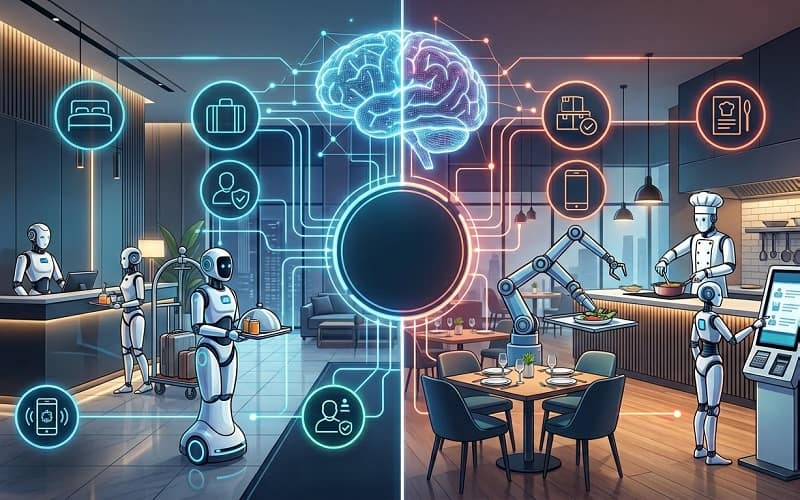
Artificial intelligence in the hospitality industry refers to the deployment of machine learning, predictive analytics, natural language processing, and automation across hotel and restaurant operations to improve guest experience, optimize pricing, reduce costs, and streamline staffing. AI is no longer experimental in hospitality — it is embedded inside the systems that drive revenue and margin performance at properties ranging from independent boutiques to global chains. According to a 2025 Deloitte report, 78% of hospitality leaders plan to increase AI investments in the next 12 months, focusing on guest experience and revenue management.
This guide covers every major application of AI across hospitality — from dynamic pricing and guest-facing chatbots to predictive maintenance, staff augmentation, and the real-world results leading brands are already generating from these deployments.
What AI in Hospitality Actually Means
AI in hospitality is not a single product or platform. It is a collection of intelligent systems embedded across the guest journey and operational stack. Revenue management software uses predictive modeling to optimize room pricing and inventory controls in real time. Chatbot and messaging platforms automate guest communication and personalize interactions at scale. AI-powered booking engines adjust offers dynamically to improve direct conversion rates and reduce reliance on online travel agencies. Marketing automation systems use behavioral modeling to personalize email, retargeting, and loyalty campaigns. Operational intelligence platforms analyze staffing patterns, maintenance signals, and cost structures to surface inefficiencies before they compound.
The competitive advantage in hospitality AI lies less in any individual tool and more in how well these systems integrate with each other and with the property management systems already in place. Fragmented AI deployments — a chatbot here, a pricing tool there — deliver partial value. Properties that connect guest data, operational data, and financial data into a unified intelligence layer consistently outperform those running isolated point solutions.
BCG’s 2025 global pan-industry AI adoption analysis found that fewer than 10% of hospitality companies could be classified as “future built” — defined as having cutting-edge AI capabilities generating substantial value across the organization. Another 25% had reached the AI-scaling stage, with strategies producing real returns across multiple operational areas. The remaining majority are still in early or experimental phases, which signals both how much transformation is already underway and how much competitive space remains for properties that move decisively.
AI for Guest Experience and Personalization
Personalization is the dimension of AI that guests feel most directly. Modern AI systems build guest profiles from booking behavior, stated preferences, past stay data, and in-stay interactions — then use those profiles to customize room settings, dining recommendations, service timing, and communication style before the guest even checks in.
AI Chatbots and Messaging Automation
AI-powered chat interfaces have become the default mode of guest interaction at properties investing seriously in technology. Modern systems go well beyond FAQ bots. They use natural language processing to understand intent — when a guest types “my room is freezing,” the AI recognizes a temperature complaint rather than a request for ice — and either resolve the issue automatically or route it to the appropriate staff member with full context already attached.
The scale these systems operate at is substantial. One platform reported processing 47.4 million guest messages and 4.58 million reservations across 77,000 properties. Properties using AI messaging automation have reported 60% to 96% automation rates on routine guest interactions, with human staff freed to handle complex service situations that benefit from genuine personal attention. In 2026, AI chat capability operates across WhatsApp, Messenger, in-app messaging, and voice channels simultaneously — a unified system that maintains context regardless of how a guest switches between them.
Hyper-Personalization at Scale
The most advanced hospitality AI deployments extend personalization across every channel and touchpoint of the guest journey. Room temperature and lighting preferences from a previous stay are automatically applied at check-in. Dietary restrictions noted in a loyalty profile surface automatically in restaurant recommendations. Pre-arrival communication is timed based on individual booking patterns — frequent travelers receive earlier notifications than leisure guests who tend to engage closer to arrival. Edge AI processing makes real-time personalization possible without routing every decision through centralized cloud infrastructure, enabling instantaneous responses at the property level even during peak demand.
Hilton’s Connie concierge robot at front desks demonstrates what branded AI presence looks like for a major chain — available around the clock to answer questions and provide recommendations without occupying staff time on routine queries. Marriott’s AI-driven loyalty personalization adjusts offers and upgrade eligibility in real time based on individual member behavior, increasing direct booking rates by targeting the specific incentives each guest segment responds to most strongly.
AI-Powered Revenue Management
Revenue management is the area where AI delivers the most measurable financial returns in hospitality. Traditional revenue management relied on historical occupancy curves and manual rate adjustments. AI-driven systems ingest pricing elasticity data, booking pace signals, competitor rate changes, local events, weather patterns, and real-time demand across all distribution channels simultaneously — then adjust rates and inventory controls automatically, faster and at greater granularity than any human revenue manager could match.
Modern forecasting platforms operating with approximately 96% accuracy represent a fundamentally different level of trustworthiness compared to the industry norm closer to 82%. The gap compounds over a full season — hotels running superior AI forecasting systems make better pricing decisions every day, accumulating RevPAR advantages that become difficult for competitors using inferior tools to close. These systems also continuously learn which demand signals correlate most reliably with actual booking behavior in each specific market, improving their own accuracy over time without manual reconfiguration.
Dynamic Pricing and Demand Forecasting
AI revenue management systems process multiple data streams that traditional tools simply cannot handle at speed — including search behavior trends, OTA demand signals, event calendars, macroeconomic indicators, and historical booking curves — to generate rate recommendations updated in real time across all channels. The outcome is pricing that maximizes RevPAR during high-demand periods while maintaining occupancy during shoulder periods, without the rate discipline failures that occur when manual processes lag behind market conditions.
Dynamic packaging extends these capabilities into bundled offers — combining room rates with food and beverage minimums, spa bookings, or experience add-ons at price points that AI has determined individual guest segments are willing to pay based on historical behavior and current demand context. Properties that have deployed AI-driven packaging consistently report higher average daily rate without corresponding drops in occupancy, because the packages are priced against willingness-to-pay data rather than uniform margin targets.
AI in Hotel Operations
Behind the guest-facing experience, AI is transforming the operational efficiency of hospitality properties in ways that directly affect labor costs, maintenance expenses, and service consistency.
Predictive Maintenance
AI predictive maintenance systems monitor equipment health signals — HVAC performance data, elevator usage patterns, kitchen equipment sensor readings — and identify degradation patterns before failures occur. In a hotel context, an undetected HVAC failure in a room block during peak occupancy creates immediate guest service failures and emergency repair costs that predictive systems can eliminate entirely by scheduling maintenance during low-occupancy periods before components reach failure thresholds.
The labor savings from predictive maintenance compound over time. Properties shift from reactive maintenance models — where breakdowns drive staffing requirements — to scheduled maintenance models where work is planned and resourced efficiently. Maintenance teams spend less time on emergency callouts and more time on systematic property improvement, which also extends asset lifespans and reduces capital replacement cycles.
Housekeeping Optimization
Ritz-Carlton San Francisco implemented an AI system that synchronizes room-cleaning schedules with check-out patterns, guest preferences, and housekeeping staff availability — achieving a 20% reduction in room turnaround time. IHG deployed predictive housekeeping models that anticipate peak cleaning demand and pre-allocate resources accordingly, reducing the bottlenecks that create check-in delays during high-occupancy arrivals.
AI scheduling systems reduce housekeeping labor costs not by cutting staff but by eliminating idle time and reactive schedule changes. When checkout timing is predictable and cleaning prioritization is automated, supervisors spend less time manually dispatching staff and more time on quality oversight — the aspect of housekeeping that directly affects guest satisfaction scores.
Staff Scheduling and Workforce Management
The hospitality industry faces a structural labor challenge that AI is increasingly central to managing. In North America alone, 65% of hotels reported staffing shortages in 2025 according to the American Hotel and Lodging Association, while labor costs jumped 11.2% year-over-year. AI workforce management systems forecast staffing demand by hour and department based on occupancy forecasts, historical patterns, and event calendars — matching labor supply to actual need rather than static shift patterns designed for average conditions.
Intelligent staff training platforms represent another emerging application in workforce management. These systems understand what a staff member is trying to accomplish, adapt training content based on role and experience level, and deliver just-in-time guidance precisely when it is needed — improving service quality while accelerating onboarding for new employees in an industry where turnover rates make continuous training a permanent operational requirement. Human-in-the-loop governance ensures these AI training systems stay aligned with property standards without requiring constant manual oversight from managers already stretched by understaffing.
AI for Food and Beverage Operations
Food and beverage represents a significant revenue stream and cost center for full-service hospitality properties — and one where AI is delivering increasingly measurable operational improvements.
Inventory and Waste Reduction
AI inventory management systems in hotel restaurants and catering operations analyze consumption patterns, booking volumes, event schedules, and historical waste data to generate precise purchasing recommendations. Properties using AI inventory optimization report food waste reductions of 20% to 40% compared to manual ordering systems, with commensurate reductions in food cost percentages that directly improve F&B margin. These systems also reduce the manual labor required for inventory management, which in labor-constrained environments represents a meaningful capacity release for F&B teams.
Personalized Dining Recommendations
AI-driven recommendation engines in hotel restaurant systems surface menu options tailored to individual guest dietary profiles, previous order history, and stated preferences. For properties with multiple dining venues, AI routing systems match guests to the venue most aligned with their profile — increasing capture rates for in-house dining and reducing the revenue leakage that occurs when guests default to external restaurants out of convenience or lack of awareness.
Robotics and Autonomous Systems in Hospitality
Physical automation through robotics has moved from pilot projects to operational deployment at properties seeking to address labor shortages while maintaining service levels. Delivery robots navigate hotel corridors autonomously, transporting room service orders, amenity requests, and linen loads without elevator conflicts or navigation assistance from staff. Similar approaches have been explored in autonomous robot deployment across other service industries, with hospitality borrowing techniques that have proven reliable in high-traffic environments.
Front-of-house robotic applications include check-in kiosks with AI facial recognition capabilities for verified guests, robotic concierge stations that handle information requests and local recommendations, and luggage-handling automation in high-volume properties where bellhop labor costs are significant. These deployments supplement rather than eliminate human front desk teams — with staff redirected from transactional tasks toward the relationship-building interactions where human presence creates genuine guest value.
AI in Restaurant Operations
The restaurant sector within hospitality is applying AI across front-of-house operations, kitchen management, and customer acquisition in parallel with hotel-side deployments.
Dynamic Menu Pricing
AI-driven dynamic pricing in restaurant operations adjusts menu item prices based on demand patterns, ingredient cost changes, time-of-day demand signals, and table availability. During peak periods, pricing algorithms increase margins on high-demand items. During slow periods, targeted promotions drive traffic that would otherwise not materialize. Quick-service restaurant chains have deployed AI menu boards that change displayed items and pricing based on real-time conditions — weather, local events, kitchen queue depth — automatically and without staff intervention.
Reservation and Table Management
AI reservation systems predict no-show rates at the reservation level and adjust overbooking strategies accordingly — maximizing covers without creating the service failures that occur when overbooking assumptions are too aggressive. Guest behavior models built from reservation history identify which guests require longer table turns, which are likely to upsell to premium menu sections, and which are celebrating occasions that create opportunities for experiential add-ons. Multi-agent AI systems coordinating across reservation platforms, kitchen display systems, and floor management tools represent the next stage of restaurant operational intelligence — where every station in the operation shares real-time context automatically.
Challenges and Risks of AI in Hospitality
AI adoption in hospitality generates real benefits but also introduces implementation challenges that properties must navigate deliberately to realize those benefits in practice.
Data quality is the foundational constraint. AI systems are only as accurate as the data they train on — and hospitality operations historically produce fragmented data across disconnected PMS, POS, CRM, and channel management systems. Properties that have not invested in data integration infrastructure before deploying AI frequently find that their AI outputs reflect the same inconsistencies and gaps that characterize their underlying data. Consolidating and cleaning operational data before AI deployment is consistently the most important prerequisite that successful implementations share.
Guest privacy expectations create compliance requirements that AI personalization must operate within. Data collected to personalize guest experiences is subject to GDPR for European guests, CCPA in California, and a growing body of state and national privacy regulations globally. Properties deploying AI guest profiling systems must implement consent management, data minimization practices, and clear data retention policies that align personalization ambitions with regulatory obligations.
The human element remains both a challenge and a strategic differentiator. Properties that deploy AI as a replacement for human service — rather than as an amplifier of it — frequently find that guest satisfaction scores decline despite operational efficiency improvements. The warmth, judgment, and genuine attentiveness that define excellent hospitality service remain human capabilities that AI systems currently augment rather than replicate. The most successful AI deployments in hospitality consistently maintain this balance: automation handles the transactional, and human staff focus on the relational.
Real-World AI Implementations: Leading Brands
The most instructive evidence for AI’s impact in hospitality comes from documented deployments at major chains where outcomes are measurable and publicly reported.
Hilton’s Connie robot concierge, deployed at select properties, handles guest information requests and local recommendation queries around the clock — reducing front desk load during peak arrival periods without requiring additional staffing. Hilton’s broader AI investments include predictive maintenance systems and AI-driven loyalty personalization that adapts offers to individual member behavior at scale.
Marriott’s AI initiatives span revenue management, direct booking optimization, and guest communication automation. The company uses behavioral modeling to identify which loyalty members are at risk of booking through OTAs and targets them with direct booking incentives calibrated to the specific price sensitivity AI has identified from their history — recovering OTA-bound bookings at meaningfully lower distribution cost.
IHG’s predictive housekeeping deployment demonstrates how operational AI can deliver measurable efficiency without guest-facing technology changes. By anticipating which rooms require cleaning at what priority level based on check-out timing and guest profiles, housekeeping supervisors eliminate the scheduling friction that normally creates check-in delays during high-occupancy arrivals.
The Future of AI in Hospitality
Several emerging developments will shape how AI evolves in hospitality over the next several years. Voice AI is transitioning from optional enhancement to mandatory infrastructure for revenue capture — properties that miss calls because staff are unavailable lose bookings to competitors whose AI voice agents answer every call, at any hour, in multiple languages. Once a property implements voice AI and experiences zero missed booking calls, the operational calculus changes permanently.
Agentic AI systems that can take operational actions — not just generate recommendations — represent the most significant near-term shift. Model Context Protocol architectures enable AI systems to pull live availability, trigger distribution system updates, generate proposals using CRM data, modify reservations, and monitor performance indicators automatically. This eliminates the lag between insight and execution that limits most current hospitality AI deployments, where a system can identify an optimal action but still requires a human to implement it.
AI discovery is also reshaping how travelers find and evaluate properties. Guests increasingly rely on conversational AI assistants and AI-powered travel tools rather than traditional search results to discover where to stay. Properties that optimize their digital presence for AI retrieval — with rich structured data, consistent entity signals, and authoritative content — will capture discovery share as the guest journey migrates further toward AI-mediated channels.
FAQ
Is AI replacing hotel staff?
AI is augmenting hotel staff rather than replacing them. Current deployments automate repetitive and transactional tasks — answering routine guest inquiries, adjusting pricing, scheduling housekeeping — freeing human staff to focus on service interactions where personal attention creates genuine guest value. Properties that position AI as a replacement for service quality rather than an amplifier of it consistently see guest satisfaction decline.
What is the biggest benefit of AI for hotels?
Revenue management consistently produces the largest measurable financial returns from AI in hotels. AI-driven pricing systems operating with superior demand forecasting accuracy generate RevPAR improvements that compound over time. Guest communication automation and predictive maintenance also produce significant cost savings, but revenue optimization delivers the most direct impact on property financial performance.
How are hotels using AI to personalize guest experiences?
Hotels use AI to build guest profiles from booking history, stated preferences, and in-stay behavior, then apply those profiles to customize room settings, communication timing, dining recommendations, and loyalty offers automatically. The most advanced deployments apply personalization across every guest touchpoint — from pre-arrival messaging to post-stay follow-up — without manual configuration for each individual guest.
What are the risks of AI adoption in hospitality?
The primary risks are data quality limitations that reduce AI accuracy, guest privacy compliance requirements, and over-automation that degrades the human service quality hospitality guests expect. Properties that invest in data integration before AI deployment, implement proper consent management, and maintain clear human oversight of AI-driven interactions mitigate these risks effectively.
Which AI applications in hospitality have the fastest ROI?
Chatbot and messaging automation, dynamic revenue management, and predictive maintenance consistently deliver the fastest measurable returns because they address high-volume, repetitive tasks with clear cost or revenue baselines to compare against. Revenue management AI in particular produces returns within the first complete booking cycle, since pricing improvements translate directly to RevPAR without requiring guest behavior changes.
Conclusion
Artificial intelligence is not a future consideration for the hospitality industry — it is an active competitive variable that separates top-performing properties from those losing ground on RevPAR, guest satisfaction, and labor efficiency simultaneously. The technology stack available to hospitality operators today covers every dimension of the business: from the moment a guest discovers a property through AI-assisted travel planning to the predictive maintenance system ensuring the HVAC works when they arrive.
The properties capturing the most value from AI share consistent characteristics. They integrated their data infrastructure before deploying AI on top of it. They selected applications with clear operational baselines that allowed ROI measurement from day one. They maintained the human service quality that defines hospitality excellence, using AI to reduce the transactional burden on staff rather than eliminate staff entirely. And they treated AI adoption as an ongoing operational discipline — not a one-time technology purchase — continuously refining deployments as new data accumulates and new capabilities become available.
The gap between properties that invest in AI strategically and those that adopt it reactively will widen every year as early movers compound the advantages of superior data, better-trained models, and more integrated systems. The entry cost is lower than it has ever been, and the operational case for beginning has never been stronger.
