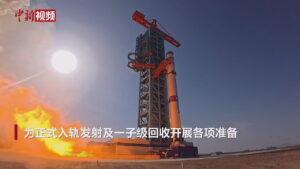
China’s rapidly expanding private space sector reached a dramatic turning point in early December 2025 when the Zhuque-3 reusable rocket, developed by Beijing-based aerospace firm LandSpace, successfully entered low Earth orbit but exploded during its landing attempt. The test flight marked a technological milestone for China’s commercial launch industry while simultaneously exposing the immense technical challenges of competing with SpaceX in reusable rocket systems.
The mission launched from the Jiuquan Satellite Launch Center in the Gobi Desert and represented the first time a Chinese private company attempted orbital insertion followed by booster recovery. While ascent, stage separation, and orbital deployment proceeded as planned, the first stage failed during its final descent burn, erupting into flames moments before touchdown.
Although visually dramatic, aerospace analysts widely regard the flight as a partial success. Key systems involving propulsion, guidance, and atmospheric re-entry performed as designed. However, the landing failure highlighted the complexity of reusable rocketry, an area in which SpaceX has spent more than a decade refining techniques through repeated trial and error.
Mission Overview and Core Objectives
The Zhuque-3 is a medium-to-heavy-lift launch vehicle standing approximately 66 meters tall and powered by nine methane-liquid oxygen engines. The rocket was engineered from inception with reusability in mind, drawing architectural inspiration from SpaceX’s Falcon 9 while incorporating domestic propulsion and guidance technologies.
LandSpace outlined several primary objectives for the flight:
- Orbital insertion capability: Demonstrate stable ascent, stage separation, and accurate placement of a test payload into low Earth orbit. This validates propulsion reliability and flight control during the most demanding phase of launch.
- Controlled atmospheric re-entry: Prove that the first stage could survive re-entry heating and aerodynamic stress while maintaining guidance and stability.
- Vertical landing attempt: Execute a precision descent and soft touchdown on a ground-based landing pad for future reuse.
According to post-flight data released by the company, the first two goals were achieved successfully. The final landing maneuver, however, encountered an anomaly during the landing burn phase.
What Caused the Landing Explosion
After stage separation, the Zhuque-3 booster conducted a series of controlled burns designed to slow its descent and align it with the landing zone. During the final landing burn, an engine malfunction triggered an uncontrolled combustion event, causing the rocket to lose thrust stability and erupt in flames.
The explosion occurred just seconds before touchdown, with video footage showing the booster descending vertically before being engulfed by fire near the landing pad. Engineers believe the failure was related to thrust modulation during the final deceleration phase, a moment that requires extreme precision in engine control.
Although the booster was destroyed, telemetry indicates that guidance and navigation systems brought the vehicle remarkably close to its intended landing site. This level of precision is considered rare for a first orbital recovery attempt and suggests that core recovery algorithms functioned largely as intended.
Why the Mission Still Matters
Despite the explosion, the Zhuque-3 test flight represents a historic achievement for China’s private aerospace industry. Successfully reaching orbit with a reusable-class rocket confirms that domestic private firms can design and operate complex launch systems previously dominated by state programs.
Industry experts frequently point out that SpaceX experienced numerous landing failures during the early development of Falcon 9. Explosions, hard landings, and ocean losses were common before the company achieved routine booster recovery. Each failure provided valuable engineering data that informed subsequent design improvements.
From this perspective, Zhuque-3’s landing failure is viewed less as a setback and more as a necessary step in the maturation of China’s reusable launch capabilities.
China’s Expanding Commercial Space Landscape
The mission underscores the rapid growth of China’s private space sector, which has expanded significantly over the past decade. Companies such as LandSpace, Space Pioneer, and Deep Blue Aerospace are now developing launch vehicles that rival international competitors in scale and ambition.
This expansion has been fueled by policy reforms allowing private investment in space technology, along with growing demand for satellite deployment, Earth observation, and communications infrastructure. Private firms are increasingly complementing China’s state-run space program by pursuing faster development cycles and experimental technologies.
However, challenges remain. Scaling production, achieving rapid launch cadence, and reducing per-launch costs require not only technical success but also a mature industrial ecosystem capable of supporting frequent operations.
How Zhuque-3 Compares With SpaceX’s Falcon 9
SpaceX’s Falcon 9 has become the global benchmark for reusable orbital launch vehicles. With hundreds of successful landings on both ground pads and autonomous drone ships, Falcon 9 has transformed the economics of spaceflight.
Zhuque-3 represents China’s first comparable attempt to integrate full reusability into an orbital-class rocket. While the landing failure shows the gap that still exists, the mission demonstrated several competitive strengths:
- Methane-based propulsion: Like Falcon 9’s newer engines, Zhuque-3 uses methane fuel, which burns cleaner and supports reuse through reduced engine wear.
- Precision guidance systems: The booster’s controlled descent to near the landing zone indicates advanced navigation and control algorithms.
- Reusable structural design: The rocket was engineered to survive re-entry and landing stresses, a foundational requirement for future reuse.
While SpaceX maintains a clear operational advantage, Zhuque-3 narrows the technological distance and signals increasing competition in the global launch market.
Industry and Expert Reactions
Aerospace analysts emphasize that reusable rocketry is among the most complex engineering challenges in modern spaceflight. Achieving a controlled vertical landing requires perfect coordination between propulsion, guidance software, structural integrity, and atmospheric modeling.
LandSpace executives acknowledged the landing failure while highlighting the mission’s broader success. The company confirmed plans to analyze flight data and implement design improvements, with additional test flights expected as early as 2026.
Experts also note that sustained progress will depend on long-term investment, regulatory clarity, and supply chain maturity. In the United States, SpaceX benefited from a robust commercial ecosystem that enabled rapid iteration. Replicating this environment will be essential for China’s private firms.
What Comes Next for China’s Reusable Rockets
Following the Zhuque-3 test, China’s private launch companies are expected to accelerate development efforts aimed at achieving a successful booster recovery. Future missions will likely focus on refining landing burn stability, improving engine throttling precision, and enhancing thermal protection systems.
A successful landing would mark a major leap forward, enabling lower launch costs and higher flight frequency. This capability would strengthen China’s position in the commercial satellite market and support long-term ambitions in lunar exploration and deep-space missions.
While challenges remain, the trajectory of development suggests that reusable rockets will play an increasingly central role in China’s space strategy.
Conclusion
The Zhuque-3 mission stands as a defining moment for China’s private space industry. Achieving orbit while failing to land highlights both the progress made and the hurdles that remain in mastering reusable launch technology. Although the booster explosion was a setback, the mission validated critical systems and demonstrated that China’s private firms are closing the gap with established players like SpaceX. With continued testing, refinement, and investment, reusable rocketry is poised to become a cornerstone of China’s commercial space future.