

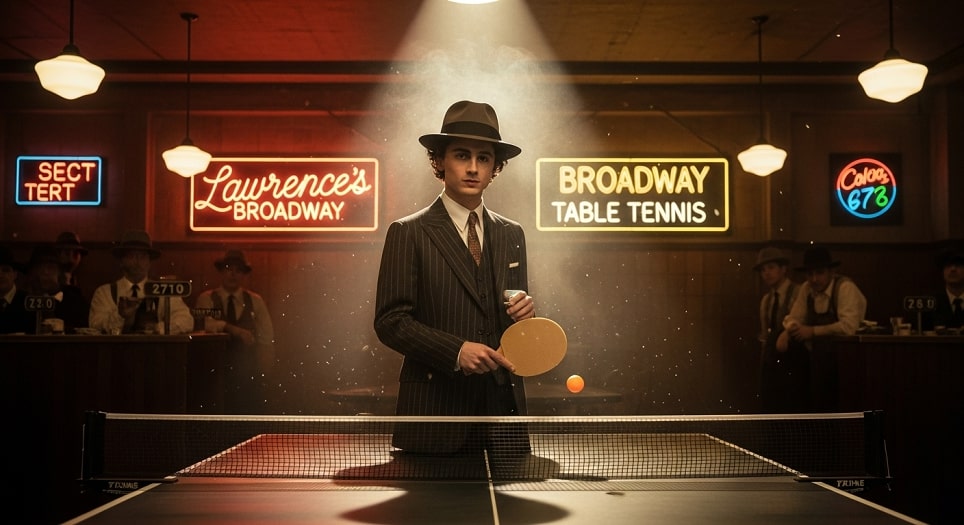
The release of Marty Supreme marks a significant cultural moment, blending the high-energy filmmaking of Josh Safdie with the star power of Timothée Chalamet to bring a niche sporting history to the global mainstream. Set against the vibrant, gritty backdrop of 1950s New York City, the film serves as both a hyperkinetic character study and a sweeping sports drama. While the movie centers on the fictionalized Marty Mauser, its narrative heart is deeply rooted in the extraordinary life of Marty Reisman, a man who transformed table tennis from a basement pastime into a high-stakes arena of showmanship and survival. This transition from real-world grit to cinematic spectacle captures a unique era of American ambition, where the line between an athlete and a hustler was often nonexistent.
Marty Reisman, born in 1930 on Manhattan’s Lower East Side, was a product of his environment—a landscape defined by the Great Depression and the relentless need to “make it.” His journey began not with a dream of glory, but with a search for solace. After experiencing a nervous breakdown at the age of nine, Reisman found that the rhythmic, focused nature of table tennis provided a necessary escape from his anxiety. This therapeutic relationship with the sport quickly evolved into mastery. By the age of 13, he was already a junior champion, and by his mid-teens, he had graduated to the legendary Lawrence’s Broadway Table Tennis Club, a venue as famous for its high-stakes wagering as it was for its athletic skill. It was here that the “Needle,” as he was nicknamed for his tall, gaunt frame, perfected the art of the hustle.
The film Marty Supreme captures this hustler spirit with an intensity that mirrors the real Reisman’s life. In the movie, Chalamet portrays Mauser as a man possessed by a single-minded obsession: to be the greatest in a sport that most of his countrymen dismissed as a game for children. This drive mirrors Reisman’s actual career, which saw him win 22 major titles, including the prestigious English Open in 1949 and two U.S. Open singles championships. However, Reisman’s legacy was never just about the trophies; it was about the bravado. He was a flamboyant figure who played in expensive, custom-tailored suits and fedoras, often betting his last dollar on his own ability to win. This unwavering self-belief is the primary engine of the A24 production, providing a window into the psychology of a man who viewed the table as his kingdom.
Central to the narrative of Marty Supreme is the intersection of sports and high society, a theme brought to life through the film’s expansive supporting cast. Gwyneth Paltrow makes a notable return to the screen as Kay Stone, a wealthy socialite who enters Mauser’s world, creating a collision between the street-level hustle of New York’s ping-pong parlors and the refined luxury of the city’s elite. This dynamic highlights one of the most fascinating aspects of Reisman’s real life: his ability to move through disparate social circles. In reality, Reisman’s Riverside Table Tennis Club on the Upper West Side became a haunt for intellectuals and celebrities alike, including the likes of Dustin Hoffman and Kurt Vonnegut. The film utilizes this “social climbing” aspect to build tension, exploring how an outsider uses a marginalized talent to gain entry into forbidden rooms.
The technical aspects of the film are equally significant, with Josh Safdie employing his signature “anxiety-inducing” style to mimic the frantic pace of a professional table tennis match. With cinematography by Darius Khondji and a score by Daniel Lopatin (Oneohtrix Point Never), Marty Supreme feels more like a thriller than a traditional sports biopic. This stylistic choice is a direct reflection of the way Reisman described his own matches in his memoir, The Money Player. To Reisman, every volley was a calculation of physics and psychology, and every game was a life-or-death struggle for financial stability. The film’s focus on the 1952 World Championships in Bombay serves as a pivotal moment, capturing the real-life historical shift that forever changed the sport: the introduction of the foam sponge paddle.
Reisman was a lifelong advocate of the “hardbat”—the classic wooden paddle covered only in thin, pimpled rubber. When the Japanese team arrived at the 1952 Championships with thick, noiseless sponge paddles, they introduced a level of speed and spin that the traditional game couldn’t match. Reisman viewed this technological advancement as a betrayal of the sport’s purity, a “villainous” innovation that replaced skill with equipment. This conflict is a major subplot in the movie, representing the broader theme of a man out of time, fighting against a changing world that no longer values the “classic” way of doing things. It is this stubborn adherence to tradition that ultimately defines both the real Reisman and his cinematic counterpart.
The production of Marty Supreme was a massive undertaking for A24, with a budget estimated between $60 million and $70 million, making it one of the studio’s most ambitious projects to date. This investment is visible in the meticulous period recreation of 1950s Manhattan, from the smoke-filled basements of Midtown to the neon-lit streets of the Theater District. The casting of unconventional figures like Tyler, the Creator and Kevin O’Leary (from Shark Tank) alongside established actors like Fran Drescher adds a layer of Safdie-esque unpredictability to the ensemble. Each character serves as a satellite in the chaotic orbit of Marty Mauser, contributing to a world that feels both hyper-realistic and mythic in its proportions.
To fully understand the historical weight and the creative liberties taken in Marty Supreme, it is helpful to examine the specific milestones of Marty Reisman’s career and how they are translated into the film’s narrative structure:
- The Early Hustle: Both the real Reisman and the fictional Mauser began their careers in the gambling dens of New York. The film emphasizes the desperation of a young man trying to escape a mundane life—working in his uncle’s shoe shop in the movie, whereas Reisman actually lived in a hotel with his gambler father.
- The Harlem Globetrotters Connection: One of the most colorful chapters in Reisman’s life was his three-year stint touring with the Harlem Globetrotters. He performed table tennis trick shots as a halftime show, a detail included in the film to showcase his transition from a pure athlete to a professional entertainer.
- The “Needle” Persona: Chalamet’s physical transformation—including stained teeth and a wiry, flailing physique—is a direct homage to Reisman’s “Needle” nickname. The film captures his unique playing style, which involved incredible physical agility and a constant stream of “trash talk” designed to rattle opponents.
- The 1952 World Championships: This event serves as the film’s climax and a turning point in sports history. The arrival of the sponge paddle is depicted as a seismic shift, marking the end of the “hardbat” era that Reisman spent the rest of his life trying to resurrect.
- The Celebrity Hub: The film hints at the social magnetism of table tennis in mid-century New York. Reisman’s real-life club was a cultural crossroads, a fact reflected in the movie through the interactions between Mauser and various high-profile socialites and business magnates.
- The 1997 Comeback: While the film focuses primarily on the 1950s, it draws inspiration from Reisman’s late-life success. At age 67, Reisman won the first-ever U.S. National Hardbat Championship, proving that his “outdated” style could still dominate when given the chance.
The cultural impact of Marty Supreme extends beyond the box office, sparking a renewed interest in the history of American table tennis. During the 1930s and 40s, the United States was a legitimate powerhouse in the sport, with players like Dick Miles and Sol Schiff leading the way. However, as the film suggests, the sport’s popularity in the U.S. began to wane just as it exploded in Asia and Europe. By the time Reisman was in his prime, he was a superstar abroad but a relative unknown at home, a discrepancy that fueled much of his lifelong resentment and drive for recognition. The film effectively uses this “prophet without honor” trope to ground Mauser’s often unlikable behavior in a relatable search for respect.
Critically, the film has been praised for Timothée Chalamet’s transformative performance, which many suggest could lead to his first Academy Award. Moving away from the “pretty boy” roles of his earlier career, Chalamet embraces a rodent-like energy and a fast-talking New York cadence that is miles away from Paul Atreides or Willy Wonka. This “uglification” of a major star is a classic Safdie tactic, designed to strip away the artifice of celebrity and reveal a raw, desperate humanity beneath. The performance is bolstered by the chemistry between Chalamet and the supporting cast, particularly Fran Drescher, who provides a grounded, if comedic, presence as Mauser’s overbearing mother.
The film’s marketing campaign was also noteworthy for its “Marty-esque” stunts. In the weeks leading up to the Christmas Day release, an 18-minute video of a pseudo-Zoom call about the movie’s marketing was released, followed by a real orange blimp emblazoned with “Dream Big” flying over Los Angeles. These tactics, designed to mimic the grandiose swagger of the protagonist, helped build a sense of event cinema around what could have been a quiet sports biopic. The result was a $10 million opening day, a significant achievement for a 150-minute drama released during the competitive holiday corridor.
Despite the acclaim, Marty Supreme has not been without controversy. Some viewers and critics have noted that the film’s portrayal of Mauser’s personal life, including his infidelity and reckless gambling, makes for a difficult protagonist to root for. Josh Safdie and co-writer Ronald Bronstein take a neutral, almost documentary-like view of this behavior, refusing to sentimentalize Mauser’s journey. This approach aligns with the “biopic of disagreeable men” genre, where the focus is on the singular talent and the chaos it leaves in its wake rather than a redemptive arc. For Safdie, the character’s unlikability is a feature, not a bug, reflecting the “whatever-it-takes” mentality required to reach the top of a niche profession.
The inclusion of a subplot involving the treatment of Jewish athletes during World War II has also sparked debate. While some critics felt it was a forced attempt to add weight to a sports story, others argued it was a necessary reflection of Reisman’s own Jewish heritage and the era’s political climate. In Reisman’s memoir, he speaks of being inspired by Alojzy “Alex” Ehrlich, a Polish table tennis champion who was reportedly spared at Auschwitz because the guards recognized him. By weaving these historical threads into the fictionalized story of Marty Mauser, the filmmakers elevate the sport of ping pong from a simple game to a matter of survival and identity.
As a professional reporting piece on a current cinematic event, it is vital to note that Marty Supreme is as much about the director’s obsession as it is the subject’s. Josh Safdie himself was once an aspiring professional table tennis player before turning to filmmaking. This personal connection is evident in the reverent way the matches are shot. The camera lingers on the tiny details—the spin of the ball, the sweat on the players’ brows, the sound of the hardbat contact—treating the sport with the same gravity as a boxing match in a Scorsese film. This authenticity is what has resonated most with table tennis enthusiasts, who have praised the film for its accurate depiction of “hardbat” technique.
The legacy of the real Marty Reisman continues to loom large over the sport. He remained an active player until his death in 2012 at the age of 82, always ready for a money match and always dressed in his signature Panama hat. He was a man who believed that table tennis was a noble pursuit, comparable to the work of Einstein or Hemingway. By bringing his story to life, Marty Supreme ensures that the “Needle” will be remembered by a new generation of fans, even if the sport he loved has changed beyond recognition. The film stands as a tribute to the “Money Player” and the era of the American hustler, where greatness was measured not just by victory, but by the size of the bet.
For those looking to understand the world of mid-century table tennis and the making of Marty Supreme, the following sections provide expert insight and practical information related to the film’s themes and history. This data is compiled from verified historical records and official production reports to ensure a factual and comprehensive overview for the reader.
Pro Tips for Understanding the World of Marty Supreme
To fully appreciate the nuances of the film and its historical context, consider these expert perspectives on table tennis history and Safdie’s filmmaking style:
- Master the “Hardbat” Knowledge: Understanding the difference between a hardbat and a sponge paddle is crucial. The hardbat (used by Reisman) relies on precision and control, making for longer, more tactical rallies. Knowing this helps you understand why the 1952 technological shift was so devastating to the classic players.
- Watch Safdie’s Influences: To prepare for the film’s tone, watch Safdie’s previous work like “Uncut Gems” and “Good Time.” He specializes in “stress-cinema,” where characters are constantly in a state of high-stakes motion. Expect a similar sensory overload in Marty Supreme.
- Read the Source Material: Marty Reisman’s 1974 memoir, “The Money Player,” is the primary inspiration for the film. Reading it provides the “raw” version of the stories depicted on screen, many of which are even more outrageous than their cinematic counterparts.
- Look for the Cameos: The Safdie brothers often cast non-professional actors or “real people” from the worlds they are depicting. Look out for actual table tennis legends and New York City “characters” who fill out the background of the film’s many parlors and clubs.
- Follow the Score: Daniel Lopatin’s music is a character in itself. Pay attention to how the electronic score interacts with the period setting; this juxtaposition is a hallmark of modern A24 “prestige” films.
Frequently Asked Questions about Marty Supreme
Is Marty Supreme a true story?
The film is “loosely inspired” by the life of Marty Reisman. While the protagonist’s name is changed to Marty Mauser and many plot points—such as the specific romances and the heist-like subplots—are fictionalized for dramatic effect, the core elements of his career (the English Open win, the Harlem Globetrotters tour, and the hardbat vs. sponge rivalry) are based on factual events.
Who is in the cast of Marty Supreme?
The film stars Timothée Chalamet as Marty Mauser. He is joined by Gwyneth Paltrow as Kay Stone, Fran Drescher as Rebecca Mauser, Kevin O’Leary as Milton Rockwell, Tyler Okonma (Tyler, the Creator) as Wally, Odessa A’zion as Rachel Mizler, and Abel Ferrara as Ezra Mishkin.
When was Marty Supreme released?
The film had its world premiere at the New York Film Festival on October 6, 2025, and was released wide in theaters across the United States by A24 on December 25, 2025.
What is the significance of the “Hardbat” in the movie?
The hardbat represents the “classic” era of table tennis. In the 1950s, the introduction of sponge-covered paddles revolutionized the sport by increasing speed and spin, which the real Marty Reisman famously opposed for the rest of his life, viewing it as a loss of the sport’s tactical soul.
Is Timothée Chalamet actually playing ping pong in the movie?
Yes, Chalamet underwent extensive training to mimic the professional form and “trick shots” of Marty Reisman. While some digital enhancement is used for the speed of the ball, the physical movement and “flailing” style are the result of the actor’s preparation for the role.
The Real Marty Reisman: A Legacy in Titles
While the film captures the spirit of the man, his actual athletic record is a testament to his dominance during the hardbat era. The following is a verified list of his most significant professional achievements:
- English Open Men’s Singles Champion (1949): Reisman became the first American man to win this prestigious title, defeating Hungarian legend Victor Barna in the final. This remains one of the greatest achievements in U.S. table tennis history.
- Two-Time U.S. Open Singles Champion (1958, 1960): These victories solidified his standing as the premier American player of his generation, even as the sport began to shift toward the sponge paddle era.
- World Championship Semifinalist (1949): Reisman reached the semifinals of the world singles, narrowly missing a chance at the world title during the peak of his physical powers.
- U.S. National Hardbat Champion (1997): At age 67, Reisman proved his style was still effective by winning the inaugural national tournament dedicated to the traditional paddle.
- 22 Major Titles Total: Between 1946 and 2002, Reisman maintained a competitive presence that spanned six decades, an unprecedented level of longevity in any racket sport.
Conclusion
The arrival of Marty Supreme signifies a rare intersection of high-concept independent filmmaking and mainstream sports appeal. By focusing on the flamboyant life of Marty Reisman, Josh Safdie and Timothée Chalamet have created a work that is simultaneously a tribute to a forgotten American subculture and a modern epic of ambition. The film’s success lies in its refusal to simplify its subject; Marty Mauser is as flawed and abrasive as the real-life “Needle” was known to be, yet his dedication to a craft that the world ignored is undeniably compelling. As A24’s biggest production to date, it sets a new standard for the “sports biopic,” proving that even a game as seemingly simple as ping pong can contain the full weight of the human experience. Whether viewed as a historical record of the 1952 technological shift in athletics or as a showcase for one of the generation’s finest actors, Marty Supreme is a definitive look at the cost of being “supreme” in a world that always wants something newer. The legacy of the real Marty Reisman—a man who lived by his own rules and died with his fedora on—is finally given the cinematic scale it deserves, ensuring that the story of the “Money Player” will resonate long after the final volley.

Loading comments…