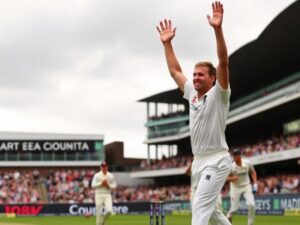
Introduction to the Boxing Day Clash
In the heart of Melbourne, the iconic Melbourne Cricket Ground hosted the fourth Test of the 2025-26 Ashes series between Australia and England on December 26, 2025. With Australia already securing an unassailable 3-0 lead and retaining the urn, this match represented an opportunity for the hosts to push toward a potential whitewash, while England sought pride and momentum in a challenging campaign. The overcast skies and a green-tinged pitch set the stage for a seamers’ paradise, drawing over 80,000 spectators for the traditional Boxing Day spectacle.
The series had been dominated by Australia’s adaptability and depth, despite significant injuries to key players. England, under captain Ben Stokes, arrived with hopes of a turnaround, but faced a formidable Australian side interim-captained by Steve Smith in the absence of Pat Cummins. The conditions, with temperatures hovering around 17 degrees Celsius—the coldest Christmas in Melbourne in nearly two decades—promised swing and seam movement, influencing the tactical decisions from the outset.
As play commenced, the focus was on England’s bowling attack, bolstered by the return of Gus Atkinson and the emergence of Josh Tongue. Australia’s batting lineup, featuring a mix of experience and youth, aimed to build a solid foundation despite the early challenges posed by the English seamers.
Series Recap: Australia’s Dominance
The 2025-26 Ashes began with high expectations, but Australia quickly asserted control. The first Test at Perth Stadium from November 21 to 22, 2025, ended in just two days, marking one of the shortest Ashes Tests in history. England, batting first after winning the toss, were bundled out for 172 in their first innings, thanks to Mitchell Starc’s career-best figures of 7/58. Australia responded with 132, before England’s second innings yielded only 164. Chasing 205, Australia cruised to victory by eight wickets, powered by Travis Head’s explosive 123 off 83 balls—the second-fastest century in Ashes history.
Moving to the second Test, a day-night affair at The Gabba in Brisbane from December 4 to 7, 2025, England again won the toss and batted, posting 334 in their first innings. Australia countered with a commanding 511, featuring contributions from all eleven batters—a rare feat in Test cricket. England’s second innings of 241 set a modest target of 65, which Australia chased down for the loss of two wickets. Mitchell Starc was again the star, earning his second consecutive Man of the Match award and surpassing Wasim Akram as the leading left-arm fast bowler in Test wickets.
The third Test at Adelaide Oval from December 17 to 21, 2025, sealed Australia’s retention of the Ashes. Batting first after winning the toss, Australia scored 371, with Alex Carey’s 106 proving pivotal. England replied with 286, followed by Australia’s second innings declaration at 349. Set 435 to win, England fought to 352 but fell short by 82 runs. Carey’s century and the bowling efforts from Australia’s pacers highlighted their all-round strength, marking the quickest Ashes victory for Australia in over two decades.
Impact of Injuries on the Series
Injuries played a significant role throughout the series, testing both teams’ depth. Australia lost Pat Cummins for the first two Tests, with Steve Smith stepping in as captain. Josh Hazlewood was ruled out after the first Test, and Nathan Lyon joined Cummins on the sidelines after the second, leading to inclusions like Todd Murphy and Jhye Richardson. For England, fast bowlers Mark Wood and Jofra Archer were sidelined for the remainder of the tour, forcing reliance on emerging talents like Gus Atkinson and Josh Tongue.
These absences reshaped strategies, with Australia opting for an all-pace attack in the fourth Test, omitting a specialist spinner for the first time in decades at the MCG. England’s bowling unit, meanwhile, showed resilience, with Brydon Carse and Tongue stepping up amid the challenges.
Despite the setbacks, Australia’s bench strength ensured continuity, while England’s struggles highlighted areas for improvement in squad management and player fitness.
Team News and Lineups for the Fourth Test
Australia made strategic adjustments for the Melbourne Test, dropping Brendan Doggett and including Michael Neser and Jhye Richardson, the latter making a comeback after an injury layoff. With Nathan Lyon ruled out, the hosts fielded an all-seam bowling lineup: Mitchell Starc, Scott Boland, Neser, and Richardson, supported by all-rounder Cameron Green. The batting order saw Travis Head and Jake Weatherald opening, followed by Marnus Labuschagne, captain Steve Smith, Usman Khawaja, Alex Carey as wicketkeeper, and the lower order.
England introduced two changes: Jacob Bethell replaced the injured Ollie Pope in the middle order, and Gus Atkinson came in for Jofra Archer. The lineup featured openers Zak Crawley and Ben Duckett, with Bethell at three, Joe Root, Harry Brook, captain Ben Stokes, wicketkeeper Jamie Smith, Liam Jacks, Atkinson, Brydon Carse, and Josh Tongue. Ben Duckett retained his spot despite a lean run and an ongoing ECB investigation into his conduct, with Stokes offering full support.
The selections reflected both teams’ emphasis on pace-friendly conditions, with England hoping their seamers could exploit the green pitch and overcast skies to mount a fightback.
Player Spotlights
Travis Head, Australia’s leading run-scorer in the series with 391 runs at an average of 55.85, entered the match in fine form, his aggressive style suiting the MCG’s vast outfield. Mitchell Starc, with 22 wickets at 17.04, remained the series’ top bowler, his swing and bounce proving lethal.
For England, Joe Root’s 219 runs at 43.80 provided stability, while Brydon Carse’s 14 wickets underlined his growing importance. Josh Tongue, in only his eighth Test, had already claimed 39 career wickets at 27.90, showcasing his potential as a key weapon.
Alex Carey’s dual role as wicketkeeper and batsman, highlighted by his Man of the Match century in Adelaide, added depth to Australia’s lineup, while Ben Stokes’ all-round abilities remained crucial for England’s revival hopes.
Toss, Conditions, and Opening Exchanges
England captain Ben Stokes won the toss and elected to bowl first, citing the cloudy conditions and grassy pitch as ideal for seam bowling. Stand-in Australian captain Steve Smith admitted he would have made the same decision, noting the absence of a spinner meant Australia would bowl last—a potential disadvantage on a wearing wicket.
The weather, with grey skies and a chill in the air, favored the bowlers, reminiscent of English conditions. Play started on time, with Gus Atkinson and Brydon Carse opening the attack for England. Australia’s openers, Travis Head and Jake Weatherald, negotiated the early overs cautiously, but the movement off the seam kept them on their toes.
In the sixth over, Carse conceded 15 runs, including boundaries from Head and Weatherald, as England struggled for control. However, the introduction of Josh Tongue in the tenth over shifted the momentum.
Morning Session: Wickets Tumble
The session belonged to England, who reduced Australia to 72 for 4 by lunch after 25 overs. Atkinson struck first in the seventh over, bowling Head for 12 with a delivery that jagged back to clip the stumps via an inside edge. Weatherald followed soon after, caught behind off Tongue for 10, nicking a leg-side delivery to Jamie Smith.
Marnus Labuschagne, struggling for form, edged Tongue to Joe Root at first slip for 6, leaving Australia at 34 for 3. Steve Smith, batting at four, looked to stabilize but was bowled by Tongue for 9, a straight full delivery uprooting middle stump at 86 mph.
Usman Khawaja, unbeaten on 21, and Alex Carey on 9, saw out the session, adding 21 runs for the fifth wicket. The partnership provided some resistance, with Khawaja striking his first boundary off Tongue in the 24th over.
Key Performances and Analysis
Josh Tongue emerged as the star, claiming 3 for 24 in eight overs, his ability to find edges and maintain pressure pivotal. His figures included two maidens, demonstrating control on a helpful surface. Gus Atkinson supported superbly with 1 for 12 in nine overs, his economy of 1.33 restricting Australia’s scoring.
Brydon Carse, however, proved expensive, conceding 32 runs in eight overs without a wicket, his inconsistency drawing criticism from experts. Australia’s top order faltered against the seam movement, with the early dismissals exposing the middle order prematurely.
Usman Khawaja’s patient 21 off 38 balls, including a boundary, highlighted his experience, while Alex Carey’s aggressive start—9 off 18—suggested intent to counterattack post-lunch.
Bowling Breakdown
- Josh Tongue’s spell included key dismissals of Weatherald, Labuschagne, and Smith, exploiting the conditions with subtle variations in line and length. His economy of 3.00 ensured Australia could not rotate strike freely, building pressure that led to errors.
- Gus Atkinson’s tight lines yielded just 12 runs in nine overs, with four maidens underscoring his discipline. His wicket of Head broke the opening stand, setting the tone for England’s dominance in the session.
- Brydon Carse’s figures of 8-1-32-0 reflected wayward bowling, including a no-ball and several boundary balls. Despite moments of threat, his lack of consistency allowed brief respites for the Australian batters.
- Ben Stokes opted not to bowl himself in the opening session, preserving energy for later while relying on his frontline seamers. This tactical choice paid off, as the trio kept Australia under 3 runs per over.
- The absence of spin for Australia meant England’s decision to bowl first positioned them well, with the pitch expected to offer turn later in the match for potential exploitation by Liam Jacks.
- Overall, England’s bowling unit achieved a run rate of 2.88, with 47 dot balls from Atkinson alone, stifling Australia’s aggressive intent and forcing defensive play.
- The extras totaled five, primarily leg-byes, indicating some swing but controlled aggression from the bowlers.
Historical Context of the Boxing Day Test
The Boxing Day Test at the MCG is a cornerstone of Australian cricket, dating back to 1950 and becoming an annual fixture since 1980. It has witnessed iconic moments, such as Shane Warne’s 700th Test wicket in 2006 and David Warner’s century in 2012. In Ashes history, Australia holds a strong record at the venue, winning 58 of 115 Tests overall, with memorable victories like the 2013-14 whitewash.
This 2025 edition added to the legacy, with the series already decided but the match carrying emotional weight for England’s touring fans. The cool conditions contrasted with typical Australian summer heat, evoking memories of rain-affected draws in past Ashes encounters at Melbourne.
The MCG’s vast capacity and electric atmosphere amplified every wicket, with the Barmy Army’s chants providing a soundtrack to England’s early success.
Notable Ashes Moments at MCG
- In 1982-83, Jeff Thomson and Allan Border orchestrated a thrilling one-wicket victory for Australia, one of the closest finishes in Test history.
- The 1998-99 series saw Australia dominate with a innings victory, Steve Waugh’s century and Shane Warne’s bowling proving decisive.
- England’s last win at the MCG came in 2010-11, when they retained the Ashes with an innings triumph, led by Jonathan Trott’s unbeaten 168.
- The 2017-18 draw featured Alastair Cook’s double century, a resilient performance amid Australia’s series win.
- In 2021-22, Australia’s innings victory included Scott Boland’s debut haul of 6/7, cementing his place in folklore.
- The venue’s pitch evolution, from seamer-friendly early days to batting paradises later, influences strategies, as seen in this match’s green top.
- Attendance records, often exceeding 90,000 on Day 1, underscore the event’s cultural significance in Australian sport.
Expert Views and Tactical Insights
Commentators praised Tongue’s performance, with Jason Gillespie noting his ability to create indecision among batters. Alastair Cook suggested England might regret not selecting Matthew Potts for additional control. Graeme Swann highlighted the gulf between England’s aggressive “Bazball” ideology and the more conservative “Benball” field settings employed by Stokes.
Tactically, England’s persistence with three seamers in the session allowed rotation without fatigue, while Australia’s deep batting lineup—from Green at seven to Boland at eleven—offered hope for recovery. The decision to omit a spinner was debated, given the MCG’s history of assisting turn on later days.
Andrew McDonald, Australia’s coach, emphasized adaptability, while Stokes focused on session-by-session gains to salvage pride.
Statistical Highlights
- Australia’s top four averaged under 20 runs per dismissal in the session, exposing vulnerabilities against quality seam bowling.
- Tongue’s three wickets took his Test tally to 39 in eight matches, with an impressive average of 27.90 and best figures of 5/66.
- Khawaja’s control percentage of 89% demonstrated his technique, with the flick shot yielding 11 runs.
- Atkinson’s four maidens in nine overs restricted scoring opportunities, contributing to 47 dot balls.
- The fifth-wicket partnership of 21 runs came at 3.7 runs per over, providing a glimmer of resistance.
- Series-wide, Australia’s perfect World Test Championship record (100% points percentage) contrasted with England’s 27.08%.
- The session’s run rate of 2.88 was the lowest in the series for an opening stanza, reflecting the conditions’ bowler-friendly nature.
What Lies Ahead in the Match
Post-lunch, Australia will look to Khawaja and Carey to build a substantial partnership, with Green and the tail capable of contributions. England aims to press their advantage, potentially introducing Stokes or Jacks to vary the attack. The forecast suggests improving weather, which could favor batting later, but any further wickets could expose Australia’s lower order early.
For England, a strong first innings total will be crucial to force a result, while Australia eyes a commanding lead to pursue a 4-0 series advantage heading into Sydney.
The match’s outcome could influence selections for the fifth Test, with both teams managing workloads amid the grueling schedule.
Conclusion
The opening day of the fourth Ashes Test at the MCG encapsulated the series’ narrative: Australia’s resilience tested by England’s spirited bowling under challenging conditions. With Josh Tongue’s triple strike putting the hosts on the back foot at 72 for 4, England gained a foothold in a campaign otherwise dominated by the Australians. The series retention already secured, this match highlighted individual brilliance amid team struggles, from Tongue’s emergence to Khawaja’s defiance. As the Test unfolds, it promises more drama, underscoring the enduring allure of the Ashes rivalry.