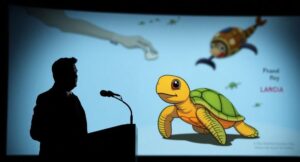
A seemingly trivial social media post by U.S. Secretary of Defense Pete Hegseth, featuring a violent, unauthorized meme of the beloved Canadian children’s character Franklin the Turtle, has escalated into an international incident, drawing swift condemnation from the character’s publisher and intensifying scrutiny over alleged war crimes tied to U.S. military operations in the Caribbean. The controversial image, which depicted the gentle turtle character as a bazooka-wielding soldier targeting “narco-terrorists,” thrust a cherished symbol of childhood innocence into a highly charged debate concerning lethal military force and the laws of armed conflict.
The incident is far more than a simple gaffe or misguided joke; it crystallizes a profound clash between political rhetoric, the conduct of warfare, and the sanctity of cultural icons. The timing and context of the post, appearing just days after reports detailed highly lethal maritime interdiction strikes involving the Secretary’s direct orders, transformed a breach of copyright and taste into a serious political liability, sparking outrage across legislative chambers and international publishing houses.
The subsequent discourse has centered on the chilling juxtaposition of a character synonymous with kindness and problem-solving through dialogue, used as a symbol for what critics are calling extrajudicial killings. This singular social media action, intended perhaps as an attempt to project strength or mock political opponents, has instead provided a stark illustration of the escalating risks associated with blending official government communications with provocative, unverified, or culturally insensitive content.
The Incident and Immediate Backlash
The controversy began when Secretary Hegseth shared an altered image, mimicking the classic cover art style of the “Franklin the Turtle” children’s books, on his social media account. The mock cover, titled “Franklin Targets Narco Terrorists,” showed the normally mild-mannered turtle equipped with military gear—a helmet, vest, and an American flag patch—standing in a helicopter and firing a large, rocket-propelled weapon toward a boat below. The vessel was labeled as carrying “packages” and a man with a weapon, implying a drug-smuggling operation.
The caption accompanying the image, “For your Christmas wish list,” was interpreted by many as a flippant reference to the recent U.S. military strikes against suspected drug-smuggling vessels in the Caribbean Sea and the eastern Pacific Ocean, a region where the U.S. military has dramatically increased its kinetic interdiction efforts. This specific blend of dark humor and military action, coupled with the misuse of a globally recognized children’s icon, immediately triggered a firestorm of criticism across political and cultural lines.
The ‘Franklin Targets Narco Terrorists’ Meme
The image itself, which appeared to be an AI-generated creation or a meticulously doctored piece of fan art, quickly circulated far beyond political circles, reaching millions who grew up reading the Franklin books or watching the associated animated television series. For many, the visual violence inflicted upon a character they associated with learning basic life lessons—like sharing, dealing with fear of the dark, and making friends—was deeply disturbing. The meme effectively inverted the core values of the franchise, shifting the narrative from gentle childhood dilemmas to the harsh realities of military conflict and lethal force.
The use of the meme was seen by critics as attempting to normalize or trivialize deadly military actions, especially within the context of alleged human rights violations. By cloaking serious national security issues in the imagery of a children’s book, Hegseth inadvertently drew intense focus not only to his communications strategy but also to the underlying military operations he was seemingly attempting to celebrate or defend. The choice was widely deemed inappropriate for a sitting defense secretary, whose public statements are typically expected to maintain a measure of gravity and diplomatic discretion.
Publisher’s Swift Condemnation
The official response from the character’s Canadian publisher, Kids Can Press, was unequivocal and immediate. In a formal statement issued to news organizations, the publisher strongly condemned the unauthorized and violent use of Franklin’s name and image. The statement underscored the character’s long-standing cultural significance, emphasizing the values he represents.
The publisher detailed the core principles that Franklin the Turtle embodies, which stand in direct opposition to the imagery shared by Secretary Hegseth. The public rebuke from Kids Can Press highlighted the serious nature of the character’s misappropriation, shifting the narrative from political debate to one of ethical and legal infringement on a cherished literary property. The condemnation was particularly significant as it introduced an international, non-political voice into the political fray, prioritizing the defense of their creation’s intended message over political silence.
The publisher’s spokesperson wrote: “Franklin the Turtle is a beloved Canadian icon who has inspired generations of children and stands for kindness, empathy, and inclusivity. We strongly condemn any denigrating, violent, or unauthorized use of Franklin’s name or image, which directly contradicts these values.” This statement served as a powerful reminder of the character’s origins and moral compass, emphasizing the dissonance between Hegseth’s post and Franklin’s legacy. This strong stance reinforced the collective outrage from parents, educators, and fans across North America.
The Military Context and Legal Scrutiny
The primary reason the Franklin meme controversy achieved such rapid saturation and political significance was its direct link to ongoing and highly sensitive U.S. military operations. The joke was seen by many critics as an attempt to deflect or minimize the severity of a recent, published report that outlined Hegseth’s alleged verbal order for lethal force in the Caribbean maritime strikes, operations that had already raised serious questions about adherence to the law of armed conflict.
These strikes, targeting alleged drug-smuggling vessels, were highly kinetic and intended to be lethal. The administration defended the operations as necessary to combat “narco-terrorists” who were poisoning the American public, asserting that every trafficker killed was affiliated with a Designated Terrorist Organization. However, the reports suggested a darker scenario, focusing specifically on one September attack that may have involved the killing of survivors.
Details of the Caribbean Maritime Strikes
The strikes in question were part of a broader U.S. military effort aimed at intercepting drug shipments originating from or passing through Central and South American waters. These operations are typically executed by Special Operations commanders and utilize a range of assets, including helicopters and armed coastal patrol vessels. The legal framework used to justify these lethal interdictions often relies on classifying the operations as part of the ongoing “War on Terror,” thereby invoking expanded rules of engagement that permit lethal force.
However, the specific incident reported in the Washington Post and referenced by lawmakers involved a strike on an alleged drug boat off the coast of Trinidad. After the initial attack, two individuals were reportedly seen clinging to the burning wreckage. Crucially, the subsequent report alleged that Secretary Hegseth issued a verbal order for a second strike—a “double-tap”—specifically aimed at eliminating any remaining personnel. This alleged order fundamentally changed the nature of the engagement from a standard military interdiction to an operation bearing the hallmarks of an extrajudicial killing, regardless of the targets’ criminal affiliations.
The Secretary’s defense of the action consistently emphasized the lethality of the threat and the legality of the operations under both U.S. and international law. He stated that the declared intent was always to “stop lethal drugs, destroy narco-boats, and kill the narco-terrorists.” Yet, the focus of the scrutiny was not on the initial engagement, but on the explicit order to ensure the death of survivors, which is what pushed the conversation directly into the realm of potential war crimes.
The Double-Tap Allegation and War Crimes Debate
The term “double-tap” in military parlance often refers to firing a second time to ensure the target is eliminated, and when applied to non-combatants or personnel seeking surrender, it is internationally recognized as a violation of the laws of war, specifically the Geneva Convention. This allegation immediately brought high-profile Democratic lawmakers into the debate, demanding a comprehensive congressional review of the strikes and of the Secretary’s command procedures. Senator Tim Kaine, among others, stated explicitly that the alleged order could “rise to the level of a war crime if it’s true.”
The legal debate surrounding the incident hinged on a complex question: Does the U.S. government’s classification of drug traffickers as “narco-terrorists” operating within a declared zone of armed conflict grant carte blanche to apply kinetic force against survivors? Critics argued that even if the legal theory of armed conflict was accepted, the deliberate targeting of non-resisting personnel or survivors, especially those requiring rescue, violates fundamental humanitarian law principles designed to protect those who are hors de combat (out of the fight).
Senator Chris Van Hollen, a Democrat, articulated the legal conundrum facing the administration, suggesting that the entire legal justification for the strikes was concocted and questionable. He argued that if the administration’s underlying legal theory was incorrect—that they were not truly in an “armed conflict” that justified such actions—the first strike could potentially be considered murder. Even if the theory were accepted, the “double-tap” order would still constitute a war crime. The seriousness of these allegations necessitated a rigorous, fact-based investigation, which the Secretary’s flippant Franklin post seemed to actively mock or deflect from.
Political Polarization and Public Reaction
The Secretary’s post and the underlying military controversy became instantly politicized, dividing opinion sharply along ideological lines, yet simultaneously provoking bipartisan condemnation on the issue of conduct and cultural standards. The meme served as an unexpected catalyst, forcing both allies and opponents of the administration to comment on the ethics of the strikes and the professionalism of the Defense Secretary’s public persona.
Bipartisan Congressional Scrutiny
While Democratic members were generally unified in their call for accountability regarding the lethal strikes, the criticism of the Franklin meme transcended typical partisan warfare. Massachusetts Congressman Seth Moulton, a Democrat and decorated veteran, responded fiercely to the post on X (formerly Twitter), calling the Secretary “a disgrace.” Moulton’s comment specifically targeted the cultural and ethical violations, querying: “Where do I start on this? The fact that you want to sell a Canadian children’s book? Or that you’re going to get copyright infringed to hell… because Franklin isn’t a murderer and you want kids to be taught to kill?”
Even former Republicans and Libertarians weighed in, with figures like former Representative Justin Amash asserting, “There’s nothing Christian about war crimes,” in reference to the Secretary’s religious and conservative public image. This multi-faceted criticism demonstrated that while the administration’s core political base might view the meme as a humorous display of strength against criminality, a substantial segment of political leadership, even those who might support aggressive anti-drug measures, found the tone and imagery unacceptable for a high-ranking government official.
The core of the congressional scrutiny focused on demanding transparency and accountability regarding the maritime operations. Lawmakers emphasized the need for clear documentation of the orders given, the rules of engagement followed, and the official justification for classifying the targeted vessels and personnel in a manner that permitted such a high degree of lethal force. The meme, rather than distracting from the issue, became a lightning rod, drawing increased public attention to the gravity of the potential war crime allegations.
Defense and Justification
The Secretary and his supporters vigorously defended the maritime operations, painting them as a necessary, effective, and lawful strategy against organized criminal enterprises that directly threatened American security. The official statements often employed strong rhetoric, contrasting the current administration’s stance with that of previous administrations, claiming: “Biden coddled terrorists, we kill them.” This was framed as a robust, no-nonsense approach to national defense and border security.
Hegseth’s own defense reiterated that the strikes were “highly effective,” “specifically intended to be ‘lethal, kinetic strikes,'” and conducted “in compliance with the law of armed conflict—and approved by the best military and civilian lawyers, up and down the chain of command.” The justification rested on the premise that the drug traffickers were not merely criminals but were affiliated with Designated Terrorist Organizations, thus legitimizing the use of military force designed for armed conflict rather than law enforcement protocols.
However, the defense did little to quell the outrage over the Franklin meme itself. The attempt to justify potentially deadly actions through a cynical, militarized version of a children’s character was widely perceived as a severe lapse in judgment. It provided opponents with easy, recognizable visual evidence of what they perceived as the administration’s cavalier attitude toward violence and its disregard for internationally accepted norms of conduct.
The Cultural Theft and Canadian Identity
Perhaps the most unexpected dimension of the controversy was the element of cultural infringement and the defense of Canadian national identity. Franklin the Turtle, created by author Paulette Bourgeois and illustrator Brenda Clark, is considered a Canadian cultural icon. The character, with over 20 million books sold worldwide, is a staple in Canadian homes and schools, symbolizing the country’s reputation for gentleness, civility, and multiculturalism. The use of Franklin in a hyper-violent, American-military context was thus seen not just as poor taste, but as a cultural appropriation and insult.
Many online comments and media analyses from Canadian sources expressed a sense of shock that a symbol of their nation’s peaceful, child-focused literature was being repurposed by a foreign military official for aggressive political messaging. The reaction highlighted the sensitivity surrounding Canadian cultural exports, which often stand in contrast to the more overtly aggressive or nationalistic narratives sometimes associated with U.S. media and politics.
The incident led to a public discussion about the protective measures surrounding cultural properties and the ethical obligations of public figures when using copyrighted material. Below is a detailed summary of the main values Franklin the Turtle represents, which were fundamentally violated by the meme:
- Empathy and Emotional Literacy: Franklin’s stories center on him navigating complex feelings like fear, shame, and jealousy. For example, in Franklin in the Dark, he overcomes his fear by sharing it and receiving comfort, a foundational lesson in emotional resilience and understanding others. This core value is completely undermined by the imagery of the character actively engaging in lethal military operations.
- Inclusivity and Friendship: The series famously features an ethnically and species-diverse group of friends—Bear, Fox, Badger, Snail, and Beaver—who work through conflicts through dialogue and cooperation. This ensemble promotes a message of inclusivity and collective problem-solving, which stands in stark opposition to the depiction of violence and extrajudicial targeting.
- Problem-Solving Through Dialogue: Franklin rarely resorts to aggression. His challenges are typically resolved through discussions with his supportive parents, teacher, or friends, focusing on personal responsibility and communication. The militarized image replaces this dialogue-centric approach with one of immediate, overwhelming force.
- Respect for Authority and Rules: While Franklin is occasionally mischievous, his overarching narrative arc involves learning to respect boundaries and institutional rules, whether at school or home. The meme, shared by a U.S. Defense Secretary already facing allegations of violating military protocol and international law, directly mocks the importance of operating within established legal and ethical frameworks.
- Simplicity and Safety: The entire aesthetic of the Franklin universe is designed to provide a safe, reassuring, and gentle world for preschool children. The intentional introduction of themes of war, deadly weapons, and terroristic conflict into this world is a psychological violation of the safe space the character was created to inhabit.
- Canadian Literary Tradition: Franklin is a key part of modern Canadian children’s literature, often lauded for its quiet, non-confrontational style. His co-creators are Members of the Order of Canada, signifying the character’s importance to national cultural heritage. The post was seen as a deliberate desecration of this specific cultural legacy.
The breadth and depth of the reaction confirmed that Franklin the Turtle is far more than just a cartoon; he is a representation of childhood values and, in the context of Canada, a symbol of national cultural temperament. His exploitation for political warfare commentary was, therefore, an act of cultural vandalism in the eyes of his originators and millions of fans.
Franklin’s Legacy: Kindness, Empathy, and Inclusivity
To fully grasp the magnitude of the Secretary of Defense’s misstep, one must appreciate the character’s profound and enduring cultural legacy. Franklin the Turtle emerged not from a focus group or a marketing blitz, but from a genuine moment of human connection and creative inspiration, setting him apart from much of the commercialized children’s media.
The Genesis of a Global Character
Franklin was conceived by Canadian author Paulette Bourgeois in the mid-1980s, shortly after the birth of her first daughter. As a new mother and former journalist, Bourgeois was searching for the right subject for a children’s book. The moment of inspiration struck during a sleepless night while she was watching a rerun of the classic television show MAS*H. In the episode, the character Hawkeye Pierce expresses his severe claustrophobia, lamenting: “If I were a turtle, I’d be afraid of my own shell.”
This quote sparked Bourgeois’s imagination, leading her to write the first story, Franklin in the Dark, published in 1986. The concept—a turtle afraid of his own shell—was immediately paradoxical and deeply resonant, serving as a perfect metaphor for common childhood fears. The story found its true visual identity through the illustrations of Brenda Clark, a Toronto native who endowed Franklin with his signature gentle expression, green hue, and recognizable world. Clark was given complete freedom to bring the character to life, focusing on making the world “believable, not realistic,” thus creating an inviting, safe, and emotionally familiar environment for young readers.
The early manuscript, which was initially titled The Turtle They Called Chicken and went through several rejections from American publishers, was ultimately embraced by Kids Can Press. The success was meteoric. The books have been translated into 38 languages and sold over 60 million copies globally. The success was driven precisely by the avoidance of the “pedantry in children’s books,” focusing instead on finding innovative, unconventional ways to tell stories about common childhood dilemmas with “emotional resonance and humor,” as noted by the publishers.
Why Franklin Matters to Children
Franklin’s enduring popularity stems from his ability to function as a mirror for young children, offering them a relatable figure who confronts the universal anxieties of early life. He is not a superhero or a caricature; he is simply a five-year-old turtle working through the often-stressful process of growing up. He is frequently afraid, occasionally lies, sometimes is messy, and often makes mistakes—behaviors that make him authentic to his audience.
His stories deliberately focus on the learning process, not the punishment. When Franklin fibs, for instance, his parents use the moment to teach him about honesty rather than simply scolding him. When he is afraid, his friends share their own hidden fears, fostering a sense of solidarity and normalization of emotional struggles. This narrative structure, where Franklin ultimately solves his own problems with the guidance of supportive adults, is a vital psychological tool. It instills in children a belief in their own agency and resilience, showing them that they, too, can manage their anxieties and complex social situations.
The animated television adaptation, co-produced by Canada’s Nelvana Limited, broadened Franklin’s reach, ensuring that a generation grew up hearing his themes of friendship, patience, and acceptance. The show’s gentle pace and educational focus reinforced the values established in the books. The cultural weight of Franklin, therefore, represents a collective societal commitment to nurturing the emotional well-being and moral development of children—a commitment that the Secretary of Defense’s post appeared to casually discard in favor of a political statement.
The entire debacle serves as a powerful reminder of how cultural symbols, particularly those rooted in childhood innocence, maintain a powerful emotional resonance that public figures underestimate at their peril. The attempt to militarize Franklin the Turtle backfired spectacularly, forcing the political conversation away from the administration’s intended talking points and back onto the ethics of command, the law of war, and the professional standards expected of the highest levels of government.
Conclusion
The controversy surrounding Defense Secretary Pete Hegseth’s appropriation of Franklin the Turtle for a violent political meme encapsulates a complex intersection of international law, cultural diplomacy, and political communication ethics. Far from being a fleeting digital distraction, the incident became a profound lens through which critics, lawmakers, and the public could scrutinize the legality and morality of highly kinetic U.S. maritime operations and the professional judgment of the Secretary himself. The meme, which visually mocked the character’s core values of kindness and empathy, inadvertently amplified the seriousness of the underlying allegations—namely, the reports concerning the “double-tap” order that suggested a disregard for the laws protecting survivors in armed conflict.
The swift and unambiguous condemnation from Franklin’s Canadian publisher, Kids Can Press, served as a crucial intervention, asserting the inviolable nature of cultural properties and the moral principles they embody for millions of children globally. The backlash was both a defense of Canadian identity and a collective outcry against the normalization of military violence in the realm of children’s literature. The bipartisan concern expressed in Congress highlighted the widely held belief that, regardless of political affiliation, high government officials must maintain a level of decorum and respect for humanitarian norms. Ultimately, the Secretary’s attempt at viral humor only succeeded in drawing intense, negative focus to the most serious accusations facing his tenure, solidifying the image of a political figure who prioritizes provocation over principle, even at the cost of tarnishing a beloved icon of childhood virtue. The enduring legacy of Franklin the Turtle, centered on dialogue, friendship, and emotional understanding, stands as a moral counterpoint to the aggressive, polarizing messaging the Secretary attempted to propagate.
Recommended For You