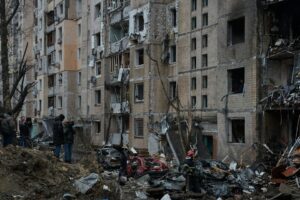
As the Russia-Ukraine war enters its fourth year, the conflict continues to reshape geopolitical dynamics, with recent weeks marking some of the most intense fighting since the full-scale invasion began in 2022. Russian forces have optimized for positional warfare, making slow but steady gains in key regions like Donetsk and Kharkiv, while Ukraine’s military and political leadership face mounting pressure both on the front lines and in diplomatic negotiations. The latest developments reveal a war of attrition, with both sides digging in for a prolonged struggle, even as international efforts to broker a peace deal gain momentum.
The capture of strategic cities such as Siversk and the ongoing battles for Pokrovsk and Kupiansk underscore Russia’s determination to secure territorial control in eastern Ukraine. Meanwhile, Ukraine’s use of advanced drone technology and targeted strikes on Russian assets—including a rare underwater drone attack on a Russian submarine—demonstrates its ability to adapt and inflict significant damage despite resource constraints. Against this backdrop, peace talks have taken center stage, with a 20-point framework proposed by Ukraine and the US now under consideration by Moscow. However, deep divisions remain, and the path to a lasting ceasefire is fraught with challenges.
The State of the Battlefield: Russia’s Slow but Steady Advances
Russian forces have made incremental but strategically important gains in recent months, particularly in the Donetsk region. The capture of Siversk, a key city in the so-called “fortress belt,” brings Moscow closer to its goal of full control over Donetsk Oblast. According to the Institute for the Study of War (ISW), Russian Defense Minister Andrei Belousov’s statements in December 2025 confirmed that Russian forces have adapted their tactics to focus on positional warfare, prioritizing the gradual seizure of territory over rapid breakthroughs. Despite these advances, the pace remains slow, with Russian gains measured in square kilometers rather than sweeping victories. ISW assessments indicate that Russian forces have seized approximately 6,000 square kilometers in 2025—an area smaller than the US state of Delaware—highlighting the grinding nature of the conflict.
The city of Pokrovsk, once a Ukrainian stronghold, has become a flashpoint, with Russian troops bogged down in urban combat. Ukrainian forces, led by the 7th Rapid Reaction Corps, have launched localized counterattacks, reclaiming some areas on the city’s western outskirts. However, the overall trend favors Russia, which has leveraged its superior artillery and drone capabilities to wear down Ukrainian defenses. The use of first-person view (FPV) drones by both sides has transformed the battlefield, making even heavily armored vehicles vulnerable to precision strikes. One Russian milblogger noted that the density of Ukrainian drone and artillery fire is so intense that “even the most protected vehicles cannot withstand multiple hits.”
In the north, Russian forces have conducted limited cross-border attacks in Sumy and Kharkiv oblasts, likely as part of a cognitive warfare campaign to create the illusion of a collapsing Ukrainian front. These attacks, while tactically insignificant, are designed to undermine Western support for Ukraine by portraying the situation as increasingly dire. Ukrainian President Volodymyr Zelensky has warned that Russia’s ultimate goal is to block Ukraine’s access to maritime logistics, further isolating the country from global trade routes.
Ukraine’s Drone Warfare and Asymmetric Tactics
Ukraine has increasingly relied on asymmetric tactics to counter Russia’s numerical and material advantages. The Security Service of Ukraine (SBU) revealed in December 2025 that Ukrainian underwater drones, dubbed “Sub Sea Baby,” successfully struck a Russian Kilo-class submarine in the Black Sea port of Novorossiysk. This marked the first time Ukraine had targeted a submarine, demonstrating its growing capability to project power beyond its borders. Additionally, Ukrainian forces destroyed a rare Il-38N reconnaissance aircraft, known as the “Sea Dragon,” using a drone equipped with an above-ground warhead. These strikes are part of a broader strategy to degrade Russia’s naval and aerial surveillance capabilities, complicating Moscow’s ability to resupply its forces in occupied Crimea and southern Ukraine.
The use of low-cost drones has become a hallmark of Ukraine’s defense strategy. Ukrainian Commander-in-Chief Oleksandr Syrskyi announced the creation of a new branch of the Ukrainian Air Force dedicated to drone warfare, reflecting the central role these systems now play in the conflict. The drones have been used not only for reconnaissance and targeted strikes but also to disrupt Russian logistics, including attacks on oil refineries and ammunition depots deep inside Russian territory. In December alone, Ukrainian drones struck refineries in Saratov and Engels, as well as the Afipsky refinery in Krasnodar Krai, setting processing units ablaze and forcing Russia to divert resources to air defense.
Despite these successes, Ukraine faces significant challenges. The Russian military has adapted by deploying anti-drone nets and electronic warfare systems, reducing the effectiveness of some Ukrainian strikes. Moreover, Russia’s use of chemical weapons—with the Ukrainian General Staff reporting 6,540 chemical attacks in 2025—has added a new layer of complexity to the conflict, raising concerns about the potential for escalation.
Peace Talks and Diplomatic Maneuvering
The prospect of a negotiated settlement has gained traction in recent weeks, following a series of high-level meetings between Ukrainian, US, and Russian delegations. A 20-point peace framework, developed during negotiations in Florida, was formally presented to Russia in December 2025. The proposal includes security guarantees for Ukraine, a demilitarized zone in contested regions, and a mechanism for international oversight of any agreement. However, Russian officials have dismissed key elements of the plan as “unconstructive,” signaling that Moscow remains unwilling to compromise on its core demands, including Ukraine’s neutrality and the recognition of Russian control over occupied territories.
President Zelensky has indicated a willingness to withdraw Ukrainian troops from parts of eastern Ukraine if Russia agrees to a demilitarized, free economic zone monitored by international forces. This proposal, which would address one of the major obstacles to peace, has been met with skepticism in Moscow. Russian Presidential Aide Yuriy Ushakov stated that the Kremlin would decide which proposals to accept or reject, suggesting that Russia is in no hurry to make concessions. Meanwhile, US officials have emphasized that any lasting agreement must include robust security guarantees for Ukraine to prevent future Russian aggression.
The stakes are high for all parties involved. For Ukraine, the war has exacted a devastating human and economic toll, with millions displaced and critical infrastructure—including energy grids and nuclear power plants—repeatedly targeted by Russian strikes. The Zaporizhzhia nuclear power plant, Europe’s largest, remains a particular concern, with both sides accusing the other of endangering its safety. A February 2025 Russian drone strike on the Chornobyl Nuclear Power Plant rendered its protective structure non-functional, raising fears of another nuclear disaster.
Economic and Humanitarian Fallout
The war’s economic impact extends far beyond the battlefield. Russia’s economy, initially resilient due to high energy prices and wartime spending, is showing signs of strain. The Washington Post reports that the Kremlin has burned through most of its cash reserves, and economists warn of a potential banking crisis in 2026. Sanctions on Russian oil have driven prices down, further squeezing Moscow’s ability to fund its military campaign. Meanwhile, Ukraine’s economy has been devastated, with the Kyiv School of Economics estimating that the cost of reconstruction could exceed $800 billion.
The humanitarian situation remains dire. The United Nations estimates that over 10 million Ukrainians have been displaced since the start of the war, with millions more facing food and energy shortages due to Russian attacks on critical infrastructure. The war has also taken a heavy psychological toll, with reports of rising suicide rates among Ukrainian soldiers and civilians. President Zelensky has repeatedly called for increased international aid, warning that without sustained support, Ukraine’s ability to resist Russian advances could be compromised.
On the global stage, the conflict has reshaped energy markets, supply chains, and geopolitical alliances. Europe’s reliance on Russian gas has plummeted, while countries like India and China have become major buyers of discounted Russian oil, complicating Western efforts to isolate Moscow economically. The war has also accelerated NATO’s expansion, with Finland and Sweden joining the alliance in 2023, and prompted a broader reassessment of European defense strategies.
Key Developments in December 2025: A Timeline
- December 1-5: Russian forces launched 704 missiles and drones at Ukrainian energy infrastructure, causing widespread blackouts. The Ukrainian State Inspectorate for Energy Supervision reported that nuclear power plants were forced to reduce electricity generation due to damage to redistribution facilities.
- December 15: Ukrainian underwater drones struck a Russian Kilo-class submarine in Novorossiysk, marking a significant escalation in naval warfare. The same operation targeted a Russian Il-38N reconnaissance aircraft, further degrading Moscow’s surveillance capabilities in the Black Sea.
- December 17: Russian Defense Minister Andrei Belousov claimed that Russian forces had seized 6,000 square kilometers in 2025, though independent assessments put the figure lower. Belousov also acknowledged that Russia’s advances had come at a high cost, with Ukrainian forces inflicting heavy casualties.
- December 19: Russian President Vladimir Putin reaffirmed his commitment to achieving Russia’s “full war aims” during his annual press conference, dismissing the possibility of a negotiated settlement that falls short of Ukraine’s neutrality and territorial concessions.
- December 20: Ukrainian forces recaptured parts of Pokrovsk in localized counterattacks, demonstrating their ability to contest Russian gains even in heavily contested areas.
- December 22: Russia conducted another large-scale missile and drone strike on Ukraine, targeting civilian infrastructure in Kyiv, Zhytomyr, and Zaporizhzhia. President Zelensky accused Moscow of attempting to “freeze Ukraine into submission” by destroying its energy grid.
- December 23: The US and Ukrainian delegations finalized a 20-point peace framework, which was subsequently presented to Russia. The proposal includes security guarantees for Ukraine and a demilitarized zone in eastern Ukraine, but Russian officials have signaled reluctance to engage seriously with the plan.
- December 24: President Zelensky revealed details of the peace framework in a nationally televised address, emphasizing that Ukraine would not accept any agreement that compromises its sovereignty or territorial integrity.
- December 25: Russian forces continued their advances in the Donetsk region, with heavy fighting reported near the cities of Kupiansk and Hulyaipole. Ukrainian officials warned of a potential Russian offensive in early 2026, aimed at seizing the remainder of Donetsk Oblast.
The Role of International Actors
The US and its European allies have played a crucial role in supporting Ukraine, providing military aid, economic assistance, and diplomatic backing. However, the approach of the 2026 US presidential election has introduced uncertainty into Western policy. Former President Donald Trump, a frontrunner for the Republican nomination, has suggested that he could push for a rapid end to the war, potentially at the expense of Ukrainian interests. His administration’s willingness to engage directly with Putin has raised concerns in Kyiv, where many fear that a Trump victory could lead to a reduction in US support.
Europe, meanwhile, has sought to reduce its dependence on Russian energy while increasing military aid to Ukraine. The European Union has pledged “robust security guarantees” as part of any peace deal, though the details remain vague. Germany, France, and the UK have been particularly active in coordinating military and humanitarian assistance, though divisions within the EU over the scope and duration of support persist.
China and India have maintained a more ambiguous stance, continuing to purchase Russian oil while calling for a diplomatic resolution to the conflict. Both countries have avoided direct involvement in the war but have leveraged their economic ties with Moscow to secure favorable trade deals. China, in particular, has positioned itself as a potential mediator, though its close alignment with Russia has undermined its credibility in Kyiv.
What Lies Ahead: Scenarios for 2026
As the war approaches its fourth anniversary, several scenarios could unfold in the coming year:
- Prolonged Stalemate: The most likely outcome is a continuation of the current stalemate, with neither side able to achieve a decisive victory. Russia’s slow but steady advances in Donetsk and Luhansk could eventually lead to the capture of key cities, but Ukraine’s ability to inflict heavy casualties and disrupt Russian logistics may prevent a complete collapse of its defenses.
- Negotiated Settlement: If diplomatic efforts gain momentum, a negotiated settlement could emerge, potentially involving a demilitarized zone in eastern Ukraine and security guarantees for Kyiv. However, any agreement would require significant compromises from both sides, particularly on the issue of territorial control.
- Escalation: The risk of escalation remains high, particularly if Russia perceives that Ukraine and its Western backers are weakening. This could involve expanded Russian attacks on NATO members, the use of tactical nuclear weapons, or a broader mobilization of Russian forces.
- Ukrainian Counteroffensive: While unlikely in the short term, a successful Ukrainian counteroffensive—backed by increased Western military aid—could shift the balance of power on the battlefield. However, such an outcome would require a significant influx of advanced weaponry, including long-range missiles and air defense systems.
- Russian Collapse: While Russia’s economy and military have proven resilient, the cumulative effects of sanctions, battlefield losses, and domestic unrest could eventually force Moscow to reconsider its war aims. However, Putin’s regime has shown a remarkable ability to adapt, making this scenario less probable in the near term.
Conclusion
The Russia-Ukraine war remains one of the defining conflicts of the 21st century, with far-reaching implications for global security, energy markets, and geopolitical alliances. As the fighting intensifies in Donetsk and Kharkiv, the human cost continues to mount, with no end in sight. The latest peace proposals offer a glimmer of hope, but deep-seated mistrust and divergent war aims make a negotiated settlement elusive.
For Ukraine, the coming months will be critical. The country’s ability to sustain its resistance depends not only on its military prowess but also on the continued support of its Western allies. For Russia, the war has become a test of endurance, with the Kremlin betting that it can outlast Ukraine and its backers. The international community faces a stark choice: either redouble its efforts to support Ukraine and deter further Russian aggression or risk a prolonged conflict that could destabilize Europe and beyond.
As 2025 draws to a close, the war’s trajectory remains uncertain. What is clear, however, is that the conflict has already reshaped the global order, with consequences that will be felt for decades to come.