The landscape of high-performance thermal management in the personal computing sector has undergone a significant transformation over the last two decades, moving from niche experimental setups to highly specialized industrial applications. Mineral oil immersion cooling, once hailed as the ultimate frontier for extreme overclockers and silent PC enthusiasts, has largely vanished from the consumer market. This shift is not the result of a single failure but rather a complex intersection of advancing competing technologies, logistical impracticalities, and the long-term chemical realities of submerging sensitive electronics in hydrocarbon-based fluids. As modern processors reach new heights of thermal density, the industry has pivoted toward more sustainable and manageable solutions like closed-loop liquid coolers and sophisticated phase-change systems, leaving the “aquarium PC” as a relic of a specific era in enthusiast DIY culture.
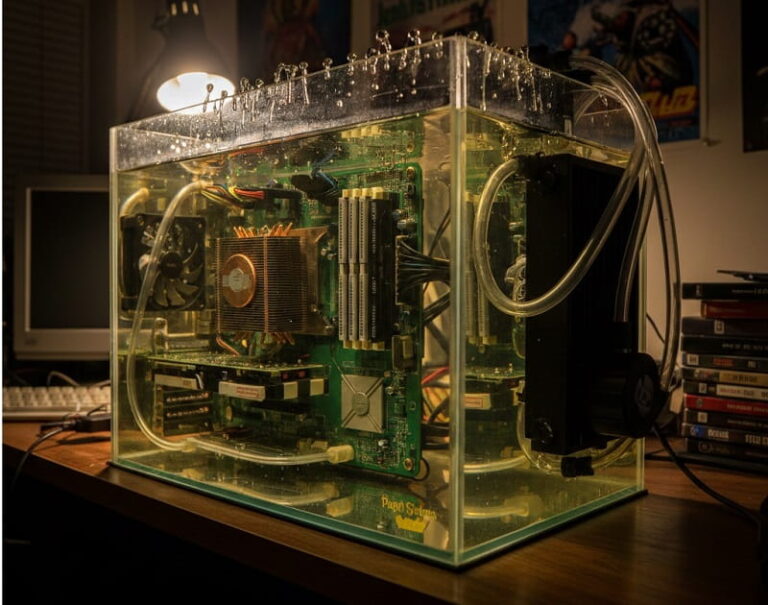
At its core, mineral oil cooling operates on the principle of total immersion, where every component of a computer—excluding mechanical hard drives and optical media—is submerged in a non-conductive, dielectric fluid. Because mineral oil has a much higher heat capacity than air, it can absorb and move thermal energy away from hotspots more efficiently than traditional heatsinks. In the mid-2000s, this was seen as a revolutionary way to achieve near-silent operation while maintaining stable temperatures for heavily overclocked hardware. Companies like Puget Systems briefly commercialized DIY kits, allowing users to turn acrylic tanks into functional, shimmering displays of hardware. However, the initial aesthetic appeal and thermal promise were quickly overshadowed by the grueling reality of maintenance and the irreversible nature of the modification.
One of the primary technical hurdles that led to the decline of oil cooling in the home was the phenomenon of capillary action, often referred to as “wicking.” While mineral oil is non-conductive and safe for silicon, it possesses a unique ability to travel up through the internal strands of copper wiring and power cables. Over months of use, users frequently reported oil leaking out of the back of their machines, dripping from I/O ports, or even reaching the internal components of monitors and peripherals connected via USB or DisplayPort. This mess was not merely an inconvenience; it represented a fundamental flaw in the compatibility between standard ATX hardware and liquid immersion environments. Manufacturers of cables and connectors never intended for their products to be submerged, and the resulting degradation of rubber seals and plastic insulation created a long-term reliability nightmare.
Furthermore, the physical degradation of components submerged in oil became a significant deterrent for users who frequently upgraded their hardware. Mineral oil acts as a solvent for many types of adhesives and certain types of rubber. Enthusiasts often discovered that the thermal pads on their VRMs would dissolve or lose their structural integrity, and the rubber dampeners on fans would turn into a gummy residue. Once a motherboard or graphics card was “oiled,” it was effectively removed from the secondary market. Cleaning a component to a state where it could be sold or used in a standard air-cooled case required dozens of liters of specialized solvents and hours of meticulous scrubbing, and even then, a faint residue often remained. This lack of “reversibility” killed the resale value of expensive hardware, making it a poor financial choice for the average gamer.
The rise of All-In-One (AIO) liquid coolers played a decisive role in making oil immersion obsolete for the general public. In the early days of oil cooling, traditional water cooling was a complex, risky endeavor involving custom loops, reservoirs, and the constant fear of leaks. Mineral oil offered a perceived safety net because a leak wouldn’t cause a short circuit. However, as companies like Asetek and Corsair refined AIO technology, liquid cooling became “plug-and-play.” These closed-loop systems offered 90% of the thermal benefits of oil immersion with 0% of the mess. By the time 240mm and 360mm radiators became affordable and standard in most mid-tower cases, the incentive to buy 20 liters of mineral oil and a custom acrylic tank had all but evaporated.
From a thermodynamic perspective, while mineral oil is excellent at absorbing heat, it is relatively poor at shedding it without active intervention. A stagnant tank of oil will eventually reach a “thermal soak” point where the entire volume becomes hot, at which point the cooling efficiency drops below that of a standard air cooler. To prevent this, users had to implement radiators and pumps to circulate the oil, essentially building a standard water-cooling loop but using a much more viscous and difficult-to-move fluid. The energy required to pump thick mineral oil is significantly higher than that required for water or glycol-based coolants, leading to more noise from the pump and lower overall system efficiency. This irony—that a “silent” oil PC often required a loud, heavy-duty pump—undermined one of the primary selling points of the technology.
The shifting focus of the hardware industry toward energy efficiency also contributed to the decline. During the era when oil cooling was most popular, CPUs and GPUs were seeing massive year-over-year increases in power consumption without corresponding jumps in efficiency. The “Pentium 4” and early “GTX” eras produced immense amounts of heat that traditional air coolers struggled to dissipate. Today, while high-end components still run hot, the density of fins on air coolers and the efficiency of heat pipes have improved to the point where air cooling is sufficient for almost any non-world-record overclocking attempt. The “need” for extreme cooling solutions has narrowed to a very small segment of the market, and that segment has largely moved on to Liquid Nitrogen (LN2) for benching or custom water loops for daily use.
Despite its disappearance from the home, immersion cooling is currently experiencing a massive resurgence in the enterprise and data center sectors. For a home user, the mess of oil is a dealbreaker, but for a data center managing thousands of high-density ASICs for AI training or cryptocurrency mining, the benefits are undeniable. In these controlled environments, professional-grade dielectric fluids—which are more advanced and less messy than basic mineral oil—are used to cool entire racks. These systems are designed from the ground up for immersion, utilizing specialized connectors that prevent wicking and high-flow industrial pumps. This divergence proves that the technology wasn’t a failure, but rather a tool that was poorly suited for the consumer “desktop” form factor.
For those interested in the history of this subculture, the Puget Systems “Bob” project remains the most famous example of the medium’s peak. They proved that it was possible to run a high-end workstation entirely underwater (or rather, under-oil) for years. However, even Puget Systems eventually discontinued their kits, citing the difficulty of support and the lack of component longevity due to chemical interactions. The lesson learned by the industry was clear: unless the hardware is specifically engineered to be submerged, the long-term trade-offs in maintenance and compatibility will always outweigh the short-term gains in thermal performance and acoustics.
Another factor often overlooked is the sheer weight of an oil-cooled system. A standard mid-tower PC weighs between 20 and 40 pounds. A similar system submerged in a tank of mineral oil can easily exceed 100 pounds. This makes the computer entirely non-portable and creates a significant risk of structural failure for the desk or the tank itself. If an acrylic tank develops a hairline crack due to the weight and thermal expansion of the oil, the resulting disaster involves a massive volume of viscous, flammable liquid spreading across the floor. Most homeowners’ insurance policies would not look kindly on a “mineral oil flood,” adding a layer of risk that simply doesn’t exist with traditional cooling methods.
Modern advancements in “Phase Change” cooling and “Two-Phase Immersion” have further pushed basic mineral oil into the history books. In two-phase immersion, a specialized engineered fluid with a low boiling point is used. When the component gets hot, the fluid boils and turns into vapor, carrying the heat away much more effectively than simple conduction. The vapor then hits a condenser coil at the top of the tank and drips back down. This process is incredibly efficient and is being used by companies like Microsoft in their experimental data centers. This technology is the high-tech successor to the mineral oil tanks of the 2000s, but it requires airtight, pressurized environments that are far beyond the reach of a DIY enthusiast.
The psychological aspect of PC building also moved away from the “mad scientist” aesthetic. The current trend in PC building favors “clean” builds with RGB lighting, cable management, and tempered glass. Mineral oil makes cable management impossible, as the cables must hang into the tank, and the oil itself eventually becomes slightly yellow or cloudy over time due to the breakdown of plastics and dust contamination. A “dirty” yellow tank of oil is a far cry from the pristine, neon-lit builds seen on social media today. As the PC building community became more focused on aesthetics and “shareability,” the messy, practical-focused world of oil cooling lost its luster.
Pro Tips for Thermal Management
Maintaining optimal temperatures in a modern PC does not require the extreme measures of the past. To ensure your system remains cool and quiet, prioritize high-quality static pressure fans for radiators and high-airflow fans for the chassis intake. Ensure that your case has a “positive pressure” setup, where more air is being pulled in through filtered intakes than is being pushed out, which helps prevent dust buildup. Additionally, never underestimate the importance of high-grade thermal paste; replacing stock paste with a high-conductivity silver or ceramic-based compound can drop temperatures by 5-10 degrees Celsius. Finally, regular maintenance—cleaning dust filters every three months—will do more for your PC’s lifespan than any exotic cooling solution ever could.
If you are still tempted by the idea of exotic cooling, consider a custom water loop with “soft tubing” before attempting immersion. Custom loops allow you to target specific components like the GPU and CPU directly, providing focused cooling that is significantly more effective than the “blanket” approach of oil. Furthermore, use “leak tester” tools that use air pressure to verify the integrity of your loop before you ever add a drop of liquid. This modern approach provides the “hobbyist” satisfaction of building a complex system without the permanent hardware damage associated with mineral oil.
Frequently Asked Questions
Is mineral oil actually non-conductive?
Yes, pure mineral oil is a dielectric, meaning it does not conduct electricity. This allows it to come into direct contact with the electrical traces on a motherboard without causing a short circuit. However, it is important to note that over time, the oil can become contaminated with dust or metallic particles that may introduce conductivity, which is why long-term filtration is necessary in immersion systems.
Can I use a mechanical hard drive in an oil-cooled PC?
No, you cannot submerge a mechanical hard drive. These drives have a small breather hole that allows internal air pressure to equalize with the environment. If submerged, oil will enter the drive, interfere with the high-speed spinning of the platters, and cause immediate mechanical failure. Solid State Drives (SSDs), however, have no moving parts and can be safely submerged, though the oil may eventually degrade the plastic casing or labels.
Why did Puget Systems stop selling their immersion kits?
Puget Systems discontinued their “Aquarium PC” kits primarily due to the logistical challenges of shipping and the high rate of component failure related to “wicking” and the degradation of plastics. They found that while the systems worked well initially, the long-term maintenance burden was too high for a commercial product, and the industry-wide shift toward better air and water cooling made the product less relevant to their customers.
How do you clean a computer that has been in mineral oil?
Cleaning an “oiled” computer is an incredibly difficult process. It typically involves using large amounts of Isopropyl Alcohol (90% or higher) or specialized electronic cleaners like citrus-based degreasers. Components often need to be soaked and agitated to remove the oil from under the BGA chips and inside the PCIe slots. Even after extensive cleaning, the components often retain a “greasy” feel and a distinct smell, which is why immersion is considered a permanent modification.
Is mineral oil cooling better than water cooling?
In terms of pure thermal capacity, mineral oil is effective, but it is less efficient at heat transfer than water-based systems. Water has a higher thermal conductivity and lower viscosity, allowing it to move heat away from a source much faster than thick oil. Oil cooling is generally better for “total system” silence, as it dampens the noise of all components, but for raw performance, a modern custom water loop or a high-end AIO will almost always outperform a mineral oil tank.
Does mineral oil catch fire if it gets too hot?
Mineral oil has a high flash point, usually above 300 degrees Fahrenheit (150 degrees Celsius). Under normal operating conditions, a computer will never reach these temperatures; the hardware would throttle or shut down long before the oil reached its ignition point. However, it is still a flammable hydrocarbon, and in the event of an external fire or an extreme electrical arc, the oil would provide significant fuel, making it a greater fire hazard than a standard air-cooled PC.
How to Choose a Modern Cooling Solution
When selecting a cooling method for your current build, the first criterion should be the Total Design Power (TDP) of your processor. For CPUs with a TDP under 65W, a basic air cooler is sufficient. For high-end chips exceeding 125W, a 240mm AIO or a large dual-tower air cooler is recommended. The second factor is case compatibility; always verify the maximum radiator size and CPU cooler height supported by your chassis. Third, consider your noise tolerance; larger fans spinning at lower RPMs provide a much more pleasant acoustic profile than small, high-speed fans. Fourth, evaluate your budget, as high-end liquid cooling can cost three to four times more than a top-tier air cooler with only marginal performance gains. Finally, consider the “maintenance” factor; if you want a system you can build and forget for five years, a high-quality air cooler is the only choice that eliminates the risk of pump failure or liquid evaporation.
Conclusion
The decline of mineral oil immersion cooling in the consumer PC market is a classic example of a technology that was surpassed by more practical, efficient, and user-friendly alternatives. While the “aquarium PC” remains a fascinating footnote in the history of extreme computing, its legacy lives on in the massive industrial immersion tanks powering the next generation of artificial intelligence and cloud infrastructure. For the home enthusiast, the risks of wicking, the destruction of resale value, and the sheer logistical mess of hydrocarbon fluids simply could not compete with the elegance of modern air and liquid cooling. As we look toward the future, the lessons learned from the era of oil cooling continue to inform the development of dielectric fluids and thermal management strategies that are now becoming essential in the enterprise world, even as they remain a distant memory for the desktop gamer.