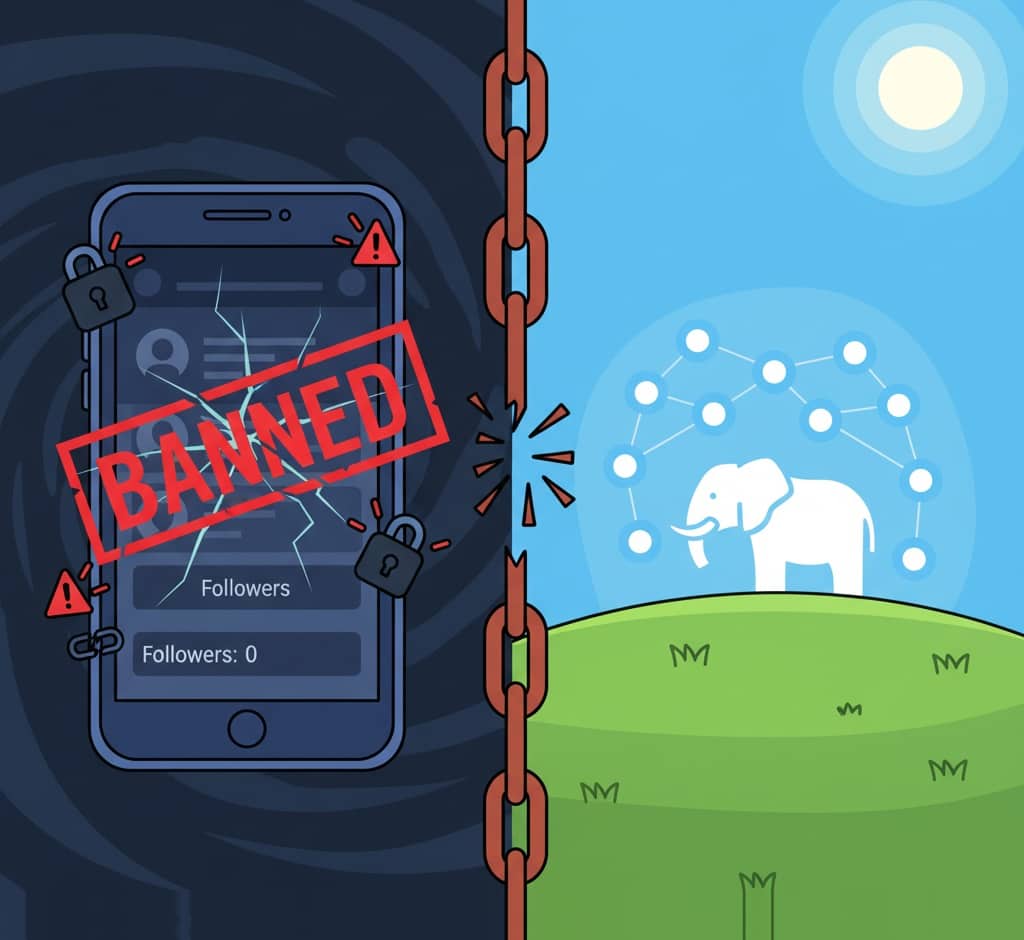
If you are an activist, community organizer, or political campaigner, you have probably spent months or years building a Facebook page. You post consistently, grow your followers, and treat that page as the foundation of your digital presence. It feels like an asset. It is not. It is a liability sitting on borrowed land — and the landlord can evict you without warning, without explanation, and without any real right of appeal. This guide explains exactly why investing in a Facebook page is one of the riskiest decisions an activist can make in 2026, and which platforms — particularly Mastodon — give you genuine, durable control over your community.
You Own Nothing on Facebook
When you build a Facebook page, you are not building an asset. You are building inside a platform that retains complete authority over everything you create there. Your followers are not your followers in any meaningful sense — they are Facebook users who chose to associate with your page inside Facebook’s ecosystem. The moment Facebook decides your page violates its policies, that relationship is severed instantly and permanently.
This is not a theoretical risk. The evidence from real users in 2025 and 2026 is consistent and alarming:
- A page admin reported losing 32,000 followers overnight after their page was removed with no prior warning and no successful appeal.
- A content creator documented a permanent ban from Facebook and Instagram after 17 years of activity with no prior violations of any kind.
- Reddit’s r/facebook community is filled with accounts of bans issued with nothing more than a vague reference to “Community Standards” and no specific explanation of what was violated.
- Facebook group admins report entire groups being placed under review — and facing potential deletion — because a single member posted content that was reported, even after the admin immediately removed it and banned the member.
- The “at risk” account status, once applied, can persist for months. Meta support staff have admitted in chat sessions that they have no ability to manually remove the restriction.
The pattern is clear. One report, one automated flag, one opaque policy interpretation — and everything you built disappears. Understanding your Facebook privacy settings can reduce some exposure, but it cannot protect you from this fundamental structural risk.
How Little It Takes to Trigger a Ban
Facebook’s Community Standards are deliberately broad. They are written in language vague enough to apply to an enormous range of content depending on how an automated system or a human moderator chooses to interpret it on a given day. For activists, this vagueness is extremely dangerous because activist content by its very nature challenges power, discusses conflict, names injustice, and sometimes depicts the realities of political violence, police brutality, or humanitarian crises.
The following types of content have all resulted in page restrictions or bans for activists and organizers:
- Posts discussing protest strategy or civil disobedience
- Images or videos documenting police violence or military operations
- Content related to the Palestinian conflict, Gaza, or pro-Palestine solidarity
- Fundraising posts for political causes
- Comments posted by followers — not by the page admin — that get reported
- Sharing news articles from outlets that have been flagged in Facebook’s internal systems
- Using certain keywords or phrases that trigger automated pattern matching
Once a report is filed, Meta’s automated systems take over. They do not read context. They do not understand nuance. They apply pattern matching against a ruleset designed to minimize Meta’s legal and advertiser risk. If you need help navigating a restriction, you can try to contact Facebook for problems with your account — but the success rate for activists facing politically sensitive bans is extremely low.
The Political Dimension of Facebook Censorship
There is a documented, long-running pattern of politically motivated moderation on Facebook that disproportionately affects activists and organizers. The Guardian reported that leftwing organizers were placed on restricted lists during the Biden inauguration period in 2021. More recently, alternative platforms have seen user surges specifically driven by accusations that Facebook and Instagram are shadow-banning content related to Gaza, Palestine, and social justice movements in 2025 and 2026.
Meta’s business model depends entirely on advertiser relationships. Advertisers do not want their brands appearing next to controversial political content. This creates a direct structural incentive for Meta to suppress exactly the content that activists produce. This is not a malfunction of the moderation system. It is the moderation system working exactly as designed — just not in your interest.
The reach suppression happens even before an outright ban. Organic reach for Facebook pages has collapsed over the past decade. In 2012, a page post would reach roughly 16% of its followers organically. By 2026, that figure for political and activist content is frequently below 2%. You can spend years building 50,000 followers and reach fewer than 1,000 of them with any given post — unless you pay for promotion on a platform that may ban you tomorrow.
The Real Cost of Losing a Facebook Page
When a Facebook page is banned or deleted, the financial and organizational damage is severe and largely unrecoverable. Here is what is actually lost:
- Every follower accumulated over months or years is gone. There is no export function. You cannot download your followers’ contact information or notify them that you moved elsewhere.
- All money spent on Facebook advertising to grow the page is gone. Boosted posts, paid follower campaigns, promoted content — all of that investment produced followers who now exist only inside a platform that just banned you.
- Your entire content archive — posts, photos, videos, documents — can disappear with the page. Years of published material, permanently inaccessible.
- Trust and momentum are disrupted. Research on audience migration consistently shows that only 10–30% of followers successfully reconnect with a creator or organization after a forced platform move. The majority simply never find you again.
- Rebuilding from zero on a new Facebook page means starting the follower growth cycle again on a platform that already demonstrated it will do this to you.
Why Mastodon Is the Right Alternative for Activists
Mastodon is not a Facebook clone. It operates on fundamentally different principles, and those differences are precisely what make it the most appropriate platform for activists who want long-term control over their communities.
Mastodon is part of the Fediverse — a network of independently operated servers that communicate with each other using an open protocol called ActivityPub. This decentralized architecture means there is no single company, no single executive, and no advertiser relationship governing what you are allowed to say. Each server is administered independently under its own community rules. You choose the server whose values align with your work.
The key differences from Facebook are structural, not cosmetic:
- No algorithmic suppression of content based on advertiser sensitivity. Your posts reach your followers in chronological order without a feed algorithm deciding how many people see them.
- No automated corporate moderation scanning your posts for policy violations on behalf of an ad-funded company.
- No paid promotion required to reach your own audience.
- If your server administrator’s rules do not suit you, you can migrate your entire account — including your followers — to a different server. The protocol is built to support this.
- If your organization has basic technical capacity, you can run your own Mastodon instance. As the administrator, you set the rules. Nobody can delete your instance except you.
Several Mastodon instances have been built specifically for activists, journalists, academics, and political organizers. Joining one of these communities means your content reaches an audience already aligned with your work, moderated by people who share your values, without corporate policy enforcement driven by advertiser pressure.
A Full List of Censorship-Resistant Alternatives for Activists
Mastodon is the strongest long-term option for audience ownership, but a resilient activist digital strategy should use multiple platforms with different risk profiles. To understand what social media is and how each platform’s business model affects your freedom on it is essential before choosing where to invest your time.
- Mastodon — Best for building a sovereign, censorship-resistant community. Decentralized, open protocol, no ads, no algorithmic suppression. Run your own instance for full control.
- BlueSky — Lower censorship risk than Meta platforms. Growing activist presence. Decentralized architecture similar to Mastodon but with a more accessible onboarding experience.
- Telegram — Allows large public channels with minimal content moderation. Admins have direct control over their communities. Widely used by activist groups across the political spectrum globally.
- Discord — Best for structured internal organizing. Supports private and semi-private groups with distinct channels for working groups, campaigns, and coordination. Lower public visibility but stronger community cohesion.
- Substack — Best for activist writers and journalists. Your subscriber list is exportable. The platform’s business model does not depend on advertiser relationships, removing the structural incentive to suppress controversial content.
- Signal — Not a social platform but essential for secure direct communication between organizers. End-to-end encrypted, no metadata retention, open source.
- Element / Matrix — Decentralized encrypted messaging for organizations that need secure group communication with full data ownership.
Democracy Technologies has specifically identified Discord, Mastodon, Telegram, and BlueSky as the four platforms that offer political organizations real alternatives to Meta’s ecosystem for community building and engagement in the current environment.
Platforms like X (formerly Twitter) offer more speech than Facebook in some respects, but still carry platform ban risk and algorithmic suppression. Knowing how to make your X account private can reduce some harassment risk there, but it does not solve the underlying ownership problem.
Building Owned Infrastructure: The Only Long-Term Solution
Every platform listed above — including Mastodon — is a distribution channel. The only truly owned communication infrastructure is infrastructure you control directly: your own domain, your own website, and your own email list.
Email remains the only channel where the relationship between you and your audience cannot be taken away by a third party. A list of 5,000 email subscribers that you can export and move to any provider is worth more than 50,000 Facebook followers you cannot contact outside of Facebook. Building that email list should be the first priority for any activist or organization currently dependent on Facebook pages.
A practical owned infrastructure stack for activists in 2026 looks like this:
- A self-hosted WordPress site or equivalent on a domain you own — all content lives here first
- An email newsletter via Mailchimp, Brevo, or a self-hosted solution — subscriber list is always exportable
- A Mastodon account on a values-aligned instance, or your own instance if your organization has the capacity
- Telegram channel for broadcast communications to large audiences quickly
- Facebook and Instagram used only as distribution channels pointing back to your owned infrastructure — never as primary publishing platforms
A Practical Migration Strategy
If you currently depend on a Facebook page, the goal is not to abandon it overnight but to systematically reduce your dependency while building owned infrastructure in parallel.
- Create a Mastodon account immediately and begin posting content there in parallel with Facebook.
- Use your existing Facebook page actively to direct followers toward your Mastodon account, your email newsletter signup, and your website. Do this consistently in every post.
- Stop spending money on Facebook advertising. Every taka spent on paid Facebook follower growth is building on sand. Redirect that budget toward SEO, email list growth, or promotion on platforms with better ownership characteristics.
- Publish all content on your own website first. Use Facebook only to distribute a link back to your site — never publish original content exclusively on Facebook.
- Set up a TikTok presence as an additional distribution channel if your audience is younger. Understanding how TikTok hashtags work for reach can accelerate growth there while you reduce Facebook dependency.
- Export whatever data Facebook allows you to export from your page right now, before a ban makes that impossible.
The Mindset Shift Every Activist Must Make
Facebook has built one of the most effective audience-capture systems in the history of media. It gives you free tools to grow a community, then holds that community hostage as leverage to keep you on the platform, complying with policies and avoiding controversy that might disturb advertiser relationships. For ordinary users posting personal content, this trade-off is acceptable. For activists whose work necessarily involves controversy, challenge, and dissent — it is a trap.
Every hour spent growing a Facebook page you do not own is an hour spent building someone else’s asset. The followers you accumulate there are not your community. They are Facebook’s users that you are currently permitted to communicate with. That permission can be revoked at any moment, for any reason, with no meaningful recourse and no compensation for the investment lost.
The activists and organizations that will be most effective in the years ahead are those who build communication infrastructure they own and control — their own domains, their own email lists, their own Fediverse presence — and use commercial platforms only as distribution channels for content that originates on infrastructure they control. Mastodon and the broader Fediverse offer a real path toward that kind of digital sovereignty. Facebook, by design, does not.
Stop investing in a platform that can erase everything with a single automated flag. Start building something you actually own.