

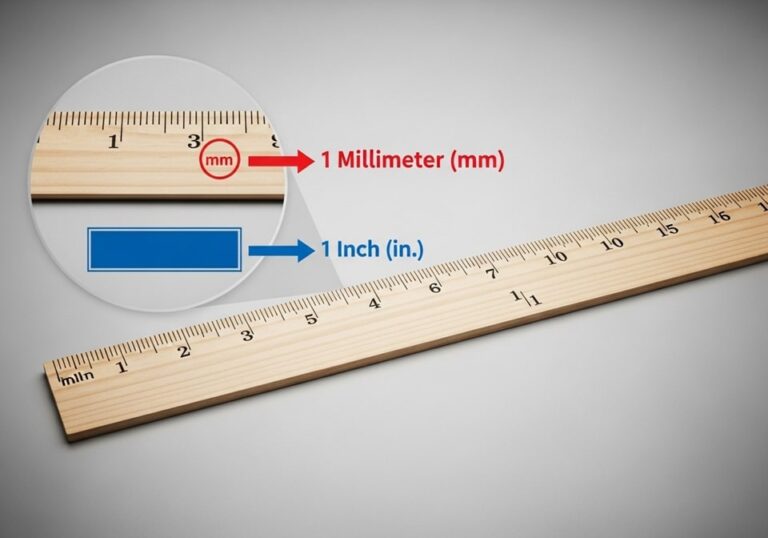
Understanding the difference between millimeters and inches is essential for anyone working with measurements, whether in engineering, construction, manufacturing, or everyday tasks. While both units measure length, they belong to different systems: millimeters are part of the metric system, and inches are part of the imperial system. This article will explore the precise relationship between millimeters and inches, their historical context, practical applications, and how to convert between them accurately. By the end, you’ll have a clear understanding of which unit is greater, when to use each, and how to make seamless conversions.
The Fundamental Difference: Millimeter vs. Inch
A millimeter (mm) is a unit of length in the metric system, defined as one-thousandth of a meter. The metric system, also known as the International System of Units (SI), is used globally for its simplicity and consistency, especially in scientific, industrial, and medical fields. The millimeter is particularly useful for precise measurements, such as the thickness of materials, the diameter of small components, or the dimensions of electronic devices. For example, the thickness of a smartphone screen is often measured in millimeters, as it allows for exact specifications that are critical in manufacturing.
An inch, on the other hand, is a unit of length in the imperial system, primarily used in the United States and occasionally in the United Kingdom. One inch is defined as exactly 25.4 millimeters, a standard established in 1959 to align imperial and metric measurements. Inches are commonly used for everyday measurements, such as the size of TV screens, clothing, or construction materials. For instance, a standard sheet of paper is 8.5 by 11 inches, and the height of a person might be described in feet and inches.
The key difference lies in their scale: a millimeter is much smaller than an inch. Specifically, 25.4 millimeters equal one inch. This means that if you have a measurement in millimeters, you can convert it to inches by dividing by 25.4. Conversely, to convert inches to millimeters, you multiply by 25.4. This relationship is crucial for industries that require precision, such as engineering and manufacturing, where even a small error in measurement can lead to significant issues in the final product.
Historical Context: The Metric and Imperial Systems
The metric system was first introduced in France during the late 18th century as a standardized, decimal-based system of measurement. Its adoption spread globally due to its logical structure, where units are based on powers of ten, making conversions straightforward. For example, 1,000 millimeters equal one meter, and 100 centimeters equal one meter. This consistency eliminates the need for complex conversion factors, which is why the metric system is the preferred choice in most countries today.
The imperial system, however, has its roots in ancient Roman and British measurements. It evolved over centuries, with units like the inch, foot, and yard becoming standardized in the 19th century. The United States, despite its historical ties to Britain, chose to retain the imperial system even as the rest of the world transitioned to metric. This decision was influenced by the cost and complexity of converting existing infrastructure, machinery, and cultural practices. As a result, the U.S. remains one of the few countries where inches and feet are still widely used in daily life.
The coexistence of these systems can lead to confusion, especially in international trade and collaboration. For instance, a product designed in millimeters in Europe may need to be adapted for the U.S. market, where inches are the standard. Understanding the historical and practical reasons behind these systems can help bridge the gap and ensure accurate communication across different measurement standards.
Practical Applications: Where Millimeters and Inches Are Used
Millimeters are the go-to unit for precision-driven industries. In engineering and manufacturing, millimeters are used to specify the dimensions of components, ensuring they fit together perfectly. For example, the diameter of a bolt or the thickness of a metal sheet is typically measured in millimeters. This precision is critical in fields like aerospace, automotive, and electronics, where even a fraction of a millimeter can impact performance and safety. Additionally, millimeters are used in meteorology to measure rainfall or snowfall, providing accurate data for weather forecasting.
Inches, however, dominate in everyday applications, particularly in the United States. Construction, carpentry, and interior design often rely on inches for measurements. For instance, the length of a 2×4 lumber or the height of a door frame is typically given in inches. Inches are also used in the fashion industry for clothing sizes and in consumer electronics, such as the diagonal measurement of TV screens. This widespread use makes inches a familiar and practical unit for many people, even as the world increasingly adopts the metric system.
In some cases, both units are used interchangeably, depending on the context. For example, in the semiconductor industry, millimeters and inches may both appear in specifications, reflecting the global nature of the field. Understanding when and why each unit is used can help you navigate different industries and ensure you’re using the right measurement for the task at hand.
How to Convert Between Millimeters and Inches
Converting between millimeters and inches is a straightforward process, thanks to the fixed relationship between the two units. To convert millimeters to inches, divide the millimeter value by 25.4. For example, if you have a measurement of 50 millimeters, dividing by 25.4 gives you approximately 1.9685 inches. This conversion is useful when working with international specifications or when precise measurements are required in a system that uses inches.
To convert inches to millimeters, multiply the inch value by 25.4. For instance, if you have a length of 2 inches, multiplying by 25.4 yields 50.8 millimeters. This conversion is particularly helpful in fields like construction or DIY projects, where materials and tools may be labeled in inches, but plans or instructions use millimeters. Online conversion calculators and mobile apps can also simplify this process, providing instant results for any value you input.
It’s important to note that while the conversion factor is exact (25.4 mm = 1 inch), rounding may be necessary depending on the context. For example, in woodworking, you might round to the nearest 1/16th of an inch for practicality, while in engineering, you might need the full decimal precision. Always consider the level of accuracy required for your specific application to ensure your conversions are both correct and useful.
Common Mistakes and How to Avoid Them
One of the most common mistakes when working with millimeters and inches is confusing the two units or misapplying the conversion factor. For example, assuming that 10 millimeters equal 1 inch (when in fact, 25.4 millimeters equal 1 inch) can lead to significant errors in measurements. To avoid this, always double-check your conversion calculations and use reliable tools or references when in doubt.
Another mistake is neglecting to account for the precision required in your work. For instance, using a rounded conversion factor (e.g., 25 mm ≈ 1 inch) might be acceptable for rough estimates but can cause problems in precision engineering or scientific research. Always use the exact conversion factor (25.4 mm = 1 inch) for accurate results, and consider the context in which your measurements will be used.
Finally, failing to label your measurements clearly can lead to confusion. Always indicate whether a measurement is in millimeters or inches, especially when sharing information with others. This practice is particularly important in collaborative environments, where different team members might be accustomed to different measurement systems. Clear communication can prevent costly errors and ensure everyone is on the same page.
Step-by-Step Guide to Measuring and Converting
- Identify the Unit of MeasurementBefore you begin, determine whether your measurement is in millimeters or inches. This step is crucial, as it dictates the conversion process. For example, if you’re working with a ruler or tape measure, check the markings to see if they are in metric (millimeters/centimeters) or imperial (inches/feet) units. If you’re unsure, look for labels or context clues, such as the country of origin or the industry standard for the item you’re measuring.If you’re starting from scratch, decide which unit is most appropriate for your task. For precision work, such as machining or scientific experiments, millimeters are typically the better choice. For everyday tasks, like measuring furniture or fabric, inches might be more practical. Understanding the context will help you choose the right unit and avoid unnecessary conversions later.
In some cases, you might need to work with both units. For example, if you’re following a tutorial or plan that uses inches but your tools are marked in millimeters, you’ll need to convert between the two. Having a clear understanding of the units involved will streamline the process and reduce the risk of errors.
- Use the Correct Conversion FactorOnce you’ve identified the units, apply the correct conversion factor. Remember that 1 inch equals exactly 25.4 millimeters. If you’re converting from millimeters to inches, divide by 25.4. If you’re converting from inches to millimeters, multiply by 25.4. For example, to convert 50 millimeters to inches, you would calculate 50 ÷ 25.4 ≈ 1.9685 inches. Conversely, to convert 2 inches to millimeters, you would calculate 2 × 25.4 = 50.8 millimeters.For quick estimates, you can use approximate conversion factors, but always verify the exact value when precision is required. For instance, you might remember that 25 millimeters is roughly 1 inch, but for accurate work, stick to the exact factor of 25.4. This precision is especially important in fields like engineering, where even small discrepancies can have significant consequences.
If you’re working with fractions of an inch, such as 1/2 inch or 1/4 inch, convert the fractional value to a decimal before multiplying by 25.4. For example, 1/2 inch is 0.5 inches, so 0.5 × 25.4 = 12.7 millimeters. This step ensures that your conversions are accurate and consistent, regardless of the format in which the original measurement is given.
- Verify Your ResultsAfter performing the conversion, take a moment to verify your results. Use an online conversion tool or a calculator to double-check your work, especially if the measurement is critical. For example, if you’ve converted 100 millimeters to inches and arrived at approximately 3.937 inches, confirm this with a reliable source to ensure accuracy.If possible, cross-reference your converted measurement with a physical object. For instance, if you’ve converted 2 inches to 50.8 millimeters, use a ruler to measure 2 inches and compare it to the millimeter marking. This hands-on approach can help you catch errors and build confidence in your conversion skills.
Document your conversions clearly, especially if you’re working on a project that involves multiple measurements. Keeping a record of your calculations can help you track your progress and identify any inconsistencies. This practice is particularly useful in collaborative settings, where others may need to review or use your measurements.
- Apply Your Knowledge in Real-World ScenariosPractice converting between millimeters and inches in real-world scenarios to reinforce your understanding. For example, if you’re assembling furniture with instructions in inches but your measuring tape is in millimeters, take the time to convert each measurement. This hands-on practice will help you become more comfortable with the process and improve your accuracy over time.Consider creating a conversion cheat sheet for quick reference. Include common measurements, such as 1/4 inch, 1/2 inch, and 1 inch, along with their millimeter equivalents. Having this information readily available can save time and reduce the risk of errors, especially when you’re working under pressure or dealing with complex projects.
Finally, share your knowledge with others. Teaching someone else how to convert between millimeters and inches can reinforce your own understanding and help you identify any gaps in your knowledge. Whether you’re explaining the process to a colleague, friend, or family member, articulating the steps can deepen your mastery of the subject.
Why the Millimeter vs. Inch Debate Still Matters Today
The debate between millimeters and inches is more than just a matter of preference—it reflects broader issues of standardization, globalization, and technological advancement. As industries become more interconnected, the ability to work seamlessly between metric and imperial units is increasingly important. For example, a company that manufactures components in millimeters but sells products in the U.S. market must ensure its measurements are accurately converted to inches for labeling and marketing.
The persistence of the imperial system in the U.S. also highlights cultural and historical influences on measurement standards. While the metric system is more logical and widely adopted, the familiarity and tradition of inches and feet keep them in use. This duality can create challenges, but it also offers opportunities for learning and adaptation. Understanding both systems allows you to navigate a globalized world with confidence, whether you’re traveling, working, or collaborating internationally.
Looking ahead, the trend toward metrication is likely to continue, driven by the need for precision and consistency in science, technology, and trade. However, inches and other imperial units will likely remain in use for the foreseeable future, particularly in the U.S. and other regions with strong cultural ties to the system. By mastering both millimeters and inches, you’ll be prepared to thrive in a world where flexibility and accuracy are key.
Common Tools and Resources for Conversion
- Online Conversion CalculatorsOnline calculators are one of the most convenient tools for converting between millimeters and inches. Websites like Metric Conversions offer user-friendly interfaces where you can input a value in one unit and instantly see the equivalent in another. These tools often include additional features, such as fractional conversions or tables for common measurements, making them versatile for a wide range of needs.
- Mobile AppsMobile apps provide on-the-go access to conversion tools, allowing you to perform calculations anywhere, anytime. Many apps also include unit converters for other measurements, such as weight, volume, and temperature, making them a comprehensive resource for all your conversion needs. Some apps even offer offline functionality, which is useful in areas with limited internet access.
- Physical Conversion ChartsPhysical conversion charts are handy references for quick lookups, especially in workshops or classrooms where digital tools may not be available. These charts typically list common measurements in both millimeters and inches, allowing you to find equivalents at a glance. They’re also useful for educational purposes, helping students visualize the relationship between the two units.
- Smart Rulers and Tape MeasuresMany modern rulers and tape measures include markings for both millimeters and inches, eliminating the need for manual conversions. These dual-unit tools are ideal for professionals who work with both systems regularly, such as carpenters, engineers, and designers. Using a dual-unit tape measure can save time and reduce the risk of errors in your work.
- Educational ResourcesBooks, tutorials, and online courses can deepen your understanding of measurement systems and conversion techniques. These resources often include practical exercises, real-world examples, and tips for avoiding common mistakes. Whether you’re a student, professional, or hobbyist, investing time in learning about millimeters and inches will pay off in accuracy and efficiency.
| Millimeters (mm) | Inches (in) | Common Use Case | Conversion Formula |
|---|---|---|---|
| 1 mm | 0.03937 in | Measuring the thickness of a credit card or paper. | 1 ÷ 25.4 = 0.03937 in |
| 10 mm | 0.3937 in | Sizing small electronic components or jewelry. | 10 ÷ 25.4 ≈ 0.3937 in |
| 25.4 mm | 1 in | Standard conversion reference; used in engineering and manufacturing. | 25.4 ÷ 25.4 = 1 in |
| 50 mm | 1.9685 in | Measuring the width of a smartphone or small tools. | 50 ÷ 25.4 ≈ 1.9685 in |


