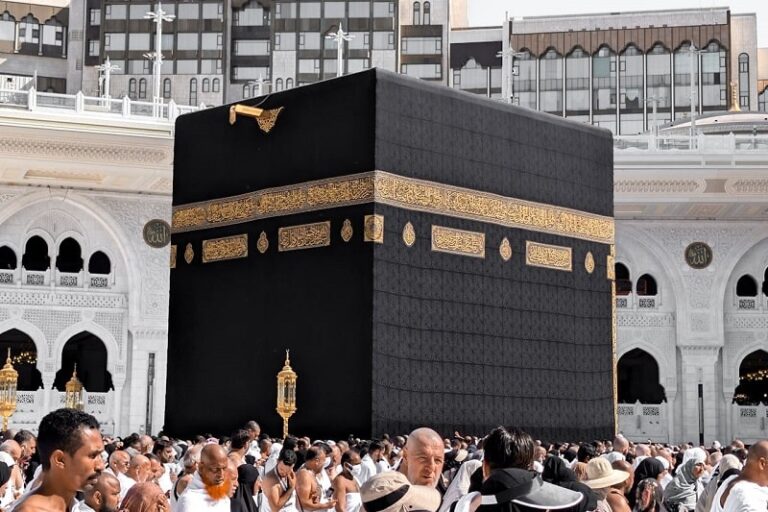
Standing as the focal point of the Islamic world, the Kaaba in Mecca is a structure that transcends physical dimensions to occupy a central spiritual space in the hearts of over a billion Muslims. Every day, from every corner of the globe, the faithful orient their prayers toward this simple, cube-shaped building. Every year, millions undertake the Hajj pilgrimage, circling it in a profound ritual of devotion. While its current form is widely recognized, the question of its origins reaches back into a timeless, faith-based narrative that begins with the dawn of monotheism itself. The history of the Kaaba is not a single event on a calendar but a rich, layered story of divine command, prophetic legacy, destruction, and restoration that intertwines with the very identity of Islam.
This article explores the complete timeline of the Kaaba, from its celestial origins and foundational construction by Prophet Ibrahim and his son Ismail, through its pivotal role in pre-Islamic Arabia, to its purification and establishment as the qibla (direction of prayer) for Muslims by Prophet Muhammad. It will also detail its architectural evolution under various Islamic caliphates and dynasties, leading to the comprehensive custodianship of the modern Saudi state. Understanding this history is essential to appreciating the Kaaba not merely as a historical site, but as a living symbol of unity, faith, and continuous worship.
The Foundation: Celestial Origins and Construction by Ibrahim and Ismail
Islamic tradition holds that the origins of the Kaaba are heavenly. It is believed that the first structure, a simple sanctuary, was built by angels or by the Prophet Adam at the dawn of humanity as a house of worship for the one God. This primordial construction was lost to time, leaving only its foundations. The seminal event in the Kaaba’s earthly history is its reconstruction by the Prophet Ibrahim (Abraham) and his son Ismail (Ishmael). Commanded by God, Ibrahim journeyed to the barren valley of Mecca, where he, with the assistance of the young Ismail, raised the walls of the Kaaba upon the ancient foundations. This narrative, deeply embedded in the Quran, establishes the Kaaba as the first monotheistic house of worship dedicated to Allah.
The construction was fraught with trial and symbol. In search of water for his wife Hajar and infant son, Ibrahim was answered by the miracle of the Zamzam well, which sprang forth at Ismail’s feet. During the building process, Ibrahim stood upon a large stone, which bore his footprint and is known as the Maqam Ibrahim (Station of Abraham), preserved to this day near the Kaaba. Upon completion, God commanded Ibrahim to call all of humanity to pilgrimage to this sanctuary, a call Muslims believe is eternally answered during the annual Hajj. The Black Stone (al-Hajar al-Aswad), a celestial relic believed to have been given to Ibrahim by the Angel Gabriel, was set into the eastern corner of the structure, marking the starting point for the ritual circumambulation (tawaf).
The Era of the Jahiliyyah: Alteration and Polytheistic Worship
In the centuries between the prophets Ibrahim and Muhammad, known in Islamic historiography as the Jahiliyyah (Age of Ignorance), the original monotheistic purpose of the Kaaba was corrupted. The nomadic tribes of Arabia, while still honoring the Kaaba as a sacred sanctuary, gradually introduced idolatry. Over time, the interior and surroundings of the Kaaba became filled with hundreds of idols, statues, and tribal deities worshipped by the various Arabian tribes. The most prominent among these was Hubal, a large idol placed inside the Kaaba. Despite this polytheistic overlay, certain Abrahamic rituals, such as the pilgrimage and circumambulation, were maintained, albeit in an altered form.
The Quraysh tribe, the custodians of Mecca and the tribe of Prophet Muhammad, undertook a significant reconstruction of the Kaaba approximately five years before Muhammad’s prophethood. A flood had damaged the structure, necessitating its rebuild. During this renovation, a dispute arose among the clans about who would have the honor of placing the Black Stone back into its position. They agreed to accept the arbitration of the next person to enter the precincts, who happened to be the young Muhammad. His wise solution—placing the stone on a cloth and having each clan leader hold a corner to lift it together—averted conflict and foreshadowed his future role as a unifying figure. This Qurayshi construction resulted in the basic cubic shape known today, though they lacked the resources to build it to its full, intended height and left a semi-circular wall (al-Hatim) to mark its original footprint.
Purification and Re-establishment as the Muslim Qibla
The pivotal moment in the Kaaba’s history came with the mission of Prophet Muhammad. After receiving revelation in 610 CE and facing persecution in Mecca for 13 years, he migrated to Medina. For the first 16-17 months in Medina, Muslims prayed toward Jerusalem. Subsequently, a Quranic revelation commanded the change of the qibla (direction of prayer) to the Kaaba in Mecca, spiritually re-linking the Muslim community to the sanctuary of Ibrahim and affirming it as the central focal point of Islamic worship. This divine directive solidified the Kaaba’s unique status in Islam.
In 630 CE, Prophet Muhammad returned to Mecca victorious and without bloodshed. His first act was to cleanse the Kaaba of its 360 idols. He entered the structure, destroyed the images and statues, and performed the ritual tawaf, thereby rededicating the House of God to pure monotheistic worship. He restored the rites of pilgrimage to their Abrahamic origins, stripping them of Jahiliyyah practices. In his Farewell Pilgrimage in 632 CE, he established the rituals of Hajj as they are performed to this day. From that moment forward, the Kaaba became the exclusive spiritual center for Muslims worldwide, its management and custodianship (siqayah and hijabah) entrusted to righteous believers.
Architectural Evolution: Expansions and Renovations Through Islamic History
Following the death of Prophet Muhammad, the physical structure of the Kaaba and the surrounding Masjid al-Haram (the Grand Mosque) underwent numerous expansions and renovations under successive Muslim rulers, each seeking to facilitate the pilgrimage for the growing Muslim populace. The core cubic building itself, however, has remained largely consistent in its basic form since the Qurayshi rebuild.
The early Caliphs initiated careful modifications. Caliph Umar ibn al-Khattab expanded the prayer grounds around the Kaaba to accommodate more worshippers. Caliph Uthman ibn Affan further enlarged the mosque and added colonnades. The most significant early structural intervention occurred during the Umayyad Caliphate when Abdullah ibn al-Zubayr, holding Mecca during a civil war, rebuilt the Kaaba to what he believed were its original Abrahamic dimensions, incorporating the semi-circular al-Hatim area into an enlarged structure with two doors. This configuration was short-lived.
After retaking Mecca, the Umayyad Caliph Abdul Malik ibn Marwan, on the advice of his commanders, reverted the Kaaba to the smaller Qurayshi dimensions, demolishing the extension. This is essentially the form that has survived. Subsequent rulers from various dynasties focused their efforts on the surrounding mosque, its infrastructure, and the ornamentation of the Kaaba itself.
- The Kiswah: The tradition of covering the Kaaba with a black silk cloth embroidered with gold Quranic calligraphy (the Kiswah) was institutionalized. It is replaced annually in a grand ceremony on the Day of Arafat during the Hajj season.
- The Gutter (Mizan al-Rahmah): A golden water spout was added to the roof to drain rainwater, a feature that has been replaced and embellished over centuries.
- Interior Furnishings: The sparse interior, which is only opened for special cleanings, received pillars, hanging lamps, and inscribed marble tablets offered as gifts by rulers and sultans over the ages.
- Structural Repairs: Major floods in 1039 CE and again in 1630 CE caused severe damage. The Ottoman Sultan Murad IV undertook a comprehensive restoration in 1630-1631 CE, using sturdy stones and iron clamps, which constitutes the core of the physical Kaaba standing today.
The Modern Era: Custodianship Under the Kingdom of Saudi Arabia
The 20th and 21st centuries have witnessed the most dramatic physical transformation of the Kaaba’s environment under the custodianship of the Kingdom of Saudi Arabia. Since its founding, the Saudi state has prioritized the expansion and modernization of the Grand Mosque to accommodate the exponentially increasing number of pilgrims, which now reaches millions annually.
The first major Saudi expansion was undertaken by King Abdulaziz Al Saud in the 1950s. His successors, Kings Saud, Faisal, and Khalid, initiated further projects. However, the most monumental expansions occurred under King Fahd and King Abdullah. The King Fahd Expansion in the 1980s and 1990s added vast new prayer areas, multiple minarets, escalators to the roof, and advanced air-conditioning systems. The King Abdullah Expansion, one of the largest construction projects in history, further increased the mosque’s capacity to over two million worshippers, adding a mammoth new wing with moving walkways and state-of-the-art facilities.
The current Makkah Royal Clock Tower, a complex housing hotels and prayer areas, dominates the skyline. Throughout these colossal engineering feats, the Kaaba itself has been treated with extreme reverence. Its foundation has been strengthened, its stones cleaned and preserved, and its surroundings meticulously maintained. The Saudi government manages all aspects of the Hajj and Umrah pilgrimages with a focus on safety, security, and service, leveraging modern technology from crowd management systems to giant water mist coolers while preserving the sanctity and rituals of the ancient sanctuary.
The Rituals and Spiritual Significance of the Kaaba
The Kaaba is not a site to be worshipped; rather, it is a physical direction unifying the global Muslim community (Ummah) in worship of the one God. Its significance is embodied in the rituals prescribed for pilgrims and observed by Muslims daily.
The primary ritual is the Tawaf, the act of circumambulating the Kaaba seven times in a counter-clockwise direction. This act symbolizes the believer’s life revolving around the centrality of God. Pilgrims strive to touch or kiss the Black Stone at the start of each circuit, an action tracing back to Prophet Muhammad. Inside the Mataf (the circumambulation area), just a few meters from the Kaaba, lies the Station of Ibrahim (Maqam Ibrahim), where pilgrims pray after Tawaf. The ritual of Sa’i, the brisk walking or jogging seven times between the hills of Safa and Marwah within the mosque complex, commemorates Hajar’s desperate search for water for her son Ismail, linking every pilgrim to this foundational story of faith and divine providence.
- The Black Stone (al-Hajar al-Aswad): A focal point of Tawaf, it is revered as a stone from heaven. Islamic scholars emphasize that veneration is for the stone’s symbolic, historical connection to the prophets, not for the stone itself.
- The Multazam: The area between the Black Stone and the Kaaba’s door is considered a place where supplications are especially accepted. Pilgrims press themselves against this wall, praying fervently.
- The Yemeni Corner (al-Rukn al-Yamani): Pilgrims touch or point toward this corner during Tawaf, as was the practice of Prophet Muhammad, but do not kiss it.
- The Hijr Ismail: The semi-circular low wall opposite the northwest wall of the Kaaba. It is considered part of the original Kaaba’s foundation, and prayers offered within it are considered as being offered inside the Kaaba.
Common Questions and Points of Clarification
Given the Kaaba’s profound significance, several questions commonly arise regarding its history and nature.
What is inside the Kaaba? The interior is an empty, simple room. It is floored with marble and has three pillars supporting the roof. The walls are lined with marble slabs, and there are several inscribed tablets and hanging gold and silver lamps. It is cleaned and perfumed twice a year by a select group of custodians.
Can anyone enter the Kaaba? Entry is extremely rare and restricted. It is typically opened only for authorized dignitaries, special guests of the Saudi King, or for essential maintenance and ceremonial cleaning by the Bani Shaybah family, who have held the key for centuries, a custodianship confirmed by Prophet Muhammad himself.
Is the Kaaba the “center of the world”? While not a geographical center, in Islamic cosmology it holds a spiritual primacy. It is referred to as Umm al-Qura (the Mother of Cities) in the Quran, signifying its foundational spiritual status. Some Islamic traditions speak of a celestial counterpart directly above it in heaven, called al-Bayt al-Ma’mur (the Frequented House).
How has the Kaaba survived conflicts and wars? Throughout history, the sanctity of Mecca and the Kaaba has been widely recognized, even by opposing sides in conflicts. There have been incidents, such as the siege by the Umayyad army using catapults in 683 CE which damaged the structure, and the 1979 seizure of the mosque, but these are exceptional. Generally, conquering rulers sought to be protectors, not destroyers, of the sanctuary.
Conclusion
The history of the Kaaba is a continuous narrative spanning from celestial origins to its modern manifestation as the heart of the Islamic world. Its construction by Prophet Ibrahim and Ismail established the first house of monotheistic worship, a purpose that was obscured during the Jahiliyyah but was triumphantly restored and purified by Prophet Muhammad. The subsequent architectural journey—from the Qurayshi rebuild to the Ottoman restoration—has preserved its essential form, while the monumental Saudi expansions have transformed its surroundings to serve the global faithful. More than just an ancient building, the Kaaba is a powerful, unifying symbol. It physically directs prayer, spiritually centers faith, and historically connects every Muslim to a lineage of prophets and to the eternal, uncompromising worship of the one God. Its timeless presence continues to answer Ibrahim’s call, gathering humanity in a single, sacred space.