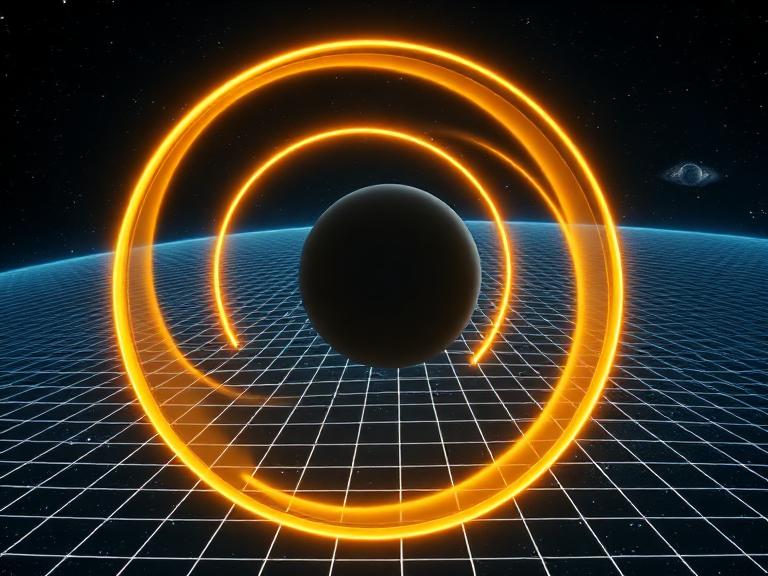
At first glance, pi (π) and gravity seem to belong to completely separate worlds — one is a pure mathematical constant tied to circles and geometry, while the other is the fundamental force that holds planets in orbit and keeps our feet on the ground. Yet the deeper you look into the equations that govern the physical universe, the more you discover that pi is not just a curiosity of geometry. It is a recurring, unavoidable presence in the mathematics of gravitational physics, woven into pendulum motion, orbital mechanics, gravitational waves, and even the structure of black holes. Understanding why pi appears in gravity is one of the most illuminating journeys a curious mind can take through the intersection of mathematics and the physical sciences.
This connection is not coincidental. Pi emerges naturally in any system that involves circles, oscillations, or periodic motion — and gravity, as it turns out, produces all three in abundance. From the swing of a pendulum to the elliptical orbit of a planet, from the rippling fabric of spacetime to the curved geometry around a black hole, pi is a silent but constant participant in how gravity expresses itself mathematically.
The Pendulum: Where Pi and Gravity First Meet
Perhaps the most historically significant relationship between pi and gravity is found in the simple pendulum. Long before modern physics formalized the connection, scientists and engineers observed that a swinging pendulum keeps remarkably consistent time — a property that made pendulums the basis of clockmaking for centuries. What drives this regularity is the mathematics of simple harmonic motion, and at the heart of that mathematics sits pi.
The period of a simple pendulum — the time it takes to complete one full back-and-forth swing — is governed by the formula:
T = 2π√(L/g)
In this equation, T is the period of the swing, L is the length of the pendulum, and g is the acceleration due to gravity. The factor of 2π arises directly from the circular and oscillatory nature of the motion involved. When you rearrange this formula to solve for g, the acceleration due to gravity, you get:
g = 4π²L / T²
This equation has deep historical significance. In the early discussions about standardizing the meter, one proposal was to define one meter as the length of a pendulum whose period is exactly two seconds — meaning it takes one second to swing each way. If you substitute L = 1 meter and T = 2 seconds into the formula above, you get a value of g that is very close to the actual gravitational acceleration at Earth’s surface of approximately 9.81 m/s². The near-perfect correspondence is not a coincidence — it reflects how early metrologists tried to link human measurement standards to the physical constants of Earth itself, with pi acting as the mathematical bridge between length, time, and gravity.
Kepler’s Laws and the Role of Pi in Planetary Orbits
The connection between pi and gravity extends far beyond Earth’s surface. Johannes Kepler’s Third Law of Planetary Motion, one of the foundational principles of classical astronomy, establishes a precise mathematical relationship between a planet’s orbital period and its distance from the Sun. When written in its full form using Newton’s law of universal gravitation, this relationship explicitly contains pi:
T² = (4π² / GM) × a³
Here, T is the orbital period of the planet, G is the universal gravitational constant, M is the mass of the Sun, and a is the semi-major axis of the planet’s elliptical orbit. The factor of 4π² in this equation is not arbitrary — it emerges because orbital motion is fundamentally circular or elliptical in nature, and any mathematical description of circular motion necessarily involves pi.
This law applies not just to planets orbiting the Sun, but to any two-body gravitational system. Satellites orbiting Earth, moons orbiting Jupiter, binary stars orbiting each other — all of them obey this formula, and in every case, pi is embedded in the calculation that links gravitational force to the geometry of motion. Space agencies around the world use this equation routinely when calculating satellite trajectories, planning orbital insertion burns, and predicting the positions of celestial bodies years in advance.
Newton’s Law of Gravitation and Spherical Geometry
Newton’s Law of Universal Gravitation is typically written as:
F = G × (m₁ × m₂) / r²
At first glance, pi does not appear explicitly in this formula. But the moment you consider that gravity acts around spherical objects — planets, stars, moons — pi becomes indispensable. The gravitational field of a spherical body is described using Gauss’s Law for Gravity, a mathematical tool that calculates the total gravitational flux through a closed surface surrounding a mass. That surface, by the spherical symmetry of gravity, is always a sphere, and the area of a sphere is 4πr². Pi is therefore embedded in every calculation of how gravitational influence radiates outward from a spherical body into space.
Similarly, when physicists calculate the gravitational potential energy of a uniform spherical shell or a solid sphere — models used for planets and stars — pi appears throughout the integration. The distribution of mass within a sphere, the surface area over which gravitational effects spread, and the volume of spherical regions all require pi. In this sense, pi’s presence in gravitational physics is inseparable from the spherical geometry that massive objects naturally adopt under the influence of gravity itself.
Gravitational Waves: Pi in the Ripples of Spacetime
One of the most dramatic confirmations of Einstein’s General Theory of Relativity came in September 2015, when the LIGO (Laser Interferometer Gravitational-Wave Observatory) detected gravitational waves for the first time — ripples in the fabric of spacetime produced by the merger of two black holes over a billion light-years away. This discovery, announced by the LIGO Scientific Collaboration and Virgo Collaboration in February 2016, opened an entirely new field of astronomy. And at the mathematical core of gravitational wave physics, pi plays a central and unavoidable role.
Gravitational waves are oscillatory by nature — they stretch and compress spacetime as they propagate, much like sound waves compress air. The frequency of a gravitational wave signal from a binary black hole or neutron star merger is expressed directly in terms of pi. Specifically, the gravitational wave frequency is twice the orbital frequency of the merging system, and orbital frequency is always expressed using the formula f = 1/T, where T contains 2π as shown in Kepler’s derivation. The chirp mass formula — a critical parameter used to characterize gravitational wave signals — also contains explicit factors of π throughout its derivation.
The strain amplitude of gravitational waves, which measures how much spacetime is being stretched or compressed by the wave, is derived from Einstein’s field equations, which are inherently geometric and involve pi through the spherical and ellipsoidal geometry of the merging objects. When physicists at LIGO match observed signals to theoretical templates, those templates are generated by solving equations that are saturated with pi at every level.
Black Holes: Pi in the Geometry of Extreme Gravity
Black holes represent the most extreme expression of gravity in the known universe, and they are described by equations that are deeply geometric — and therefore deeply connected to pi. The Schwarzschild radius, which defines the size of the event horizon of a non-rotating black hole, is given by:
rₛ = 2GM / c²
While pi does not appear explicitly in this formula, it enters through the surrounding geometry. The surface area of the event horizon is 4πrₛ², and the Bekenstein-Hawking entropy of a black hole — a profound result linking thermodynamics, quantum mechanics, and general relativity — is proportional to this surface area and therefore contains pi. Stephen Hawking’s landmark derivation of Hawking radiation, the theoretical process by which black holes slowly emit thermal energy and evaporate, involves pi in the temperature formula:
T_H = ℏc³ / (8πGMk_B)
Here, π appears directly in the denominator, relating the mass of the black hole to the temperature of the radiation it emits. This formula is one of the most celebrated results in theoretical physics, uniting quantum mechanics, thermodynamics, and general relativity — and pi is woven into its very structure.
The study of gravitational time dilation near black holes also involves pi indirectly. According to general relativity, time passes more slowly in stronger gravitational fields — a phenomenon verified experimentally using atomic clocks at different altitudes and through the precision timing of GPS satellites. The mathematical description of this effect, derived from the Schwarzschild metric, relies on the spherical geometry of spacetime curvature, which once again brings pi into the picture through the geometry of the surrounding space.
Pi in Einstein’s Field Equations
Perhaps the most encompassing appearance of pi in gravitational theory comes from Einstein’s Field Equations themselves, the set of ten interrelated differential equations that form the core of General Relativity:
Gμν + Λgμν = (8πG / c⁴) × Tμν
In this equation, Gμν is the Einstein tensor describing spacetime curvature, Λ is the cosmological constant, gμν is the metric tensor, G is the gravitational constant, c is the speed of light, and Tμν is the stress-energy tensor describing the distribution of matter and energy. Notice the factor of 8π on the right-hand side. This factor arises from the requirement that General Relativity reduce to Newtonian gravity in the weak-field, low-velocity limit — and since Newtonian gravity involves the inverse-square law and spherical geometry, pi is necessary to make the two theories consistent.
The factor of 8π in Einstein’s field equations is one of the most profound appearances of pi in all of physics. It connects the geometry of spacetime — expressed on the left side of the equation — to the physical content of matter and energy on the right side, with pi serving as the mathematical constant that makes the geometry of curved space consistent with the inverse-square behavior of gravity that Newton first described.
The Cosmic Scale: Pi in Cosmology and the Expanding Universe
The relationship between pi and gravity does not stop at individual objects or even solar systems. At the largest scales of the universe, pi continues to appear in the equations governing cosmic structure and evolution. The Friedmann equations, which describe the expansion of the universe and form the basis of modern cosmology, contain pi through their derivation from Einstein’s field equations. The critical density of the universe — the average density of matter and energy that determines whether the universe will expand forever or eventually collapse — is expressed using a formula that contains G, the Hubble constant, and implicitly relies on the spherical geometry that brings pi into the calculation.
When cosmologists study the cosmic microwave background (CMB), the faint thermal radiation left over from the early universe, they analyze its patterns using spherical harmonics — a mathematical framework that is built on pi and the geometry of the sphere. The angular power spectrum of the CMB, which encodes information about the density fluctuations that gave rise to galaxies, stars, and planets, is analyzed using Fourier transforms on a sphere, with pi appearing throughout. In this way, pi connects the gravitational physics of the early universe to the large-scale structure of the cosmos we observe today.
Pro Tips for Understanding Pi and Gravity
- Start with the pendulum formula. The equation T = 2π√(L/g) is the most accessible entry point for understanding why pi appears in gravitational physics. Build intuition here before moving to more advanced topics like general relativity or gravitational waves. Working through the algebra of how g = 4π²L/T² is derived will give you a concrete, hands-on appreciation of the relationship.
- Think geometrically, not just algebraically. Pi appears in gravity because massive objects are spherical and orbital paths are elliptical or circular. Whenever you see pi in a physics formula, ask yourself: where is the circle or sphere in this system? Answering this question will dramatically improve your conceptual understanding of why pi keeps showing up.
- Use dimensional analysis as a check. When working with gravitational formulas that involve pi, dimensional analysis is your best friend. Checking that your units work out correctly on both sides of an equation is a powerful way to catch errors and build confidence in your calculations.
- Connect Kepler to Newton to Einstein. The appearance of pi in Kepler’s Third Law, Newton’s gravitational formulas, and Einstein’s field equations is not three separate coincidences — it is a continuous thread. Tracing how pi flows from one theory to the next deepens understanding and reveals the mathematical unity underlying all of gravitational physics.
- Explore LIGO’s public data. The LIGO Scientific Collaboration makes its gravitational wave data publicly available. Exploring this data, even qualitatively, gives you a real-world window into the physics where pi and gravity intersect most dramatically. Even without advanced mathematics, visualizing the waveform of a black hole merger provides powerful intuition about the oscillatory, periodic nature of gravitational phenomena.
- Study the Schwarzschild metric. For those ready to go deeper, the Schwarzschild metric is the simplest exact solution to Einstein’s field equations. Working through its derivation — or at least its structure — reveals how pi, spherical geometry, and gravitational curvature are all tied together at the mathematical foundations of General Relativity.
- Use pi to estimate g from a pendulum at home. You can measure the local acceleration due to gravity using nothing more than a string, a weight, and a stopwatch. Measure the length of your pendulum, time ten full swings, divide by ten to get the period, and apply g = 4π²L/T². Comparing your result to the standard 9.81 m/s² is a satisfying real-world demonstration of the pi-gravity connection.
Frequently Asked Questions
Why does pi appear in the formula for a pendulum?
Pi appears in the pendulum formula because pendulum motion is a form of simple harmonic motion, which is mathematically equivalent to the projection of circular motion onto a straight line. Since circular motion inherently involves pi, any system exhibiting simple harmonic motion — including pendulums — will have pi in its period formula. The factor of 2π in T = 2π√(L/g) reflects one complete cycle of this underlying circular geometry.
Does pi appear in Newton’s Law of Gravitation?
Pi does not appear explicitly in the formula F = Gm₁m₂/r², but it becomes essential the moment you apply this law to real physical systems. Any calculation involving the gravitational field around a spherical body — which describes every planet, star, and moon — requires the surface area formula 4πr², bringing pi into the result. Gauss’s Law for Gravity, which is the most rigorous way to calculate gravitational fields around spherical mass distributions, explicitly contains pi.
What is the significance of 8π in Einstein’s Field Equations?
The factor of 8π in Einstein’s Field Equations — written as Gμν = (8πG/c⁴)Tμν — is not arbitrary. It is precisely calibrated so that General Relativity reproduces Newton’s Law of Gravitation in the appropriate limit of weak gravitational fields and slow-moving objects. Without this factor of 8π, the two theories would be inconsistent. In this sense, 8π is the mathematical constant that unifies Newtonian and Einsteinian gravity.
How is pi connected to gravitational waves?
Gravitational waves are oscillatory disturbances in spacetime, and all oscillatory phenomena involve pi through the mathematics of periodic motion. The frequency, amplitude, and phase of gravitational wave signals are all described using equations that contain pi — including the orbital frequency formulas derived from Kepler’s laws and the strain amplitude equations derived from General Relativity. When physicists at LIGO analyze gravitational wave signals, pi is embedded in the theoretical templates they use to identify and characterize each event.
Is the relationship between pi and gravity unique to Earth?
No. The mathematical relationship between pi and gravity is universal — it applies equally on Earth, on other planets, in binary star systems, in distant galaxies, and at the cosmic scale of the entire universe. The formulas that contain pi describe how gravity behaves anywhere in the universe, because they are derived from fundamental geometric principles that do not depend on location. Pi is a mathematical constant, not a physical one that varies from place to place, which is precisely why its relationship with gravity is so deep and universal.
Conclusion
The relationship between pi and gravity is one of the most elegant examples of how mathematics and the physical world are not merely related — they are, in a profound sense, the same thing expressed in different languages. Pi appears in gravitational physics not because anyone put it there by choice, but because the universe is built on geometry, and gravity is the force that most powerfully shapes that geometry. From the gentle swing of a pendulum to the catastrophic merger of black holes a billion light-years away, pi is present in every oscillation, every orbit, every ripple of spacetime. It appears in Newton’s gravitational theory through spherical geometry, in Kepler’s laws through orbital periodicity, in Einstein’s field equations through the mathematical requirements of consistency, and in gravitational wave physics through the oscillatory nature of spacetime disturbances.
Understanding this connection is more than an academic exercise. It reveals that the constants and structures of mathematics are not human inventions applied to nature from the outside — they are nature’s own language, and pi is one of its most fundamental words. As gravitational physics continues to advance through new generations of gravitational wave detectors, next-generation space telescopes, and ever-more-precise tests of general relativity, pi will remain at the center of every calculation, every prediction, and every discovery. The bond between pi and gravity is not just a mathematical curiosity; it is a window into the deep, beautiful, and enduring unity of the cosmos.

Full-stack developer at Scylla Technologies (USA), working remotely from Bangladesh. Adobe Certified Magento Developer.