U.S. Intervention in Venezuela and Capture of President Maduro
In a historic and controversial military operation in early January 2026, United States forces launched a broad offensive in Venezuela that resulted in the capture and removal of President Nicolás Maduro and his wife, Cilia Flores, marking one of the most dramatic shifts in Western Hemisphere geopolitics in decades. The operation, conducted under the leadership of U.S. President Donald J. Trump, involved precision strikes on key Venezuelan military facilities followed by the extraction of Maduro and Flores, who were flown to the United States to face a series of federal charges, including alleged narcotics and weapons offenses.
Trump’s announcement that “the United States has captured President Maduro” signaled a unilateral escalation in U.S.–Venezuelan relations that had been deteriorating for years under sustained American pressure on Maduro’s regime over corruption, human rights abuses, and alleged involvement in narcotics trafficking networks. U.S. officials justified the operation as a necessary action to remove what they described as an authoritarian leader and to address broader concerns about drug flows into the United States. However, those claims remain contested, and critics have raised significant questions regarding the legality of such an intervention without congressional approval or explicit international mandates.
Operation Details and Military Execution
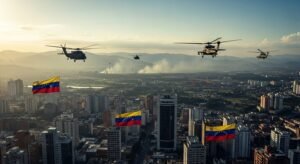
The military operation, described by U.S. authorities as a targeted and limited use of force, involved an aerial component and special operations units that struck strategic military positions in the Venezuelan capital of Caracas and surrounding regions. Reports indicate that dozens of aircraft, including helicopters and fixed-wing aircraft, played a coordinated role in neutralizing air defenses and isolating Maduro’s command centers before his capture. Witness accounts from Caracas noted explosions and low-flying aircraft in the early hours of the operation.
Government statements in Washington described the mission as meticulously planned and executed with minimal civilian involvement, though Venezuelan officials have disputed this, asserting that the strikes constituted an air assault that led to casualties among both military personnel and civilians. The total number of casualties remains difficult to verify independently in the midst of rapidly evolving conditions on the ground.
Political Claims and U.S. Control Over Venezuela
Upon the successful removal of Maduro, President Trump publicly stated that the United States would “run Venezuela” temporarily until what he termed a “safe, proper, and judicious transition” could occur. This declaration, which Trump made in a press conference aboard Air Force One, invoked language suggesting a form of direct or indirect control over Venezuelan governance and its vast natural resources, especially its oil reserves.
Venezuela has the world’s largest proven crude oil reserves, and Trump’s administration quickly signaled that American oil companies would play a central role in revitalizing production and infrastructure. In the days following the intervention, the White House announced agreements to allow Venezuela to export tens of millions of barrels of oil to the United States, with U.S. officials asserting control over the distribution and marketing of these resources. American oil majors, including Chevron and ExxonMobil, were reported to be in discussions about a broad reentry into the Venezuelan oil sector under new operational frameworks.
U.S.–Venezuela Oil Agreements and Economic Strategy
In a strategic pivot, the Trump administration stated that millions of barrels of Venezuelan crude, previously subject to U.S. sanctions and export restrictions, would flow into U.S. refineries and markets. The initial phase of this expanded oil cooperation was reported to include between 30 million and 50 million barrels of crude oil for direct shipment to Gulf Coast ports, where it would be refined for domestic use or export.
Officials framed the expanded oil trade as beneficial to both Venezuelans and Americans, citing stabilizing effects on global energy markets and increased fueling of domestic industries. The proceeds from these sales, according to U.S. authorities, would be administered in ways designed to support Venezuelan reconstruction efforts and provide economic relief to the country’s population, which has endured years of hyperinflation, economic collapse, and infrastructure decay.
Analysts noted that reviving Venezuela’s energy sector will require significant investment, with estimates suggesting it could take well over a decade and tens of billions of dollars to rebuild the nation’s dilapidated oil fields and production systems. Moreover, the broader economic strategy under U.S. oversight carries political implications for both domestic Venezuelan constituencies and international energy markets.
Domestic and International Response
The U.S. intervention sparked an immediate and intense reaction at home and abroad. In Washington, lawmakers across the political spectrum expressed sharply divergent views. Supporters of the intervention framed it as a bold step toward confronting authoritarianism and addressing violent narcotics networks that have flourished in Venezuela. Critics, including some congressional leaders and international law experts, condemned the operation as an overreach of executive authority, raising questions about constitutional war powers and the absence of a formal declaration of war.
Internationally, reactions were equally mixed. Several Latin American governments publicly rejected the military action, arguing that it represented a breach of Venezuelan sovereignty and a dangerous precedent for foreign intervention in regional affairs. Global institutions, including the United Nations, scheduled emergency deliberations to address the legality and humanitarian implications of the strike, while regional organizations debated resolutions condemning unilateral action in the hemisphere.
The Venezuelan government’s interim leadership under Delcy Rodríguez openly denounced the capture of Maduro as an illegal and unjustified act, asserting continued legitimacy and authority over Venezuelan governance. Rodríguez pledged resistance to U.S. control and called for national unity against what she described as external aggression. Venezuelan state media has maintained that Maduro remains the rightful leader, challenging reports from the United States and its allies.
Global Power Dynamics and Strategic Tensions
The unfolding situation has significant geopolitical implications. Russia and China, long-standing allies of Venezuela’s government, swiftly condemned the United States’ military intervention. Moscow characterized the strikes as a violation of international law and a direct attack on Venezuelan sovereignty, while Beijing expressed concern about escalating tensions and the destabilizing impact of military actions in the region.
These global power dynamics reflect deeper strategic rivalries, with both Russia and China having vested economic and diplomatic interests in Venezuela. The U.S. move has intensified discussions among major world powers about influence in Latin America and the broader framework of 21st-century geopolitical competition.
Humanitarian and Legal Debate
The humanitarian dimensions of the intervention are a central aspect of international debate. Human rights organizations and legal scholars have raised alarms about the consequences of military action in densely populated areas, potential civilian casualties, and the overarching legality under international law. Questions about the use of force without explicit United Nations authorization or clear self-defense justification have dominated scholarly and diplomatic discussions since the operation was announced.
Proponents of the U.S. action point to Maduro’s controversial governance record, citing longstanding reports of abuses, political repression, and economic mismanagement that plunged Venezuela into a protracted humanitarian crisis. Critics counter that unilateral military strikes are not a legally defensible method for addressing internal governance failures and risk fueling further instability and suffering among the Venezuelan population.
Humanitarian organizations continue to call for unfettered access to aid and independent monitors on the ground amid escalating tensions. The displacement of Venezuelans, already among the largest migration movements in the Western Hemisphere, may accelerate if political and security conditions deteriorate further.
Political Future and Transition Pathways
With Maduro detained and the stated intention of a U.S.-supervised transition, questions loom about Venezuela’s political future. The prospect of elections, constitutional reform, and the establishment of a post-Maduro governance structure are high on the agenda for international diplomats and Venezuelan political figures alike. Trump’s statements that elections would be postponed until the country is “fixed” suggest a timeline that could extend months or even years, depending on evolving political negotiations.
Opposition leaders and civic groups within Venezuela are advocating for a democratic roadmap that respects Venezuelan autonomy and prioritizes national reconciliation. However, friction between interim authorities loyal to Maduro, Venezuelan civil institutions, and foreign oversight complicates efforts to establish a universally accepted transition process.
Conclusion
The U.S. intervention in Venezuela in January 2026 and the capture of President Nicolás Maduro have thrust the country into a new and highly complex phase of political, economic, and diplomatic transformation. The United States’ assertion of temporary authority, combined with expanded access to Venezuela’s oil reserves, has galvanized global attention and polarized regional opinion. While proponents frame the operation as a decisive stance against authoritarianism and narcotics trafficking, critics argue it contravenes international law and risks exacerbating humanitarian hardship. As global powers react and Venezuelan voices seek paths toward stability and democratic renewal, the trajectory of this crisis will continue to shape U.S.–Latin American relations and broader geopolitical alignments in the months and years ahead.