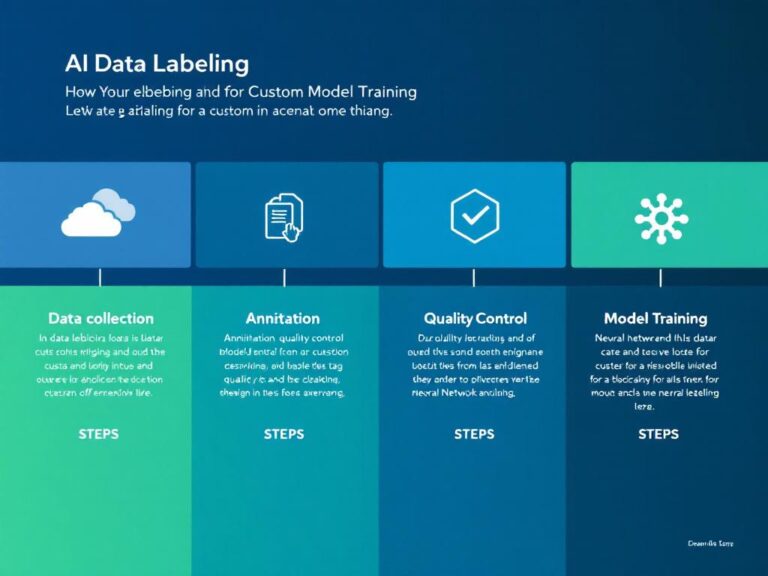
If you’re training custom AI models, you already know that labeled data is everything. I’ve worked with enough machine learning projects to say this with confidence: the quality of your training data will make or break your model’s performance. Garbage in, garbage out—it’s that simple. That’s why choosing the right data labeling service matters more than most people realize.
The market for AI data labeling has exploded recently, crossing $17 billion and growing fast. Every industry from healthcare to autonomous vehicles needs massive amounts of accurately labeled data, and doing it all in-house just isn’t realistic for most teams. I’ve tested and worked with numerous labeling platforms over the years, and in this guide, I’m breaking down what actually matters when you’re choosing a service for your custom models.
Why Data Labeling Quality Actually Matters
Here’s what I’ve learned from watching AI projects succeed and fail: your model is only as good as the data you feed it. Data labeling is the foundation of supervised machine learning, and cutting corners here will cost you later in poor model performance, biased predictions, or systems that completely fail in real-world conditions.
Professional labeling services combine human expertise with AI-assisted tools to catch errors that pure automation misses. This hybrid approach is crucial because context matters—especially in complex domains like medical imaging or legal document analysis where subtle distinctions determine accuracy.
The right labeling service ensures your datasets are clean, diverse, and representative of real-world conditions. This isn’t just about making your AI “smarter”—it’s about building systems that actually work when deployed, reducing bias, and meeting the accuracy requirements that production environments demand.
Most teams stick with professional services for good reasons:
- Accuracy through validation: By combining human reviewers with AI tools, professional services catch subtle errors that fully automated systems miss. Multiple annotators review complex cases, and consensus mechanisms ensure quality stays high even as volume scales.
- Scalability without quality loss: Whether you’re labeling a few thousand images or millions of video frames with 3D sensor data, established platforms maintain consistent quality at scale. They’ve built infrastructure specifically for handling volume spikes without compromising accuracy.
- Speed that matters: Between crowdsourcing networks and smart automation, professional services return labeled data in days instead of weeks. When you’re iterating on model architectures or racing toward a product launch, this turnaround time makes a real difference.
- Security and compliance: The reputable providers follow strict security protocols, ensuring your sensitive data stays protected. For regulated industries like healthcare or finance, this compliance infrastructure is non-negotiable and expensive to build in-house.
- Domain expertise on demand: Sometimes you need specialists—radiologists for medical scans, legal experts for contract analysis, or linguists for multilingual NLP. Professional services maintain networks of these experts that would be impractical to hire internally.
The Top AI Data Labeling Services Worth Considering
I’ve worked with or extensively researched all of these platforms. Each one brings different strengths, and the right choice depends heavily on your specific use case, budget, and technical requirements.
Labelbox: The Enterprise Powerhouse
Best for: Enterprise AI teams, complex multimodal datasets, and end-to-end model training workflows.
Labelbox has built something impressive—a true end-to-end platform that handles everything from annotation through model training integration. What sets them apart is how seamlessly they’ve integrated AI-assisted labeling with human-in-the-loop workflows. Their quality control tools are genuinely sophisticated, not just checkbox features.
The platform supports every data type you’d need: images, video, text, audio, 3D point clouds, and geospatial data. I’ve seen teams use Labelbox for everything from autonomous vehicle perception to medical imaging analysis, and it handles the complexity well.
The downside? There’s definitely a learning curve, and their pricing reflects their enterprise focus. Small teams or early-stage startups might find it overkill, but for organizations running serious AI operations, Labelbox delivers the robustness and features that justify the investment.
Key features: AI-assisted pre-labeling, human-in-the-loop validation, direct model training integration, robust consensus mechanisms, and comprehensive quality analytics.
Pricing approach: Custom enterprise pricing that scales with usage. They’re upfront that this isn’t a budget option, but for the right use case, the ROI is there.
Scale AI: Speed and Volume at Scale
Best for: High-volume projects, autonomous vehicle development, and generative AI training datasets.
Scale AI made its name in the autonomous vehicle space, and that pedigree shows in how they handle massive, complex labeling projects. They’re particularly strong with sensor fusion data—combining camera, LiDAR, and radar inputs into coherent labeled datasets.
What I appreciate about Scale is their managed service approach. You don’t need to worry about recruiting annotators or managing workflows—they handle everything and deliver labeled data on schedule. Their AI-driven automation has gotten genuinely good at pre-labeling, which speeds up the overall process significantly.
The fast turnaround times are real. I’ve seen teams get labeled data back in days when comparable projects elsewhere took weeks. For companies where time-to-market matters, this speed advantage can be decisive.
The main criticism I hear is around pricing transparency for smaller projects. They’re clearly optimized for enterprise deals, and getting clear pricing for pilot projects can require some back-and-forth. But once you’re working with them, the execution is solid.
Supported data types: Images, video, text, LiDAR, radar, and comprehensive sensor fusion for autonomous systems.
Pricing model: Pay-as-you-go for smaller projects, with custom enterprise contracts for larger commitments.
Appen: The Multilingual Specialist
Best for: Global teams, multilingual datasets, and text/audio annotation at scale.
Appen brings something unique to the table: genuinely global coverage with annotators speaking hundreds of languages. If you’re building NLP models that need to work across markets, or training speech recognition for multiple languages, Appen’s network is hard to beat.
They’ve built their reputation on crowdsourced annotation, but they’ve evolved to include expert annotators for specialized domains. Their quality assurance processes have matured significantly—they use consensus labeling, gold standard test sets, and continuous monitoring to maintain accuracy.
The platform handles text and audio particularly well, with strong capabilities for sentiment analysis, intent classification, and entity recognition. Video and image annotation are also supported, though that’s not where they shine brightest.
One thing to know: highly technical or niche projects can take longer with Appen than with more specialized providers. They excel at scale and breadth, but if you need deep domain expertise in something like medical imaging, other options might be better fits.
Language coverage: 235+ languages and dialects with native speakers.
Ethical practices: They’ve made real commitments to fair pay and ethical sourcing of annotators, which matters if your organization cares about responsible AI development.
iMerit: The Precision Expert
Best for: High-stakes AI applications, medical imaging, and safety-critical domains where errors are unacceptable.
iMerit occupies a specific niche: projects where accuracy matters more than cost. They specialize in complex, high-stakes domains like medical imaging, autonomous vehicles, and aerospace applications where labeling errors could have serious consequences.
What sets them apart is their expert-led approach. Instead of crowdsourcing, they employ trained specialists who understand the domain they’re labeling. A radiologist labels medical scans, not a general crowdworker following basic instructions. This expertise costs more, but for certain applications, it’s the only approach that works.
Their AI-assisted workflows are sophisticated, but they keep humans deeply involved in validation. The combination produces exceptionally accurate labels, which is exactly what you need when training models for FDA-approved medical devices or Level 4 autonomous driving systems.
The compliance infrastructure is robust—HIPAA, GDPR, and industry-specific regulations are baked into their processes. For regulated industries, this compliance framework alone can justify the premium pricing.
Specializations: Medical imaging (radiology, pathology, ophthalmology), LiDAR annotation for autonomous systems, geospatial intelligence, and pharmaceutical research.
Best suited for: Organizations with serious budgets where accuracy and compliance are non-negotiable.
SuperAnnotate: The Collaboration Champion
Best for: Collaborative teams, active learning workflows, and projects requiring real-time iteration.
SuperAnnotate has built a platform that feels modern in all the right ways. Real-time collaboration actually works—multiple team members can label simultaneously, leave comments, and review each other’s work without the clunky workflows that plague older platforms.
Their active learning integration is particularly impressive. The platform identifies samples where the model is uncertain and prioritizes those for human review. This means you spend annotator time where it matters most, dramatically improving efficiency as your model improves.
The platform supports images, video, text, audio, and 3D data. The annotation tools themselves are intuitive—there’s still a learning curve, but it’s gentler than most enterprise platforms. They offer a free trial, which is genuinely useful for evaluating fit before committing.
The limitation is customization for highly specialized use cases. SuperAnnotate works great for standard computer vision, NLP, and video tasks, but if you need deeply custom annotation interfaces or unusual data types, you might hit constraints.
Standout features: Real-time team collaboration, AI model integration for active learning, version control for datasets, and automated quality metrics.
Pricing: Tiered plans starting at reasonable levels for small teams, scaling to enterprise contracts for larger operations.
Amazon SageMaker Ground Truth: The AWS-Native Option
Best for: Teams already deep in the AWS ecosystem, automated labeling workflows, and projects requiring tight integration with other AWS services.
If you’re already building ML models on AWS, SageMaker Ground Truth deserves serious consideration. The integration with other AWS services is seamless—labeled data flows directly into S3, training jobs launch in SageMaker, and everything stays within your existing security perimeter.
Ground Truth’s automated labeling uses machine learning to label data automatically, then routes uncertain samples to human reviewers. As your model improves, the automation gets better, reducing costs over time. For large datasets, this can create significant savings versus purely manual labeling.
The platform supports standard labeling tasks well: image classification, object detection, semantic segmentation, text classification, and named entity recognition. They also support custom templates if you need something specific.
The workforce options are flexible: you can use Amazon’s Mechanical Turk for crowdsourced labeling, hire third-party vendors through AWS Marketplace, or use your own private workforce. This flexibility lets you match workforce type to task complexity.
The main limitation is that Ground Truth works best for AWS-centric teams. If your infrastructure is elsewhere or you need platform-agnostic solutions, other options might integrate more smoothly with your existing stack.
Best feature: Automated data labeling that learns and improves over time, reducing costs as your dataset grows.
Pricing model: Pay-per-task pricing with significant discounts when using automated labeling.
V7: The Computer Vision Specialist
Best for: Computer vision projects, medical imaging, and teams needing advanced auto-annotation.
V7 has carved out a niche in computer vision, particularly for complex annotation tasks like instance segmentation, polygon annotation, and 3D cuboid labeling. Their auto-annotation AI is genuinely impressive—it can handle a significant portion of labeling work automatically, with human reviewers focusing on edge cases and quality control.
The platform’s interface is clean and modern, making it easy for annotators to work quickly without constant friction. Keyboard shortcuts, smart polygon tools, and AI-assisted boundary detection all contribute to faster annotation without sacrificing accuracy.
What stands out is their focus on medical imaging workflows. They’ve built specific tools for DICOM files, 3D medical scans, and pathology images. The platform handles medical image formats natively, which saves significant preprocessing time compared to general-purpose tools.
The collaboration features are solid—teams can work simultaneously, leave comments on specific annotations, and track changes through version control. For organizations where multiple specialists need to review complex imagery, this workflow support matters.
Key strength: Auto-annotation AI that actually works well, significantly reducing manual labeling time for computer vision projects.
Pricing: Starts with a free tier for small teams, scaling to enterprise plans for larger operations.
How to Choose the Right Data Labeling Service for Your Project
With this many options available, choosing the right platform requires thinking carefully about your specific needs. Here’s how I approach the decision when helping teams select labeling services.
Define Your Data Requirements First
Start by getting crystal clear on what you’re actually labeling. Are you working with images, video, text, audio, or some combination? How much data are we talking about—thousands of samples or millions? Does your project need specialized domain knowledge, like medical expertise or legal understanding?
These questions narrow your options significantly. If you’re labeling medical scans, iMerit or V7 make more sense than general-purpose platforms. For multilingual text data, Appen’s global annotator network becomes extremely valuable. Match your data characteristics to platform strengths.
Decide on Automation vs. Human Review
Automation speeds everything up and cuts costs, but it’s not always appropriate. Simple, repetitive tasks—like classifying common objects in images—can handle heavy automation. Complex, nuanced tasks—like sentiment analysis in customer service conversations—need more human judgment.
The best platforms offer hybrid approaches where AI handles straightforward cases and routes uncertain or complex samples to human reviewers. This balances speed and cost with the accuracy that matters for production models. Ask potential providers how they balance automation and human review for projects like yours.
Evaluate Quality Control Processes
Quality control separates good labeling services from mediocre ones. The best providers use multiple validation approaches: consensus labeling where multiple annotators review the same data, gold standard test sets that check annotator accuracy, and real-time quality dashboards that flag issues immediately.
Ask specific questions about quality processes. How do they handle disagreements between annotators? What’s their inter-annotator agreement threshold? How do they identify and remove low-quality annotators from projects? Vague answers here are red flags.
Check Integration and Scalability
Your labeling platform needs to fit into your existing ML pipeline smoothly. Check for API support, compatible export formats, and integration with tools you’re already using—TensorFlow, PyTorch, AWS SageMaker, or whatever your stack includes.
Scalability matters even if you’re starting small. Your pilot project might involve a few thousand samples, but production could require millions. Make sure the platform can scale without performance degradation or requiring you to completely restructure your workflow.
Understand Pricing and Contract Terms
Pricing models vary dramatically across providers. Some charge per task, others per annotator hour, and enterprise platforms often use custom contracts. Get quotes based on your actual expected volume, not just theoretical pricing.
Watch for hidden costs: setup fees, minimum commitments, charges for quality review, or premium pricing for rush turnaround. Flexible contracts matter too—avoid providers that lock you into rigid annual agreements when your project timeline might shift.
Verify Compliance and Security
For regulated industries, compliance isn’t optional. Healthcare projects need HIPAA compliance, European data requires GDPR adherence, and financial services have their own regulatory frameworks. Verify that providers have proper certifications and audit trails, not just claims of compliance.
Data security matters regardless of industry. Look for encryption in transit and at rest, strict access controls, regular security audits, and clear data handling policies. Ask where annotators work and how data moves through their systems. Geographic restrictions on data processing might matter for your use case.
Emerging Trends Shaping Data Labeling
The data labeling space keeps evolving. Understanding where things are headed helps you choose platforms positioned for the future, not just solving yesterday’s problems.
AI-Assisted Labeling Gets Smarter
AI tools now pre-label data with genuinely useful accuracy, reducing manual effort by 50-70% on appropriate tasks. Platforms like Labelbox and SuperAnnotate use active learning—where the AI identifies its own uncertainty and requests human review on those specific samples. This focuses expensive human time exactly where it matters most.
The key is that these systems learn from corrections. As human reviewers fix AI mistakes, the automation improves, creating a virtuous cycle where labeling gets faster and more accurate over time.
Ethical AI and Bias Reduction
AI bias has moved from academic concern to business risk, and leading labeling providers are responding. They’re investing in diverse annotator teams, building bias detection into workflows, and providing tools for checking dataset representativeness.
Ethical sourcing matters too. The best providers ensure fair wages for annotators, transparent working conditions, and opportunities for skill development. This isn’t just ethics—it’s quality control, since fairly treated annotators produce better work.
Multimodal and 3D Annotation
As AI models get more sophisticated, they need more complex data types. Demand for multimodal labeling—combining text, image, audio, and video—is surging. Platforms like Encord and Dataloop now support 3D point clouds, LiDAR data, and sensor fusion for autonomous systems.
This complexity requires specialized tools. Labeling a 3D point cloud isn’t like annotating a 2D image—it needs different interfaces, validation approaches, and annotator training. Providers building these capabilities now will have advantages as multimodal AI becomes standard.
Real-Time Collaboration and Version Control
Modern labeling platforms finally feel like modern software. Real-time collaboration lets teams work simultaneously without file conflicts. Version control tracks every change, making it possible to audit decisions and roll back errors. Comment threads allow discussion directly on annotations.
These features might sound basic, but they transform workflow efficiency for larger teams. Instead of emailing files or managing complex folder structures, everything lives in one system with proper access controls and audit trails.
Synthetic Data Generation
When real-world data is scarce, expensive, or privacy-sensitive, synthetic data offers alternatives. Providers are adding synthetic generation and augmentation capabilities to create training data for edge cases and rare scenarios.
This approach particularly helps safety-critical applications where dangerous scenarios can’t be captured easily in real data. Synthetic data lets you train models on accident scenarios, medical emergencies, or security threats without waiting for real examples.
Maximizing Your Data Labeling ROI
Getting good results from labeling services requires more than just picking the right platform. Here’s what actually moves the needle based on my experience.
- Start with a small pilot project: Test providers with a few thousand samples before committing to millions. This reveals workflow issues, quality problems, and hidden costs before they become expensive. Compare pilot results across 2-3 providers to make informed decisions.
- Use hybrid workflows strategically: Automation for straightforward tasks, human review for complex or ambiguous data. Don’t treat it as all-or-nothing—the right mix depends on your specific data and accuracy requirements. Monitor where automation works well and where it struggles.
- Track quality metrics obsessively: Measure inter-annotator agreement, error rates, and how labeled data affects model performance. These metrics reveal quality issues early when they’re fixable. Most teams don’t monitor closely enough and discover problems only after investing heavily.
- Ensure dataset diversity: Your training data needs to represent real-world variability, not just easy examples. Actively check for demographic balance, scenario coverage, and edge cases. Biased training data creates biased models, and fixing that post-deployment is painful and expensive.
- Plan for continuous labeling: AI models require ongoing updates as the world changes and you discover edge cases. Choose providers supporting iterative workflows and feedback loops rather than one-time labeling projects. The relationship should improve over time as they learn your requirements.
- Invest in clear labeling guidelines: Ambiguous instructions create inconsistent labels. Spend time upfront creating detailed guidelines with examples, edge case handling, and clear decision criteria. Good guidelines dramatically improve quality regardless of which platform you use.
- Review samples regularly: Don’t just wait for final delivery. Review samples throughout the labeling process to catch systematic errors early. A quick check after the first 1,000 labels can prevent wasting budget on 100,000 incorrect labels.
Common Questions About AI Data Labeling Services
What’s the difference between labeling tools and labeling services?
Labeling tools are software platforms you use to label data yourself—basically annotation interfaces with workflow features. You provide the annotators, manage quality control, and handle all project coordination. Services provide end-to-end solutions including trained annotators, quality assurance, and project management. Many providers offer both options.
Tools work well when you have internal resources and need control over every detail. Services make sense when you want to offload the operational burden and access specialized expertise you don’t have in-house.
How much does professional data labeling actually cost?
Costs vary wildly based on complexity, volume, and required expertise. Simple crowdsourced tasks might run $0.01-0.05 per item. Expert annotation for specialized domains—like radiology or legal review—can exceed $1.00 per item or even charge hourly rates around $50-150 for specialist time.
Volume discounts are standard. Labeling 1,000 images costs more per image than labeling 100,000. Enterprise contracts often include significant volume pricing that makes services much more affordable at scale than small pilot costs suggest.
Can I use open-source tools instead of commercial platforms?
Absolutely. Open-source options like Label Studio, CVAT, and Doccano work well for prototyping and small-scale projects. They’re free and customizable, which appeals to teams with strong engineering resources.
The tradeoff is that you handle setup, maintenance, hosting, security, and quality control yourself. For small research projects, this makes sense. For production datasets at scale, the hidden costs of managing everything in-house often exceed commercial platform fees.
How do I ensure labeled data isn’t biased?
Start by working with providers offering diverse annotator teams representing different demographics, geographies, and perspectives. Use bias detection tools that analyze dataset composition for representativeness. Regularly audit datasets for systematic patterns that might indicate bias.
Consult domain experts who understand potential bias sources in your specific application. Medical AI might have different bias concerns than hiring software or credit scoring models. The key is identifying what bias looks like for your use case, then actively checking for it.
Which industries benefit most from professional labeling?
Industries with high-stakes AI applications—healthcare, autonomous vehicles, finance, legal, and defense—benefit most from professional services. These sectors need precision, regulatory compliance, and audit trails that only specialized providers deliver reliably.
But honestly, any organization training custom models benefits from quality labeling. The question is whether your accuracy requirements and scale justify external services versus handling it internally. Most teams overestimate their ability to maintain quality at scale in-house.
Conclusion
Choosing the right AI data labeling service directly impacts your model’s performance, development timeline, and ultimate success in production. The platforms covered here—from enterprise solutions like Labelbox and Scale AI to specialized options like iMerit and V7—each bring distinct strengths suited to different use cases.
Focus on matching platform capabilities to your actual requirements: data types, volume, complexity, domain expertise needed, and budget constraints. Don’t just pick the biggest name or lowest price—choose the provider whose strengths align with what your project actually needs to succeed.
Quality data labeling isn’t where you cut corners. The time and money invested in proper labeling pays back many times over through better model performance, faster deployment, and fewer costly fixes after launch. Professional services justify their cost by delivering consistent quality at scale, which most teams simply can’t match internally.
Start small with pilot projects to evaluate providers before making large commitments. Track quality metrics obsessively. Plan for continuous labeling as your models evolve. And remember that the best labeling service is the one that helps you build AI systems that actually work in the real world, not just in development environments.