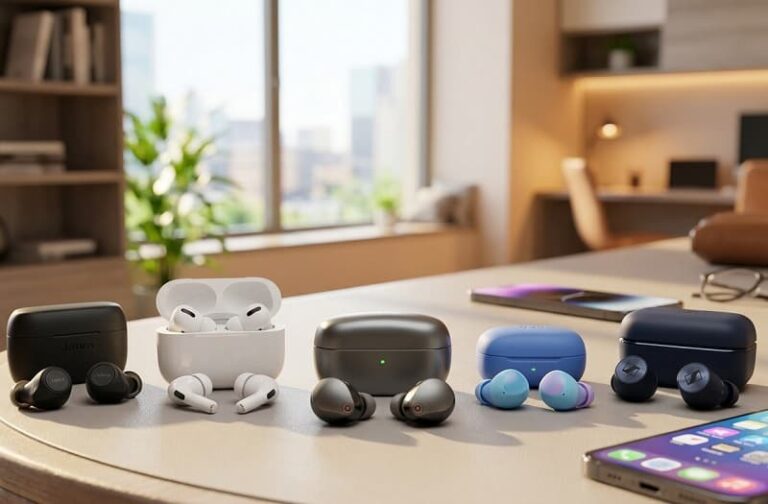
Wireless earbuds have reached a level of maturity where even mid-range options deliver genuinely impressive sound quality, active noise cancellation, and all-day battery life. The challenge is no longer finding a decent pair — it is identifying which pair is the right fit for a specific use case, budget, and device ecosystem. This guide cuts through the noise with category-specific picks drawn from extensive comparative testing data, covering flagship models, budget standouts, and specialist options for Apple users, Android users, athletes, and remote workers.
The recommendations below are organized by use case rather than ranked in a simple top-ten format. That structure mirrors how the best earbuds actually work: no single pair is universally best for everyone, but the right pair for a given profile is usually clear once the priorities are understood.
What Makes a Great Pair of Wireless Earbuds
Sound quality, active noise cancellation performance, fit and comfort, battery life, and device compatibility are the five factors that separate great wireless earbuds from merely acceptable ones. Sound quality is the foundation — it encompasses tonal balance, detail retrieval, soundstage width, and low-frequency extension. Active noise cancellation quality varies enormously between price tiers; the best flagship earbuds can block up to 90% of external noise across a wide frequency range, while budget options typically manage 60 to 70%.
Fit is underappreciated but critically important. An earbud that does not seal properly in the ear canal will sound thin and flat regardless of its driver quality, and its ANC performance will be compromised by the passive isolation deficit. Battery life targets of 8 hours per charge and 24 to 30 hours total with the case cover most daily use patterns. Anything below 6 hours per charge becomes inconvenient for all-day use.
Codec support determines the ceiling of audio quality on compatible devices. LDAC and aptX Lossless deliver significantly higher audio resolution than the standard AAC or SBC codecs — but only on Android devices. iPhones are limited to AAC regardless of the earbuds’ codec support, which is an important consideration when evaluating spec sheets. Multipoint Bluetooth, which allows simultaneous connection to two or more devices, has become an expected feature at mid-range and premium price points.
Best Overall: Sony WF-1000XM6
The Sony WF-1000XM6 represent Sony’s most capable wireless earbuds to date, improving on the already-excellent WF-1000XM5 across ANC performance, sound quality, transparency mode, and microphone quality. They launched in February 2026 and have quickly taken the top spot in most independent testing comparisons for Android users and general consumers who are not embedded in Apple’s ecosystem.
ANC performance on the XM6 achieves an average 88% noise reduction across all measured frequencies, measurably better than the XM5 and comparable to the best-in-class performers at this price range. The eight-microphone array — up from six on the XM5 — provides more data for the noise cancellation processor, with particularly notable improvement in the 100Hz and 2kHz ranges that cover the most common environmental noise sources: traffic, HVAC systems, and office background noise. Transparency mode has also been improved, producing a more natural sound when letting in ambient audio — essential for urban commuting and pedestrian safety.
Sound quality is tuned with more upper midrange presence than the XM5, making vocals and strings more immediate and detailed. A full 10-band EQ in the Sony Headphones Connect app allows the signature to be adjusted to taste. Battery life reaches approximately 9 hours and 40 minutes in independent testing with ANC on, exceeding Sony’s stated 8-hour figure. The case supports wireless charging. At approximately $330, the XM6 sits at the upper end of the premium tier but delivers performance that justifies the price for users who prioritize ANC and all-around versatility.
Best for Apple Users: Apple AirPods Pro 3
For anyone using an iPhone as their primary device, the AirPods Pro 3 are the clear recommendation. Apple’s deep hardware-software integration produces features that no third-party earbud can replicate on iOS: real-time language translation, heart-rate monitoring during workouts, clinical-grade hearing aid functionality for mild to moderate hearing loss, Personalized Spatial Audio with head tracking, and seamless one-tap pairing across all Apple devices signed into the same iCloud account.
ANC performance on the AirPods Pro 3 is the highest measured of any wireless earbuds tested by SoundGuys as of early 2026, blocking an average of 90% of external noise — marginally ahead of the Sony XM6’s 88%. The redesigned ear tips provide a secure fit across a broader range of ear shapes than the previous generation. Battery life sits at approximately 8 hours and 42 minutes with ANC on, with the MagSafe charging case adding additional charges for a total of approximately 30 hours. The charging case supports wireless charging including Apple Watch chargers and Qi pads.
Sound quality is balanced and detailed without over-emphasizing bass — a tuning choice that rewards critical listening and handles diverse music genres well. Adaptive EQ automatically adjusts the frequency response to the fit of the ear tips in real time. Call quality is excellent, with the microphone array effectively isolating voice from background noise. At $249, they are not cheap, but for iPhone users, the ecosystem advantages make them the most capable option regardless of price.
Best for Android: Technics EAH-AZ100
The Technics EAH-AZ100 launched in early 2025 and spent much of the year as the top-rated wireless earbuds for Android users across major review publications. The Sony WF-1000XM6 has since challenged that position on ANC performance and transparency mode quality, but the Technics retain advantages in battery life, sound quality at stock tuning, and multipoint connectivity depth.
Battery life is the EAH-AZ100’s most distinctive specification: 10 hours and 40 minutes on a single charge with ANC enabled, with a total of 28 hours including the case. That extends meaningfully beyond the 8 to 9 hours typical of flagship competitors. The Technics also support three-way multipoint Bluetooth — simultaneous connection to three devices rather than the industry-standard two — which is valuable for users who regularly switch between a laptop, phone, and tablet. LDAC and LC3 codec support delivers high-resolution audio on compatible Android devices.
Sound quality at stock tuning is considered superior to the XM6 by most audiophile reviewers, with a more natural tonal balance and better imaging. ANC performance, while strong, trails the Sony WF-1000XM6 slightly in objective measurements, particularly in the upper frequency range. The EAH-AZ100 has also seen price reductions since launch and is frequently available below its original $299 retail price, making it a strong value proposition against the newer Sony flagship.
Best Noise Cancellation: Bose QuietComfort Ultra Earbuds (2nd Gen)
Bose built its reputation on noise cancelling performance, and the second-generation QuietComfort Ultra Earbuds continue that tradition with ANC that rivals the Sony XM6 in overall effectiveness. The stability bands that tuck into the upper portion of the inner ear distinguish the Bose design from traditional ear tip-only retention systems, producing a secure and comfortable fit that many users — particularly those with ears that do not seal well with standard earbuds — find more reliable than the competition.
Sound quality leans toward enhanced bass and treble with a recessed midrange, a tuning that works well for bass-heavy music genres but can sound colored on acoustic and vocal-focused recordings. The three-band EQ in the Bose Music app offers limited adjustment range compared to Sony’s 10-band option. Battery life sits at 6 hours per charge — shorter than most competitors at this price — with the wireless charging case providing additional capacity for a total of approximately 24 hours. At approximately $279 during frequent sales from its original $299 price, the QuietComfort Ultra Earbuds remain a top recommendation for anyone who prioritizes noise cancellation and wearing comfort over absolute sound fidelity or battery longevity.
Best Mid-Range: Samsung Galaxy Buds 4 Pro
The Samsung Galaxy Buds 4 Pro are the strongest option for users within the Samsung or broader Android ecosystem who want flagship-tier performance without paying Sony or Bose prices. Integration with Samsung Galaxy phones unlocks features including 360 Audio with head tracking, Seamless device switching across Galaxy devices, and automatic detection of Galaxy AI features including real-time translation similar to what Apple offers AirPods Pro users on iPhone.
ANC performance is competitive with the Sony XM6 in most frequency ranges, with the notable exception of very high-frequency sounds where the Sony’s eartip design provides a slight passive isolation advantage. Sound quality is balanced and detailed, with a slight bass emphasis at stock settings that can be adjusted through Samsung’s graphic EQ. Battery life reaches approximately 8 hours with ANC on, with 24 hours total including the case. The earbuds carry an IPX7 water resistance rating — higher than most competitors — making them more capable as workout and outdoor earbuds than the Sony or Bose flagship options.
Best Budget Overall: EarFun Air Pro 4+
The EarFun Air Pro 4+ delivers a specification sheet that would have been considered flagship-tier two years ago at a price that typically falls between $69 and $80. Bluetooth 6.0, aptX Lossless codec support, LDAC, and Auracast compatibility — features absent from many earbuds costing twice as much — are all present. A 10-band EQ with a personalized hearing profile test in the companion app, multipoint connectivity, and a low-latency game mode round out the feature set.
ANC performance is good for the price range, achieving approximately 80% noise reduction in independent testing — adequate for commuting and open-plan office environments, though noticeably behind flagship options in quieter environments. Battery life reaches approximately 6 hours with ANC enabled, with 54 hours total including the case. Sound quality is tuned with a neutral-bright character that makes vocals clear and detailed. The EarFun Air Pro 4+ represents the strongest single value proposition in the wireless earbuds market for users unwilling to spend over $100.
Best Budget ANC: CMF Buds Pro 2
The CMF Buds Pro 2, from Nothing’s sub-brand CMF, delivers active noise cancellation performance that objectively outperforms many earbuds at three times its price. The dual-driver configuration — combining a balanced armature driver for high frequencies with a dynamic driver for bass — produces sound quality that punches well above the $59 to $69 typical retail price. Adaptive ANC with manual intensity controls, wind noise reduction, and a transparency mode are all included.
Total battery life reaches 61 hours including the case — exceptional at any price point and particularly remarkable at this level. The companion Nothing X app provides EQ customization and ANC mode management. IPX55 dust and water resistance makes the buds suitable for workouts and outdoor use in light rain. For users on a tight budget who want functional noise cancellation and high-quality sound, the CMF Buds Pro 2 is the most efficient use of money currently available in the category.
Best for Running and Workouts: Beats Powerbeats Pro 2
The Powerbeats Pro 2 are purpose-built for athletic use in a way that most standard wireless earbuds are not. The over-ear hook design locks the earbuds in place during vigorous movement, producing a fit stability that in-ear designs cannot match for high-intensity activity. IPX4 water resistance handles heavy sweat and rain. The earbuds are compatible with Apple’s H2 chip, enabling fast pairing, hands-free Siri, and integration with Apple Fitness+ for users in the Apple ecosystem, while remaining fully functional with Android devices via standard Bluetooth.
Sound quality is strong for a sport earbud, with enough bass presence to provide motivation during running without the sound becoming fatiguing. Battery life hits approximately 10 hours on a single charge, with the case adding additional capacity for approximately 40 hours total. At $249, the Powerbeats Pro 2 are not budget options, but they are the most reliable choice currently available for serious athletes who need earbuds that stay in place regardless of activity intensity.
Best for Calls and Remote Work: Jabra Evolve2 Buds
For remote workers and professionals who spend significant time on calls, the Jabra Evolve2 Buds prioritize microphone quality and call clarity above pure music listening performance. Jabra’s professional audio heritage is evident in the six-microphone array and the WindSeal filter technology, which isolates voice from background wind and environmental noise more effectively than consumer-grade microphone designs. Microsoft Teams and Google Meet certification ensures compatibility with the dominant enterprise communication platforms.
The earbuds include a dedicated charging pad for desk use, reducing the friction of keeping them charged during long work-from-home sessions. ANC performance is effective for office environments, and the extended use comfort — optimized for hours of wear rather than occasional listening sessions — sets them apart from consumer earbuds that become uncomfortable after two or three hours. Battery life reaches approximately 6 hours on a single charge. At approximately $249, they are primarily a professional tool rather than a general-purpose recommendation, but for the remote work use case, they outperform every consumer option at a similar price.
Best Open-Ear Option: Shokz OpenFit Air
Open-ear earbuds that sit outside the ear canal rather than sealing inside it have grown significantly in popularity, and the Shokz OpenFit Air is the strongest current option in that category. The design rests in the concha of the ear — the outer bowl — without any insertion into the ear canal, allowing users to hear ambient sound naturally while listening to music or taking calls. This makes them particularly suitable for outdoor activities where awareness of surroundings is important, and for users who find in-ear designs uncomfortable for extended wear.
Sound quality from an open-ear design is inherently limited in bass response compared to sealed in-ear designs, but the OpenFit Air delivers more low-frequency presence than earlier generations of open-ear products. Battery life reaches approximately 8 hours on a single charge, with 28 hours total including the charging case. At $119, the Shokz OpenFit Air represents the best current balance of audio quality and situational awareness for users who prefer or require an open-ear listening experience.
How to Choose the Right Wireless Earbuds
Ecosystem compatibility is the first decision point. iPhone users who want the full feature set of their device should consider the AirPods Pro 3 first. Android users, particularly those with Samsung devices, have more freedom to choose based on sound quality and features rather than ecosystem lock-in. The Technics EAH-AZ100 and Sony WF-1000XM6 are both strong general-purpose options for Android users, with the Technics leading on battery life and sound neutrality and the Sony leading on ANC performance and transparency mode quality.
Budget alignment matters as much as feature comparison. Spending $80 on the EarFun Air Pro 4+ provides genuinely impressive performance. Spending $250 on the Sony XM6 or AirPods Pro 3 provides measurably better ANC, superior microphone quality, and access to premium ecosystem features — but the gap is smaller than it was three years ago. The $100 to $200 range currently represents the worst value, offering performance only marginally better than the best sub-$100 options at prices approaching flagship territory.
Fit should be tested before committing. Most retailers offer return windows sufficient for evaluating fit over several days of real-world use. An earbud that fits perfectly and seals reliably will consistently outperform a technically superior product that does not fit well. The relationship between fit quality and both sound quality and ANC effectiveness is direct and significant. When evaluating wearables of any kind, comfort over long wear sessions is a criterion that specification sheets cannot convey.
Frequently Asked Questions
What is the best brand of wireless earbuds?
Sony, Apple, and Bose consistently lead independent testing across the categories of sound quality, ANC performance, and build quality. Sony leads for Android users seeking the best overall package. Apple leads for iPhone users due to ecosystem integration advantages that no third-party product can replicate. Bose leads for users who prioritize wearing comfort and noise cancellation above all else. For budget options, EarFun, CMF by Nothing, and Anker Soundcore consistently deliver the best performance-to-price ratios in the market.
What are the number one wireless earbuds right now?
As of early 2026, the Sony WF-1000XM6 holds the top overall position in most independent tests for general consumers. The Apple AirPods Pro 3 leads specifically for iPhone users due to ecosystem-exclusive features including heart rate monitoring and clinical hearing aid functionality. The Technics EAH-AZ100 remains the top recommendation from several major publications for Android users who prioritize battery life and sound quality over absolute ANC performance.
Which earbuds have the best battery life?
The Technics EAH-AZ100 leads flagship earbuds with approximately 10 hours and 40 minutes per charge and 28 hours total with the case. In the budget segment, the CMF Buds Pro 2 provides 61 hours total battery life including the case — exceptional at any price point. The Jabra Evolve2 Buds and Shokz OpenFit Air also deliver approximately 8 to 10 hours per charge, making them viable for full workday use without recharging.
What is the best alternative to AirPods for iPhone?
For iPhone users who want an alternative to AirPods, the Sony WF-1000XM6 and Bose QuietComfort Ultra Earbuds offer superior ANC performance compared to the AirPods 4 standard model. The Technics EAH-AZ100 provides excellent sound quality and longer battery life. The trade-off for all non-Apple options on iPhone is the loss of H2 chip features, Personalized Spatial Audio, and seamless iCloud pairing — features that remain exclusive to AirPods regardless of the third-party product’s overall quality.
Which Bluetooth earbuds are best for working out?
The Beats Powerbeats Pro 2 lead for serious athletes due to the over-ear hook design that prevents movement-related displacement. The Samsung Galaxy Buds 4 Pro offer IPX7 water resistance — higher than most flagship earbuds — alongside strong sound quality and ANC. For open-ear exercise use, the Shokz OpenFit Air provides ambient awareness without the safety concerns of sealed in-ear designs during outdoor activity. Bluetooth codec performance also matters for gym use: lower-latency connections improve the experience when watching video content on gym equipment displays.
Conclusion
The wireless earbuds market in early 2026 is the most competitive it has ever been, with genuine performance available across every price tier from under $70 to over $300. The Sony WF-1000XM6 leads for general consumers seeking the best all-around package. The AirPods Pro 3 are the definitive choice for iPhone users. The Technics EAH-AZ100 remains the audiophile-leaning option for Android users who want exceptional sound quality and battery life. The EarFun Air Pro 4+ and CMF Buds Pro 2 deliver remarkable value under $100.
Identifying the right pair requires matching the product to the specific use case, device ecosystem, and budget rather than defaulting to a single “best” recommendation. The category-based framework in this guide provides that alignment — and any pair selected from this list will outperform a default or randomly-chosen option in the areas that matter most to its intended user.

Full-stack developer at Scylla Technologies (USA), working remotely from Bangladesh. Adobe Certified Magento Developer.