

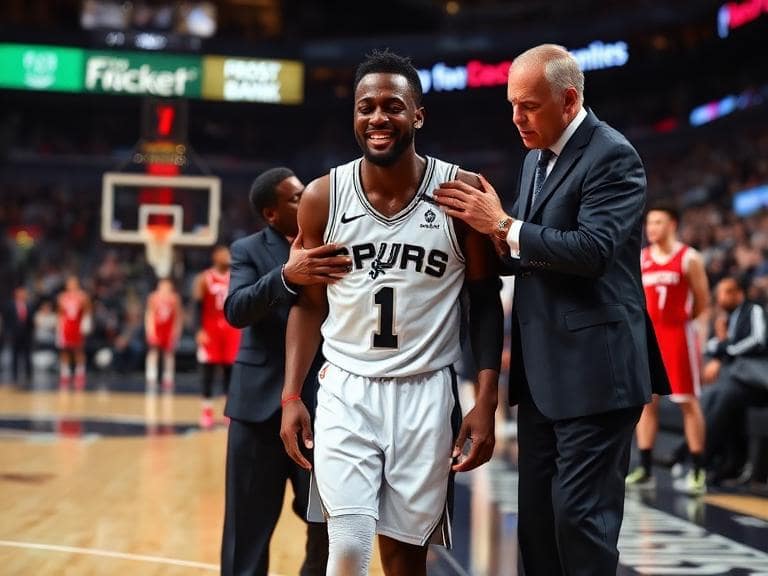
Victor Wembanyama, the towering rookie sensation for the San Antonio Spurs, exited Monday night’s game against the Houston Rockets with an apparent leg injury, sending a wave of concern through the NBA and the fantasy basketball world. The incident occurred in the first quarter as Wembanyama landed awkwardly after contesting a shot. He was seen limping noticeably before being helped to the locker room by team staff and did not return for the remainder of the contest.
The immediate aftermath was filled with uncertainty. The Spurs organization, known for their cautious approach with player health, announced he would be evaluated further on Tuesday. Initial reports from the team suggested the issue was with his left ankle, a detail that would become the focal point of all subsequent updates and fan speculation across social media and sports forums.
This development is a significant blow to a Spurs team in the midst of a challenging season. Wembanyama is not just a player; he is the cornerstone of the franchise’s future and the most watched rookie in recent memory. His unique blend of size, skill, and defensive instinct has made him a nightly must-watch event, and his absence leaves a gaping hole on both ends of the floor. For a young team still developing its identity, losing its best player is a severe test of resilience.
From a broader NBA perspective, the injury raises questions about the toll of a grueling 82-game schedule on a 7-foot-4 frame still adapting to the professional game’s physicality. Wembanyama has been managed carefully with minutes restrictions and occasional rest, but the unpredictable nature of in-game contact is an ever-present risk. The league, which has heavily promoted his arrival, holds its breath alongside Spurs fans.
The Nature and Severity of the Ankle Injury
Following overnight evaluation and imaging, the San Antonio Spurs provided a crucial update on Tuesday afternoon. The team’s medical staff diagnosed Victor Wembanyama with a left ankle sprain. Crucially, the statement indicated that no structural damage was found, which was the best possible news given the concerning visual of his exit. The Spurs listed him as day-to-day, a term that, while vague, suggests the injury is not expected to be a long-term issue.
An ankle sprain, while common in basketball, can vary widely in severity. The “day-to-day” designation typically points toward a Grade 1 sprain, which involves mild stretching or microscopic tearing of the ligaments. Recovery for such an injury can range from a few days to a couple of weeks, depending on the individual’s pain tolerance, healing response, and the specific ligaments involved. The Spurs’ notoriously conservative medical team, led by head team physician Dr. David Schmidt, is expected to follow a meticulous rehabilitation protocol.
Rehabilitation for a sprained ankle focuses on reducing swelling, restoring range of motion, and rebuilding strength and proprioception—the body’s sense of its position in space—to prevent re-injury. The process typically involves:
- Immediate R.I.C.E. Protocol: Rest, Ice, Compression, and Elevation are the standard first steps to control inflammation and pain in the initial 48-72 hours post-injury.
- Physical Therapy: Once swelling subsides, controlled exercises begin. This includes ankle circles, alphabet tracing with the toes, and resistance band work to strengthen the surrounding muscles.
- Balance and Proprioception Training: This is critical for basketball players. Exercises like single-leg stands on unstable surfaces (e.g., a Bosu ball) retrain the nervous system to stabilize the joint dynamically.
- Gradual Return to Activity: The final phase involves progressing from light jogging and agility drills to full-contact practice, ensuring the ankle can withstand the cutting, jumping, and landing demands of an NBA game.
The Spurs’ history with managing injuries, particularly with star players like Tim Duncan and Kawhi Leonard in the past, suggests they will not rush Wembanyama back. His long-term health is unequivocally the priority over winning games in February.
Immediate Impact on the San Antonio Spurs
Wembanyama’s absence forces a significant recalibration for Head Coach Gregg Popovich and his staff. The rookie leads the team in points, rebounds, and blocks per game, embodying an irreplaceable two-way presence. Adjusting without him requires a collective effort and strategic shifts.
In the immediate game following his injury, the Spurs struggled to contain the Rockets’ offense and generate consistent scoring, highlighting his dual importance. Looking forward, the burden will fall on several players to elevate their roles:
- Devin Vassell and Keldon Johnson: As the team’s primary scoring wings, their offensive output and efficiency must increase. They will be asked to create more shots and carry a heavier playmaking load.
- Zach Collins: The starting center will see his minutes increase and will be the primary rim protector in Wembanyama’s stead. His ability to space the floor with his three-point shooting becomes even more valuable.
- Jeremy Sochan: The versatile forward may see more time in small-ball lineups and will need to contribute more as a rebounder and secondary defender.
- The Point Guard Committee: Tre Jones, Blake Wesley, and Malaki Branham will need to orchestrate the offense with greater precision to generate easier shots for their teammates in a lineup lacking its primary offensive threat.
The tactical approach will likely shift to a more perimeter-oriented, motion-heavy offense while relying on team defense rather than the singular deterrent Wembanyama provides at the rim. It presents a development opportunity for the Spurs’ young core to grow in responsibility, a silver lining in an otherwise disappointing situation.
Fantasy Basketball Fallout and Manager Strategy
For the millions engaged in fantasy basketball, an injury to a first-round draft pick like Victor Wembanyama is a league-altering event. Managers who invested a top pick in him are now facing a potentially lineup-crippling absence during a critical period of the fantasy season as playoffs approach. The immediate reaction requires calm and strategic action.
The first step is to place Wembanyama in an Injured Reserve (IR) slot if your league settings allow it, freeing up a roster spot. The “day-to-day” tag can be tricky, as he may not immediately qualify for IR in all leagues, so vigilance is required. The next step is identifying potential waiver wire additions who can temporarily offset his lost production. Targets should include players who see increased opportunity in San Antonio, as well as speculative adds from other teams.
Key waiver wire targets in the wake of this news include:
- Zach Collins (C, San Antonio Spurs): The most direct beneficiary. Collins will see a major minutes boost and increased usage as the primary big man. His points, rebounds, blocks, and three-pointers should all see an uptick, making him a must-add in all formats.
- Sandro Mamukelashvili (PF/C, San Antonio Spurs): “Mamu” is a deep-league target who could see backup center minutes. He offers decent scoring, rebounding, and occasional three-point shooting for managers in 14-team leagues or deeper.
- Tari Eason (SF/PF, Houston Rockets): While not on the Spurs, Eason is a classic “injury beneficiary” from the opposing team in the incident. A relentless energy player, he is returning from his own injury and could be widely available. He provides elite steals and rebounding from the forward position.
- Trending Performers: Always scan for players on hot streaks, like Simone Fontecchio (UTA) or Nick Richards (CHA), who may have been recently overlooked and can provide short-term value.
Managers should avoid panic-dropping Wembanyama. His top-20 per-game value when healthy is too significant to give up on for nothing. The prudent path is to stash him if possible, manage the short-term loss through the waiver wire, and anticipate a return to dominance later in the season.
Historical Context and Injury Prevention for Elite Big Men
Victor Wembanyama’s injury, while minor, fits into a broader historical narrative concerning exceptionally tall NBA players and injury management. The combination of extreme height, leverage, and the explosive demands of professional basketball creates unique biomechanical stresses. Teams have become increasingly sophisticated in managing these risks over the decades.
Historical examples like Yao Ming (7’6″) and Ralph Sampson (7’4″) serve as cautionary tales of foot and leg injuries derailing generational talents. In contrast, modern examples like Kristaps Porzingis (7’3″) and Joel Embiid (7’0″) illustrate how a combination of advanced load management, specialized training, and sometimes surgical intervention can lead to sustained All-Star careers despite early injury concerns. The Spurs are arguably the league’s foremost experts in this domain, having successfully managed Tim Duncan’s knees and Kawhi Leonard’s quadriceps through precise minute restrictions and scheduled rest.
For a player of Wembanyama’s profile, a comprehensive injury prevention strategy is multi-faceted:
- Load Management: This remains the cornerstone. Limiting back-to-backs, capping minute totals, and even sitting out certain games based on sports science data are now standard practice for franchise players.
- Strength and Conditioning: A focused program to strengthen the lower body—particularly the ankles, knees, and hips—is non-negotiable. Building robust muscles around the joints helps absorb impact and stabilize the skeleton.
- Movement Efficiency: Working with biomechanics specialists to optimize running, cutting, and landing patterns can reduce unnecessary strain. This includes teaching a “softer” landing technique to dissipate force.
- Nutrition and Recovery: Elite fueling and sleep protocols, along with modalities like cryotherapy and float tanks, enhance the body’s innate ability to repair itself from the wear and tear of games and practices.
The Spurs’ handling of this ankle sprain will be a textbook case of this philosophy in action. Every decision, from his first day of practice to his return game, will be data-informed and patient.
Long-Term Outlook and Return Timeline Projection
Given the confirmed diagnosis of a left ankle sprain with no structural damage, the long-term outlook for Victor Wembanyama remains overwhelmingly positive. This is a minor setback in what is projected to be a legendary career. The primary goal for the Spurs is to ensure he returns at 100% fitness, with no lingering issues that could affect his performance or make him susceptible to re-injury.
Based on typical recovery timelines for Grade 1 ankle sprains in the NBA and the Spurs’ conservative history, a reasonable projection would see Wembanyama miss approximately 7-14 days of game action. This could translate to anywhere from 3 to 7 missed games, depending on the team’s schedule and his response to treatment. His return will likely be preceded by a full practice session and a confirmed absence of any pain or swelling during basketball activities.
Upon his return, fans and fantasy managers can expect the Spurs to continue their careful management. His minutes may be slightly capped initially, and he might be held out of one game of a back-to-back set. However, his on-court impact should return swiftly. His game is not solely reliant on elite athleticism; his shooting touch, basketball IQ, and unparalleled length for shot-blocking are innate skills that will not diminish after a short hiatus.
In the grand narrative of his rookie season, this injury may ultimately be a footnote—a brief interruption in his march toward the Rookie of the Year award. It serves as a reminder of the physical realities of the NBA, but also of the advanced medical and performance infrastructure in place to support its stars. The “Wemby” show is on a brief intermission, not canceled.
Conclusion
The incident involving Victor Wembanyama’s ankle sprain underscores the fragile equilibrium between immense talent and physical vulnerability in professional sports. While the immediate sight was alarming, the subsequent news has been reassuring. The San Antonio Spurs, an organization with a deep institutional knowledge of player preservation, are now tasked with guiding their prized asset through a routine rehabilitation process. For the team, it is a challenge to adapt and grow in his absence. For the league and its fans, it is an anxious pause in witnessing a historic rookie campaign. For fantasy basketball managers, it is a test of roster management and patience. All evidence points toward a full and relatively swift recovery, allowing Wembanyama to resume his development and continue captivating the basketball world with his unique and transformative abilities on the court. The focus now shifts from concern to anticipation for his return, whenever the Spurs’ meticulous medical team deems it appropriate.

