Every month, millions of people stare at that Spotify upgrade prompt and wonder whether paying $11.99 changes anything meaningful — or whether the free tier is quietly good enough. The answer depends on how you actually listen, and the gap between these two tiers is both wider and more nuanced than Spotify’s own marketing lets on.
Spotify remains the world’s largest music streaming platform, with over 600 million active users and a catalog exceeding 100 million tracks. That scale means both tiers benefit from extraordinary depth. But the experience of navigating that catalog on Free versus Premium feels, at times, like using two entirely different products.
This comparison cuts through the promotional language to give you an honest, detailed look at what each plan delivers, where the real friction points lie, and which type of listener genuinely benefits from paying.
What Spotify Free Actually Gives You
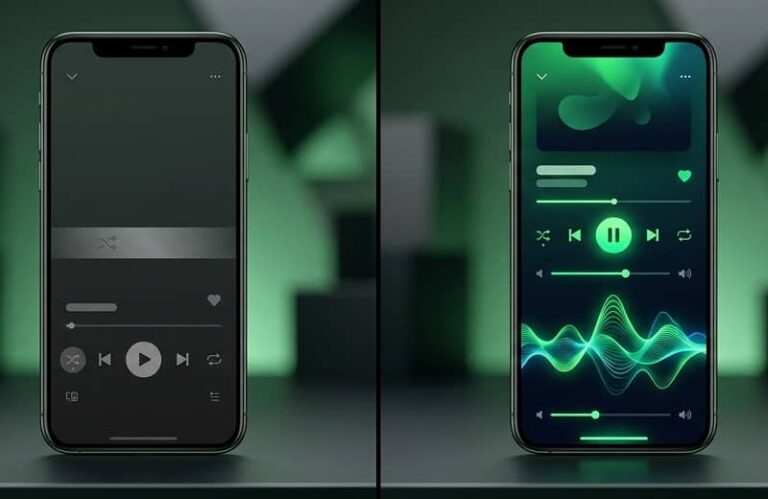
Spotify’s free tier is supported by advertising, and that shapes everything about how it functions. On mobile — where most people listen — Free users cannot play specific songs on demand. Instead, you’re locked into shuffle mode for artist and album pages, meaning the app decides the order. You can play any song directly from playlists, Daily Mixes, and Spotify’s curated content, but full on-demand playback for albums and artist discographies is reserved for Premium.
Ad interruptions arrive every few songs, typically 15 to 30 seconds in length, and you have no mechanism to skip them. Audio quality is capped at 128 kbps on mobile, which is listenable but noticeably compressed compared to higher-quality streams. Offline listening is unavailable entirely — every play requires an active internet connection.
On desktop and web, the restrictions ease considerably. Free users get full on-demand playback, the ability to choose specific tracks, and access to the full library without shuffle limitations. This asymmetry is intentional: Spotify’s conversion strategy targets mobile-first users, where the Free experience is designed to feel limited enough to motivate an upgrade.
One area where Free genuinely holds up is discovery. Spotify’s algorithmic playlists — Discover Weekly, Daily Mixes, Release Radar — are available at no cost, and they’re among the best music recommendation engines in the industry. If exploration rather than control is your primary use case, Free delivers real value.
What Premium Unlocks
Spotify Premium removes every meaningful restriction from the Free tier and adds capabilities that change the listening experience fundamentally. On-demand playback becomes available everywhere, including mobile, so you can queue exactly what you want, when you want it, without shuffle interference.
Audio quality increases to 320 kbps for standard Premium subscribers, which represents a significant improvement over Free’s 128 kbps mobile ceiling. For most listeners on typical consumer headphones, this difference is audible primarily in the high frequencies — cymbal detail, vocal air, and spatial separation improve noticeably. Users with better audio equipment will hear the gap more clearly.
Offline downloads are available for up to 10,000 songs across five devices. This is genuinely transformative for commuters, travelers, or anyone in areas with unreliable connectivity. The ability to front-load a long flight or road trip with downloaded playlists, podcasts, and albums represents one of the clearest practical advantages of Premium.
Skip limits disappear entirely. On Free mobile, you’re allowed six skips per hour per station, which forces you to sit through tracks you’d rather not hear. Premium removes that ceiling completely. Combined with no advertising, the listening experience becomes fluid in a way that Free simply cannot replicate on mobile.
Pricing Tiers and Plan Options
Spotify structures its Premium offering across several tiers designed to serve different household sizes and demographics. Individual Premium costs $11.99 per month in the United States and covers a single account with full Premium features. This is the standard plan most single users consider when weighing the upgrade.
The Duo plan, priced at $16.99 per month, covers two accounts and is designed for couples or roommates sharing a residence. Each account is fully independent with its own recommendations, playlists, and listening history. Premium Student offers the same individual benefits at $5.99 per month for verified students at eligible institutions — this is genuinely good value and available through Spotify’s SheerID verification system.
The Family plan at $19.99 per month supports up to six individual accounts under one subscription. Each member gets their own personalized experience, and a Family Mix playlist auto-generates based on everyone’s combined listening. Spotify verifies that all members share a primary residence.
Spotify regularly offers promotional introductory pricing — typically one to three months free for new Premium subscribers. These promotions rotate through the year and are often available through partnerships with mobile carriers, credit card companies, and device manufacturers. Checking through your existing service providers before subscribing directly to Spotify can yield significant savings.
Audio Quality: A Closer Look
The quality difference between 128 kbps and 320 kbps matters more than it might sound in a spec sheet. Spotify uses the Ogg Vorbis codec, which is efficient enough that 128 kbps produces acceptable results for casual listening through phone speakers or low-end earbuds. But on any system capable of resolving detail — quality headphones, home speakers, a car stereo with decent amplification — the compression artifacts become apparent.
High hats and cymbals lose shimmer. Dense mixes in orchestral recordings or heavily produced pop can sound slightly congested. Quiet passages in acoustic recordings sometimes feel digitally smoothed rather than naturally present. None of this is dramatic, but for listeners who pay attention to audio quality, it accumulates.
Premium’s 320 kbps ceiling is competitive with Tidal’s standard tier and Apple Music’s AAC encoding at equivalent bitrates. It falls short of lossless formats — Tidal HiFi, Apple Music Lossless, and Amazon Music HD offer CD-quality or above — but for the majority of listeners, 320 kbps represents the point where improvements become negligible on typical consumer equipment.
Spotify has been developing its own lossless tier, internally referenced as “Spotify HiFi,” for several years. As of this writing, lossless audio has not been released as a standalone offering in any market. Premium subscribers seeking lossless audio will need to look at competing platforms in the meantime.
The Mobile Experience Gap
The sharpest divide between Free and Premium is felt on smartphones, where most streaming happens. Spotify’s mobile app on the Free tier enforces shuffle play for albums and artist radio, limits skips, and inserts unskippable ads. These aren’t minor annoyances — they fundamentally alter how you interact with music.
Listeners who prefer to experience albums as complete, sequentially ordered works find Free on mobile genuinely frustrating. The shuffle mandate breaks narrative albums, concept records, and any listening experience that depends on track order. For playlist-first listeners who consume music more casually, this matters less — but it’s a real constraint for anyone with specific listening habits.
Background play, which allows music to continue when you switch apps or lock your phone, is available on both Free and Premium. Spotify removed the restriction on background play from Free several years ago, which eliminated one of the tier’s most significant complaints. This is now a non-issue in the comparison.
The ad experience on Free mobile varies in intrusiveness. Audio ads interrupt the flow; occasional video ads appear when the app is open and stationary. Users report ad frequency increasing over time, and some markets see more aggressive insertion rates than others. Spotify’s ad-supported revenue model depends on this friction — it’s not a bug in the Free tier, it’s the product design.
Podcasts and Audiobooks on Each Plan
Spotify has invested heavily in becoming a destination for podcasts and, more recently, audiobooks. The podcast library is available in full on both Free and Premium with no restrictions — this is one area where Free users receive exactly the same access as paying subscribers. Discovery features, show alerts, and episode downloads for podcasts are also available across both tiers.
Audiobooks represent a meaningful Premium differentiator that many users overlook. Premium Individual subscribers in eligible markets receive 15 hours of audiobook listening time per month at no additional cost, drawing from a catalog of over 200,000 titles. Additional hours can be purchased if needed. Free users cannot access audiobooks through Spotify.
The audiobook benefit alone provides measurable financial value. Audible’s individual plan costs $14.95 per month for one credit, while Spotify’s 15-hour monthly inclusion covers most full-length audiobooks within the Premium subscription price. For readers who consume one or two audiobooks per month, this shifts the value calculation considerably.
Who Should Stay on Free
Free makes sense for a specific profile of listener: someone who primarily streams on desktop or laptop, uses Spotify mainly for background music rather than focused listening, doesn’t travel frequently or commute in areas without reliable data, and isn’t bothered by occasional audio advertising. The desktop experience on Free is genuinely capable, and the algorithmic discovery tools are among the best available at any price point.
Budget-constrained listeners who already pay for other streaming services may find Free sufficient as a supplementary platform — using Spotify Free for discovery and exploring new music, then listening on a higher-quality platform for serious sessions. This hybrid approach isn’t elegant, but it’s economically rational for people managing multiple subscription costs.
Who Should Upgrade to Premium
Premium makes financial and practical sense for mobile-first listeners who want full control over playback. If you primarily use your phone as your music player and you care about song order, skip frequency, and uninterrupted listening, the $11.99 monthly cost is well justified. The mobile experience difference is stark enough that Free users who try Premium routinely describe it as a revelation rather than a marginal improvement.
Commuters and travelers benefit from offline downloads in a way that’s difficult to overstate. Downloading playlists and albums for a flight or subway commute with patchy signal eliminates a persistent frustration with streaming dependency. For anyone who regularly loses connectivity during their listening hours, this feature alone often justifies the subscription.
Audiophiles and quality-focused listeners will benefit from the jump to 320 kbps, especially on better headphones and speakers. And the audiobook inclusion represents genuine standalone value for regular readers who would otherwise pay for a separate audiobook service.
Students should evaluate the $5.99 Student plan specifically. At half the individual price with identical features, it’s one of the better-value entertainment subscriptions available to eligible listeners and worth checking eligibility before defaulting to either Free or full-price Premium.
Frequently Asked Questions
Can you use Spotify Free on multiple devices?
Yes. Spotify Free can be used on multiple devices, but only one device can stream at a time. If you start playing on your phone and then open Spotify on your laptop, one will pause the other. Premium Individual has the same single-stream limitation, while Premium Duo and Family plans support simultaneous streams on separate accounts.
Does Spotify Free include podcasts?
Fully and without restriction. The entire podcast catalog, including exclusive Spotify originals and episodes from major networks, is available to Free users. There’s no premium gating on podcast content, and you can download podcast episodes for offline listening on Free — a notable exception to the general no-download rule that applies to music.
What happens to downloaded songs if you cancel Premium?
Downloaded content becomes inaccessible immediately when Premium lapses. The files remain on the device temporarily but are locked and unplayable. If you resubscribe, downloads become available again without needing to re-download. This is standard practice across all major streaming platforms.
Is there a way to remove ads on Spotify Free without paying?
There is no legitimate method to remove ads on the Free tier without upgrading. Third-party ad blockers and modified app versions exist but violate Spotify’s terms of service and risk permanent account bans. Spotify actively detects and acts against accounts using unofficial clients.
How does Premium Student verification work?
Spotify uses SheerID, a third-party verification service, to confirm enrollment at an eligible institution. You provide your school name and email address, and SheerID verifies current enrollment against institutional records. Verification is typically instant for institutions in its database. Students must re-verify annually to maintain the discounted rate.
Is Spotify Premium worth it compared to Apple Music or Tidal?
Spotify Premium is priced comparably to Apple Music’s individual tier ($10.99/month) and significantly below Tidal’s HiFi plan ($19.99/month). Apple Music offers lossless audio and spatial audio at its standard price, which is a meaningful quality advantage over Spotify’s 320 kbps ceiling. Tidal provides the most extensive high-resolution catalog. Spotify’s advantage is its recommendation algorithm and podcast/audiobook integration, which remain industry-leading. The best choice depends on whether audio quality or content ecosystem matters more to you.
Can you share a Premium Individual plan with someone else?
Premium Individual is designed for one person. Sharing login credentials violates Spotify’s terms of service, and the platform’s detection systems have become more sophisticated at identifying account sharing across different locations. For two people living together, the Duo plan at $16.99 is the official solution and only costs $5 more than individual while providing two fully independent accounts.
The Bottom Line on Spotify Free vs Premium
The gap between Spotify Free and Premium is not cosmetic. On mobile — the dominant listening environment for most users — the difference in control, audio quality, and experience is substantial. Free is a functional product for desktop listeners and for people whose primary use case is algorithmic discovery. For anyone who listens seriously on a phone and cares about what plays and when, Free creates friction that compounds across every listening session.
At $11.99 per month for individuals, Premium sits at a reasonable price point for daily use entertainment. The Student plan at $5.99 is exceptional value. The Family plan at $19.99 for six accounts works out to roughly $3.33 per person — difficult to argue against for households where multiple people actively use the platform. Audiobook access adds a benefit that meaningfully exceeds the standalone cost for regular readers.
The honest answer to whether you should pay is this: try the Premium trial first. Spotify’s free introductory offers are generous, and a month of full access will tell you more about whether the upgrade fits your habits than any comparison article can. Most listeners who spend significant time in the app find the transition difficult to reverse.