

Hundreds of Shahed-136 loitering munitions streaked across Gulf skies in the opening days of Iran’s latest military escalation, striking U.S. bases in Kuwait and Bahrain, targeting oil infrastructure in the United Arab Emirates, and killing at least a dozen American service members in what defense officials are calling the most sustained Iranian drone campaign in history. The attacks, launched in retaliation for U.S. and Israeli strikes that reportedly killed senior Islamic Revolutionary Guard Corps commanders, have forced a global reckoning with a weapon that costs as little as $20,000 to build yet demands million-dollar interceptors to stop.
The Shahed-136 is no longer a regional footnote. From the energy grids of Ukraine to the military logistics hubs of the Arabian Gulf, Iran’s signature drone has become the defining munition of 21st-century asymmetric warfare — cheap enough to produce in mass, dangerous enough to reshape strategic calculations for the world’s most advanced militaries.
What Makes the Shahed-136 So Difficult to Stop
The drone’s lethality is rooted not in sophistication but in economics. A single Shahed-136 costs an estimated $20,000 to $50,000 to manufacture, while intercepting it with a Patriot or NASAMS missile costs anywhere from $1 million to $4 million per shot. That cost asymmetry is not incidental — it is the strategy.
“The Shahed is not designed to be unstoppable,” said Michael Knights, a senior fellow at the Washington Institute for Near East Policy. “It is designed to be economically unsustainable to defend against at scale. When you fire 200 of them in a single night, even a 90 percent intercept rate means 20 get through — and that is enough to cause catastrophic damage.”
The Shahed-136 measures approximately 3.5 meters in length with a 2.5-meter wingspan and weighs around 200 kilograms at launch. It carries a 40- to 50-kilogram high-explosive warhead — Russian variants have reportedly increased this to 90 kilograms in some configurations — and achieves a maximum speed of about 185 kilometers per hour. Its operational range extends up to 2,000–2,500 kilometers depending on payload, powered by an Iranian copy of the German Limbach L550E engine. Navigation relies on inertial systems supplemented by satellite guidance, enabling fully autonomous flight after launch from truck-mounted containers using rocket-assisted takeoff.
Russia’s Role in Scaling the Threat
Russia’s adoption of the design under the Geran-2 designation transformed a regionally significant weapon into a globally consequential one. Moscow initially imported complete units from Iran before localizing production at the Alabuga Special Economic Zone in Tatarstan, where output has reportedly reached thousands of units per month with assistance from Chinese electronics suppliers and Iranian engineering expertise.
That indigenization paid immediate dividends. Russian forces launched nearly 19,000 long-range drones against Ukraine during the winter of 2025–2026 alone — a volume that would have been impossible without domestic manufacturing capacity. Ukrainian air defenses downed the majority, often 80 to 90 percent in a given wave, but the sheer scale kept civilian populations under unrelenting pressure and drained interceptor stockpiles faster than Western suppliers could replenish them.
The drone’s core tactic is saturation. Launched in coordinated swarms, Shaheds overwhelm radar coverage, split the attention of air defense operators, and force defenders to make rapid, high-stakes intercept decisions. Ukrainian President Volodymyr Zelenskyy recently confirmed that both the United States and Gulf partners have formally requested Kyiv’s expertise in countering Shahed attacks, acknowledging that four years of front-line experience have produced practical innovations — AI-enabled interceptor drones, mobile electronic warfare units, and acoustic detection networks — that no other country yet possesses at scale.
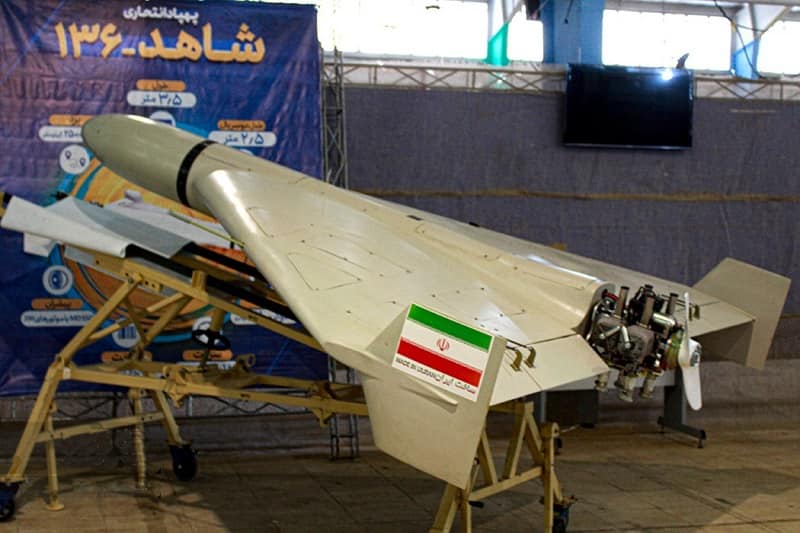
Iran Deploys the Shahed Across the Gulf
Iran’s current campaign mirrors Russia’s approach but adapts it to the specific geography and political stakes of the Gulf. Following U.S.-backed strikes that reportedly killed senior IRGC figures, Tehran launched barrages targeting American military facilities, allied logistics infrastructure, and civilian energy assets across multiple Gulf states. The Islamic Revolutionary Guard Corps framed the attacks as proportional retaliation, a characterization that defense analysts dispute given the scale and breadth of the strikes.
The Shahed family has evolved considerably since its earliest variants. The Shahed-131, a smaller predecessor with reduced range and payload, was largely supplanted by the 136 as Iran’s preferred long-range strike platform. Production simplicity — built around commercial off-the-shelf electronics that remain accessible despite international sanctions — has enabled mass manufacturing at a pace that diplomatic pressure has struggled to interrupt.
“What Iran has done is industrialize asymmetric warfare,” said Fabian Hinz, a research fellow for defence and military analysis at the International Institute for Strategic Studies. “The Shahed is not a precision weapon in the traditional sense. It is a logistics weapon. It is designed to impose costs, drain stockpiles, and force adversaries to spend ten dollars defending against every one dollar Iran spends attacking.”
The broader implications extend well beyond active battlefields. Adversary cooperation at facilities like Alabuga demonstrates accelerating technology transfer among Iran, Russia, China, and potentially North Korea. Innovations born in Ukraine — including fiber-optic guidance cables that resist electronic jamming — are now feeding back into Iranian and Russian production cycles, raising the technical floor for the next generation of loitering munitions.
How Defenders Are Adapting: Layered Air Defense Under Pressure
Countering Shahed drones has forced a fundamental rethink of air defense economics. Traditional surface-to-air missile systems remain essential for protecting high-value fixed targets, but their per-shot cost makes them fiscally untenable as the primary response to mass drone attacks. A single Patriot PAC-3 interceptor costs approximately $4 million. Firing two at a $30,000 drone — standard practice to ensure a kill — produces a cost exchange ratio of roughly 270 to one in Iran’s favor.
Ukraine’s response has been the most consequential adaptation yet documented. Mobile counter-drone teams now deploy low-cost interceptor drones — some built for as little as $1,000 per unit — that ram or detonate near incoming Shaheds, achieving high intercept rates in defended airspace corridors. Zelenskyy has formally offered these specialists and the underlying technology to Gulf partners, proposing a swap arrangement: Ukrainian interceptors and expertise in exchange for additional Patriot and NASAMS missiles to replenish depleted Ukrainian stocks.
Experts are clear that no single technology resolves the problem. Electronic warfare disrupts satellite navigation, mobile radar-guided anti-aircraft cannons provide close-in point defense, and fighter aircraft conduct opportunistic intercepts during daylight hours. Yet the drones’ low radar cross-section, unpredictable flight paths, and preference for nighttime operations continue to complicate engagements even for the most capable air forces.
Directed Energy and the Next Phase of Counter-Drone Warfare
Forward-looking defense programs are investing heavily in directed-energy weapons — high-powered lasers and microwave systems — as the only realistic path to restoring a favorable cost exchange ratio. A laser intercept costs fractions of a cent per shot once the system is operational, compared to thousands of dollars per engagement for kinetic interceptors. The U.S. Army’s DE M-SHORAD program and similar Israeli and British initiatives aim to field truck-mounted laser systems capable of engaging drone swarms continuously without depleting ammunition stocks.
The timeline remains challenging. Most directed-energy programs are still in testing or early fielding phases, leaving a capability gap that adversaries like Iran are actively exploiting in the interim. Military planners are acutely aware that the window between now and viable directed-energy deployment represents a period of elevated vulnerability — one that current Shahed campaigns are designed precisely to exploit.
The Production Economics Sustaining Iran’s Campaign
The strategic durability of Shahed drone warfare rests on a foundation that military force alone cannot easily disrupt: industrial production capacity. Iran is estimated to produce several thousand Shahed-136 units annually through domestic facilities, while Russia’s Alabuga complex has reportedly achieved monthly output in the thousands at peak capacity. Together, these production lines represent a supply chain that outpaces the defensive manufacturing capacity of many targeted nations.
This contrasts sharply with Iran’s ballistic missile arsenal, which is produced in far smaller quantities at substantially higher per-unit cost and with greater sensitivity to sanctions on specialized components. The Shahed’s reliance on commercial electronics — microcontrollers, GPS receivers, and fuel injection systems available through civilian supply chains — makes it uniquely resilient to the export controls that constrain higher-end weapons programs.
International responses have focused on sanctioning identified component suppliers in China and elsewhere, as well as diplomatic pressure on third-party governments facilitating technology transfer. The results have been mixed. While some supply chain nodes have been disrupted, the technology’s fundamental simplicity allows substitution and replication at a pace that outstrips interdiction efforts.
Lessons From Ukraine That Are Reshaping Gulf Defense
The tactical and operational lessons accumulated by Ukrainian forces over four years of Shahed defense represent the world’s most comprehensive real-world dataset on countering this class of weapon. That knowledge is now in active demand. U.S. officials have held consultations with Ukrainian counterparts on transferring counter-drone methodologies, while Gulf states including Qatar and Saudi Arabia have opened parallel discussions on acquiring Ukrainian interceptor technology.
The U.S. military itself faces a stockpile problem that makes these conversations urgent. Extended engagements in the Gulf have drawn down inventories of advanced interceptor missiles faster than current production contracts can replenish them. Defense Department officials have publicly acknowledged that Shahed-class threats require a fundamental reprioritization of air defense procurement — away from legacy high-cost platforms and toward affordable, attritable systems that can be fielded in numbers sufficient to match the volume of incoming threats.
The Shahed family’s battlefield record has also forced changes in civilian preparedness. In Ukraine, the drone’s distinctive engine noise — widely likened to a lawnmower or chainsaw — has become the basis for acoustic early-warning networks that give civilians minutes to seek shelter before impact. Gulf populations, now hearing the same sound overhead, are adapting similar protocols under real operational pressure rather than in exercises.
Proliferation Risk and the Non-State Actor Problem
Perhaps the most consequential long-term concern raised by the Shahed’s success is proliferation beyond state actors. The drone’s low production cost, commercial component base, and documented effectiveness make it an attractive model for well-resourced non-state groups. Hezbollah has already operated Iranian-supplied Shahed variants in previous conflicts. Houthi forces in Yemen have launched comparable loitering munitions against Saudi and Emirati targets for years.
“The barrier to entry for this class of weapon is dropping every year,” said Samuel Bendett, an adjunct senior fellow at the Center for a New American Security. “What Iran needed a sophisticated aerospace industry to produce in 2018, a determined non-state actor with access to commercial manufacturing could potentially replicate today. That is the trajectory that should concern planners most.”
Military doctrine across NATO, the Gulf Cooperation Council, and Indo-Pacific alliance structures is being revised to account for this reality. Exercises increasingly simulate coordinated swarm attacks against forward operating bases and naval assets. Procurement cycles are shifting to favor scalable, high-volume counter-drone systems over the single-point, high-value interceptors that have dominated air defense budgets for decades.
Conclusion
The Shahed-136 has done something that far more expensive weapons programs have failed to achieve: it has fundamentally altered the cost calculus of modern warfare at scale. By flooding battlefields from Kyiv to Kuwait with inexpensive, autonomous munitions, Iran and Russia have forced the world’s most capable militaries to confront a gap between offensive volume and defensive capacity that money alone cannot quickly close. The drone did not win any single battle. It is winning a longer war of economic attrition.
The adaptations now underway — Ukrainian interceptor technology, directed-energy programs, revised procurement priorities, and multinational counter-drone cooperation — represent the first serious institutional responses to a threat that emerged gradually and was underestimated for years. Whether those adaptations arrive fast enough to close the gap before the next escalation cycle depends on decisions being made now in Washington, Riyadh, Brussels, and Kyiv.
The core strategic lesson the Shahed has delivered is one that military historians will recognize immediately: the side that controls production economics in a sustained conflict holds an advantage that tactical superiority alone cannot neutralize. Addressing that imbalance — through innovation, allied coordination, and industrial investment — is the defining air defense challenge of this decade.