The Oura Ring 4 arrives at a point when the smart ring market has never been more competitive. Samsung, Ultrahuman, and RingConn are all pushing hard, and every one of them is cheaper. So the real question is not whether the Oura Ring 4 is a good device — it clearly is — but whether it is still worth choosing over everything else available right now. After extended hands-on use, covering sleep tracking, activity monitoring, battery life, and the subscription model, here is everything worth knowing before spending $349.
Design and Build Quality
The Oura Ring 4 is built entirely from titanium, which is a meaningful upgrade over the Gen 3 that used a non-metallic epoxy inner surface. The result is a ring that looks and feels genuinely premium — closer to fine jewelry than a fitness tracker. It is available in six finishes including Silver, Black, Brushed Silver, Stealth, Gold, and Rose Gold, plus a newer ceramic line in Midnight, Cloud, Tide, and Petal for buyers who want color.
The most important physical change from the previous generation is the removal of the raised sensor domes on the inside of the ring. The Gen 3 had three protruding bumps where the sensors sat, which some users found irritating during extended wear, particularly when the finger swells overnight. The Gen 4 interior is now completely flat, with sensors flush against a smooth titanium surface. This makes 24/7 wear significantly more comfortable for most people.
Sizing options have expanded to cover ring sizes 4 through 15, which matters more than it sounds for a biometric device. Smart rings only function accurately when they maintain consistent contact with the skin, and a ring that is too loose or too tight will produce degraded readings. Oura sends a free sizing kit before purchase, and using it properly is one of the most important steps a new buyer can take to ensure data quality.
Water resistance is rated to 100 meters, which covers everything from hand washing and showering to casual swimming. Anyone curious about how waterproof ratings work across modern devices will find the waterproof certification standards covered in detail elsewhere on this site. The titanium construction shows minimal wear under normal daily conditions. The ring weighs between 3.3 and 5.2 grams depending on size, which is light enough that most people stop noticing it within a day or two of wear.
Smart Sensing: How the New Sensor Platform Works
The headline hardware upgrade in the Oura Ring 4 is what the company calls Smart Sensing. The Gen 3 had eight signal pathways through its optical sensors. The Gen 4 expands this to 18, and the system uses an algorithmic layer to dynamically select the most reliable signal path based on real-time conditions including finger size, skin tone, movement, and contact quality.
The sensor array includes red LEDs, infrared LEDs, and green LEDs used for different measurements. Red and infrared handle blood oxygen estimation. Green and infrared alternating signals are used for heart rate and heart rate variability. A digital skin temperature sensor runs continuously, capturing trend data throughout the day and night rather than single-point readings.
The practical effect of Smart Sensing is fewer data gaps. The most common complaint about the Gen 3 was that it would occasionally fail to capture heart rate data during certain positions or movements, particularly during sleep when the hand shifts position repeatedly. The expanded signal pathways allow the ring to compensate for these situations by switching to a cleaner channel rather than dropping data entirely. Independent testing and user reports consistently confirm that nighttime data gaps are noticeably reduced compared to the previous generation.
Oura also notes that the improved algorithm is specifically designed to perform better across a wider range of skin tones and body types, addressing a long-standing criticism of optical sensors that were originally calibrated on a narrow demographic. The accuracy improvements are most apparent in heart rate and HRV data, which are the metrics that drive the sleep and readiness scoring.
Sleep Tracking: Still the Core Strength
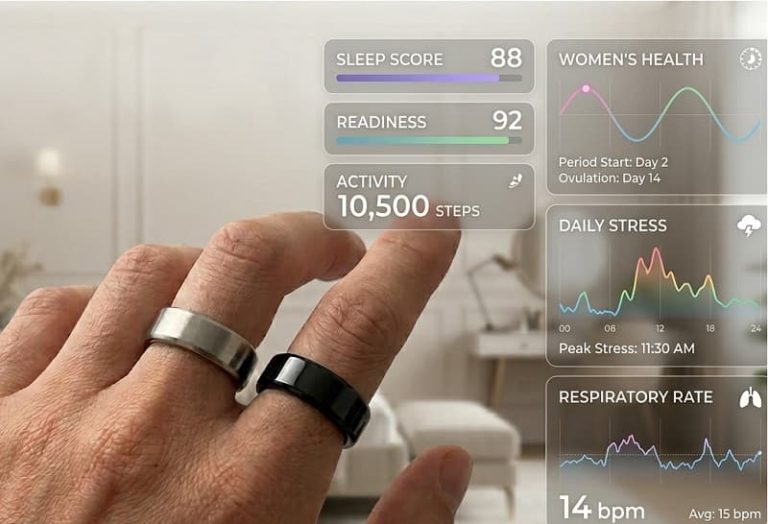
Sleep tracking is the reason most people buy an Oura Ring, and the Gen 4 reinforces that reputation. The ring monitors sleep duration, sleep staging including light, deep, and REM phases, sleep efficiency, respiratory rate, resting heart rate during sleep, and HRV. These inputs feed into a nightly Sleep Score that gives a single number representing overall sleep quality.
The sleep staging performance is genuinely impressive for a consumer device. Clinical sleep studies require electroencephalography to measure brain activity directly, which is the gold standard for staging. Oura uses a combination of heart rate patterns, HRV fluctuations, movement, and temperature to infer staging indirectly. The correlation with polysomnography studies is strong enough that researchers have used Oura data in published academic work on sleep behavior.
In real-world use, the ring handles common disruptions well. It accurately captures wake events during the night, registers alcohol-related sleep degradation through elevated heart rate and temperature trends, and distinguishes restless sleep from genuinely restorative deep sleep cycles. The ring also tracks naps separately from main sleep sessions, which is useful for anyone who supplements nighttime sleep with short daytime rest.
One area where the ring’s sleep tracking is less useful is as a diagnostic tool. It is not a replacement for a sleep study if the goal is diagnosing sleep apnea or other sleep disorders. The respiratory rate data and blood oxygen readings can flag patterns worth investigating with a physician, but the device is not cleared as a medical diagnostic product and should not be treated as one. For general wellness insight and long-term trend tracking, however, it is one of the best tools available outside a clinical setting.
Readiness Score and Recovery Tracking
The Readiness Score is the feature that most distinguishes the Oura ecosystem from basic fitness trackers. Rather than simply logging what the body did, the ring attempts to assess how prepared the body is for the day ahead. The score is calculated from nocturnal HRV and resting heart rate compared to the user’s personal baseline, sleep balance over recent days, recent activity load, and body temperature deviation.
The practical value of this score depends heavily on how a person responds to it. Users who adjust their training intensity, recovery activities, and sleep habits in response to the readiness data consistently report long-term improvements in resting heart rate, HRV, and subjective energy levels. Users who ignore the score get less value, which is true of any biometric feedback system.
HRV in particular is a metric that becomes more meaningful over weeks and months of tracking rather than day to day. The Oura app presents HRV trends over time, which allows users to see whether their baseline is improving or declining in response to lifestyle changes. This long-term trending is one of the most legitimate use cases for continuous biometric monitoring, and the Oura app handles it better than most competing platforms.
The ring also tracks body temperature as a recovery and health signal. Deviations above personal baseline are flagged and can indicate illness onset before other symptoms appear. Multiple users report that the temperature alert gave them one to two days of advance notice before developing a fever or cold. The temperature sensor in the Gen 4 has higher resolution than the Gen 3, making it more sensitive to small deviations that may carry early illness signals.
Activity Tracking: Honest Limitations
Activity tracking is the area where the Oura Ring 4 is most frequently misrepresented in both directions. It is not a sports performance device. It has no GPS, no real-time display, and no ability to deliver workout coaching. Anyone who needs live heart rate zone monitoring during a run, a cycling session, or a strength training workout will find the ring insufficient as a standalone tool for that purpose.
What the ring does do is automatic passive activity detection across more than 40 activity types. Walking, running, and cycling are detected and logged without any user input. The ring estimates calories burned using metabolic equivalent calculations combined with heart rate data, and it sets a daily activity goal based on the user’s current fitness level and recovery status.
The step counting is less accurate than a wrist-based device, which is a known limitation of finger placement. Wrist motion correlates more reliably with steps than finger motion, particularly during activities that involve arm swinging. The calorie estimates are reasonable approximations but should not be treated as precise measurements for athletes managing training load carefully.
For high-intensity interval training specifically, the ring’s heart rate data during the workout is often unreliable. Rapid changes in intensity and the position of the hand during exercises like burpees or weightlifting can cause the optical sensor to lose contact or pick up motion artifacts. Many users who do serious gym work wear the Oura Ring for sleep and recovery data and use a chest strap or wrist device during workouts. This combination approach captures the benefits of both without expecting the ring to do something it was not designed for.
Battery Life and Charging
Oura advertises up to eight days of battery life on a single charge. Real-world results cluster between six and eight days for most users under mixed use, which includes continuous sleep tracking, activity detection, and regular Bluetooth syncing. Users who enable frequent on-demand SpO2 readings or keep Bluetooth active continuously will land closer to the six-day end of that range.
Charging is done on a small magnetic puck charger. The ring sits in the cradle and charges in roughly 60 to 80 minutes from empty. A partial charge of 20 to 30 minutes in the morning provides several additional days of runtime, which means most users can maintain continuous tracking by slipping the ring onto the charger during a shower or while getting ready in the morning.
The practical implication of multi-day battery life is that the ring can capture complete sleep data for an entire week without interruption. Wrist-based trackers that require nightly charging create a tradeoff between charging the device and capturing sleep data. The Oura Ring eliminates that tradeoff for most users.
One legitimate criticism is the absence of a charging case. If the ring dies unexpectedly and the charger is not immediately available, there is no portable option for topping up — which is a real concern for frequent travelers. Anyone evaluating a health wearable alongside other travel gear like international phone plans for travelers should factor charging logistics into the packing routine.
The App, Subscription Cost, and Long-Term Value
The Oura app has undergone a significant redesign. The current version organizes data into three main tabs: Today for current-day scores and metrics, Vitals for underlying health data compared to personal baseline, and My Health for long-term trend analysis. The home screen surfaces sleep, readiness, activity, and stress scores at a glance, which makes the morning check-in fast and practical.
The subscription model is the most debated aspect of the Oura ecosystem. Full access to analytics, trend data, guided sleep coaching, sleep stories, and historical storage costs $5.99 per month or $69.99 per year. Without a subscription, users see only their daily scores with no historical context or detailed breakdowns.
Whether the subscription is worth it depends entirely on how the data is used. For someone who actively reviews trends, adjusts habits based on readiness scores, and uses the sleep coaching content, the subscription provides clear value relative to the hardware purchase. For someone who glances at a number each morning and does nothing with it, the subscription adds recurring cost without proportional benefit.
The total cost of ownership matters in any comparison with competitors. Platforms like Netflix manage their subscription tiers with a clear free-to-paid feature ladder — Oura operates similarly, but the base hardware cost is already high. Over three years, the Oura subscription adds over $200 to the total cost. The Samsung Galaxy Ring, for example, carries no subscription fee at all. The app quality and analytics depth do justify the cost for engaged users, but it is not a neutral factor in the buying decision.
Integrations with Apple Health, Google Health Connect, and Strava allow the Oura data to flow into broader health ecosystems. Users who want to track activity data alongside their broader Google activity history can pull Oura data through Health Connect for a more unified view. The Oura API also supports data export for users who want to maintain long-term personal health records outside the platform.
Oura Ring 4 vs. Competitors
The Samsung Galaxy Ring is the most direct competitor at a similar price point. It has no subscription fee, offers deeper integration with Samsung Health and Galaxy AI features, and is backed by Samsung’s support infrastructure. Its sleep and recovery tracking is competent but not yet at the analytical depth of Oura’s platform. For Samsung ecosystem users, it is a genuinely strong alternative. For everyone else, the ecosystem lock-in is a limitation.
The RingConn Gen 2 offers similar passive health monitoring at a significantly lower price with no subscription and battery life approaching 12 days. It lacks the analytical sophistication and app quality of Oura, but for users who primarily want sleep duration and basic heart rate data without the premium cost, it is a reasonable consideration.
The Ultrahuman Ring Air targets data-focused athletes and offers detailed metabolic scoring without a subscription, though the hardware and app have historically lagged Oura in sleep staging quality. Ultrahuman recently returned to the US market with updated positioning, making it worth watching as a developing alternative.
Against all of these, the Oura Ring 4 maintains its lead primarily through the quality of its sleep staging algorithm, the depth of its readiness analytics, and the maturity of its platform developed over multiple hardware generations. The gap has narrowed, but it has not closed.
Who Should Buy the Oura Ring 4
The Oura Ring 4 is the right choice for people who prioritize sleep quality and recovery tracking above everything else in a wearable, who prefer a discreet form factor over a smartwatch, and who will actively engage with the data rather than passively collect it. It is also well suited for women tracking menstrual cycle patterns, given the temperature trend resolution and cycle prediction features built into the platform.
It is not the right choice for serious athletes who need live workout metrics, for people who require a screen for real-time feedback, or for cost-sensitive buyers who find the subscription model difficult to justify. Those users will find better value elsewhere.
For anyone who has been considering the Oura Ring 4 and is genuinely committed to improving sleep and understanding long-term recovery trends, it remains the strongest product in its category. The competition is closing, but the platform depth and measurement quality still justify the premium for the right user.
Final Verdict
The Oura Ring 4 is a mature, well-engineered product that delivers on its core promise: continuous, accurate, passive health monitoring in a form factor that disappears into daily life. The Smart Sensing upgrade meaningfully reduces data gaps, the all-titanium construction improves durability and comfort, and the battery life is practical enough to maintain uninterrupted sleep tracking across a full week. The subscription cost is real and should factor into any purchase decision, but for users who engage with the data, the analytical quality justifies it. At its price point, it is still the benchmark that every other smart ring is measured against.