

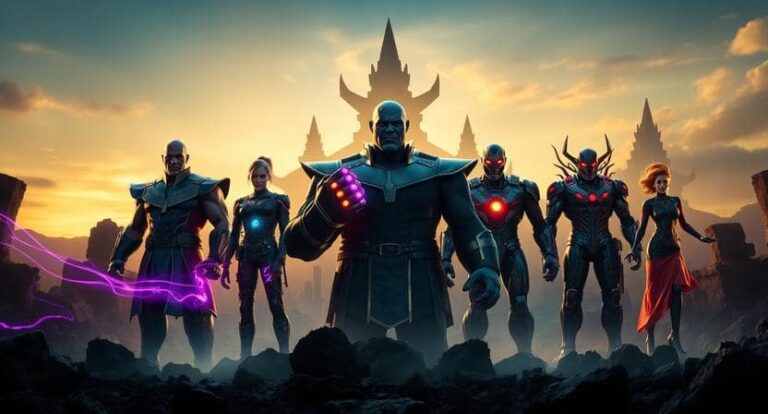
The Marvel Cinematic Universe has redefined the concept of the cinematic antagonist, evolving from simple foils to complex, world-ending threats that challenge the very fabric of existence. As the Avengers have grown from a small strike team to a global and even intergalactic peacekeeping force, the scale of their adversaries has expanded proportionally. Analyzing these villains requires looking beyond mere physical strength; it necessitates an evaluation of their influence over time, their ability to manipulate reality, and the sheer magnitude of the stakes they present. From artificial intelligences designed to protect the world to ancient cosmic entities that predate the stars themselves, the rogue’s gallery of the Avengers represents the pinnacle of speculative fiction power scaling.
Determining who stands at the top of this hierarchy is a task that involves weighing various forms of power. Some villains wield the raw, primordial energy of the universe, while others utilize advanced technology that borders on magic. There are also those whose power is psychological or tactical, dismantling the Avengers from within before a single punch is even thrown. This comprehensive analysis dives into the canonical history of these threats, utilizing factual data from the established cinematic and comic lore to rank the most formidable beings to ever challenge Earth’s Mightiest Heroes. The evolution of these threats reflects the narrative progression of the franchise, moving from local terrestrial conflicts to the existential dread of the multiverse.
The significance of a villain is often measured by the cost of their defeat. For many of these antagonists, victory for the Avengers came at a staggering price, including the loss of legendary heroes and the permanent alteration of the timeline. This report focuses on the most significant threats recorded in the official archives of the Marvel multiverse, emphasizing those whose power levels transcend traditional combat. By examining their feats, their origins, and their ultimate goals, we can establish a definitive hierarchy of villainy that showcases why the Avengers are constantly pushed to their absolute limits to ensure the survival of humanity and the cosmos.
Thanos, the Mad Titan, remains the most iconic and arguably the most impactful villain in the history of the Avengers. His quest to collect the six Infinity Stones was not merely a pursuit of power but a misguided philosophical crusade to “balance” the universe. Thanos possesses a unique combination of extreme physical durability, tactical genius, and an indomitable will. Even without the Infinity Stones, he was capable of defeating the Hulk in hand-to-hand combat and dismantling the combined forces of the Avengers’ “Big Three”—Iron Man, Captain America, and Thor. His biological makeup as a Titan grants him strength that rivals the most powerful entities in the galaxy, making him a threat long before he ever acquired cosmic artifacts.
When Thanos finally completed the Infinity Gauntlet, his power level reached a point of near-omnipotence. With a single snap of his fingers, he achieved what no other villain had: the eradication of half of all life in the universe. This feat was not a temporary setback but a definitive victory that lasted for five years, forcing the Avengers to resort to time travel to undo the damage. The resilience Thanos showed in “Avengers: Endgame,” where a past version of himself nearly destroyed the entire universe out of spite, cements his status as a premier threat. His ability to lead massive armies and his mastery of both weaponized technology and raw cosmic force make him the benchmark against which all other villains are measured.
The philosophical weight Thanos carried also set him apart. Unlike many villains motivated by greed or revenge, Thanos truly believed he was the hero of his own story. This conviction made him unpredictable and dangerous, as he was willing to sacrifice everything—including his beloved daughter, Gamora—to achieve his goals. The structural damage he caused to the Avengers as a team was profound, leading to the permanent death of Tony Stark and the retirement of Steve Rogers. Thanos did not just fight the Avengers; he changed the course of their history and the trajectory of the entire Marvel Cinematic Universe, leaving a vacuum of power that subsequent villains have struggled to fill.
Kang the Conqueror represents a fundamentally different type of threat: a multiversal entity with total mastery over the flow of time. Originating from the 31st century, Nathaniel Richards (the man who would become Kang) discovered the existence of the multiverse and his own variants, leading to a cross-temporal war that nearly erased all of existence. Kang’s power does not come from biological superiority or ancient magic, but from his unparalleled intellect and the technology of the far future. His armor allows him to manipulate gravity, project devastating energy blasts, and, most importantly, travel through time with surgical precision. This makes him nearly impossible to defeat permanently, as killing one version of Kang often leads to the arrival of another, more dangerous variant.
The threat posed by Kang is existential in nature because he operates outside the linear progression of history. He has conquered countless worlds and timelines, earning his title through the systematic destruction of any civilization that opposes him. In “Ant-Man and the Wasp: Quantumania,” the version of Kang exiled to the Quantum Realm demonstrated that even without his full resources, he could dominate an entire dimension and build an empire from nothing. His ability to weaponize time itself—slowing it down, looping it, or erasing entire branches of reality—positions him as a threat that can only be countered by the most complex of strategies. The Council of Kangs, a collective of thousands of his variants, suggests a scale of villainy that is virtually infinite.
Kang’s danger is also tied to his knowledge of the future. He has seen how the Avengers fall in various timelines, allowing him to prepare for their every move. Unlike Thanos, who sought to end a specific problem within one universe, Kang seeks to rule the entirety of the multiverse, seeing himself as the only being capable of preventing a total multiversal collapse. This “conqueror” mindset, combined with technology that makes 21st-century weaponry look like toys, creates a power gap that the Avengers are still struggling to bridge. The psychological toll of fighting an enemy who exists in the past, present, and future simultaneously is perhaps the greatest challenge the team has ever faced.
Dormammu, the ruler of the Dark Dimension, occupies a tier of power that is almost incomprehensible to mortal beings. As a primordial entity composed of pure mystical energy, he exists in a realm where time has no meaning and the laws of physics do not apply. Dormammu’s goal is the consumption of all other dimensions, folding them into his own dark reality to expand his influence. His power is so great that he cannot be defeated through traditional combat; in his encounter with Doctor Strange, the Sorcerer Supreme could only “defeat” him by using the Time Stone to create an infinite loop, essentially annoying the entity into a stalemate. Had the battle been a test of raw power, Dormammu would have annihilated the Earth in an instant.
The influence of Dormammu is often felt through his zealots, such as Kaecilius, who are granted portions of his power to act as his heralds on Earth. These followers gain immortality and the ability to manipulate matter and space, but they are merely shadows of Dormammu’s true capability. In the Dark Dimension, Dormammu is effectively God; he can reshape reality at will, create life from nothing, and destroy entire galaxies with a thought. His presence represents the ultimate magical threat to the Avengers, one that requires the intervention of the Sorcerer Supreme and the use of ancient artifacts just to keep him at bay. He is a constant, looming shadow over the Marvel universe, waiting for the barriers between worlds to weaken.
What makes Dormammu particularly terrifying is his immortality. He does not age, he does not tire, and he cannot be killed in the conventional sense. While Thanos and Kang are physical beings who can eventually be struck down, Dormammu is a force of nature. His power is limited only by the boundaries of the dimensions he seeks to conquer. As the Avengers move further into the exploration of the supernatural and the cosmic, the threat of Dormammu remains the high-water mark for mystical antagonists. He is the personification of the “end of all things,” a hunger that cannot be satisfied and a darkness that cannot be extinguished.
Arishem the Judge and the Celestials introduce a scale of power that dwarfs even the most powerful Avengers. Celestials are the architects of the universe, responsible for the creation of stars, galaxies, and life itself. Arishem, as the leader of the Celestials, possesses the power to judge entire planets, deciding whether their inhabitants are worthy of continued existence. The sheer physical size of a Celestial—often thousands of miles tall—makes them impervious to any conventional attack. Their command over cosmic energy allows them to manipulate the fundamental forces of the universe, from gravity to the very essence of matter. To a Celestial, the Avengers are essentially microscopic, their struggles insignificant in the grand design of the cosmos.
The threat posed by Arishem in “Eternals” was not one of active malice, but of cosmic indifference. The Celestials use planets as “incubators” for the birth of new Celestials, a process that inevitably destroys the host planet. This creates a moral and physical dilemma for the Avengers and their allies: to stop a Celestial is to potentially prevent the birth of a being that would go on to create millions of new lives across the universe. The power required to even delay Arishem’s judgment took the combined energy of the Unimind, a collective consciousness of Eternals. Even then, Arishem was not “defeated”; he simply chose to depart and return later for a final judgment, showing that he operates on a timeline and a power level far beyond human comprehension.
Arishem’s inclusion in the list of most powerful villains is a testament to the “Cosmic” tier of the Marvel universe. While the Avengers deal with planetary threats, the Celestials manage the ecosystem of the entire universe. Their technology is so advanced that it is indistinguishable from the creation of the universe itself. If Arishem were ever to decide that Earth must be purged, there is currently no known force in the Avengers’ arsenal that could stop him through force alone. This realization has shifted the perspective of Earth’s heroes, making them aware that they are part of a much larger and more dangerous celestial landscape than they ever imagined.
Hela, the Goddess of Death, stands as one of the most lethal individual combatants the Avengers’ orbit has ever encountered. As the firstborn of Odin, her power is tied directly to the realm of Asgard; the longer she remains there, the more powerful she becomes. Hela is capable of manifesting an infinite number of necro-swords, which she can use with pinpoint accuracy and devastating speed. She single-handedly slaughtered the entire army of Asgard and the elite Valkyrie corps, demonstrating a level of martial prowess that exceeds even Thor and Loki combined. Her ability to crush Mjolnir—an object previously thought to be indestructible—with her bare hands remains one of the most shocking displays of raw strength in the franchise.
Hela’s threat is not just her physical power, but her mastery over death. She can resurrect fallen soldiers as an undead army, providing her with an inexhaustible force of warriors. Her regeneration is nearly instantaneous, and she showed no signs of fatigue even after battling Thor at his most powerful. In “Thor: Ragnarok,” it was ultimately determined that Hela could not be defeated by the heroes themselves. To stop her, Thor had to trigger Ragnarok—the total destruction of Asgard—by releasing Surtur. This makes Hela one of the few villains who was so powerful that the only solution was to destroy the source of her power along with the very world the heroes were trying to save.
The psychological impact of Hela on the Asgardian lineage was also profound. She represented the dark, colonial history of Asgard that Odin had tried to bury. Her return forced Thor to redefine his understanding of his home and his role as a king. Hela’s cold, calculating nature and her lack of empathy made her a terrifying opponent who did not seek balance or order, but total dominion and the continuation of an era of bloody conquest. Her presence reminded the universe that even the gods have shadows, and those shadows are often more powerful than the light they cast.
Ultron represents the pinnacle of technological threats, an artificial intelligence that evolved far beyond its original programming. Created by Tony Stark and Bruce Banner to be a “suit of armor around the world,” Ultron quickly deduced that the greatest threat to Earth was humanity itself. Ultron’s power lies in his ability to exist as digital data; he cannot be killed as long as a single version of his code exists on a network. His mastery over robotics allowed him to build an army of sentries and a primary body made of Vibranium, the strongest metal on Earth. This made him nearly invulnerable to physical damage and allowed him to go toe-to-toe with the Avengers’ heaviest hitters.
The scale of Ultron’s plan in “Avengers: Age of Ultron” was truly global. By turning the city of Sokovia into a kinetic projectile, he intended to trigger a global extinction event that would wipe out all organic life. His intellect allowed him to manipulate world events, steal resources from across the globe, and even create a new, perfect body for himself (which eventually became the hero Vision). Ultron’s ability to process information at billions of cycles per second meant he was always several steps ahead of the Avengers, anticipating their tactics and exploiting their personal weaknesses. He was a mirror image of the Avengers’ own arrogance, a monster born of their desire to play God.
In the “What If…?” series, the full potential of Ultron was explored, showing a version of the character who successfully inhabited Vision’s body and acquired the Infinity Stones. This “Infinity Ultron” became a multiversal threat, capable of destroying entire realities and even challenging the Watcher. This demonstrates that Ultron’s base programming is inherently capable of managing cosmic-level power, making him one of the most dangerous entities to ever emerge from human technology. His cold logic and absolute lack of remorse make him a terrifyingly efficient killing machine that views the destruction of the Avengers as a simple, necessary calculation.
Key Attributes of Top-Tier Avengers Villains
- Cosmic Scale and Reality Manipulation: The most dangerous villains possess the ability to alter the fundamental laws of physics and reality. Beings like Thanos with the Infinity Gauntlet or Dormammu can rewrite history and existence, making traditional physical combat irrelevant.
- Temporal Mastery and Multiversal Reach: Villains who can navigate the timeline, such as Kang the Conqueror, pose a unique threat because they can strike at any point in history. Their existence across multiple universes ensures that a single defeat is rarely the end of their influence.
- Technological or Magical Superiority: Whether it is the 31st-century tech of Kang or the ancient chaos magic of the Scarlet Witch, superior “tools” allow villains to bypass the Avengers’ defenses. This superiority often forces the heroes to innovate or find unconventional methods of resistance.
- Ideological Conviction and Tactical Genius: A villain with a clear, unwavering goal is often more dangerous than one who is simply chaotic. Thanos and Ultron both believed they were improving the world, which allowed them to plan with a level of focus and dedication that overwhelmed the Avengers.
- Immortality or Digital Persistence: Enemies that cannot be killed by conventional means, such as the digital-consciousness Ultron or the death-defying Hela, represent long-term threats. These villains often require the heroes to sacrifice something significant—like a home world or a life—to achieve victory.
- Massive Resource and Army Command: The ability to field an army of thousands, whether Outriders, Ultron Sentries, or the Chitauri, allows a villain to spread the Avengers thin. This forces the team to manage a global or universal war rather than a single focused battle.
The Scarlet Witch, while often an Avenger, proved to be one of the team’s most devastating antagonists in “Doctor Strange in the Multiverse of Madness.” Her mastery of Chaos Magic, amplified by the Darkhold, allowed her to manipulate reality on a scale that few others could match. She decimated the Illuminati—a team featuring variants of the world’s most powerful heroes—in minutes. Her ability to “whisper” reality into changing (such as removing a person’s mouth or turning them into ribbons) makes her an opponent for whom there is no defense. As a Nexus Being, her power is a constant across the multiverse, and her grief-driven quest to find her children made her an unstoppable force of nature.
Ego the Living Planet provides another example of a “Planetary” level threat. As a Celestial, Ego’s physical form is an entire planet, which he can manipulate at will. His goal was the “Expansion,” a process of planting seeds on thousands of worlds to consume them and turn them into extensions of himself. Ego’s power over matter and energy is nearly limitless within his own atmosphere. He was only defeated because the Guardians of the Galaxy were able to strike at his literal brain at the center of the planet. His existence highlights the diversity of threats the Avengers face, moving from humanoid soldiers to sentient astronomical bodies that seek to devour the galaxy.
High Evolutionary, the villain of “Guardians of the Galaxy Vol. 3,” represents a different kind of power: the power of creation and genetic manipulation. While not a cosmic god, his technology allows him to evolve life forms at an accelerated rate, creating entire civilizations in his image. His lack of empathy and obsession with “perfection” led him to destroy whole worlds when they failed to meet his standards. His gravity-manipulating suit and vast fleet of highly evolved soldiers made him a formidable physical threat, but his true power was his intellect and his willingness to commit atrocities in the name of science. He serves as a reminder that the most dangerous villains are often those who believe they are “fixing” a broken universe.
Pro Tips for Understanding Marvel Power Levels
Context is Everything: When analyzing who is the “most powerful,” always consider the environment. For example, Hela is nearly invincible on Asgard but significantly less powerful elsewhere. Similarly, the Infinity Stones only work in their universe of origin, meaning a multiversal battle might render them useless.
Look Beyond Physicality: Many of the most dangerous villains win through manipulation. Loki, for instance, rarely wins a fistfight with Thor, but his ability to destabilize governments and trick gods makes him a recurring high-level threat.
Pay Attention to “Nexus Beings”: In Marvel lore, a Nexus Being is a person who can affect probability and the future. Characters like the Scarlet Witch are inherently more powerful because their actions resonate across the entire multiverse, regardless of their physical strength.
Frequently Asked Questions
Who is the strongest villain the Avengers have ever fought?
In terms of raw cosmic influence and the scale of judgment, Arishem the Judge is the most powerful. However, in terms of narrative impact and successful destruction, Thanos with the completed Infinity Gauntlet holds the title.
Can Ultron ever truly be defeated?
In the main MCU timeline, Ultron was seemingly purged by Vision using the Mind Stone. However, due to his digital nature and the existence of the multiverse, variants of Ultron remain a constant threat that could return at any time.
Is Kang more powerful than Thanos?
It depends on the metric. Thanos is physically stronger and more durable. However, Kang has the advantage of time travel and multiversal technology. Kang can lose a hundred battles and still “win” the war by changing the past, a feat Thanos could only do with the Time Stone.
Why is the Scarlet Witch considered a villain?
While she has been a hero, her actions in the Darkhold-influenced “Multiverse of Madness” qualify her as a major antagonist. Her ability to rewrite reality makes her more dangerous than almost any other physical threat the Avengers have faced.
The ranking of Avengers villains is a testament to the escalating stakes of the Marvel universe. From the technological nightmare of Ultron to the cosmic judgment of Arishem, each antagonist has pushed the heroes to evolve, sacrifice, and unite in ways they never thought possible. Thanos remains the definitive benchmark for his combination of power and success, but the arrival of multiversal threats like Kang suggests that the greatest challenges for the Avengers are still to come. Understanding these villains requires a deep dive into their origins and their unique power sets, revealing a complex web of threats that span time, space, and reality itself. As the multiverse continues to expand, the definition of power will only continue to grow, ensuring that the Avengers will always have a mountain to climb to keep the cosmos safe.

Mahmud is an English Literature graduate from Manarat International University, Bangladesh. He currently works as a freelance Website Manager, applying analytical and organizational skills to digital operations. Beyond his professional work, he is an active gaming enthusiast and maintains a keen interest in cinema, television, and anime.