The southeastern city of Lyon has become the focal point of a major national security crisis following the death of Quentin Deranque, a twenty-three-year-old activist associated with nationalist movements. As of February 18, 2026, French authorities have confirmed the arrest of eleven individuals in connection with a violent assault that occurred on the sidelines of a university conference last week. The incident, which has been officially categorized as an intentional homicide by the Lyon prosecutor’s office, has ignited a fierce political debate regarding the rise of extremist violence and the role of parliamentary figures in fostering a climate of radicalization. Law enforcement officials have conducted multiple raids across the region, securing several suspects who are believed to have direct ties to “ultra-left” militant groups.
The tragedy took place on the evening of February 12, during a demonstration opposing a public appearance by Rima Hassan, a member of the European Parliament from the hard-left La France Insoumise (LFI) party. Witnesses describe a chaotic scene in which a group of masked individuals, allegedly armed with iron bars and other blunt instruments, ambushed Deranque and several other protesters. While others managed to escape the fray, Deranque sustained a severe brain injury and a fractured skull. Despite being rushed to a nearby medical facility and placed in an induced coma, he succumbed to his injuries on Saturday, February 14. The brutality of the attack has drawn universal condemnation from the highest levels of the French government, with President Emmanuel Macron calling for “calm, restraint, and respect” during a period of intense public grieving.
The judicial response has been swift, led by Lyon prosecutor Thierry Dran. On Tuesday night and Wednesday morning, nine men and two women were taken into custody. Among those detained is a parliamentary assistant to Raphaël Arnault, a prominent LFI lawmaker and a co-founder of the anti-fascist group La Jeune Garde, which was officially dissolved by the government in June 2025. The inclusion of a legislative staffer among the suspects has funneled intense scrutiny toward LFI leadership. Arnault has since announced the immediate dismissal of the assistant, while the party itself reported a bomb threat at its Paris headquarters on Wednesday, leading to an emergency evacuation as police specialized units swept the building.
Chronology of the Lyon Assault and Victim Profile
Quentin Deranque was a mathematics student at a local university and an active volunteer at Saint George’s Church in Lyon. According to family members and legal representatives, Deranque was a “fervent nationalist” who participated in political activism through non-violent means. On the night of the attack, he was reportedly present to provide security for the Nemesis collective, an anti-immigration group protesting the arrival of Rima Hassan. The investigation suggests that the confrontation was not a spontaneous brawl but an organized ambush by a group described by the family’s lawyer as “trained and vastly superior in number.”
The victim’s death has resonated deeply within Lyon, a city historically regarded as a stronghold for both far-right and anti-fascist organizations. The local prosecutor noted that the autopsy confirmed the cause of death as extensive intracranial trauma consistent with a beating by multiple assailants. Digital evidence, including social media posts and recorded video from the scene, has been instrumental in helping investigators identify the suspects. The police have also analyzed telecommunications data to determine if the attackers coordinated their arrival at the university specifically to target the protesters after the conference concluded.
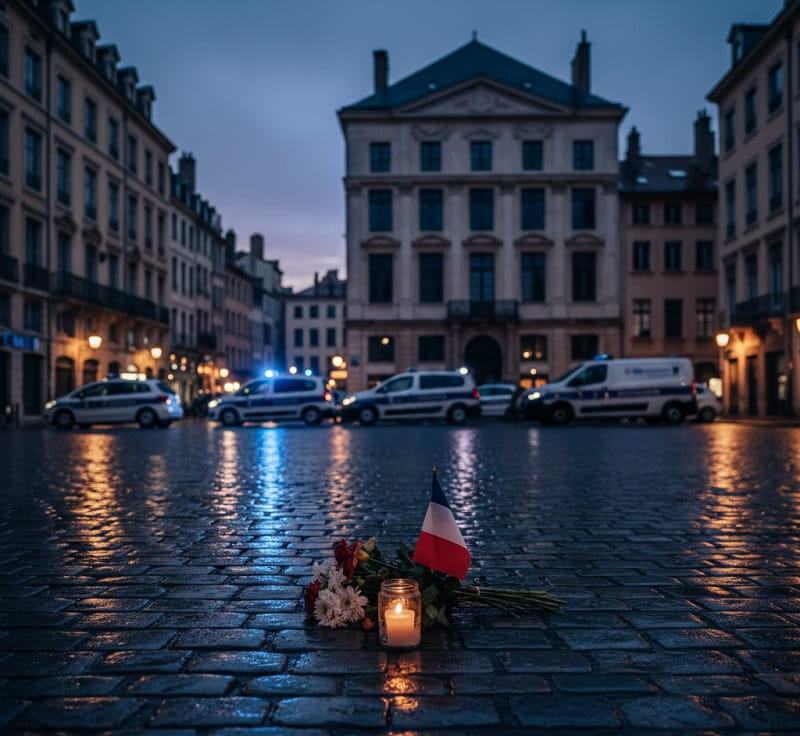
Following the news of Deranque’s death, spontaneous vigils were held in Paris, Montpellier, and Lyon. In the city center of Lyon, protesters unfurled banners demanding justice and condemning “antifa murderers.” These demonstrations have been met with a heavy police presence to prevent retaliatory attacks against left-wing establishments, such as bookstores and community centers. The Ministry of the Interior has mobilized additional CRS (riot police) units to the Auvergne-Rhône-Alpes region, anticipating further civil unrest as the municipal elections in March approach.
Judicial Proceedings and the Search for Culpability
The eleven suspects currently in custody are facing a range of serious criminal charges. According to the Lyon prosecutor, two of the individuals—a man and his partner—are being investigated for “intentional homicide” and “aiding a fugitive,” respectively. The remaining nine are suspected of varying degrees of participation in the beating or providing logistical support for the ambush. French law regarding “participation in a group with intent to commit violence” allows for broad prosecution of those present during such assaults, even if they did not deliver the final, fatal blow. This legal framework is expected to be a cornerstone of the upcoming trial.
The involvement of a parliamentary aide has created a unique legal and political entanglement. The French Parliament Speaker, Yaël Braun-Pivet, has already banned the aide from the National Assembly premises following reports from witnesses. Investigators are currently examining whether any official resources or communication channels were used to facilitate the movement of the attackers. While the lawmaker Raphaël Arnault has expressed “horror” at the death of Deranque, his critics argue that his historical associations with La Jeune Garde make his position untenable. The prosecutor’s office has declined to comment on the specific political affiliations of all detainees but confirmed that the investigation is ongoing.
The “ultra-left” label used by Justice Minister Éric Dupond-Moretti has signaled a shift in the government’s rhetoric toward radical leftist movements. By categorizing the attackers as part of a dangerous militant fringe, the government is laying the groundwork for further administrative dissolutions of similar groups. Security experts note that the decentralized nature of modern anti-fascist cells makes them difficult to monitor, as they often operate without formal hierarchies. However, the use of forensic technology and integrated surveillance networks in Lyon has allowed the judicial police to make significant breakthroughs in a relatively short period.
Political Fallout and the Crisis within La France Insoumise
The La France Insoumise party is facing what political analysts call its most significant existential crisis since its inception. Opponents from the National Rally (RN) and the centrist Renaissance party have accused LFI leader Jean-Luc Mélenchon of “moral and political responsibility” for the atmosphere that led to the killing. Jordan Bardella, head of the RN, claimed that LFI has “opened the doors of the National Assembly to suspected murderers.” This pressure has forced LFI into a defensive posture, with party leaders condemning the violence while simultaneously claiming they are victims of a coordinated “demonization” campaign by the state.
The internal cohesion of the broader left-wing coalition, the Nouveau Front Populaire, is also under strain. Former President François Hollande, representing the reformist Socialist wing, has explicitly stated that there can be no alliance with LFI in the second round of the upcoming municipal elections. This fragmentation on the left could potentially clear a path for the National Rally to gain unprecedented ground in local governments across France. The debate has moved beyond the death of one individual to a broader referendum on whether radical left-wing parties can still be considered part of the “republican front.”
Meanwhile, the LFI headquarters in Paris remains a site of high tension following the February 18 bomb threat. Party coordinator Manuel Bompard stated on social media that while all staff are safe, the constant harassment and threats against their officials have reached an unsustainable level. The party argues that the government is using the Lyon tragedy to distract from its own security failures and the rise of far-right radicalization. Nevertheless, the presence of a legislative assistant at the scene of a homicide has significantly weakened the party’s ability to claim the moral high ground in the national discourse on political violence.
Security Measures and Urban Stability in Lyon
In response to the escalating violence, the Prefecture of the Rhône has implemented several emergency measures to maintain order in Lyon. These steps are designed to de-escalate tensions between the rival factions while ensuring the safety of the general public. The city has seen a marked increase in surveillance and a temporary ban on certain types of public gatherings in the historic Vieux Lyon district. The following list outlines the primary security and administrative actions taken by authorities in the wake of the activist’s death:
- The deployment of over 500 additional police officers and gendarmes to patrol high-risk neighborhoods and university campuses. This measure is intended to provide a visible deterrent against spontaneous clashes and to facilitate rapid response times should violence erupt again.
- The temporary closure of several bars and community centers known to be hubs for extremist organizations from both the left and the right. By removing these physical gathering spots, authorities hope to disrupt the organizational capacity of radical groups during this volatile period.
- An immediate increase in the use of the city’s integrated CCTV network, coupled with real-time AI analytics to detect the movement of masked groups. This technological approach allows for the early identification of potential ambushes before they can reach their intended targets.
- The establishment of a dedicated judicial task force to expedite the processing of evidence related to the homicide investigation. This team includes experts in digital forensics and crime scene reconstruction to ensure that the prosecution’s case is airtight.
- The implementation of a “republican dialogue” program in local schools and community centers to educate youth on the dangers of radicalization. This initiative aims to address the root causes of political violence through education and community outreach rather than just policing.
- Enhanced protection for elected officials and their staff following a surge in threats across social media platforms. Security details have been assigned to high-profile figures from multiple parties who have been identified as potential targets for retaliation.
The Historical Context of Ideological Extremism in France
The death of Quentin Deranque is not an isolated incident but the latest chapter in a long history of ideological street fighting in France. Lyon, often called the “capital of the Resistance” during World War II, has a complex legacy that includes both radical right-wing identitarian movements and a fierce anti-fascist tradition. The current polarization mirrors the tensions of the 1930s and the 1960s, where political differences frequently manifested as physical confrontations. Historians point to the 2013 death of Clément Méric, a young anti-fascist activist killed by skinheads, as a direct parallel to the current situation, though the ideological roles of victim and perpetrator have now been reversed.
In recent years, the rise of “identitarian” groups like Les Remparts and Lyon Populaire has met with the emergence of militant anti-fascist collectives like La Jeune Garde. These groups often view themselves as the defenders of their respective communities against what they perceive as an existential threat. The dissolution of such groups by the government in 2025 was intended to curb their influence, but analysts argue that it may have instead pushed them into more clandestine and violent forms of operation. The inability of mainstream political parties to provide a satisfactory narrative for disillusioned youth has left a vacuum that these radical organizations are all too eager to fill.
The socio-economic landscape of Lyon also plays a role in this friction. The city’s historic center, with its narrow streets and traditional architecture, has become a contested space where different visions of French identity collide. On one side are those who seek to preserve what they see as traditional Western values; on the other are those who advocate for a multicultural, anti-racist society. When these opposing ideologies meet in a confined urban environment, the results are increasingly lethal. The challenge for the French Republic is to find a way to accommodate these competing visions within a democratic framework without allowing them to descend into tribal warfare.
National Security Response and the “Ultra-Left” Label
The decision by the French government to specifically target the “ultra-left” in its official communications marks a significant tactical shift. Interior Minister Laurent Nuñez stated that the far-left fringe is “clearly at the helm” of recent violent acts, suggesting a broader crackdown is imminent. This terminology is controversial, as many on the left feel it is a form of collective punishment for an entire political movement. However, the government insists that it is targeting specific individuals and de-facto organizations that have proven themselves to be a threat to public order and the safety of citizens.
Security services are now focusing on the intersection of student activism and militant “antifa” networks. The university setting of the Lyon attack has raised questions about the radicalization of students and the degree to which educational institutions can or should monitor political activities on campus. There are calls for stricter regulations on university-hosted events, including mandatory security assessments for high-profile speakers like Rima Hassan. However, proponents of academic freedom argue that such measures could stifle legitimate debate and turn campuses into sterile, over-policed environments.
The international community is also watching the situation closely, as France is often seen as a bellwether for political trends in Europe. The rise of extremist violence is a concern shared by many EU member states grappling with similar levels of polarization. The French response—combining rapid judicial action, administrative group dissolutions, and increased surveillance—could serve as a blueprint for other nations facing domestic radicalization. For now, the focus remains on the eleven suspects in Lyon and the potential for their trial to serve as a moment of reckoning for the country’s political culture.
Expert Insights on Political Polarization and Violence
Sociologists and political scientists warn that the killing in Lyon could lead to a “tit-for-tat” cycle of violence if not handled correctly. Joel Crisetig, an assistant research manager at ACLED, noted that the death of a “neo-fascist” activist by suspected anti-fascists represents a significant escalation. There is a tangible risk of vigilante-style retaliation from far-right groups seeking revenge for their fallen comrade. Such a cycle would be devastating for French social cohesion, especially in the lead-up to a high-stakes presidential election in 2027.
The “moral responsibility” debate sparked by the government’s accusations against LFI is also a point of contention. While it is difficult to prove a direct legal link between a politician’s rhetoric and a specific criminal act, the influence of combative language cannot be ignored. Experts argue that when leaders use “war-like” terminology to describe their political opponents, it provides a sense of legitimacy for supporters who choose to take those words literally. This phenomenon is not limited to the left; the far right has also been accused of using inflammatory language that has led to racist attacks and the harassment of minorities.
Ultimately, the stability of the French state relies on the public’s confidence in the rule of law. If citizens feel that justice is being applied unevenly based on political affiliation, it will only further fuel the fire of radicalization. The Lyon prosecutor’s commitment to a transparent and thorough investigation is therefore critical. By ensuring that all eleven suspects are treated according to the evidence rather than their ideologies, the judicial system can play a vital role in de-escalating the crisis. The goal is to move the conflict away from physical violence and back into the realm of democratic debate, no matter how heated that debate may be.
Frequently Asked Questions on the Lyon Political Crisis
Who was Quentin Deranque and why was he targeted?
Quentin Deranque was a 23-year-old mathematics student and nationalist activist who volunteered for local charities and his church. He was not a prominent political figure but was present at a protest to provide security for the Nemesis collective. It appears he was targeted because of his association with the far-right protest against a left-wing conference, becoming a victim in a larger clash between ideological groups.
What are the specific charges against the 11 people arrested?
The primary charges include intentional homicide, aggravated assault, and participation in a group with the intent to commit violence. One individual is specifically charged with helping a suspect evade justice. The exact nature of the charges for each individual depends on their level of involvement, as determined by witness statements and forensic evidence collected by the Lyon police.
How is La France Insoumise (LFI) linked to the suspects?
The direct link involves one of the suspects being a parliamentary assistant to LFI lawmaker Raphaël Arnault. Furthermore, the government has accused the party of fostering a climate that encourages militant behavior from groups like La Jeune Garde, an anti-fascist organization co-founded by Arnault. LFI denies any direct or indirect involvement in the killing and has dismissed the staff member in question.
What is the “ultra-left” and how does it differ from mainstream left-wing parties?
The “ultra-left” refers to a radical fringe of the political left that often rejects traditional democratic processes in favor of direct action, which can include physical confrontation. While mainstream parties like the Socialists or Greens operate within the parliamentary framework, ultra-left militants may view violence as a legitimate tool against what they perceive as fascist threats. The French government uses this term to distinguish criminal actors from legitimate political opposition.
What impact will this have on the upcoming 2026 and 2027 elections?
The incident has caused a significant rift in the left-wing coalition, potentially benefiting the center and the far-right National Rally. By associating the hard-left with violence, opponents hope to alienate moderate voters. This could lead to a shift in local governance during the March municipal elections and set the stage for a more polarized presidential race in 2027, where security and extremism will likely be top-tier issues.
Is there a risk of further violence in Lyon or other cities?
Yes, there is a recognized risk of retaliatory violence. Security services are monitoring far-right forums for calls to “avenge” Deranque. The government has increased police presence in Lyon and other major cities like Paris and Montpellier to prevent any further escalation. Public order remains a high priority, with authorities prepared to use administrative bans on any demonstrations that appear likely to lead to conflict.
How does the French government dissolve extremist groups?
Under the Internal Security Code, the government can dissolve groups that provoke armed demonstrations, incite violence, or promote discrimination. This is done through a decree by the Council of Ministers. The process involves a legal analysis of the group’s actions and public statements. Several groups associated with both the far-right and the far-left in Lyon have already been dissolved using this power over the last year.
Conclusion
The killing of Quentin Deranque in Lyon has fundamentally altered the French political landscape, highlighting the dangerous level of polarization currently gripping the nation. With eleven individuals now in custody, including a parliamentary aide, the judicial system is tasked with providing a definitive answer to a tragedy that has left the country in shock. The fallout has reached the highest levels of government, sparking a debate on the moral responsibility of political leaders and the necessity of curbing extremist violence from all sides of the spectrum. As Lyon attempts to recover from this dark episode, the focus shifts to the upcoming elections and whether the French Republic can find a way to bridge its deep ideological divides. The case remains a stark warning of the consequences when political disagreement transcends the boundaries of law and results in the loss of human life.