Understanding Financial Terminology in Business Operations
In the realm of accounting and finance, precise terminology ensures accurate financial reporting and decision-making. Businesses routinely encounter various costs that impact their financial statements differently. Distinguishing between these costs is essential for compliance with accounting standards and optimizing tax strategies.
Financial professionals emphasize the importance of categorizing costs correctly to reflect true economic activities. This categorization affects how companies plan budgets and forecast future performance. Organizations that manage these aspects effectively often achieve better financial health and operational efficiency.
Regulatory bodies and accounting principles provide guidelines for handling these financial elements. Adhering to these guidelines prevents misstatements in financial reports. Accurate classification also aids in analyzing profitability and liquidity positions.
Stakeholders, including investors and creditors, rely on clear financial distinctions to assess company viability. Transparent reporting builds trust and supports informed investment decisions. Companies that excel in this area typically enjoy stronger market positions.
Defining Expenditure in Accounting Contexts
An expenditure refers to the outflow of funds or the incurrence of a liability in exchange for goods or services. This transaction is recorded at the point of purchase or commitment. It encompasses payments that may benefit the business immediately or over extended periods.
Expenditures are fundamental to tracking cash flows and resource allocation within an organization. They represent the actual disbursement of resources, whether in cash or credit. Proper documentation, such as invoices or receipts, supports their recording in financial systems.
In financial statements, expenditures influence the balance sheet by reducing cash reserves or increasing liabilities. They are crucial for maintaining accurate records of asset acquisitions and operational funding. Businesses monitor expenditures to control spending and ensure alignment with strategic goals.
Expenditures can vary in scale, from minor daily purchases to significant investments in infrastructure. Their impact on financial health depends on their nature and timing. Effective management of expenditures contributes to sustainable growth and resource optimization.
Types of Expenditures Commonly Encountered
Capital expenditures involve acquiring or upgrading long-term assets that provide benefits beyond one accounting period. These include purchases of property, plant, and equipment. Such investments are capitalized on the balance sheet and depreciated over their useful lives.
Revenue expenditures cover costs associated with maintaining daily operations and generating immediate revenue. Examples encompass repairs, maintenance, and utility payments. These are expensed in the period incurred, directly affecting the income statement.
Deferred revenue expenditures pertain to payments made in advance for benefits expected in future periods. This category includes prepaid insurance or marketing campaigns spanning multiple years. They are initially recorded as assets and amortized over time.
Organizations classify expenditures based on their expected duration of benefit. This classification ensures compliance with accounting standards like GAAP or IFRS. Accurate typing prevents distortions in financial ratios and performance metrics.
Businesses often budget separately for different expenditure types to allocate resources efficiently. Capital budgets focus on long-term investments, while operating budgets handle revenue expenditures. This separation aids in strategic planning and financial forecasting.
Defining Expense in Financial Reporting
An expense represents the consumption of resources or reduction in asset value to generate revenue within a specific period. It is recognized on the income statement when the benefit is realized or the cost is matched to revenue. Expenses directly offset income to determine net profit.
Expenses are periodic and recur in the normal course of business operations. They include costs like salaries, rent, and utilities that support ongoing activities. Tracking expenses helps in assessing operational efficiency and cost control measures.
In accrual accounting, expenses are recorded when incurred, regardless of cash payment timing. This method provides a more accurate picture of financial performance. Cash basis accounting, in contrast, recognizes expenses only upon payment.
Expenses are deductible for tax purposes in the period they are recognized, reducing taxable income. Businesses maximize deductions by ensuring expenses meet criteria of being ordinary and necessary. This strategy enhances after-tax profitability.
Types of Expenses in Business Activities
Fixed expenses remain constant regardless of production or sales volume, such as rent or salaries. They provide stability in budgeting but can strain finances during low revenue periods. Managing fixed expenses involves negotiating long-term contracts for favorable terms.
Variable expenses fluctuate with business activity levels, including raw materials and commissions. They align closely with revenue generation, offering flexibility in cost management. Monitoring variable expenses helps in identifying efficiency improvements.
Operating expenses encompass costs necessary for core business functions, excluding interest and taxes. These include administrative and selling expenses. Controlling operating expenses is key to maintaining healthy profit margins.
Non-operating expenses arise from activities outside primary operations, like interest on loans. They impact overall profitability but are not indicative of core performance. Separating these aids in evaluating operational effectiveness.
Periodic expenses occur at irregular intervals, such as annual insurance premiums. Planning for these ensures liquidity is maintained. Businesses often set aside reserves to cover such costs without disrupting operations.
Key Distinctions Between Expenditure and Expense
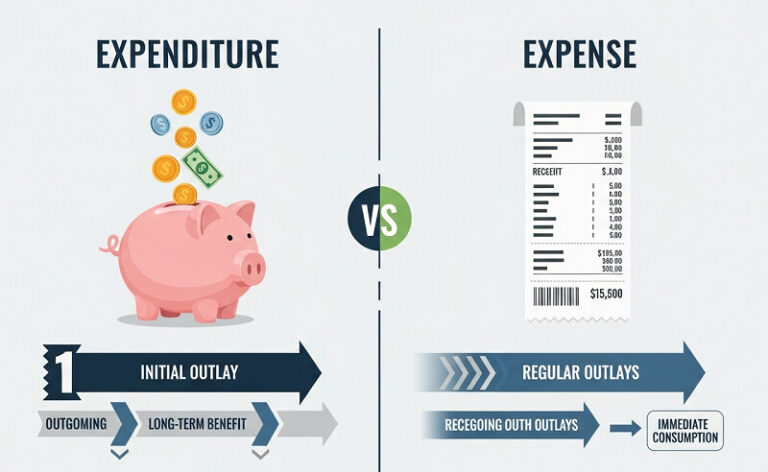
The primary difference lies in timing and recognition: expenditures are recorded at the point of payment or commitment, while expenses are recognized when the benefit is consumed. This distinction affects how each appears in financial statements. Understanding this helps in accurate financial analysis.
Expenditures often involve larger sums for long-term benefits, whereas expenses are typically smaller and short-term. Capital expenditures, for instance, are depreciated over years, spreading the cost. Expenses are fully deducted in the current period.
Financial reporting treats expenditures as investments on the balance sheet if capital in nature, while expenses directly reduce income. This treatment influences key metrics like assets and profitability. Misclassification can lead to inaccurate financial insights.
Tax implications differ: expenses provide immediate deductions, reducing current taxable income. Capital expenditures offer deductions through depreciation over time. Strategic planning considers these differences for optimal tax efficiency.
Purpose varies: expenditures may build long-term capacity, like acquiring equipment. Expenses support daily revenue generation, such as paying utilities. Aligning both with business goals ensures balanced growth.
Recognition and Timing in Accounting
Recognition of expenditures occurs at the transaction date, capturing the outflow immediately. This ensures cash flow statements reflect actual movements. Timing is critical for liquidity management.
Expenses are matched to the period of benefit under the matching principle. This accrues costs even if unpaid, providing a true performance view. It contrasts with cash-based timing.
Depreciation bridges expenditures and expenses for capital items, allocating costs over useful life. Methods like straight-line or accelerated affect expense patterns. Choosing appropriately aligns with asset usage.
Accrual adjustments ensure expenses reflect economic reality, not just cash transactions. This practice enhances comparability across periods. It supports better forecasting and analysis.
Periodic reviews reconcile expenditures and expenses, identifying discrepancies. This process maintains financial integrity. Adjustments prevent over or understating profits.
Practical Examples Illustrating Concepts
Consider a manufacturing firm purchasing a new machine for $100,000. This is a capital expenditure, recorded as an asset. Annual depreciation of $10,000 over ten years becomes the expense.
A retail store paying monthly rent of $5,000 treats this as an operating expense. It deducts the full amount in the current period. No capitalization occurs since benefits are immediate.
Salaries paid to employees represent revenue expenditures and are expensed fully. They support ongoing operations without creating long-term assets. This impacts the income statement directly.
Advance payment for a two-year insurance policy is a deferred expenditure. It is amortized as an expense over the coverage period. Initial recording is as a prepaid asset.
A company incurring marketing costs for a campaign spanning quarters classifies them as deferred if benefits extend. Otherwise, they are immediate expenses. This depends on expected revenue generation.
Utility bills for factory operations are variable expenses, fluctuating with production. They are recognized in the period consumed. Monitoring helps in cost control.
Interest on a business loan is a non-operating expense, deducted from income. It arises from financing activities, not core operations. Separation aids in performance evaluation.
Repair costs for equipment are revenue expenditures if minor and routine. Major upgrades may qualify as capital, extending asset life. Classification requires judgment based on impact.
Implications for Financial Management
Accurate distinction enables better budgeting and forecasting. Businesses allocate resources effectively, balancing short-term needs with long-term investments. This supports strategic decision-making.
Investors analyze these elements to gauge management efficiency. Low expense ratios may indicate strong controls, while prudent expenditures signal growth potential. Transparent reporting enhances investor confidence.
Tax planning leverages the differences for optimal deductions. Immediate expense recognition reduces current taxes, while depreciation provides ongoing benefits. Compliance avoids penalties.
Cash flow management considers expenditure timing to maintain liquidity. Large capital outlays require financing arrangements. Expenses, being recurrent, demand steady revenue streams.
Performance metrics like EBITDA exclude certain expenses for operational insight. Expenditures affect asset bases, influencing return on assets. Holistic analysis incorporates both.
Audits verify classifications to ensure financial statement accuracy. Misclassifications can trigger restatements. Robust internal controls prevent errors.
Industry benchmarks compare expense and expenditure patterns. Variations highlight competitive advantages or areas for improvement. Adaptation enhances market positioning.
Sustainability initiatives influence expenditure choices, favoring eco-friendly assets. Expenses may include compliance costs. Integration aligns with corporate responsibility.
Business Strategies Involving These Terms
- Cost Reduction Initiatives: Companies target variable expenses for quick savings through efficiency measures. Negotiating supplier contracts lowers costs without impacting quality. Long-term strategies focus on automating processes to reduce labor expenses.
- Investment in Technology: Capital expenditures on software and hardware enhance productivity. Initial outlays are offset by reduced operating expenses over time. Evaluation includes return on investment calculations to justify spending.
- Budget Allocation Practices: Separate budgets for capital and revenue expenditures ensure balanced resource distribution. Prioritizing high-impact investments drives growth. Regular reviews adjust allocations based on performance data.
- Tax Optimization Techniques: Accelerating depreciation on capital expenditures maximizes deductions. Classifying qualifying expenses correctly minimizes tax liabilities. Consulting experts ensures adherence to regulations.
- Risk Management Approaches: Hedging against fluctuating expenses like fuel costs stabilizes finances. Diversifying expenditures reduces dependency on single suppliers. Insurance covers potential large expenditures from unforeseen events.
- Performance Measurement Tools: Key performance indicators track expense ratios against industry standards. Expenditure analysis reveals investment efficiency. Dashboards provide real-time insights for proactive management.
- Sustainability Integration: Expenditures on green technologies reduce long-term environmental expenses. Energy-efficient assets lower utility expenses. Reporting on these aligns with stakeholder expectations for responsible practices.
- Expansion Planning: Large capital expenditures fund new facilities or markets. Associated expenses include hiring and marketing. Phased implementation manages cash flows effectively.
Challenges in Classification and Reporting
Determining whether a cost is capital or revenue requires judgment, leading to potential inconsistencies. Guidelines from accounting standards help, but application varies. Training ensures staff apply rules uniformly.
Changes in regulations can alter classification requirements, necessitating updates to systems. Staying informed prevents compliance issues. Professional development keeps teams current.
International operations face varying accounting treatments across jurisdictions. Harmonization efforts like IFRS aid, but differences persist. Consolidated reporting reconciles these variances.
Technology aids in automating classification, reducing errors. Software integrates with financial systems for accuracy. Implementation requires initial expenditure but yields long-term savings.
Auditor scrutiny focuses on significant expenditures for proper capitalization. Documentation supports decisions. Transparent processes facilitate smooth audits.
Inflation impacts expense levels, requiring adjustments in budgeting. Expenditures on assets may appreciate, affecting depreciation. Economic analysis informs adaptations.
Small businesses often struggle with resources for detailed tracking. Simplified methods comply with requirements. Outsourcing provides expertise without full-time costs.
Ethical considerations prevent aggressive classifications for financial appearance. Integrity maintains stakeholder trust. Policies enforce ethical standards.
Future Trends in Financial Terminology Usage
Evolving business models, like subscription services, blur lines between expenses and expenditures. Accounting bodies update standards accordingly. Adaptation ensures relevance.
Digital transformation increases expenditures on intangible assets like software. Amortization parallels depreciation. Valuation challenges arise.
Sustainability reporting incorporates environmental expenditures and expenses. Metrics evaluate impacts. Integration enhances corporate reporting.
AI and analytics predict expense patterns and optimize expenditures. Data-driven decisions improve efficiency. Investment in tools becomes essential.
Globalization demands standardized terminology for cross-border understanding. Convergence of standards facilitates this. Collaboration among regulators supports progress.
Remote work shifts expense structures, reducing office-related costs. Expenditures on technology rise. Adjustments reflect new norms.
Regulatory focus on transparency increases disclosure requirements. Detailed breakdowns of expenses and expenditures become standard. Compliance tools aid in meeting demands.
Economic uncertainties prompt conservative expenditure approaches. Flexibility in expense management becomes key. Scenario planning prepares for variations.
Conclusion
Distinguishing between expenditures and expenses is vital for accurate financial reporting, strategic planning, and tax optimization. Expenditures represent outflows for long-term benefits, often capitalized, while expenses are consumed costs offsetting revenue in the current period. Proper classification ensures compliance, enhances decision-making, and supports business sustainability across various operational contexts.