Walk into any electronics store and the TV wall hits you with a wall of acronyms — OLED, QLED, QD-OLED, Mini-LED, MicroLED, QNED — each promising to be the best picture you have ever seen. Most explanations either go too deep into the physics or stay too shallow to actually help you decide. This guide covers every major TV display type with enough technical context to understand what each one actually does differently, and enough practical guidance to know which one belongs in your living room.
The single most important distinction in the entire TV market is this: some TVs make their own light at each pixel, and some TVs use a backlight that shines through the panel. That one difference — emissive versus transmissive — determines everything downstream: black levels, contrast ratio, viewing angles, burn-in risk, brightness ceiling, and price. Every TV type on this list falls into one of those two categories.
The Two Fundamental TV Categories
Emissive displays generate light at the pixel level. Each individual pixel switches on and off independently, which means black areas of the image are produced by pixels that are completely off — true black, with no light leakage. OLED, QD-OLED, Plasma, and MicroLED are all emissive technologies. The contrast ratio of an emissive display is theoretically infinite because the darkest point produces zero light.
Transmissive displays use a backlight — a separate light source behind the panel — that shines through liquid crystals which open and close to control how much light passes through each pixel. LCD, LED, QLED, QNED, and Mini-LED all belong to this category. The fundamental challenge for transmissive displays is that the backlight is always on to some degree, which means true black is impossible — some light always leaks through even closed pixels, raising the black floor and reducing contrast.
This is not a flaw in transmissive displays — it is a physics constraint that manufacturers have spent decades engineering around with increasingly sophisticated backlighting and local dimming systems. The result is that the gap between the best transmissive and emissive displays has narrowed significantly, though it has not closed entirely.
Legacy TV Technologies — Where It All Started
CRT — Cathode Ray Tube
CRT televisions were the dominant TV technology from the 1930s through the early 2000s. A cathode ray tube fires electron beams at a phosphor-coated screen, causing it to glow and produce an image. CRTs are bulky — a 29-inch CRT can weigh over 30 kilograms and extend nearly half a metre deep — but they produced genuinely excellent picture quality for their era: fast response times with no motion blur, no input lag, and good colour reproduction.
CRTs are no longer manufactured for consumer use, but a dedicated community of retro gamers and collectors still prize them. Original Nintendo, Sega, and PlayStation games were designed for CRT displays, and the scanline aesthetic they produce is considered more accurate to the original artistic intent than modern flat panels. For everything else, they are obsolete — power-hungry, physically massive, and limited to standard definition resolutions.
Plasma
Plasma televisions dominated the premium flat-panel market through the 2000s before being discontinued by all major manufacturers by around 2014. Plasma panels are emissive — each cell contains gas that produces ultraviolet light when electrically charged, which excites a phosphor coating to create visible colour. The result was exceptional picture quality: deep blacks, wide viewing angles, accurate colour, and smooth motion handling that LCD panels struggled to match at the time.
Plasma’s weaknesses were significant enough to ultimately lose the market. They consumed considerably more power than LCDs, ran warm to the touch, were susceptible to burn-in from static images, and struggled to reach the brightness levels that LED-backlit LCDs could achieve in brightly lit rooms. Panasonic produced the last plasma TVs in 2013. The technology’s legacy lives on in OLED, which shares plasma’s emissive architecture and delivers similar strengths with fewer drawbacks.
Current TV Technologies — The Modern Market
LCD — Liquid Crystal Display
LCD is the foundational technology underlying most TVs sold today. Liquid crystals are molecules that can be electrically oriented to either block or allow light to pass through. In an LCD TV, a backlight shines through a layer of liquid crystals that act as a shutter — opened or closed at each pixel position to control the brightness of that pixel, with colour filters adding the red, green, and blue information.
Pure LCD with a fluorescent backlight — the original configuration — is essentially obsolete in consumer TVs. Every modern LCD TV uses LED backlighting, which is why the industry shifted to calling them LED TVs even though the panel technology is still LCD. The liquid crystal layer is the same; only the light source changed. Understanding this distinction matters because “LED TV” is a marketing term describing a backlight type, not a fundamentally different display technology.
LED TV — LED-Backlit LCD
An LED TV is an LCD TV with a light-emitting diode backlight. This is currently the most common and affordable TV category, covering everything from budget sets under $200 to mid-range models in the $500 to $1,000 range. LED backlights are more energy efficient, thinner, and longer-lasting than the fluorescent backlights they replaced, and they produce significantly better brightness.
Two main LED backlight configurations exist. Edge-lit LED places the LEDs along the edges of the panel, allowing for very thin profiles but limited local dimming capability — the backlight cannot be precisely controlled in small regions because the LEDs are far from the centre of the panel. Direct-lit or full-array LED places LEDs across the entire back of the panel in a grid, which enables local dimming — the ability to dim or brighten specific zones independently. Full-array local dimming (FALD) significantly improves contrast by darkening the backlight in areas of the image that should be dark while keeping bright areas lit.
The limitation of standard LED remains the backlight bleed and blooming — visible halos of light around bright objects on dark backgrounds — that local dimming reduces but cannot fully eliminate. For users who watch primarily in moderately lit rooms and want reliable, affordable performance, a good direct-lit LED TV with local dimming delivers strong value. For users focused on streaming content, pairing a quality LED TV with a live streaming service covers the full entertainment setup at a budget-friendly total cost.
QLED — Quantum Dot LED
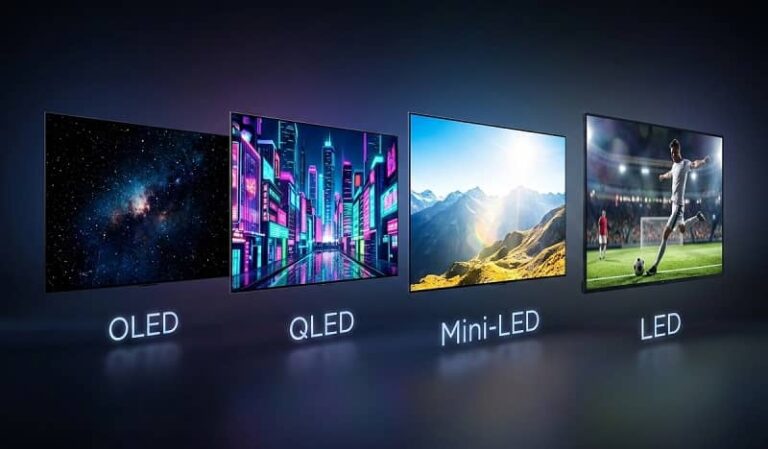
QLED is Samsung’s marketing name for LCD televisions enhanced with a quantum dot filter layer. Quantum dots are nanoscale semiconductor particles that emit precise wavelengths of light when energised — specific sizes produce specific colours with exceptional purity. In a QLED TV, a quantum dot film sits between the LED backlight and the LCD panel, converting the backlight’s broad-spectrum blue LEDs into more precisely defined red, green, and blue light before it passes through the liquid crystals.
The practical result is significantly improved colour volume — QLEDs can display a wider colour gamut and maintain colour accuracy at high brightness levels better than standard LED TVs without quantum dots. Brightness is QLED’s primary strength: the best QLED sets reach 2,000 to 3,000 nits of peak brightness, which makes them exceptional for bright, sunlit rooms where OLED’s lower peak brightness would wash out. Contrast is better than standard LED but still limited by the LCD backlight architecture — blacks are dark grey rather than true black.
LG’s equivalent marketing term is QNED, which combines quantum dot technology with NanoCell colour filtering and typically pairs it with Mini-LED backlighting on higher-end models. The underlying technology is essentially the same approach as QLED — quantum dots improving colour accuracy in an LCD panel — with different proprietary variations in the filtering layer.
Mini-LED
Mini-LED is a backlight technology, not a panel technology. Mini-LED TVs use the same LCD panel as standard LED TVs but replace the conventional LED backlight with thousands of much smaller LEDs — a typical Mini-LED TV might use 1,000 to 5,000 individual dimming zones compared to the 50 to 200 zones in a standard full-array LED TV. More zones means more precise local dimming, which produces dramatically better contrast, deeper blacks, and reduced blooming compared to standard LED backlights.
The result narrows the gap with OLED significantly. A premium Mini-LED TV like Samsung’s QN90D or the TCL QM8 can produce black levels approaching OLED in dark scenes while exceeding OLED’s peak brightness by a factor of three or four — making them particularly strong for HDR content in bright rooms. Blooming still exists — a bright object on a pure black background will still produce a subtle halo — but at high zone counts it becomes difficult to notice in normal viewing conditions.
Mini-LED occupies a compelling middle ground in the market: better contrast than standard QLED, higher brightness than OLED, no burn-in risk, and pricing that, while premium, typically undercuts equivalent OLED sets. For gaming in particular, where sudden transitions between very dark and very bright scenes occur frequently, high-brightness Mini-LED sets with 120Hz or 144Hz panels are a strong alternative to OLED.
OLED — Organic Light-Emitting Diode
OLED is the most discussed TV technology of the past decade and the benchmark against which all others are measured for picture quality. Each pixel in an OLED panel contains organic compounds that emit light directly when electrically charged — no backlight required. When a pixel needs to display black, it simply turns off completely, producing true zero-light black. The contrast ratio of an OLED display is effectively infinite — the darkest point is absolute darkness, the brightest point is as bright as the panel can drive those pixels.
The practical picture quality advantages are substantial. Black levels in dark scenes are unmatched by any transmissive display regardless of price. Viewing angles are the widest available — colour and contrast remain accurate when viewed from extreme angles, unlike LCD panels which shift colour and lose contrast when viewed off-axis. Response times are extremely fast, producing sharp motion with minimal blur. Colour accuracy out of the box is consistently excellent across all major OLED manufacturers.
OLED’s weaknesses are real and worth understanding. Peak brightness is lower than the best LED and Mini-LED TVs — typically 800 to 1,200 nits for the brightest LG OLED models, compared to 2,000 to 3,000 nits for premium QLEDs. In a bright, sunlit room, this matters. Burn-in — permanent image retention caused by static elements like news tickers, sports scores, or navigation bars displayed for extended periods at high brightness — is a genuine risk, though modern OLED panels have significantly reduced its likelihood through pixel-refreshing algorithms and brightness limiting. For the best home cinema experience in a controlled-light environment, OLED remains the standard. The content available through Amazon Prime Video and other streaming platforms in 4K HDR looks exceptional on a quality OLED panel.
QD-OLED — Quantum Dot OLED
QD-OLED is the most technically sophisticated TV technology currently in mainstream production. Developed by Samsung Display and used in panels sold under both Samsung and Sony’s premium TV lines, QD-OLED combines the self-emissive pixel architecture of OLED with quantum dot colour conversion. Instead of the white OLED subpixels used in LG’s WOLED panels, QD-OLED uses blue OLED subpixels that emit blue light, which then strikes red and green quantum dot layers to produce the full colour spectrum.
The result addresses the two main criticisms of standard OLED simultaneously. Colour volume is dramatically improved — QD-OLED sets consistently measure near or above 100 percent of the DCI-P3 colour space at high brightness, whereas standard WOLED panels lose colour saturation as brightness increases. Peak brightness is also higher than standard OLED, with current QD-OLED panels reaching 1,500 to 2,000 nits in small highlight windows. The combination produces the most visually impressive picture quality currently available in a production TV: OLED-level black depth with near-QLED colour vibrancy.
The trade-off is price — QD-OLED panels appear in premium sets from Samsung and Sony that typically start at $1,500 and rise steeply. Burn-in risk exists for the same reasons as standard OLED. For buyers who want the absolute best picture quality and have the budget to match, QD-OLED currently represents the highest point of the market.
MicroLED
MicroLED is the most technologically ambitious display type currently in existence and the least accessible to mainstream consumers. MicroLED panels use microscopic inorganic LEDs — each one smaller than a human hair — as individual self-emissive pixels. The technology combines OLED’s perfect-black emissive architecture with the high brightness, long lifespan, and burn-in immunity of inorganic LEDs. On paper it is the ideal display technology: true black like OLED, extreme brightness like LED, no organic compounds to degrade, and no backlight.
In practice, MicroLED is currently available only in Samsung’s modular “The Wall” installation products starting at tens of thousands of dollars, and in a small number of ultra-premium consumer sets. The manufacturing challenge — precisely placing millions of microscopic LEDs onto a substrate at consumer scale and acceptable yield rates — has not yet been solved at price points accessible to most buyers. Industry analysts expect MicroLED to become more accessible through the late 2020s, but as of 2026 it remains aspirational technology for the vast majority of buyers.
What Are the 5 Types of TVs in Order?
Ranked from most to least common in terms of current market availability: LED/LCD is the most widely available at all price points. QLED and Mini-LED occupy the mid-range to premium segment. OLED covers the premium market with the widest range of screen sizes. QD-OLED sits at the top premium tier. MicroLED exists at the extreme luxury end. Plasma and CRT are legacy technologies no longer in production. For practical purposes, the five types a buyer will encounter in a typical electronics store are LED, QLED, Mini-LED, OLED, and QD-OLED.
Which Is Better — OLED or QLED?
OLED is better for dark room viewing, cinema content, and anyone who prioritises black levels and contrast above all else. QLED is better for bright rooms, sports viewing, and anyone who watches primarily in daylight conditions where OLED’s lower peak brightness would be overwhelmed. Neither is objectively superior across all scenarios — the right answer depends entirely on where and how you watch. A buyer who watches movies at night in a darkened room will prefer OLED every time. A buyer with floor-to-ceiling windows and no light control will get more consistent performance from a high-brightness QLED or Mini-LED set.
How to Choose the Right TV Type for Your Home
Room lighting is the single most important factor in choosing a TV technology. Emissive displays like OLED and QD-OLED reach their full potential in rooms with controlled lighting — a darkened living room or dedicated home cinema where the surrounding environment does not wash out the exceptional black levels that make these panels special. In a bright room with windows and ambient light, the contrast advantage of OLED shrinks significantly, while a high-brightness QLED or Mini-LED set remains punchy and visible at all times of day.
Viewing angle matters more than most buyers anticipate. If your seating arrangement places viewers at the sides of the room rather than directly in front of the TV, OLED and QD-OLED maintain consistent colour and contrast at wide angles that LCD-based panels cannot match. Standard VA-panel LCDs — which most QLEDs use — show noticeable colour shift and contrast loss beyond about 30 degrees off-axis. IPS-panel LCDs handle angles better but sacrifice black level depth in exchange. If multiple people often watch from different positions, OLED’s viewing angle advantage is practically significant.
Budget determines the realistic technology options. Under $500, the market is entirely LED LCD with varying backlight configurations — full-array direct-lit with basic local dimming is the target at this price. Between $500 and $1,000, Mini-LED and QLED options become available that deliver meaningfully better performance. Between $1,000 and $2,000, entry and mid-tier OLED sets from LG and Sony become accessible — the LG C-series in particular is the most recommended OLED at this range. Above $2,000, QD-OLED, premium OLED with MLA technology, and high-end Mini-LED sets compete at the top of the market. For tracking what to watch on whichever TV you choose, the tools for tracking TV shows make managing a watchlist across streaming services significantly easier.
Burn-in is a frequently overstated concern for most buyers. The risk is real but concentrated in specific use cases: watching news channels with static lower-third graphics for many hours daily, or leaving a video game HUD at maximum brightness for thousands of hours. A typical viewer who watches a mix of streaming, sports, and films across multiple sources is extremely unlikely to experience burn-in on a modern OLED panel within its expected product lifespan. If you are a dedicated sports viewer who watches the same channel with a static score bug for six or more hours daily, a Mini-LED or QLED set is the more conservative choice.
Screen size interacts with technology choice because OLED panel manufacturing costs scale significantly with size. The most common OLED screen sizes are 55, 65, and 77 inches, with 83-inch panels available at steep premiums. Mini-LED and QLED are available in larger sizes — 85 and 98 inches — at prices that compete favourably with smaller OLED sets. For buyers who prioritise screen size over absolute picture quality, a large Mini-LED set at 85 inches can deliver a more impactful viewing experience than a smaller OLED at the same price point. The audio setup matters as much as the screen — the best speakers for movies and gaming complement a quality display in ways that the TV’s built-in audio rarely can.
Refresh rate and input lag matter specifically for gaming. All modern TV types are available with 120Hz panels, which is the recommended minimum for current-generation console gaming. OLED panels have historically offered the lowest input lag — some LG OLED models measure under 1ms — which is why they are the preferred display among competitive gamers. Mini-LED sets at 120Hz and 144Hz have closed this gap considerably. For casual gaming at 60Hz, any modern TV type performs adequately.
TV Panel Technologies Inside LCD TVs — VA vs IPS
Within the LCD/LED category, two panel types determine different performance characteristics independently of the backlight. VA panels — Vertical Alignment — produce deeper blacks and better contrast but show significant colour shift when viewed from the side. They are the dominant panel type in mid-range to premium QLED and LED TVs. IPS panels — In-Plane Switching — maintain colour accuracy at wide viewing angles but sacrifice contrast depth, showing lighter blacks than VA panels. IPS appears more commonly in monitors and some budget to mid-range TVs. When choosing between two similarly specified LED TVs, checking whether they use VA or IPS panels clarifies the real-world performance difference that spec sheets often obscure.
Frequently Asked Questions
What are the 5 types of TVs?
The five TV types a buyer encounters in today’s market are LED/LCD (most common, all price ranges), QLED (enhanced colour LCD, mid-range to premium), Mini-LED (advanced backlit LCD, premium), OLED (self-emissive, premium), and QD-OLED (quantum dot OLED, top premium). MicroLED exists but is not yet accessible to mainstream buyers. CRT and Plasma are legacy technologies no longer in production.
Which is better — OLED, QLED, or 4K?
OLED, QLED, and 4K are different categories — OLED and QLED describe panel and backlight technology while 4K describes resolution. Almost all OLED and QLED TVs sold today are 4K. For picture quality, OLED outperforms QLED in dark room contrast and black levels. QLED outperforms OLED in peak brightness for bright room viewing. QD-OLED combines the strengths of both at a higher price point.
Is OLED worth the extra cost over QLED?
For dark room viewers who prioritise cinema-quality contrast, yes — the picture quality difference is immediately visible and OLED’s advantages compound with good content in a controlled environment. For bright room viewers or those primarily watching sports and daytime TV, a high-brightness Mini-LED or QLED set at a lower price often makes more practical sense. The value calculation depends almost entirely on your specific viewing environment and habits.
What is the difference between Mini-LED and OLED?
Mini-LED uses thousands of tiny LEDs as a backlight behind an LCD panel — it is a transmissive display that requires a backlight. OLED is emissive — each pixel produces its own light and can turn off completely for true black. OLED produces better black levels and contrast in ideal conditions. Mini-LED produces higher peak brightness and has no burn-in risk. Mini-LED typically costs less than equivalent OLED at the same screen size.
Does TV panel type affect streaming quality?
Yes — the panel technology determines how HDR content from streaming platforms is rendered. OLED and QD-OLED display the high-contrast, wide-colour HDR10 and Dolby Vision content from services like Netflix, Disney Plus, and Hulu with the full dynamic range the content was graded for. QLED and Mini-LED sets require careful HDR calibration to get accurate results, particularly in darker scenes where backlight blooming can obscure shadow detail that OLED renders cleanly.
How many types of TV are there?
There are eight distinct TV display technologies: CRT (legacy), Plasma (legacy), LCD/LED (current), QLED (current), QNED (current), Mini-LED (current), OLED (current), QD-OLED (current), and MicroLED (emerging). In practice the active market for new TV purchases in 2026 covers five main types: LED, QLED/QNED, Mini-LED, OLED, and QD-OLED. CRT and Plasma are collector items. MicroLED is available only at extreme price points.
Is burn-in still a problem with OLED TVs?
Burn-in risk on modern OLED panels is significantly lower than early OLED sets from 2015 to 2018. Current LG, Sony, and Samsung OLED TVs include pixel-shifting, automatic brightness limiting, and panel-refresh cycles that reduce the conditions under which burn-in occurs. For typical mixed-use viewing — streaming, sports, gaming across different sources — burn-in is unlikely within the realistic product lifespan of 7 to 10 years. The elevated risk applies specifically to users who display static content at high brightness for many hours daily over years.
Conclusion
The TV market in 2026 has never offered better value at every price point, but the range of technologies available makes the decision genuinely complex without a clear framework. The fundamental choice remains emissive versus transmissive: OLED and QD-OLED for viewers who want the deepest blacks and best contrast in a controlled light environment, Mini-LED and QLED for viewers who prioritise brightness and burn-in immunity in a bright room or want maximum screen size for their budget.
For most buyers, the decision comes down to three questions: How bright is your room? How much do you want to spend? How large a screen do you need? A dark room with a $1,500 budget and a preference for 65 inches points clearly toward a mid-tier OLED. A sunlit living room with a $1,200 budget and a desire for 75 inches points equally clearly toward a premium Mini-LED or QLED. The technology gap between the best sets in each category has narrowed — any of the top-tier options from major manufacturers will produce a picture quality that would have been considered extraordinary just five years ago.
CRT and Plasma had their era and shaped everything that followed. MicroLED will likely define the next era when manufacturing costs fall to realistic levels. For now, the practical market sits between the excellent value of full-array LED, the brightness advantage of QLED and Mini-LED, and the contrast supremacy of OLED and QD-OLED — each occupying a legitimate position depending on what you watch, where you watch it, and what you are willing to pay.

Full-stack developer at Scylla Technologies (USA), working remotely from Bangladesh. Adobe Certified Magento Developer.