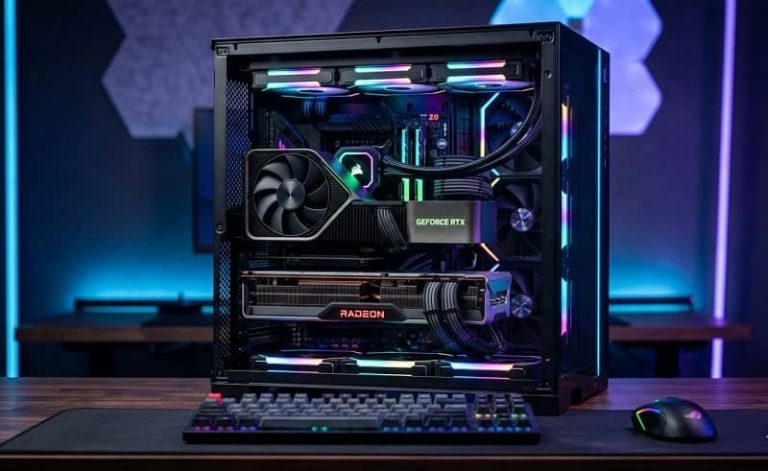
The best GPU in the US market today is no longer just about buying the most expensive graphics card. After benchmarking modern GPUs across gaming, rendering, and AI workloads, the real winners are defined by performance-per-dollar, VRAM capacity, and software technologies like DLSS, FSR, and AI acceleration. The current generation of GPUs has created clear tiers—from extreme 4K monsters to highly efficient mid-range cards that outperform last generation flagships.
Independent benchmark hierarchies consistently rank Nvidia’s RTX 5090 as the fastest consumer GPU available, while AMD’s RX 9070 XT dominates value-focused performance segments in real gaming workloads. According to aggregated benchmark rankings and pricing data, GPU selection now depends heavily on resolution target and budget rather than raw horsepower alone.
This list ranks the top GPUs currently available in the United States based on real benchmarks, pricing trends, and long-term usability.
Top GPUs Available in the US Market (Ranked)
NVIDIA GeForce RTX 5090 — Best Overall GPU
The RTX 5090 sits at the absolute top of the performance hierarchy, designed for uncompromising 4K gaming, AI workloads, and professional rendering. Benchmarks show it leading all consumer GPUs thanks to massive CUDA core counts and next-generation ray tracing acceleration. Testing indicates it can push modern titles beyond 120 FPS at 4K Ultra settings where previous generations struggled.
Price (USA): ~$1,999 MSRP (market prices vary due to demand).
It excels in ray tracing, AI upscaling, and productivity workloads, though high power draw and cost make it impractical for average gamers.
- 32GB GDDR7 VRAM
- 21,760 CUDA cores
- DLSS 4 support
- Advanced AI tensor cores
- Extreme 4K and creator performance
Where to buy: NVIDIA partners and major US retailers.
AMD Radeon RX 9070 XT — Best Performance Value GPU
The RX 9070 XT has become the most balanced high-performance card available. Real-world testing shows performance close to higher-priced Nvidia competitors while costing significantly less. Analysts frequently call it the ideal 1440p Ultra and entry-level 4K GPU due to strong rasterization performance.
Price (USA): ~$599 MSRP.
It delivers excellent gaming performance but trails Nvidia slightly in ray tracing and AI workloads.
- 16GB GDDR6 VRAM
- RDNA 4 architecture
- High rasterization performance
- Strong 1440p/4K gaming capability
- Lower power requirements
Where to buy: AMD board partners and online retailers.
NVIDIA GeForce RTX 5080 — High-End Enthusiast Choice
The RTX 5080 bridges the gap between flagship and enthusiast tiers. Benchmark comparisons show roughly a 25% FPS advantage over AMD’s mid-high cards, making it a strong option for competitive 4K gaming and creators needing CUDA acceleration.
Price (USA): ~$1,199–$1,399 depending on model.
Its strength lies in ray tracing and DLSS performance, although price inflation has reduced overall value.
- Next-gen Blackwell architecture
- Advanced ray tracing cores
- DLSS AI upscaling
- High 4K frame rates
- Creator workload optimization
Where to buy: Authorized NVIDIA partners.
NVIDIA GeForce RTX 5070 — Best Mid-Range GPU
The RTX 5070 is widely considered the sweet spot for gamers upgrading from older RTX 30-series cards. It delivers strong 1440p performance with modern AI features, making it future-ready for upcoming game engines.
Price (USA): ~$549 MSRP.
While powerful, pricing fluctuations sometimes reduce its advantage compared with AMD alternatives.
- Excellent 1440p gaming
- DLSS 4 frame generation
- Efficient power consumption
- Ray tracing support
- Modern encoder for streaming
Where to buy: Major US electronics retailers.
AMD Radeon RX 9060 XT — Best Budget Performance GPU
The RX 9060 XT consistently ranks among the best sub-$400 GPUs thanks to strong performance relative to price. Testing shows it outperforming several competing GPUs in traditional rendering workloads while maintaining efficiency.
Price (USA): ~$329–$379.
It is ideal for high-refresh 1080p or entry-level 1440p gaming, though ray tracing performance remains moderate.
- 8GB–16GB VRAM variants
- FSR upscaling support
- Strong price-to-performance ratio
- Efficient thermal profile
- Great esports performance
Where to buy: AMD retailers and online stores.
NVIDIA GeForce RTX 5060 — Reliable Mainstream Choice
The RTX 5060 targets mainstream gamers upgrading older GPUs. While not revolutionary, it provides stable performance, strong driver support, and advanced AI upscaling technologies.
Price (USA): ~$299 MSRP.
It is reliable but faces strong competition from AMD’s similarly priced offerings.
- DLSS support
- Efficient power usage
- 1080p ultra gaming
- Modern NVENC encoder
- Compact designs available
Where to buy: NVIDIA partners.
Intel Arc B580 — Best Entry-Level Value GPU
Intel’s Arc B580 has matured significantly through driver updates, becoming a strong budget option. Reviewers highlight its impressive performance for the price, especially with modern APIs like DirectX 12.
Price (USA): ~$249.
Compatibility has improved dramatically, though some legacy games still perform inconsistently.
- 12GB VRAM
- XeSS AI upscaling
- Strong 1080p performance
- Competitive pricing
- Improved drivers
Where to buy: Intel board partners.
GPU Specification Comparison (Quick Overview)
The current GPU hierarchy clearly separates into three performance tiers. Flagship cards like the RTX 5090 dominate raw performance rankings, while mid-range GPUs such as the RX 9070 XT deliver superior value for most gamers. Budget GPUs increasingly rely on AI upscaling rather than brute-force rendering power.
Benchmark data shows the RTX 5090 leading overall rankings, followed by upper-tier cards like the RTX 5080 and RX 9070 XT. Midrange options now deliver performance previously reserved for premium hardware only two generations ago.
Price vs Performance Comparison
US GPU pricing remains volatile due to memory supply constraints and strong AI demand affecting availability. Market tracking reports indicate high-end GPUs frequently sell above MSRP, especially flagship models. Meanwhile, mid-range GPUs provide the strongest long-term value because performance differences shrink significantly at higher resolutions.
Value-focused buyers typically gain the most benefit from GPUs in the $400–$700 range, where performance scaling remains efficient compared with flagship pricing.
Pros and Cons Across GPU Brands
NVIDIA currently leads in ray tracing performance, AI workloads, and software ecosystem maturity. Technologies like DLSS allow lower-tier GPUs to achieve higher frame rates through AI-assisted rendering.
AMD offers stronger raw rasterization performance per dollar, making its GPUs attractive for traditional gaming workloads where ray tracing is less important. Power efficiency and pricing flexibility also contribute to AMD’s competitiveness.
Intel continues improving rapidly in the budget segment, providing affordable entry points for new PC builders while refining driver stability.
Which GPU Should You Buy Right Now?
If budget is unlimited, the RTX 5090 delivers unmatched performance and future-proof capability. For most gamers, however, the RX 9070 XT or RTX 5070 represents the smartest purchase because performance gains above this tier become increasingly expensive per frame.
Entry-level builders should consider Intel Arc or RTX 5060-class GPUs, which now offer performance once considered high-end only a few years ago.
Conclusion
The US GPU market has reached a rare balance where nearly every price tier offers a strong option. Flagship GPUs push technological boundaries with AI rendering and advanced ray tracing, while mid-range cards provide exceptional real-world gaming value.
The smartest buying strategy is matching GPU power to your resolution target rather than chasing the highest benchmark score. For most users, mid-range GPUs deliver the best long-term satisfaction, while enthusiasts and creators benefit most from flagship hardware built for extreme workloads.