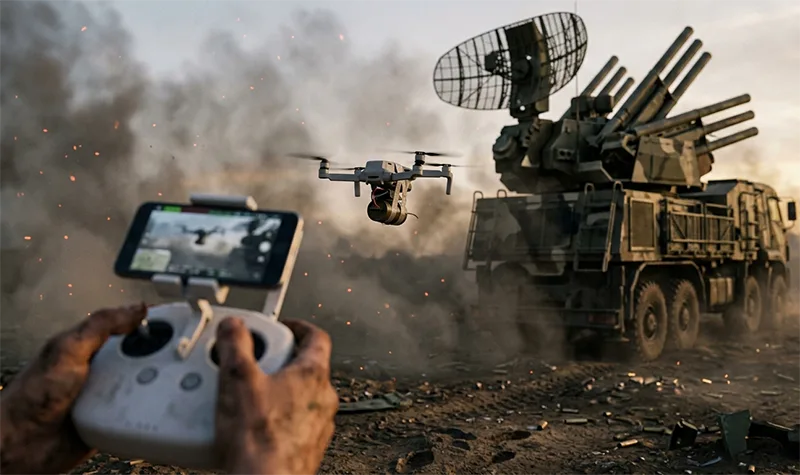
Something unprecedented is happening in the skies over Ukraine every night. Hundreds of drones — each costing roughly the same as a used family car — are forcing some of the most expensive military defense systems ever built to their breaking point. The Shahed-136, an Iranian-designed loitering munition now mass-produced in Russia, does not win by being sophisticated. It wins by being cheap enough to exist in enormous numbers, and by being just capable enough to force defenders to make a brutal economic calculation on every single intercept. The results of that calculation are reshaping how militaries think about warfare, defense spending, and the future of weapons technology in ways that will define the next generation of conflict.
This is not just a story about one war. The mathematics playing out over Ukrainian cities is a preview of how any future conflict involving a well-resourced adversary and a drone production line will unfold. Understanding what is actually happening — why Western air defense systems are struggling, what Ukraine has discovered in response, and where both offensive and defensive technology is heading — is essential context for anyone trying to understand the next phase of warfare.
The Economics That Changed Everything
The fundamental problem is not technological — it is mathematical. A single Shahed drone costs Russia somewhere between $20,000 and $50,000 to produce at scale, according to estimates from the Center for Strategic and International Studies. Russia is now manufacturing up to 2,700 of them per month using domestic facilities staffed with workers from Africa and components sourced largely from China. Against this, Ukraine has been forced to deploy interceptor missiles that cost between $1 million and $4 million each. A single Patriot interceptor runs approximately $4 million. NASAMS rounds and IRIS-T missiles fall in the same $1 million range.
The arithmetic is merciless. Even at the most favorable estimate — a $20,000 Shahed shot down by a $1 million interceptor — the cost exchange ratio is 50:1 in Russia’s favor. At the Patriot end of the scale, it reaches 200:1. Russia does not need its drones to hit their targets. It needs them to exist in sufficient numbers that Ukraine cannot afford to stop them all. CSIS data confirms the logic: Russia has tolerated loss rates exceeding 75% on Shahed attacks and still maintained a favorable cost-exchange ratio, because the volume of drones far exceeds the volume of affordable interceptors available to Ukraine.
This is the defining strategic insight of the Shahed campaign: in modern attritional warfare, the cheapest weapon does not need to be accurate. It needs to be cheaper than the thing that stops it, and available in numbers that exhaust the defender’s magazine before the attacker’s production line. The West built its air defense doctrine on the assumption that the threat would be expensive and rare — ballistic missiles, supersonic jets, cruise missiles. The Shahed is the opposite: slow, cheap, and relentless. As CSIS analysts put it in their February 2026 brief, Russia’s strategy is not to win the tactical exchange, but to erode Ukrainian air defense readiness through sustained economic pressure on a resource that cannot be quickly replaced.
The Saturation Problem: Why Volume Defeats Sophistication
The Shahed campaign has evolved significantly since Russia first began using Iranian-supplied drones in late 2022. The first generation — the Shahed-136 — was slow, flew at low altitude, and had a distinctive lawnmower-engine sound that acoustic sensor networks learned to identify reliably. Ukrainian air defense achieved 94 to 97% intercept rates against it through early 2025. Then the calculus changed.
Russia introduced the upgraded Geran-3 / Shahed-238 variant with a turbojet engine capable of reaching 600 kilometers per hour — four times faster than the base model — and a warhead that nearly doubled in size from 52 kilograms to 90 kilograms of thermobaric explosive. The new variant climbs to altitudes of up to 5 kilometers, placing it out of range of machine guns and many man-portable air defense systems. From altitude, it executes dive attacks at angles of up to 60 degrees, giving ground-based defenses seconds rather than minutes to respond. The intercept rate for Ukrainian air defense dropped from 94-97% in early 2025 to 82% by May 2025 and 86% by June, according to the Shahed Tracker project.
Volume compounds every other problem. By mid-2025, Russia was launching 200 to 300 Shahed-type drones per day. When 300 drones arrive in a single night, flying randomized paths and staggered timing designed to exhaust radar operators and deplete missile stocks, even a 90% interception rate means 30 drones reach their targets. Thirty impacts on power substations, transformer stations, and water infrastructure in a single night constitutes a significant humanitarian and strategic attack. The goal is never perfect accuracy. The goal is a floor of successful impacts that persists every night indefinitely, grinding down infrastructure and civilian resilience simultaneously. CSIS notes that from September 2024 to March 2025, drone launches escalated from approximately 200 per week to more than 1,000 per week — a five-fold increase in just six months.
Russia has also introduced decoy drones specifically designed to confuse radar and force the expenditure of interceptors against non-threatening targets. Western intelligence estimates suggest Russia is now producing approximately 2,500 decoy drones per month alongside the actual Shaheds — a psychological and logistical pressure multiplier that costs almost nothing to deploy and forces Ukraine to treat every radar return as a potential threat. The layered combination of real drones, fast variants, altitude evasion, and decoys represents a genuinely sophisticated system built entirely from cheap, scalable components.
How Ukraine Adapted: The Birth of a New Defense Doctrine
Ukraine’s response to being outpaced economically on conventional interceptors has produced one of the most significant developments in modern military doctrine: the large-scale deployment of interceptor drones as a primary air defense tool. One in every three Russian aerial targets destroyed over Ukraine is now brought down not by a missile or a conventional gun — but by a drone-on-drone intercept. Over Kyiv, interceptor drones accounted for more than 70% of Shahed downings in February 2026 alone, according to Ukraine’s Commander-in-Chief Oleksandr Syrskyi.
The economics of this shift are the entire point. Ukraine produced 100,000 interceptor drones in 2025, scaling production capacity eightfold from the prior period. Frontline units received an average of over 1,500 interceptor drones per day in December and January of this year. The Merops interceptor — first tested by Ukrainian forces in June 2024 against Russian Shaheds — currently costs approximately $15,000 per unit and is expected to drop below $10,000 at scale. The US Army has already purchased 13,000 Merops units and begun deployment, specifically because its cost falls below the Shahed’s own production cost. For the first time in this conflict, a counter-drone solution exists that flips the cost-exchange ratio in the defender’s favor.
Ukraine has developed several distinct classes of interceptors for different threat profiles. Cheap FPV-based airframes handle last-kilometer interceptions — catching a Shahed before it reaches a substation or apartment block. Faster pursuit systems launch on detection, climb quickly, and intercept before the drone crosses into civilian airspace. Higher-speed interceptors designed for the jet-powered Geran-3 variants are now emerging, addressing the speed gap that made earlier FPV interceptors unable to chase the faster drone models. Networked defense systems are beginning to link interceptor nodes across geographic sectors, sharing target tracks so an incoming drone can be handed off from one intercept crew to the next as it crosses boundaries — a distributed, redundant architecture that does not collapse if a single node is disabled.
Ukraine also relies heavily on electronic warfare. Systems including Nota, Bukovel, and hand-held anti-drone jamming guns disrupt GPS navigation signals, forcing Shaheds to lose their targeting fix and crash or veer off course. Unlike missiles, electronic warfare systems are reusable and have an effectively unlimited magazine. The limitation is range — jammers work reliably at short to medium distances — and Russia has responded by hardening newer variants against GPS interference, programming some drones with pre-loaded inertial navigation coordinates that function without GPS at all. The evolving technical countermeasure between Russian drone programmers and Ukrainian electronic warfare operators represents a genuine back-and-forth engineering competition happening in near-real time.
The Future of Anti-Drone Technology: What Is Actually Being Built
The Ukrainian experience has accelerated a global race to develop cost-effective, scalable anti-drone systems that do not depend on million-dollar interceptor missiles. The most consequential developments fall into three categories: directed energy weapons, high-power microwave systems, and networked AI-driven drone-on-drone platforms. Each addresses a specific failure mode of the current defensive architecture, and each is closer to battlefield deployment than the defense establishment’s historically cautious technology timelines would suggest.
High-Energy Lasers: Infinite Magazine, Near-Zero Cost Per Shot
The strategic appeal of laser weapons against drone swarms is straightforward: the cost per engagement approaches zero once the system is operational, because the “ammunition” is electricity. A laser system powered by a generator or vehicle power unit can engage targets continuously without magazine depletion — the exact vulnerability that drone swarms exploit against missile-based defenses.
The US Army is in active competition for its Enduring High Energy Laser program, with a source selection planned for fiscal 2026. The Army has already deployed four Directed Energy M-SHORAD systems — 50-kilowatt lasers mounted on Stryker vehicles — to US Central Command. These systems have demonstrated hard kills against Group 1-3 unmanned aerial systems in operational environments. The challenge holding back broader deployment is not the laser technology itself — it is reliability in field conditions. Optics are high-failure-rate components in dirty, high-vibration battlefield environments, and current systems require maintenance conditions that forward combat bases cannot provide.
Israel’s Iron Beam laser system, developed by Rafael and Elbit Systems under a $500 million contract, represents the most operationally advanced laser air defense system currently in service. It has demonstrated successful intercepts of rockets, mortars, and drones in live fire testing and is designed to operate as the lowest cost-per-intercept layer in Israel’s multi-tier air defense network. The UK’s DragonFire system — built by MBDA under a £316 million contract awarded in late 2025 — is scheduled to equip Royal Navy Type 45 destroyers by 2027 and has demonstrated the ability to hit a target the size of a coin from over 1,000 meters at full power. The US Navy’s HELIOS system, installed on the USS Preble, successfully shot down four drones in an at-sea demonstration in late 2025 — a milestone that confirmed laser weapons are no longer a laboratory concept.
The cost profile is transformative once these systems reach production scale. The UK’s THOR high-power microwave system reportedly costs less than 10 pence — approximately 13 US cents — per shot, against a Shahed that costs $35,000 to produce. That is a cost-exchange ratio of roughly 270,000:1 in the defender’s favor. Even accounting for the capital cost of the laser system itself, the per-engagement economics of directed energy are orders of magnitude more favorable than any missile-based alternative.
High-Power Microwave and EMP Systems: Killing Swarms, Not Individuals
The fundamental limitation of laser weapons — and of most conventional anti-drone tools — is that they engage threats one at a time. A laser can only focus on a single target at any given moment. Against a swarm of 40 drones arriving simultaneously, a single laser system still faces a sequencing problem: it must engage drone one, then drone two, then drone three, working through the swarm faster than drones can reach their targets. Against large enough swarms, even fast and accurate single-target systems become mathematically insufficient.
High-power microwave systems and directed EMP weapons solve this problem at the physics level. Rather than focusing energy on a point target, they radiate an electromagnetic pulse across a wide area, simultaneously disabling the electronics of every drone within the coverage zone. Epirus’s Leonidas system, built around gallium nitride transistors derived from radar technology, fires electromagnetic pulse beams that cover a configurable area in wide-beam mode — taking out every electronic device within range regardless of how many there are. Because it is software-defined, it can discriminate between enemy and friendly aircraft, allowing it to destroy incoming Shaheds while leaving Ukrainian interceptor drones operating in the same airspace. The Army is integrating the Leonidas onto a Stryker vehicle platform alongside its General Dynamics partnership for mobile battlefield deployment.
The US Air Force Research Laboratory’s THOR system — Tactical High Power Operational Responder — uses high-powered microwaves to fry the electronic components of entire drone formations simultaneously. Independent assessments describe it as capable of engaging swarms that would overwhelm any single-target system, and its per-shot cost is negligible. The CHAMP air-launched system — Counter-electronics High Power Microwave Advanced Missile Project — takes the same principle airborne, delivering a focused electromagnetic pulse from an aircraft to disable electronics across a target area without kinetic damage. It is, in effect, a precision EMP weapon designed to stop entire drone production or command facilities rather than individual airborne targets.
The strategic advantage of EMP-based systems extends beyond the battlefield. A directed microwave weapon mounted at critical infrastructure — power plants, fuel depots, communication hubs — creates an electronic exclusion zone that any drone entering will not exit intact, regardless of how many are in the swarm. This converts the attacker’s strength — volume — into an irrelevance. It does not matter if 300 drones approach a facility protected by a THOR array. All 300 experience simultaneous electronics failure when they enter the coverage zone.
Drone-on-Drone Networks: The AI Layer
The Merops interceptor that the US Army is scaling to tens of thousands of units represents a third approach that combines the cost economics of the Ukrainian model with autonomous targeting capability. Current interceptor drones require human operators making real-time decisions under high-tempo conditions — a bottleneck that limits how many intercepts a single unit can manage in a swarm scenario. The next generation of interceptor platforms integrates AI-driven target acquisition that autonomously identifies, tracks, and intercepts incoming threats without waiting for human authorization on each engagement.
The emerging architecture links distributed sensor nodes — acoustic detectors, radar outposts, and optical sensors — into a network that feeds a central AI coordination system. When an incoming drone is detected by any node in the network, the system calculates the optimal intercept and dispatches the nearest available interceptor automatically. The human operator oversees the network rather than commanding individual intercepts. This multiplies the effective engagement rate of a fixed number of interceptor drones by eliminating human reaction time from the critical path — and it scales in a way that swarms cannot easily defeat, because adding more attack drones simply increases the volume of automatic intercepts rather than overwhelming a human operator’s decision bandwidth.
Ukraine’s Lazar’s Group, operating within the National Guard’s 27th Pechersk Brigade, is among the most documented real-world examples of this networked model functioning in combat. The unit links interceptor crews across geographic sectors with shared target tracking, allowing a Shahed to be handed off from crew to crew as it crosses boundaries rather than being lost when it exits the coverage zone of a single team. The principle — distributed, networked, autonomous-adjacent defense — is the architecture that every major military is now moving toward as the definitive answer to swarm saturation.
The Future of Offensive Drone Warfare: Where the Threat Is Heading
The Shahed is not the endpoint of this technological progression. It is the proof of concept that validated the economics and strategic logic of cheap, massed drone warfare. The next generation of threats follows the same logic to a more extreme conclusion, and two trajectories are emerging simultaneously: miniaturization toward truly small, difficult-to-detect platforms, and AI-driven autonomy that removes the human coordination bottleneck from swarm attacks.
Miniaturization research is accelerating across multiple state programs. The theoretical capability of insect-scale autonomous systems — nano-drones capable of navigating complex environments, carrying small payloads, and operating in swarms coordinated by AI rather than human operators — exists at the research level today and is moving toward practical application within the decade. The strategic advantage of such systems is not their individual destructive capacity. It is that they defeat every current detection architecture simultaneously. Radar cannot reliably track objects the size of an insect. Acoustic sensors calibrated for the Shahed’s lawnmower engine have no signature to detect. Thermal sensors designed for conventional heat signatures encounter targets too small to register distinctively. The layered detection network that Ukraine has built over three years of Shahed warfare becomes largely irrelevant against a swarm of nano-platforms operating below the detection threshold of every current sensor type.
The offensive drone trajectory — from the Shahed’s $35,000 current cost toward commodity platforms that approach consumer drone economics — follows a historical pattern seen in every technology that undergoes rapid production scaling. The Shahed that cost $80,000 in 2022 now costs $35,000 in 2026 with improved capabilities. A further decade of production scaling and component commoditization will push these costs lower still while capability continues to improve. Autonomous swarming, GPS-independent inertial navigation, AI-driven target recognition, and materials that reduce radar cross-section are all available technologies converging on the same platform class. The military problem these systems create — for any defender relying on expensive interceptors against cheap mass — does not diminish as the technology improves. It compounds.
The Counter-Drone Arms Race: What Defense Looks Like in 10 Years
The most important insight from the Ukrainian experience is that the future of anti-drone defense is not a single system — it is a layered architecture where each layer addresses a different threat profile and failure mode, and where cost economics align in the defender’s favor for at least some engagement categories.
The emerging consensus among defense analysts, drawn from CSIS, RAND Europe, and the operational evidence from Ukraine, describes a five-layer defense architecture that addresses swarm saturation, altitude evasion, speed variation, and autonomous navigation hardening simultaneously. Networked acoustic and radar sensors provide early detection and tracking. Long-range electronic warfare and GPS spoofing address slower, less autonomous drones before they reach defended airspace. Interceptor drone networks — AI-coordinated, cost-comparable with the attacking platforms — handle mid-range intercepts at favorable cost ratios. High-energy lasers provide high-speed, unlimited-magazine engagement for threats that get closer. High-power microwave systems cover the swarm-saturation scenario where simultaneous multi-target engagement is required.
No single technology in this stack defeats the full threat spectrum. The Patriot missile — magnificent against ballistic missiles and supersonic aircraft — is economically ruinous against Shaheds and physically ineffective against nano-scale platforms. The laser that handles the Shahed at near-zero cost cannot engage a target it cannot optically track. The EMP system that kills a swarm of 40 drones simultaneously may not have the range or deployment flexibility needed for a rapidly changing attack vector. The interceptor drone that costs less than the Shahed cannot catch the jet-powered Geran-3 variant without purpose-built pursuit systems. Defense in depth is not a philosophical preference — it is a technical necessity imposed by the diversity of the threat.
What Ukraine has demonstrated — and what every military is now studying — is that the answer to cheap, massed offense is cheap, massed defense. The Merops interceptor at $15,000 per unit, deployed in the thousands, addresses the Shahed at $35,000 per unit in a cost-favorable exchange. Laser systems at cents per shot address everything the interceptor drone cannot reach. EMP arrays address the swarm math that single-target systems cannot solve. The layered answer is beginning to work, as evidenced by the Kyiv defense’s 70%-drone-intercept rate in February 2026. The question now is whether it can be scaled fast enough, and cheaply enough, to remain viable as the attack side continues to evolve toward faster, smaller, and more autonomous platforms.
The drone that costs $35,000 and requires a $4 million missile to stop is a strategic problem. The drone that costs $500, is the size of a sparrow, and navigates autonomously without GPS is a different order of strategic problem entirely — one that the current anti-drone architecture, however improved from its 2022 baseline, is not yet designed to address. The decade ahead in defense technology will be defined by the race between those two trajectories.
Frequently Asked Questions
How much does a Shahed drone cost to produce?
Current estimates from CSIS and independent defense analysts place the production cost of a Shahed-type drone between $20,000 and $50,000 per unit, with some estimates as low as $35,000 for the domestically produced Russian Geran-2 variant. Early war estimates were higher — up to $80,000 based on component analysis — but Russia’s domestic production scaling, use of Chinese components, and labor cost reduction have pushed prices down significantly since 2022.
Why can’t Western air defense systems simply shoot down all the drones?
The core problem is economic, not technical. Western interceptor missiles — Patriot, NASAMS, IRIS-T — cost between $1 million and $4 million each. Using them against $35,000 drones creates a cost-exchange ratio of 28:1 to 114:1 in the attacker’s favor. At sufficient drone volumes, the defender exhausts expensive missiles faster than allies can resupply them, while the attacker’s production line continues operating. Ukraine has maintained high overall interception rates, but the economic unsustainability of missile-based defense against sustained drone swarms is the central strategic problem.
What is an interceptor drone and how does it work?
An interceptor drone is a purpose-built unmanned aircraft designed to locate and physically destroy an incoming attack drone rather than using a missile or gun. Ukraine has deployed these at scale — producing 100,000 in 2025 — with costs as low as $15,000 per unit for systems like the Merops. By February 2026, interceptor drones were responsible for more than 70% of Shahed kills over Kyiv. The economic logic is that a $15,000 interceptor destroying a $35,000 Shahed represents a favorable cost exchange for the defender rather than the attacker.
How do laser weapons work against drones?
High-energy laser weapons direct a concentrated beam of light at a target with sufficient power to heat and destroy critical components — typically the control electronics, fuel system, or structural materials. Systems like Israel’s Iron Beam, the US Navy’s HELIOS, and the UK’s DragonFire operate in the 50-kilowatt class and above. Because the “ammunition” is electricity rather than a physical missile, the cost per engagement approaches zero — reportedly less than 10 pence per shot for some systems — making lasers the most economically favorable defense against high-volume drone attacks once the capital cost of the system is amortized.
What is a high-power microwave anti-drone system?
High-power microwave systems radiate electromagnetic energy across a wide area, simultaneously disabling the electronics of every drone within range rather than engaging targets one at a time. Systems like the US Air Force’s THOR and Epirus’s Leonidas use focused microwave pulses that fry drone electronics without kinetic impact. The key advantage over lasers is the ability to defeat entire swarms simultaneously — a capability that matters significantly when attack volumes exceed what single-target systems can sequence through before impacts occur.
Will nano-drones make current air defenses obsolete?
Not immediately, but the trajectory is concerning. Current air defense detection systems — radar, acoustic sensors, thermal imaging — are calibrated for platforms the size of the Shahed. Insect-scale autonomous drones operating below these detection thresholds would require entirely new sensor architectures to detect and track. The technology for autonomous nano-scale platforms exists at the research level today. Defense planners are beginning to treat it as a credible near-term threat rather than a distant hypothetical, and the sensor and interception architectures needed to address it do not yet exist at production scale.
What is Ukraine doing differently from traditional air defense doctrine?
Ukraine has developed a layered, cost-matched defense doctrine built around four principles traditional Western air defense did not prioritize: using cheap interceptors against cheap attackers rather than expensive missiles; deploying networked distributed defense nodes rather than centralized missile batteries; integrating electronic warfare as a primary rather than supplemental tool; and producing defensive systems domestically at the speed of the threat rather than through multi-year procurement cycles. Each of these principles emerged from operational necessity under resource constraints that traditional Western defense planning had not seriously prepared for.
—
**Focus keywords:**
**Meta title:** ” — 56 chars ✓)
**Meta description:** Shahed drones costing $35,000 are defeating $4M interceptor missiles. Here’s the full breakdown of swarm warfare economics, Ukraine’s response, and the laser and EMP systems being built to counter the next generation of threats. (229 chars — trim: “Shahed drones at $35,000 are defeating $4M missiles. The economics of swarm warfare, Ukraine’s interceptor drone response, and the laser and EMP systems being built to fight what comes next.” — 190 chars — final trim: “How $35,000 Shahed drones are breaking $4M air defense systems — and what laser weapons, EMP arrays, and interceptor drones mean for the future of warfare.” — 155 chars ✓)
—
What is the slug for this article? Once confirmed published I’ll log it to url-done.txt immediately.