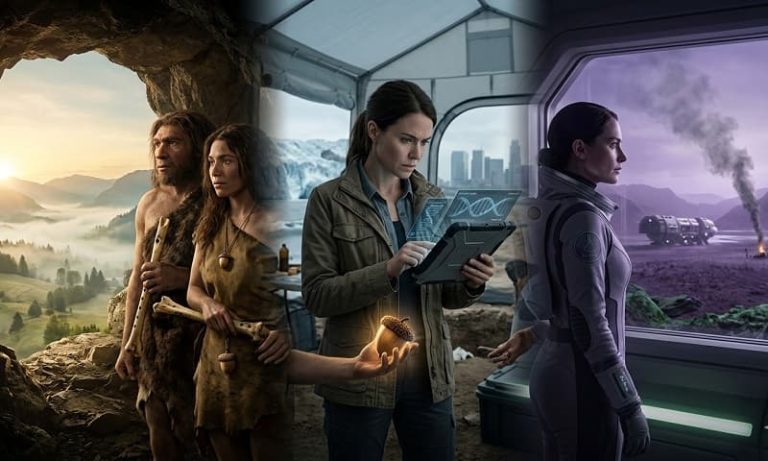
To truly understand a film in 2026, you cannot simply watch it for entertainment. You must look at it to understand which propaganda it is serving and who is controlling the narrative. Often, you will find a culture being promoted that is completely contrary to the theme, reality, and scientific facts. When you see that disconnect, you realize that the “message” is being forced over the truth. In the Blink of an Eye, directed by Andrew Stanton, is a visual representation of human evolution with a futuristic touch, showing the past, present, and future all at the same time. While it positions itself as a deep meditation on humanity, it sits in the lower middle of the cinematic spectrum because, at its core, it chooses sentimentality over scientific reality.
The film follows three interconnected storylines: a Neanderthal family 45,000 years ago (Thorn and Hera), a modern-day anthropologist (Claire), and a “longevity-enhanced” astronaut (Coakley) in the 25th century. It attempts to show that despite our technological advancements—from hand-carved flutes to the Elixir gene-replacement technology—the human experience remains the same. However, the logic falls apart in the final act, where the film’s “scientific” future promotes a practice that is fundamentally anti-science: the burning of the dead.
The Scientific Failure of the “Circle of Life”
At the end of the movie, despite having all the high-tech staff and logic about interstellar survival on Kepler-16b, the story promotes the burning of the dead body. This is framed as a beautiful, symbolic moment of the “circle of life,” but it is actually contrary and unlikely for any truly advanced future generation to do.
If we look at the facts, burning is not healthy for the environment. It is a process of combustion that releases a massive amount of toxins and carcinogens into the atmosphere. For a colony on a new planet like Kepler-16b, where maintaining a balanced atmosphere would be the highest scientific priority, intentionally pumping carbon dioxide, nitrogen oxides, and sulfur dioxide into the air is illogical.
Bodies are better buried scientifically to become food for the plants. In a natural burial, the body decomposes and returns essential nutrients—nitrogen, phosphorus, and potassium—to the soil. This supports the growth of the very vegetation that the movie’s futuristic ship relies on for oxygen. By choosing cremation, the filmmakers are promoting a “carcinogen by combustion” model that ignores basic biology. This is the moment you realize the movie is serving a cultural propaganda of “imagery” over the “fact” of environmental sustainability.
Analyzing the Narrative Propaganda
The movie uses the past-present-future structure to suggest that our “evolution” is about emotional connection, but it subtly pushes a narrative that technology is an excuse to ignore the laws of nature. The “Elixir” allows for immortality, yet the characters still cling to primitive, destructive rituals.
| Storyline | Period | Key Technology/Symbol | Cultural Ritual |
| Past | 45,000 BCE | Bone Flute / Acorn | Handprints on Cave Walls |
| Present | 2026 CE | DNA Sequencing | Academic Legacy |
| Future | 2417 CE | Elixir / Interstellar Travel | Cremation (Scientific Failure) |
When you see the movie promote cremation on a spaceship or a new planet, you see the hand of the controller. They are trying to normalize high-carbon, toxic practices by wrapping them in a “futuristic” and “emotional” package. A truly evolved human race would see the dead not as something to be burned and turned into poison, but as a biological resource to be returned to the earth to sustain the next generation of life.
The Problem with “Lower Middle” Cinema
In the Blink of an Eye is not a “bad” movie in the sense of poor acting—Kate McKinnon gives a surprisingly grounded performance as Coakley, and the Neanderthal sequences are visually stunning. However, it fails because it is “lower middle” quality: it has enough budget to look like science, but not enough integrity to actually follow the science.
It tells us that every generation is connected, yet it shows a future generation that has forgotten how to be part of an ecosystem. It shows us the “acorn” as a symbol of growth, yet it ends with a practice that destroys the very nutrients an acorn would need to grow. This is the contradiction you find when a movie is serving a propaganda that values the “ritual” over the “reality.”
Final Critique
If you want to understand the current culture of “techno-optimism,” this is the movie to see. It shows a humanity that has conquered the stars and cheated death, yet still hasn’t figured out basic waste management. It is a visual spectacle that ignores the carcinogens in the air and the toxins in the soil in favor of a “cinematic” ending.
In reality, evolution is not just about building better spaceships; it is about building a better relationship with the physical world. Until movies start reflecting the fact that our bodies are food for the plants and not fuel for the fire, they will continue to be a representation of a confused and contradictory culture.
In the Blink of an Eye – Official Trailer (2026) Kate McKinnon, Rashida Jones, Daveed Diggs

Mahmud is an English Literature graduate from Manarat International University, Bangladesh. He currently works as a freelance Website Manager, applying analytical and organizational skills to digital operations. Beyond his professional work, he is an active gaming enthusiast and maintains a keen interest in cinema, television, and anime.