
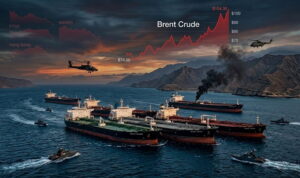
Iran has declared the Strait of Hormuz closed, with its Revolutionary Guard Corps warning that any ship attempting to pass through the vital waterway will be attacked, sending global oil prices sharply higher and bringing international shipping in the region to a virtual halt. The announcement, reported by Iranian state media on Monday, marks a severe escalation in the conflict that erupted after U.S. and Israeli strikes targeted Iranian sites, including the reported killing of Supreme Leader Ali Khamenei.
Shipping companies have responded immediately by suspending tanker movements through the narrow chokepoint between Iran and Oman, which handles roughly one-fifth of the world’s seaborne crude oil and a similar share of liquefied natural gas shipments. Tanker traffic has plunged, with major operators such as Maersk and MSC halting transits amid soaring insurance costs and direct threats from Tehran.
Brent crude, the global oil benchmark, jumped as much as 13 percent to $81.57 a barrel in early trading before easing to around $77.53, still marking a 6.4 percent gain on the week and the highest level in more than a year. Analysts warn that a prolonged blockade could push prices well above $100 a barrel, with ripple effects on gasoline costs, heating bills, and broader inflation worldwide.
The closure stems directly from Iran’s retaliation to the weekend’s U.S. and Israeli military campaign, which Iranian officials have described as an act of aggression aimed at regime change. Ebrahim Jabari, a senior adviser to the commander-in-chief of Iran’s Islamic Revolutionary Guard Corps, stated unequivocally on state television that the strait is closed and that naval forces would set ablaze any vessel attempting to transit it.
The Strategic Chokepoint at the Heart of Global Energy Security
The Strait of Hormuz serves as the only sea passage from the Persian Gulf to the open ocean, making it one of the most critical energy arteries on the planet. Approximately 21 million barrels of oil pass through its waters each day under normal conditions, accounting for about 20 percent of global seaborne crude supplies. Major producers including Saudi Arabia, the United Arab Emirates, Kuwait, Iraq, and Iran itself rely on this route to reach key markets in Asia, Europe, and beyond.
Liquefied natural gas shipments add another dimension of vulnerability, with roughly one-fifth of worldwide LNG volumes transiting the strait, primarily from Qatar, the world’s largest exporter. In addition, about one-third of global urea fertilizer trade moves through the same waters, underscoring the potential for disruptions to affect food production and agricultural costs far beyond energy markets.
Geographically, the strait narrows to just 21 miles at its widest point and less than two miles in the shipping lanes, leaving little room for evasion once threats materialize. Its depth allows for the passage of very large crude carriers, but the confined space also makes it highly susceptible to mining, missile strikes, or naval interdiction. For decades, military planners and energy analysts have identified the strait as the world’s most important oil chokepoint, a designation now being tested in real time.
China stands out among the most exposed importers, with its refiners purchasing nearly all of Iran’s 1.6 million barrels per day of exported crude, equivalent to 13 percent of Beijing’s total seaborne oil imports. Japan, South Korea, Taiwan, Singapore, and Hong Kong each source more than 80 percent of their energy needs from imports that must navigate this route. Even nations farther afield, including those in Europe with already strained inventories following previous supply shocks, face renewed pressure on wholesale gas prices that could triple under sustained disruption scenarios.
Timeline of Escalation Leading to the Blockade Declaration
The current crisis traces back to February 28, when joint U.S. and Israeli strikes commenced against Iranian targets. Reports indicate that one early strike hit a girls’ elementary school in Minab, southern Iran, resulting in significant civilian casualties according to Iranian state media. Over the following days, Iranian forces launched retaliatory drone attacks on Gulf states hosting U.S. military bases, including a strike on the UAE’s Musaffah fuel terminal and operations near Dubai.
By March 1, the death of Supreme Leader Ali Khamenei was confirmed amid the bombardment, prompting swift condemnation from Chinese Foreign Minister Wang Yi, who described the action as unacceptable and an attempt at regime change. Israel expanded operations into Lebanon with strikes on Hezbollah facilities in Beirut, while the United States reported six of its service members killed in the exchanges.
On Monday, as the assault entered its fourth day, Iranian media carried the formal declaration from the Revolutionary Guard that the Strait of Hormuz was closed. Ebrahim Jabari’s statement left no ambiguity: the IRGC and regular navy stood ready to destroy any vessel defying the order. Shipping data confirmed the immediate effect, with vessel tracking showing traffic reduced to a crawl and several tankers already targeted or warned via VHF radio transmissions.
President Donald Trump commented that the military campaign could extend beyond four to five weeks, while Secretary of State Marco Rubio emphasized that U.S. forces had no deliberate intent to strike civilian sites such as the school in Minab. International reactions included condemnation from UNESCO over the school incident and calls from U.S. congressional Democrats for a war powers resolution.
Shipping Disruptions Bring Global Trade to a Standstill in the Gulf
Major shipping lines have suspended all operations through the strait, citing both direct Iranian threats and the sharp rise in war-risk insurance premiums. Satellite data and analytics firms such as Kpler reported that tanker movements dropped dramatically within hours of the declaration, with Homayoun Falakshahi of Kpler telling the BBC that the strait is now effectively closed because of Iran’s warnings.
Oil and gas majors along with trading houses have followed suit, halting crude, fuel, and LNG loadings destined to cross the passage. QatarEnergy, a dominant LNG supplier, paused production as safe transit became impossible. Saudi Arabia’s Ras Tanura refinery, one of the region’s largest, shut down following a reported drone strike, further tightening supply availability.
The United Kingdom Maritime Trade Operations center issued alerts about attacks on vessels on both sides of the strait and elevated electronic interference affecting navigation systems. Crews on ships already in the area face heightened danger, with some operators offering danger pay or allowing refusal of transit. The cumulative effect has been a near-total cessation of commercial shipping through what had been one of the busiest sea lanes on Earth.
Alternative routes, such as pipelines bypassing the strait or shipments via the Red Sea and Suez Canal, cannot accommodate the volume displaced. The result is a supply shock that compounds existing tightness in global inventories following earlier geopolitical disruptions.
Oil Markets React with Sharp Gains and Heightened Volatility
Energy traders priced in the immediate risk of lost supply from the Persian Gulf, driving benchmark prices upward in the most significant single-day move in years. Brent crude’s intraday peak of $81.57 reflected fears of even greater losses should the closure persist, while West Texas Intermediate followed a similar trajectory. Analysts at Wood Mackenzie noted that inaccessible OPEC spare capacity and halted exports could push prices beyond $100 a barrel if flows remain blocked for more than a few weeks.
UBS analysts cautioned clients that Iran might disrupt traffic sufficiently to force shipping companies and insurers to avoid the crossing, creating a material supply shortfall potentially exceeding the impact of Russian oil sanctions in 2022, when spot prices exceeded $120 a barrel. Bernstein revised its 2026 Brent forecast upward, highlighting the dual shock of current export halts and unavailable future production increments.
European wholesale gas prices also climbed, with analysts from Citi warning that a full three-month closure could triple TTF prices to $100 per megawatt hour, reigniting inflation concerns across the continent. In Asia, where most economies import the bulk of their energy, the price surge translates directly into higher costs for manufacturers and households already grappling with post-pandemic pressures.
Stock markets reflected the uncertainty, with energy shares gaining while broader indices and travel-related companies declined sharply on concerns over prolonged instability and airport closures in the region.
Expert Assessments Highlight Risks of Stagflation and Recession
Economists have described the developing situation as among the most challenging for the global economy in recent memory. Joseph Capurso, head of global economics at the Commonwealth Bank of Australia, observed that the current Middle East developments rank as one of the worst possible scenarios, with escalation likely before any de-escalation. He emphasized the unknown extent of Iran’s remaining capability to enforce the blockade despite degraded military assets.
Johnathan McMenamin of Barrenjoey characterized rising oil prices as stagflationary, simultaneously boosting inflation through higher fuel costs and dampening growth by reducing consumer spending power. Shane Oliver of AMP provided a concrete illustration for Australian motorists: each $1 increase in global oil prices adds roughly one cent per litre to pump prices, potentially pushing unleaded fuel toward $2.20–$2.40 in major cities under worst-case assumptions.
Richard Yetsenga of ANZ noted that sustained higher energy costs represent a loss of national income for import-dependent Asian nations and could reignite cost-of-living protests. In Europe, low gas inventories amplify the danger, with Citi analysts warning of non-linear price escalation reminiscent of the 2021–2022 energy crisis triggered by Russia’s actions in Ukraine.
Bob McNally, a former White House energy adviser, has stated that a prolonged closure of the Strait of Hormuz would amount to a guaranteed global recession, a view echoed in varying degrees across financial institutions monitoring the crisis.
Broader Economic and Geopolitical Ramifications Worldwide
The blockade’s effects extend well beyond oil and gas. Fertilizer shipments represent one-third of global urea trade, raising concerns for agricultural input costs and food security in importing nations. Supply chains for chemicals and plastics derived from petrochemical feedstocks face similar interruptions, with manufacturers in Europe and Asia already assessing contingency plans.
China’s heavy reliance on Iranian crude adds a layer of diplomatic complexity, as Beijing balances condemnation of the strikes with its energy needs. Thailand has already moved to ban petroleum exports and tap national fuel reserves to shield domestic motorists, illustrating early governmental interventions seen in other vulnerable markets.
In the United States, higher gasoline prices threaten to compound affordability challenges ahead of midterm elections, even as domestic production offers some buffer. European governments, still recovering from earlier energy shocks, confront the prospect of renewed fiscal support measures to protect households from spiking utility bills.
Travel and aviation sectors have suffered collateral damage, with Dubai International Airport closed for multiple days and airlines reporting stranded passengers and declining share prices. The conflict’s widening scope, including strikes in Lebanon and Gulf states, has disrupted regional logistics networks essential for global commerce.
Historical Parallels and Lessons from Past Threats to the Strait
Iran has threatened to close the Strait of Hormuz on multiple occasions, most notably during the 1980s Tanker War and again in 2012 amid nuclear sanctions. In 2019, attacks on vessels near the strait heightened tensions without resulting in a full closure. Previous incidents demonstrated the waterway’s resilience when international naval forces, including U.S. escorts, maintained open passage. The current situation differs in scale and context, following direct strikes on Iranian leadership and infrastructure that have degraded Tehran’s conventional forces while leaving asymmetric naval capabilities intact.
Analysts draw comparisons to the 1970s oil shocks, when embargoes and revolutions drove prices into triple digits in real terms and triggered recessions in oil-importing economies. The 2022 Russian supply disruptions similarly elevated energy costs, though global markets adapted through diversified sourcing and strategic reserves. The present crisis combines elements of both, with the added complexity of simultaneous damage to production facilities across the Gulf.
Despite these precedents, the speed and totality of the current shipping halt have surprised many observers. Satellite imagery and shipping trackers confirm that commercial traffic has effectively ceased, a development not seen in prior confrontations.
Forward Outlook as Diplomacy and Military Options Are Weighed
Market participants and policymakers now focus intently on the duration of the closure and the feasibility of alternative supply arrangements. While Iran’s economy depends heavily on oil revenues, sustained enforcement of the blockade carries self-inflicted costs that could limit its longevity. U.S. officials have signaled readiness to respond to further provocations, including the drone attack on the embassy in Riyadh, though President Trump indicated that ground operations remain unlikely.
International efforts to reopen the strait could involve naval coalitions or diplomatic pressure from major importers such as China and India. In the interim, strategic petroleum reserves in consuming nations offer a temporary cushion, though prolonged disruption would test their limits and force demand destruction through higher prices.
The situation remains fluid, with new developments in the broader conflict potentially altering the calculus on both sides. What is clear is that the closure of the Strait of Hormuz has already imposed significant costs on the global economy and will continue to shape energy markets and geopolitical calculations for weeks or months to come.
The events of recent days serve as a stark reminder of the fragility of global energy infrastructure and the far-reaching consequences when strategic chokepoints fall under direct threat. As governments and businesses assess the damage and prepare contingencies, the world watches to see whether the blockade will hold or yield to renewed flows that could ease the mounting pressure on households and industries alike.
Restoration of normal shipping through the strait would require de-escalation and security guarantees that appear distant amid ongoing military exchanges. Until such conditions materialize, elevated energy prices and supply uncertainty will remain defining features of the global economic landscape.